
Why startups eventually realise recruiting isn’t the real hiring problem
Early hiring in startups usually feels straightforward.
A founder posts a role.
Candidates apply.
A few interviews happen.
Someone joins the team.
For the first few hires, this works.
Everyone understands the company context.
Decisions happen quickly.
Roles evolve naturally.
But as the team grows, something begins to change.
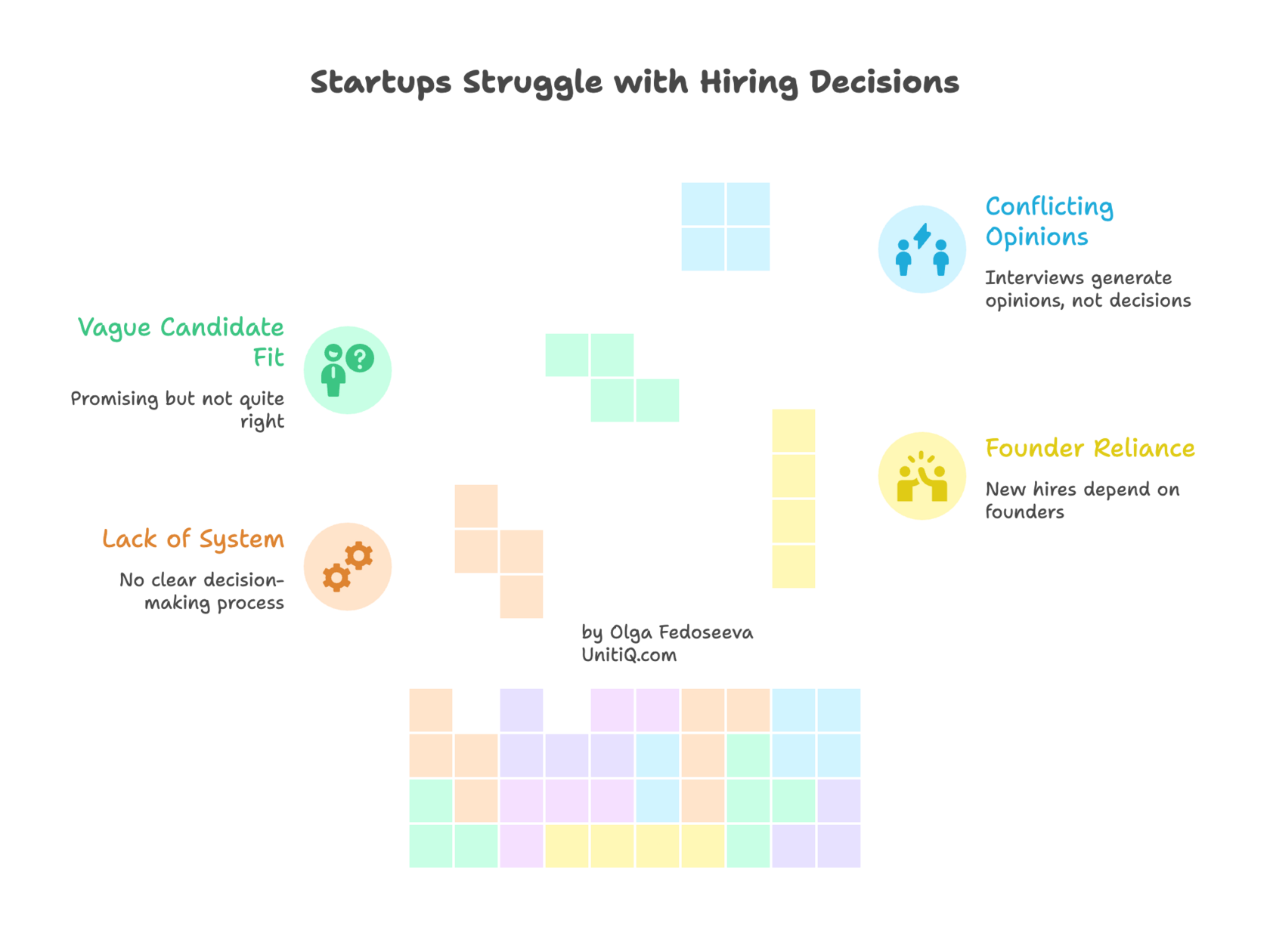
Interviews generate opinions but not decisions.
Candidates look promising but not quite right.
New hires still rely heavily on founders.
Most breakdowns don’t happen during sourcing — they appear after onboarding, when authority, ownership, and escalation design haven’t been clarified. (Read: Execution Fails After Hiring — Not During It)
At that point, hiring starts feeling slow, uncertain, and exhausting.
Most founders assume the problem is recruiting capacity.
They try to fix it with more sourcing.
But the real issue is usually something else.
The company hasn’t yet built a system for making clear hiring decisions.
In scaling startups, hiring only works when it’s treated as infrastructure — not a series of isolated recruiting tasks. (Read: Hiring as Infrastructure: Why Talent Acquisition Must Be Designed for Scale)
That’s the gap a modern Talent Partner exists to solve.
The Real Problem Behind Most Startup Hiring
Startups rarely fail to hire because of a lack of candidates.
They struggle because roles are unclear and decision ownership is weak.
When that happens, several patterns emerge:
- job descriptions become vague
- interviews focus on opinions instead of signals
- founders stay involved in every decision
- strong candidates hesitate to commit
From the outside this looks like a recruiting problem.
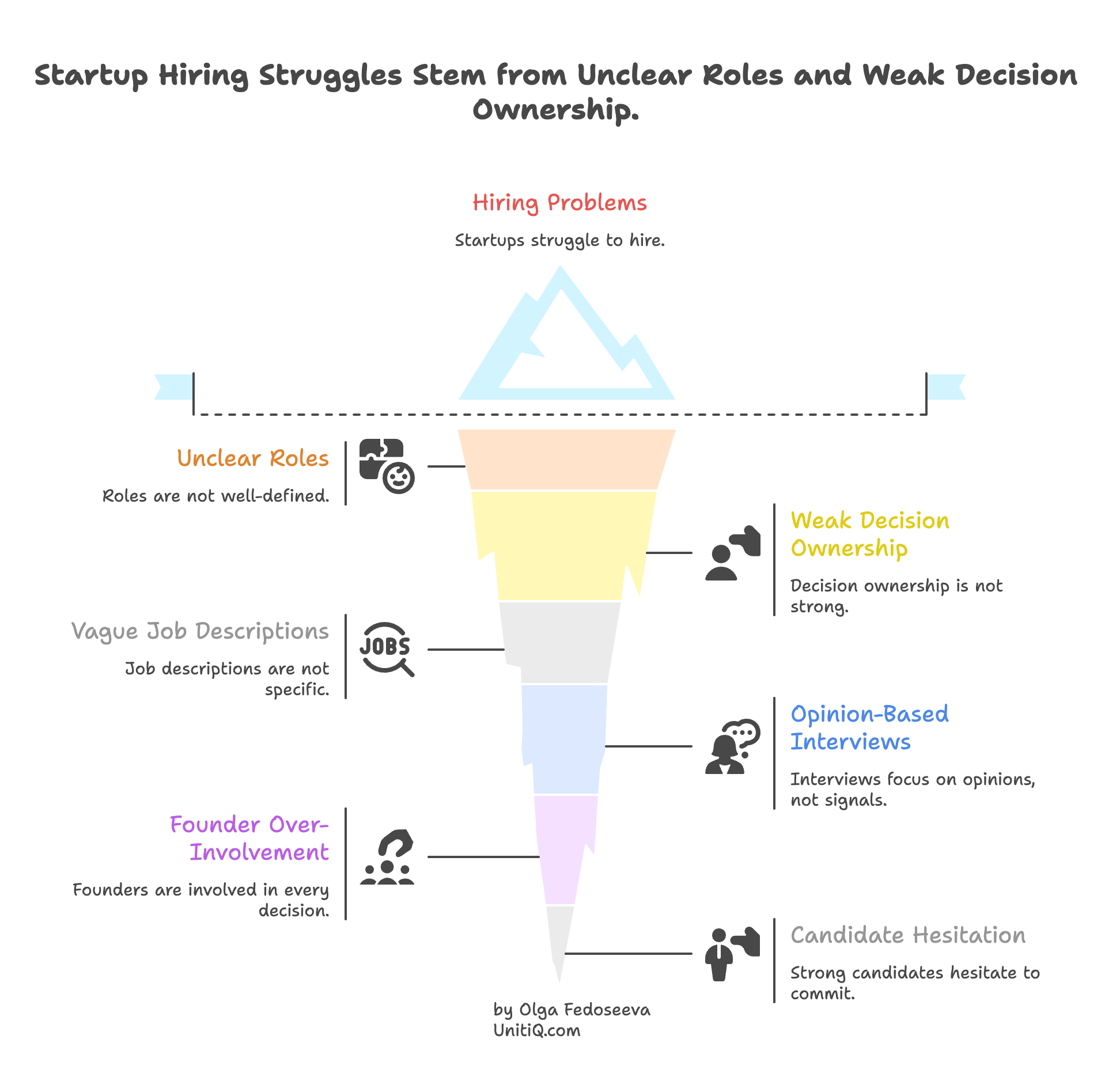
Inside the company, it’s actually an execution design problem.
Recruiters can supply candidates.
But someone still needs to translate business needs into clear hiring decisions.
That work starts long before interviews begin — when ownership, decision authority, and execution readiness are defined. (Read: What Must Be True Before You Hire)
That is the role of a Talent Partner.
Why the Talent Partner Role Emerged
Traditional recruiting models were built for stable organizations.
Roles are predefined.
Responsibilities are well understood.
Hiring processes are already established.
Startups operate in a very different environment.
Roles evolve rapidly.
Responsibilities overlap.
The organization itself is still being shaped.
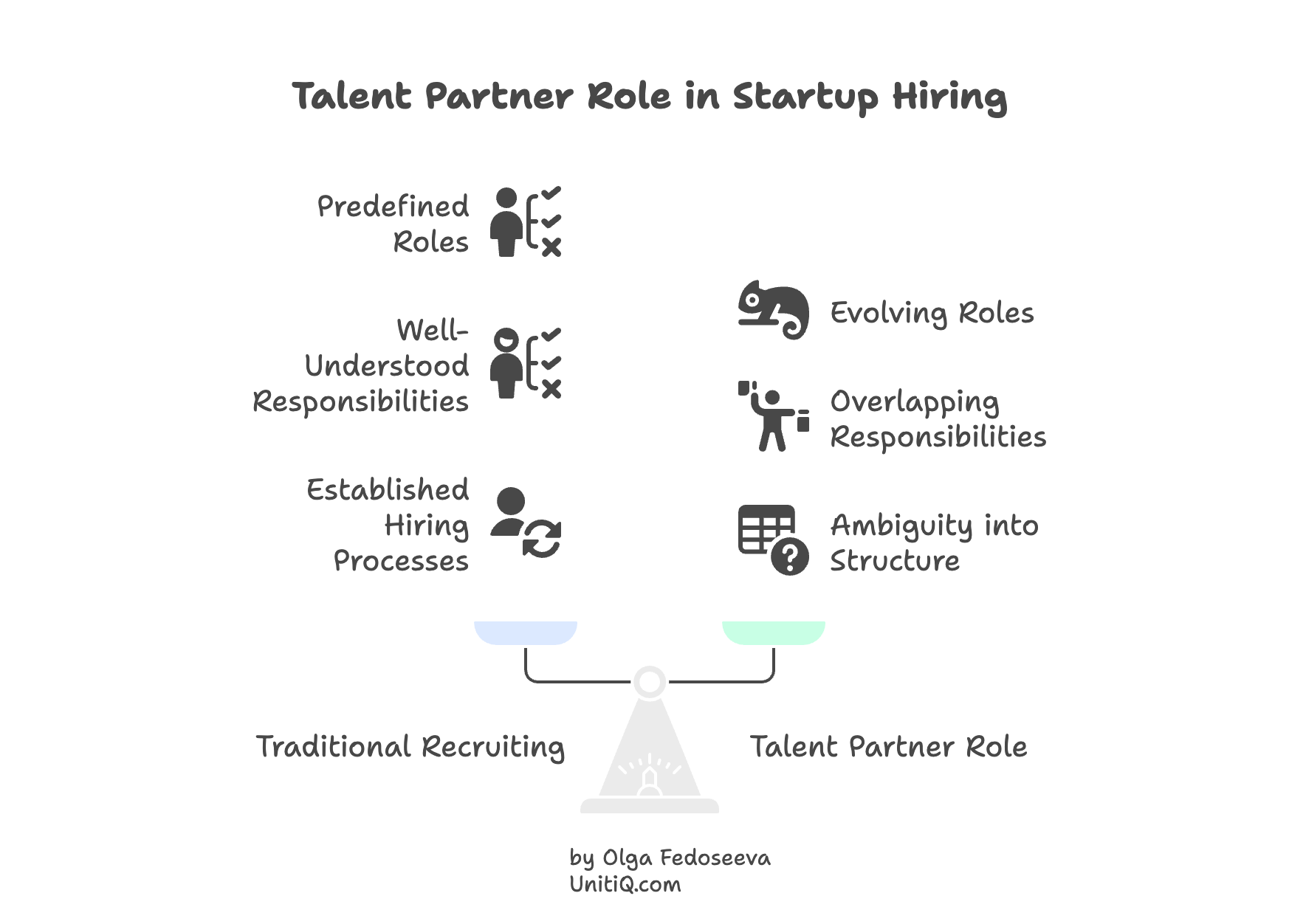
In that environment, hiring decisions require interpretation and context, not just sourcing.
A Talent Partner helps founders convert ambiguity into structure.
Instead of starting with a job description, they begin with questions like:
- What problem should this hire solve?
- What decisions should they own?
- What outcomes should they be responsible for?
Only after those questions are answered does recruiting actually begin.
The Four Problems a Talent Partner Solves
A modern Talent Partner does not simply help startups hire faster.
They solve four structural problems that typically emerge as companies grow.
1. Role Ambiguity
Many hiring mistakes begin before interviews start.
Founders often describe what they need in vague terms:
“We need someone more strategic.”
“We need someone who can own this.”
“We need someone strong in operations.”
These signals reflect real pressure inside the company.
But they are not yet hiring definitions.
A Talent Partner helps translate these signals into:
- clear role ownership
- decision authority
- measurable success criteria
Without this step, hiring becomes guesswork.
Even highly capable hires struggle when ownership and success criteria are unclear once they join. (Read: Why “Good Hires” Still Fail in the First 90 Days)
2. Decision Diffusion
As startups grow, more people become involved in hiring.
Founders.
Team leads.
Operators.
Sometimes advisors or investors.
Without clear structure, this leads to a familiar problem:
Everyone contributes feedback.
No one owns the decision.
When hiring signals multiply but decision ownership disappears, founders get pulled back into every hire. (Read: Talent Acquisition Breaks When Everyone Has a Signal — but No One Owns the Decision)
A Talent Partner introduces clarity around:
- who evaluates which signals
- how interviews are structured
- who ultimately makes the hiring decision
This prevents hiring from slowing down as the organization grows.
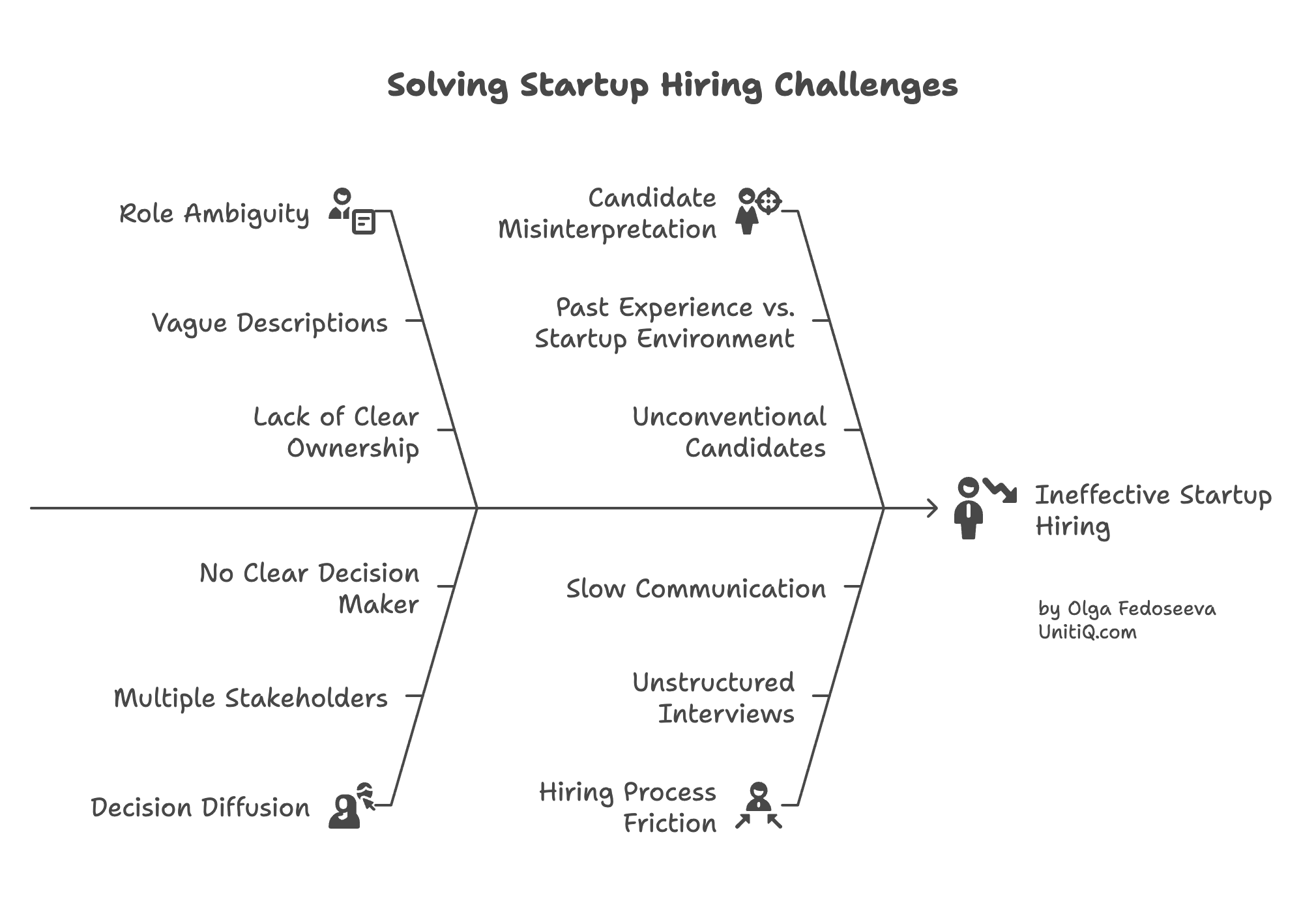
3. Candidate Misinterpretation
Resumes and interviews show past experience.
But they do not automatically predict how someone will operate inside a specific startup environment.
Many hiring mistakes happen because companies misinterpret candidates.
Someone who succeeded in a structured company may struggle in ambiguity.
Someone who looks unconventional may thrive in a fast-moving startup.
A Talent Partner evaluates candidates in the context of the company’s execution environment, not just their past roles.
4. Hiring Process Friction
Candidates form impressions about a company long before an offer appears.
Unstructured interviews, slow communication, or conflicting signals can quietly erode trust.
A Talent Partner introduces a hiring structure that keeps the process:
- clear
- responsive
- aligned internally
This improves both candidate experience and decision quality.
The Real Difference Between Recruiters and Talent Partners
The difference between these roles is not about seniority.
It is about where the work begins.
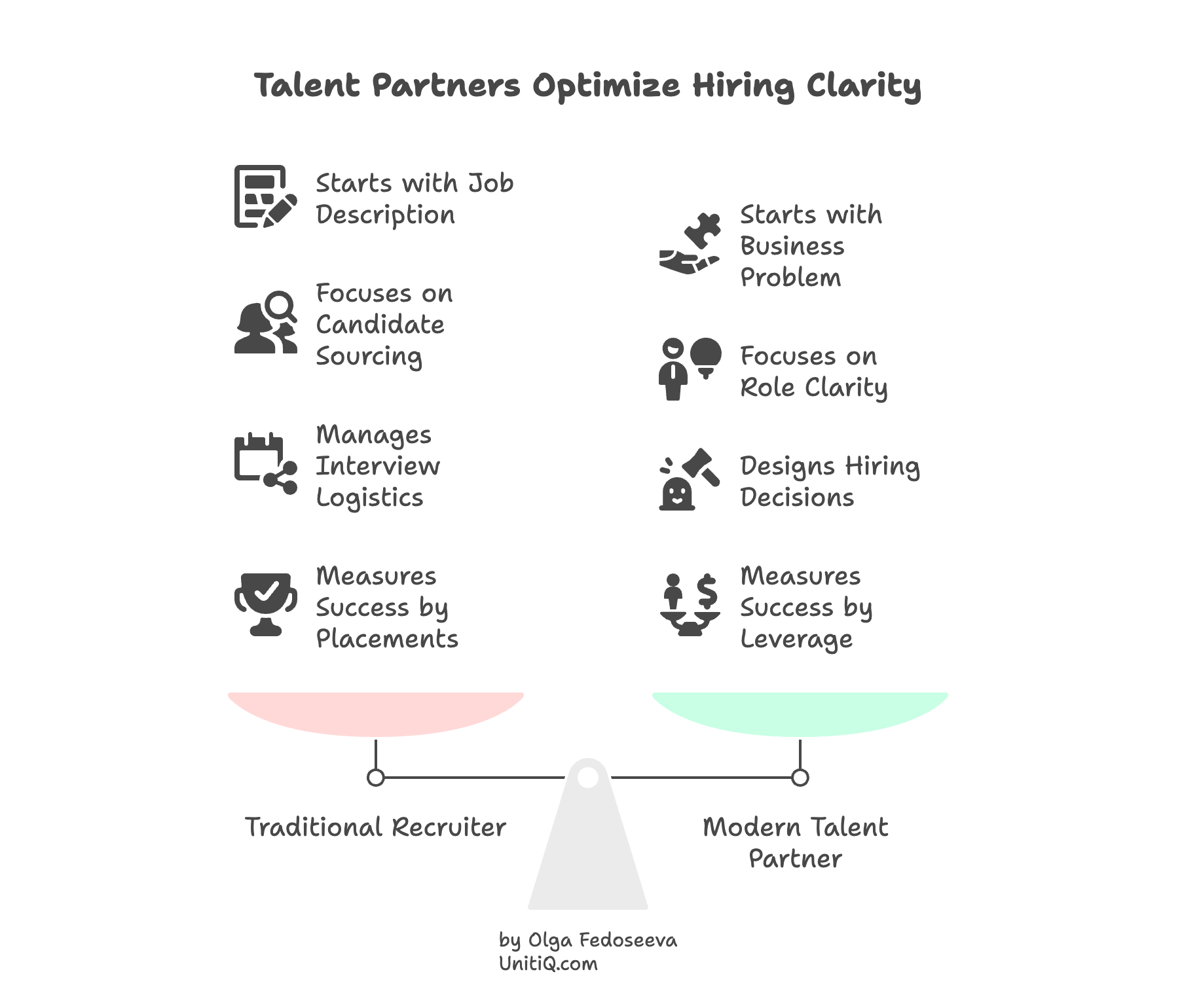
Traditional recruiting optimises candidate supply.
Talent partnership optimises hiring clarity.
When Startups Actually Need a Talent Partner
In the earliest stage, founders can personally evaluate every hire.
But as soon as hiring expands across multiple functions, this becomes difficult.
Product roles require different signals than go-to-market roles.
Operations hires require different evaluation criteria than engineering hires.
Without someone responsible for maintaining hiring clarity, founders often find themselves pulled back into every hiring decision.
A Talent Partner helps prevent that.
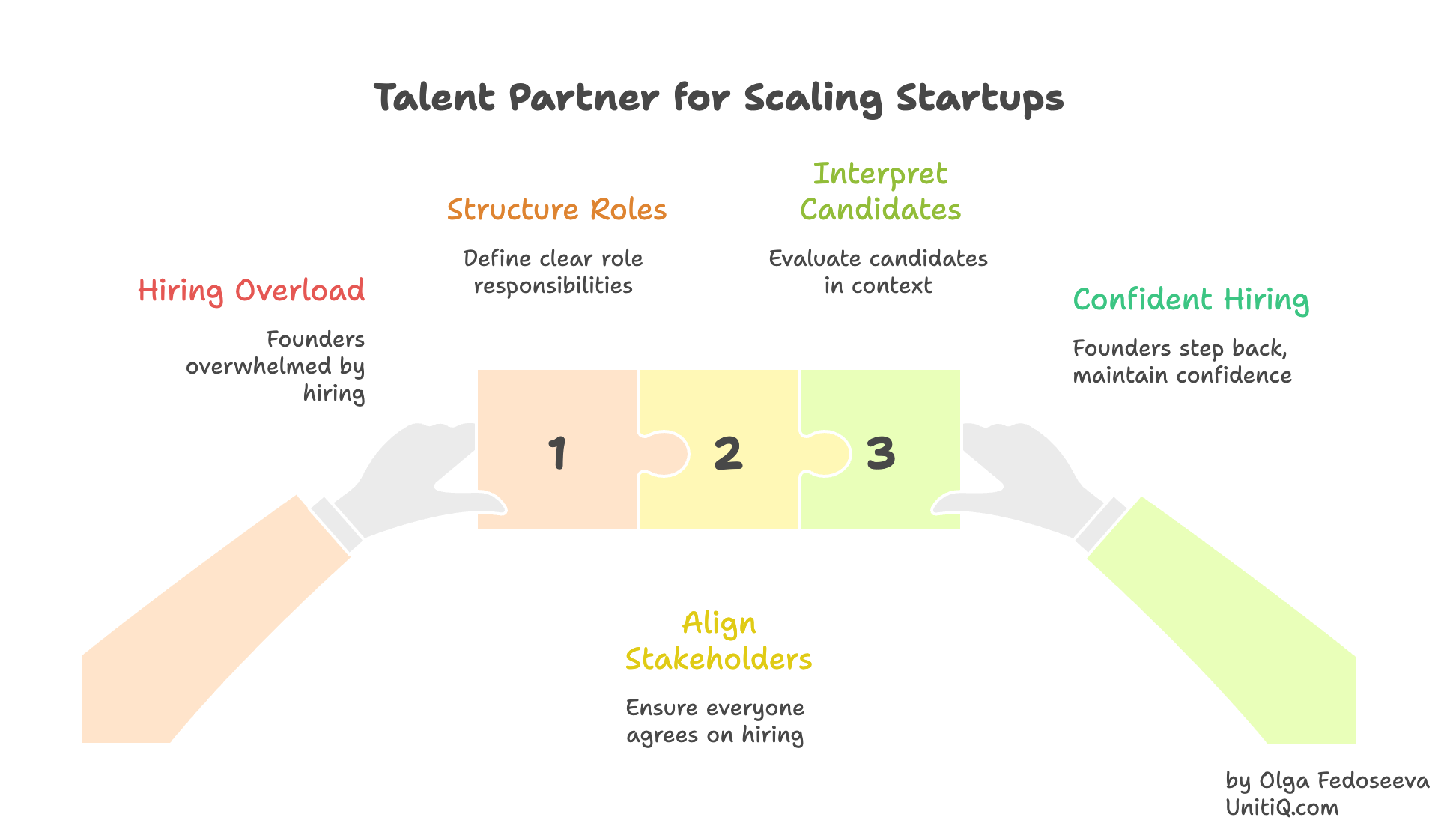
By structuring roles, aligning stakeholders, and interpreting candidates in context, they allow founders to step back while maintaining confidence in the outcomes.
Final Thought
Startups often believe hiring becomes easier once they bring in recruiting support.
But speed alone rarely fixes hiring — when ownership and decision clarity are weak, faster hiring simply increases coordination cost. (Read: Why Hiring Faster Won’t Fix Your Execution)
But the real challenge isn’t sourcing candidates.
It’s turning business needs into clear hiring decisions.
A modern Talent Partner exists to make that translation possible.
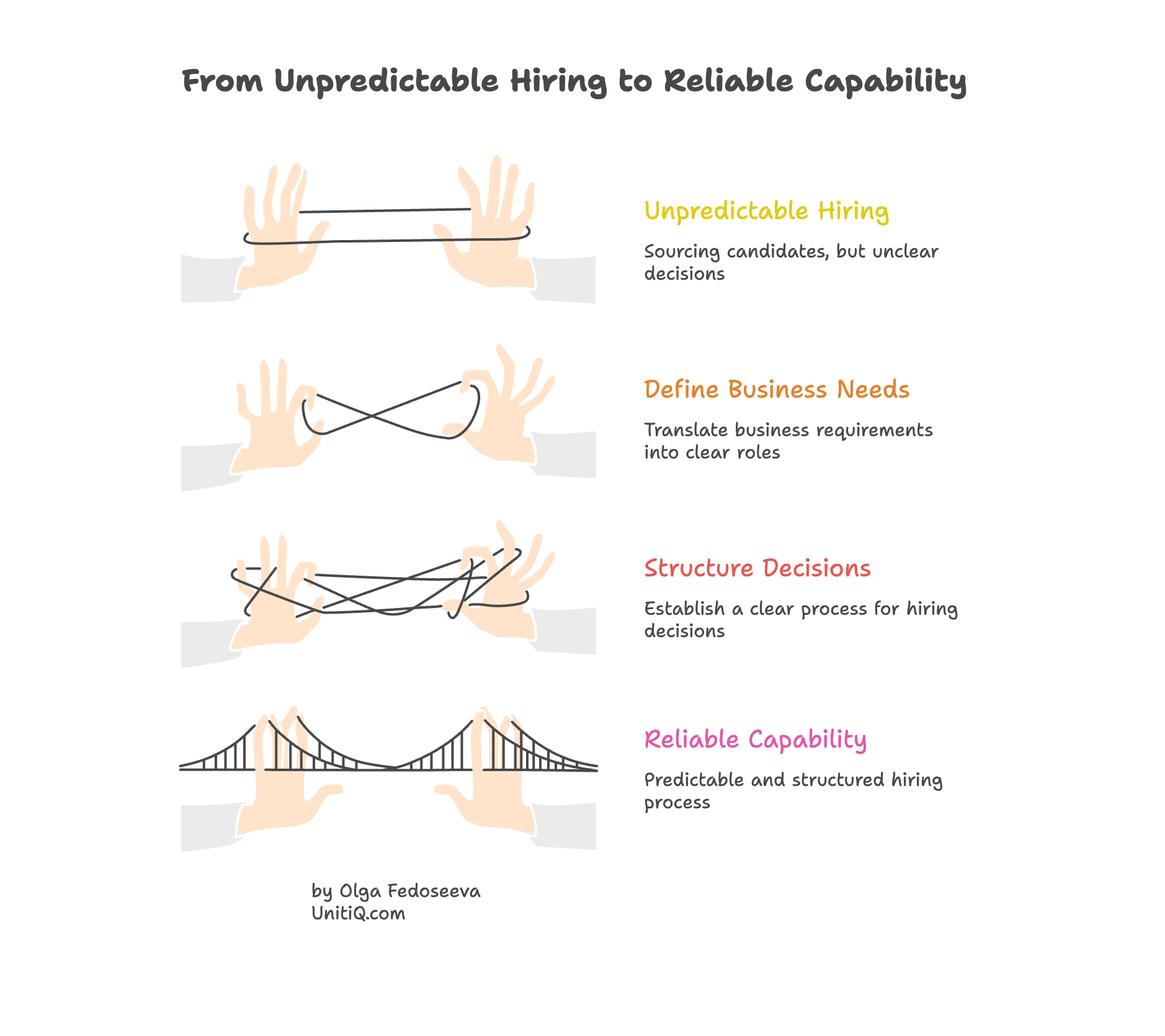
Because when roles are clearly defined and decisions are structured, hiring stops feeling unpredictable.
It becomes a capability the company can rely on as it grows.
About the author
Olga Fedoseeva is the Founder of UnitiQ, a talent acquisition and People Projects partner for Tech Startups across EU, UKI, and MENA.
She works with founders in Fintech, AI, Crypto, and Robotics to prevent mis-hires before they compound — restoring execution momentum and protecting teams from quiet burnout.


