Roadmaps slip.
Features ship but don’t move metrics.
Senior hires join — and nothing feels lighter.
The founder is still in every decision.
At some point, every scaling startup hits this moment. The instinctive diagnosis is predictable:
“We need better hiring.”
But hiring is rarely the problem.
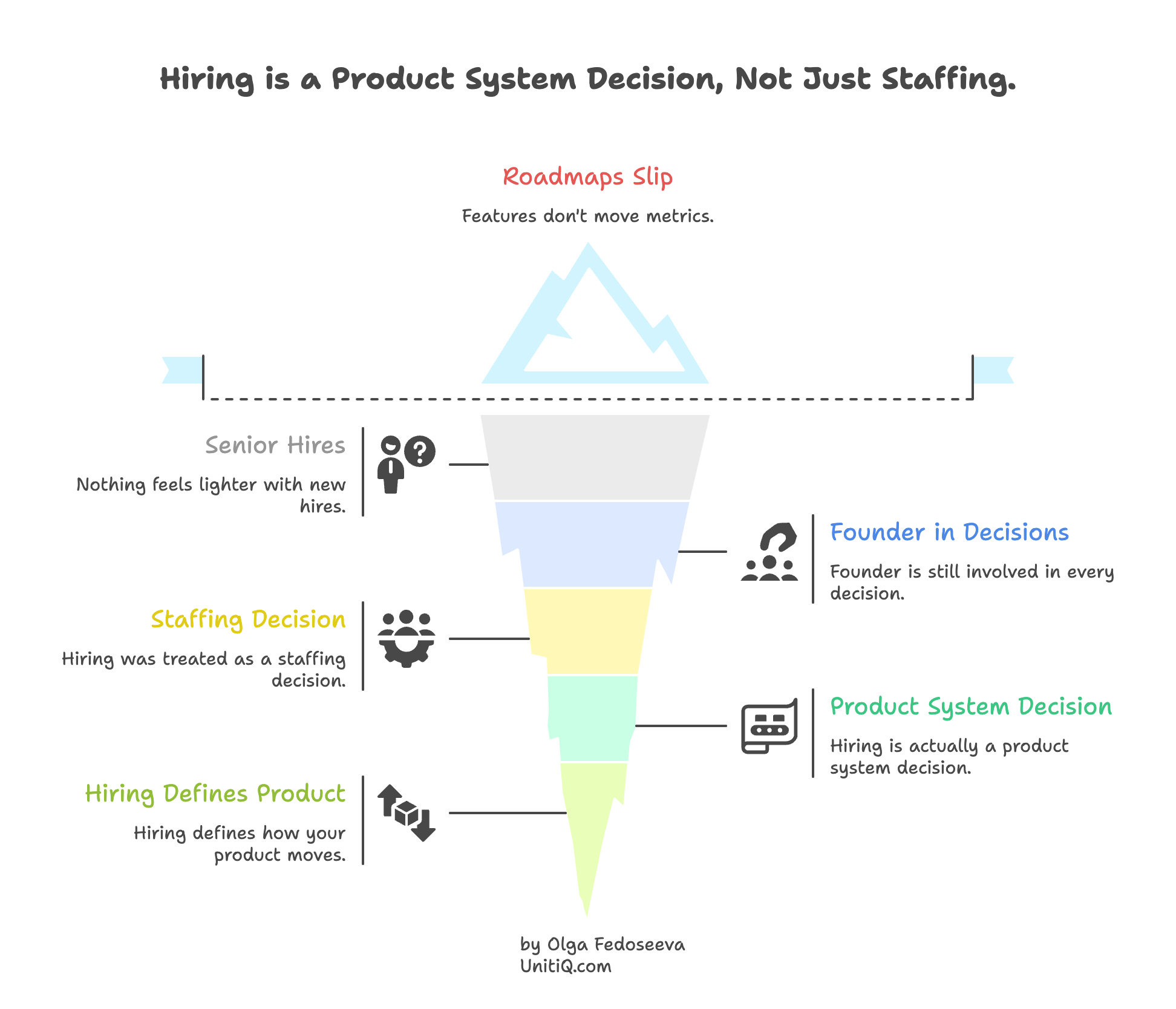
The real issue is that hiring was treated as a staffing decision — when it was actually a product system decision.
Hiring doesn’t support your product.
Hiring defines how your product moves.
Hiring Doesn’t Add Capacity — It Redesigns the System
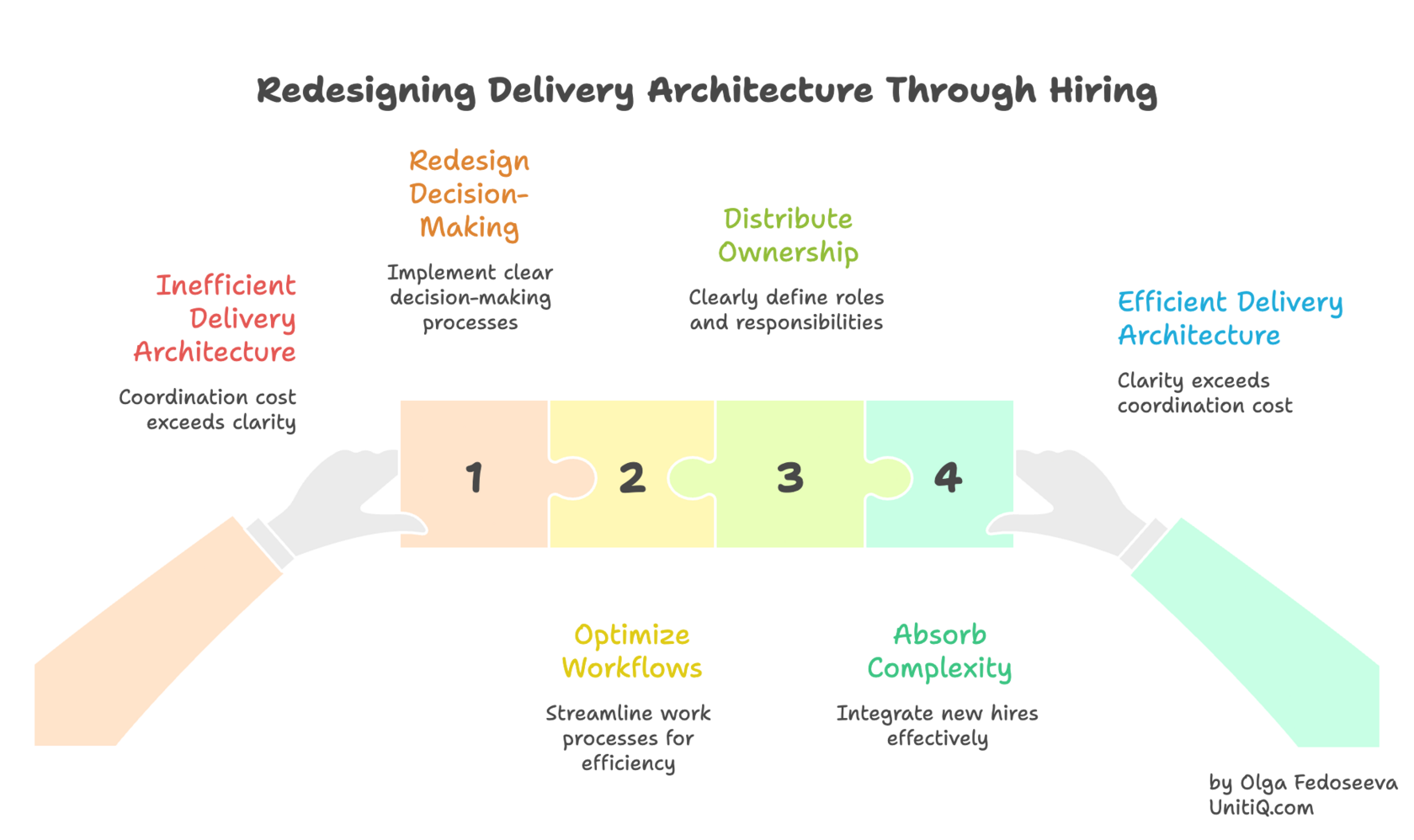
Every hire changes:
- how decisions are made
- how work flows
- how ownership is distributed
- how complexity is absorbed
You are not adding a person.
You are redesigning the delivery architecture of your company.
At seed stage, this effect is subtle.
At Series A–B, it becomes decisive.
Because once coordination cost rises faster than clarity, velocity drops — even if headcount increases.
Hiring is leverage.
But leverage cuts both ways.
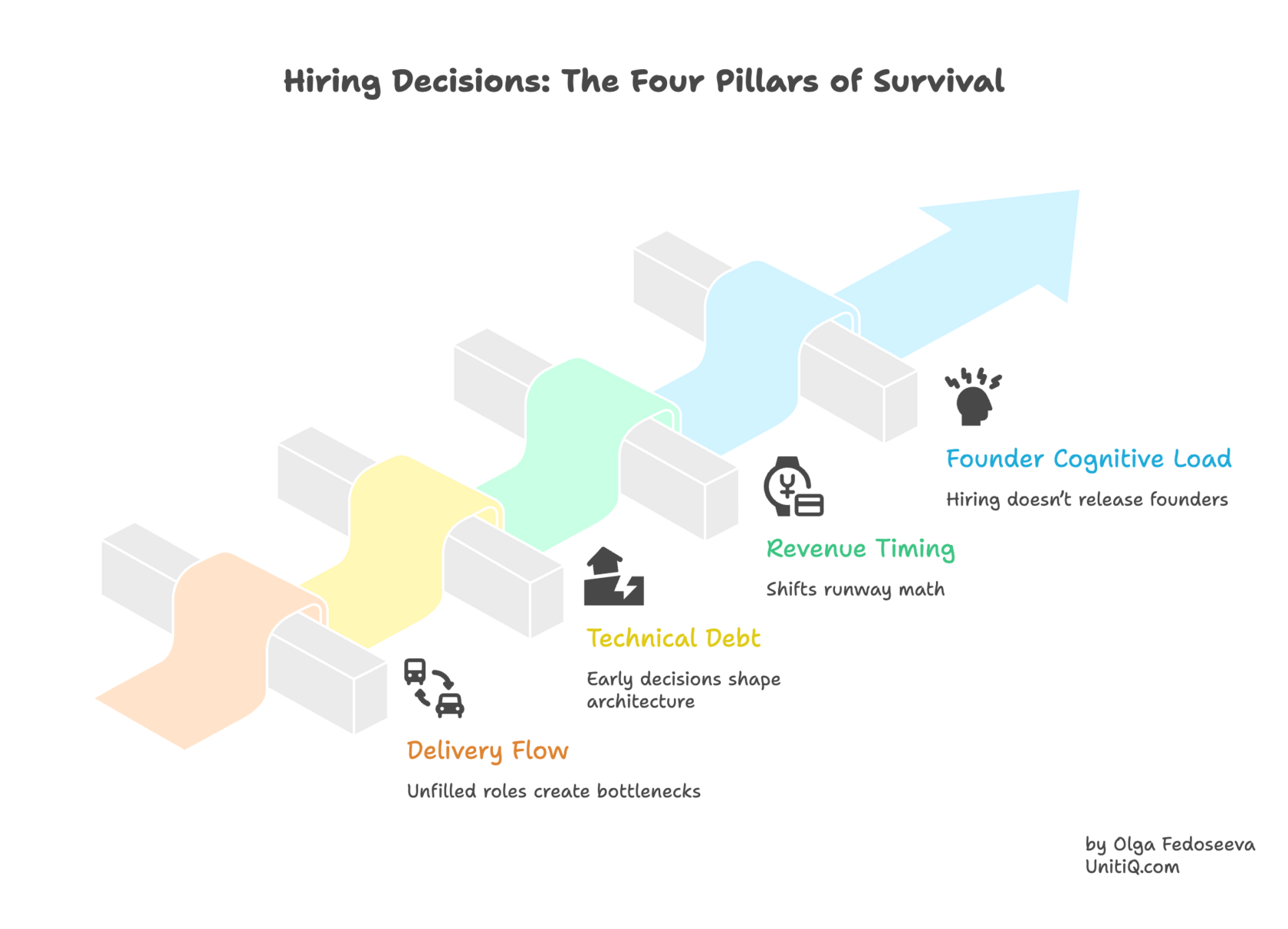
The Four Places Hiring Quietly Decides Survival
Founders often see hiring risk as “bad hire cost.”
In reality, hiring affects four structural layers simultaneously.
Delivery Flow
Unfilled roles create bottlenecks.
Wrong hires create rework.
Overlapping ownership creates escalation.
When delivery slows, the first instinct is to add people.
But if decision authority is unclear or ownership overlaps, headcount increases coordination cost.
Suddenly:
- Engineers wait for decisions.
- Product waits for clarification.
- Sales waits for roadmap answers.
- Founders become escalation points.
The team looks busy.
Velocity quietly collapses.
Hiring determines whether work flows — or fragments.
Technical Debt and Irreversibility
Early hiring decisions shape architecture.
Not just technical architecture — decision architecture.
An early engineering hire can:
- Choose the wrong structural direction.
- Create shortcuts that compound.
- Lock the company into scaling constraints.
- Generate debt that requires a rewrite 12 months later.
Some debt is financial.
Hiring debt is structural.
And structural debt is rarely reversible without slowing the entire product.
This is why “we’ll fix it later” becomes fatal.
By the time the damage is visible, 6–12 months of roadmap have already been consumed.
Revenue Timing and Runway Compression
Hiring also shifts runway math.
Unfilled sales roles compress pipeline.
Misaligned product hires delay launch windows.
Senior leaders without clear authority stall go-to-market decisions.
A single missed launch window can cost more than a funding round.
A 2–3 month delay in enterprise sales compounds into quarters of lost pipeline.
Founders track burn rate carefully.
Few track hiring-induced revenue drag with the same discipline.
Yet hiring decisions often move runway faster than expense control does.
Founder Cognitive Load
This is the least discussed — and often the most dangerous.
Hiring that doesn’t release founders is not leverage.
It is weight.
When roles lack clarity:
- Founders re-enter decisions.
- Escalations multiply.
- Performance management consumes energy.
- “Almost right” hires require supervision.
The founder becomes the system’s shock absorber.
Research shows more than half of founders experience burnout symptoms annually.
Burnout is rarely about volume.
It’s about unresolved ownership.
When hiring fails to transfer decision authority, founders remain in perpetual hiring mode — even after the hire joins.
And cognitive overload degrades decision quality everywhere else.
Why Founders Underestimate Hiring Leverage
There are three common blind spots.
1. Shipping Feels Like Progress
Tickets move.
Features deploy.
Standups run.
But shipping is not the same as solving.
A team can move fast in the wrong direction for months before realizing impact is minimal.
2. Busyness Masks Misalignment
Activity hides structural flaws.
When everyone is busy, no one questions system design.
Velocity metrics look stable — until complexity compounds.
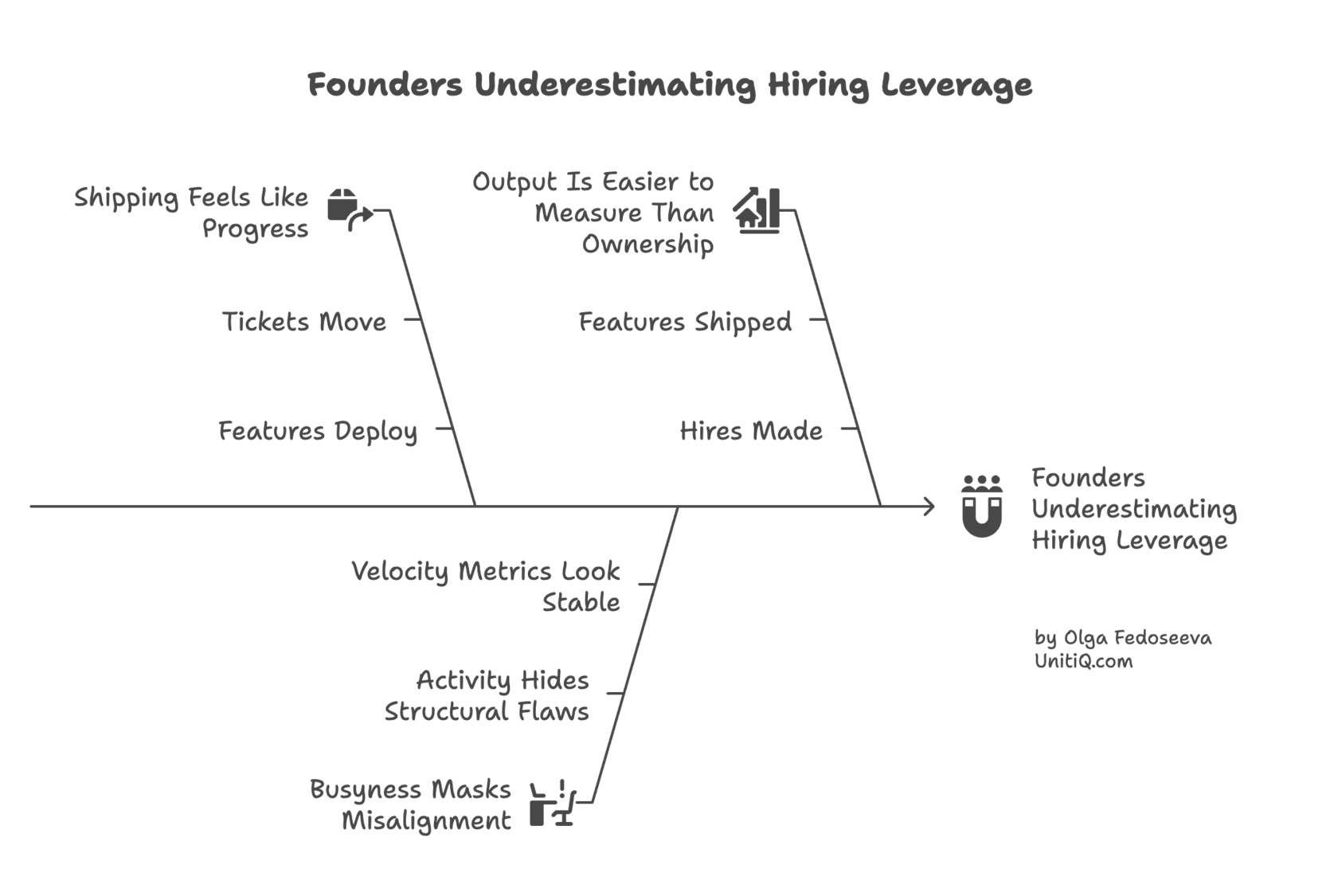
3. Output Is Easier to Measure Than Ownership
It’s easy to measure:
- features shipped
- hires made
- time-to-fill
It’s harder to measure:
- clarity of authority
- reduction in founder involvement
- increase in autonomous decision quality
But those are the real indicators of hiring leverage.
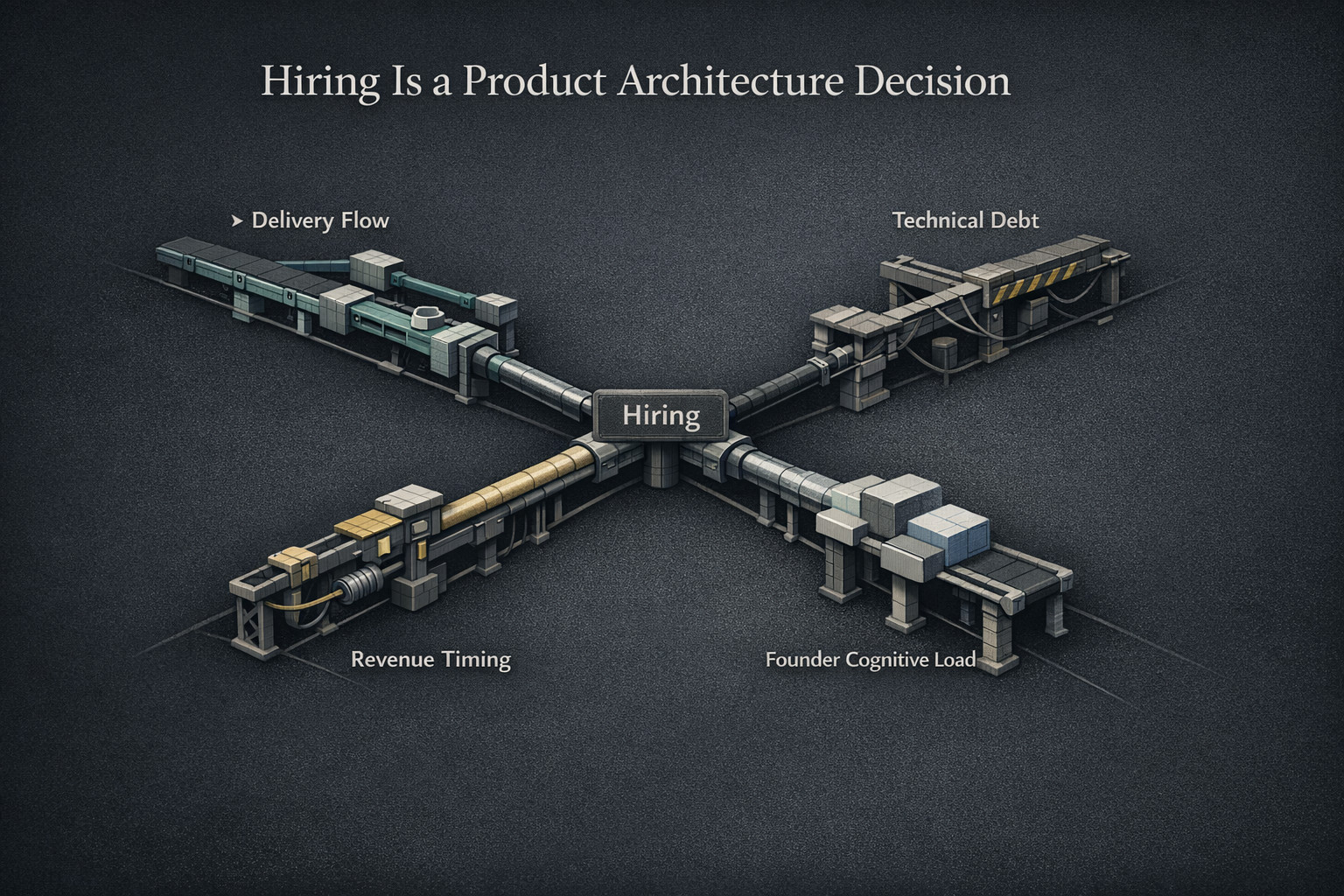
Hiring Is a Product Architecture Decision
Most founders treat product decisions as roadmap choices.
Features.
Pricing.
Positioning.
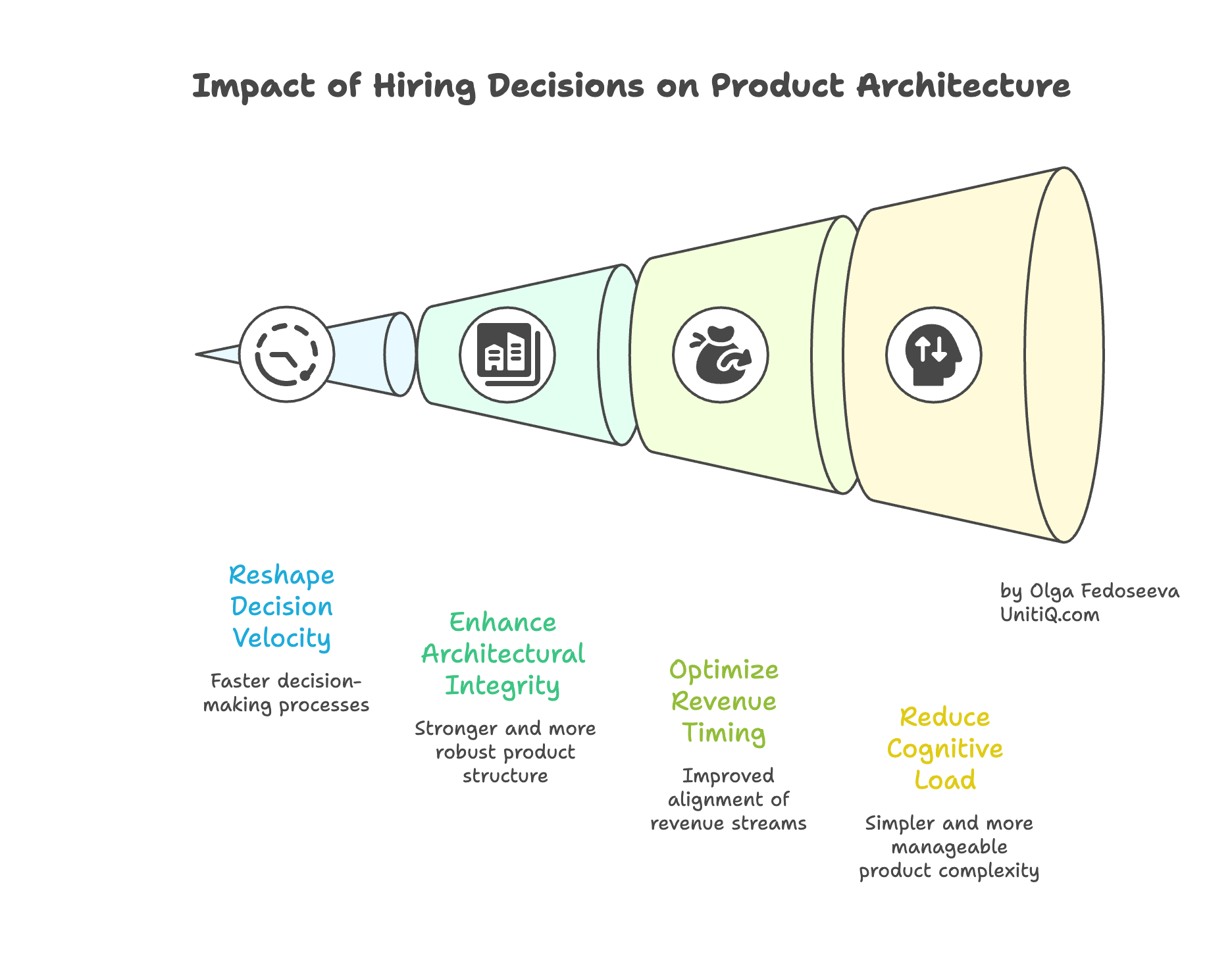
But the highest-leverage product decisions are hiring decisions that reshape:
- decision velocity
- architectural integrity
- revenue timing
- cognitive load
Every hire changes how your product thinks.
And once the system scales, reversing those decisions becomes exponentially harder.
What Must Be True Before Hiring Creates Leverage
Hiring only compounds when structural conditions are in place.
Before adding headcount, founders should ask:
1. Is decision authority explicit?
Who decides?
Who owns trade-offs?
Who escalates — and when?
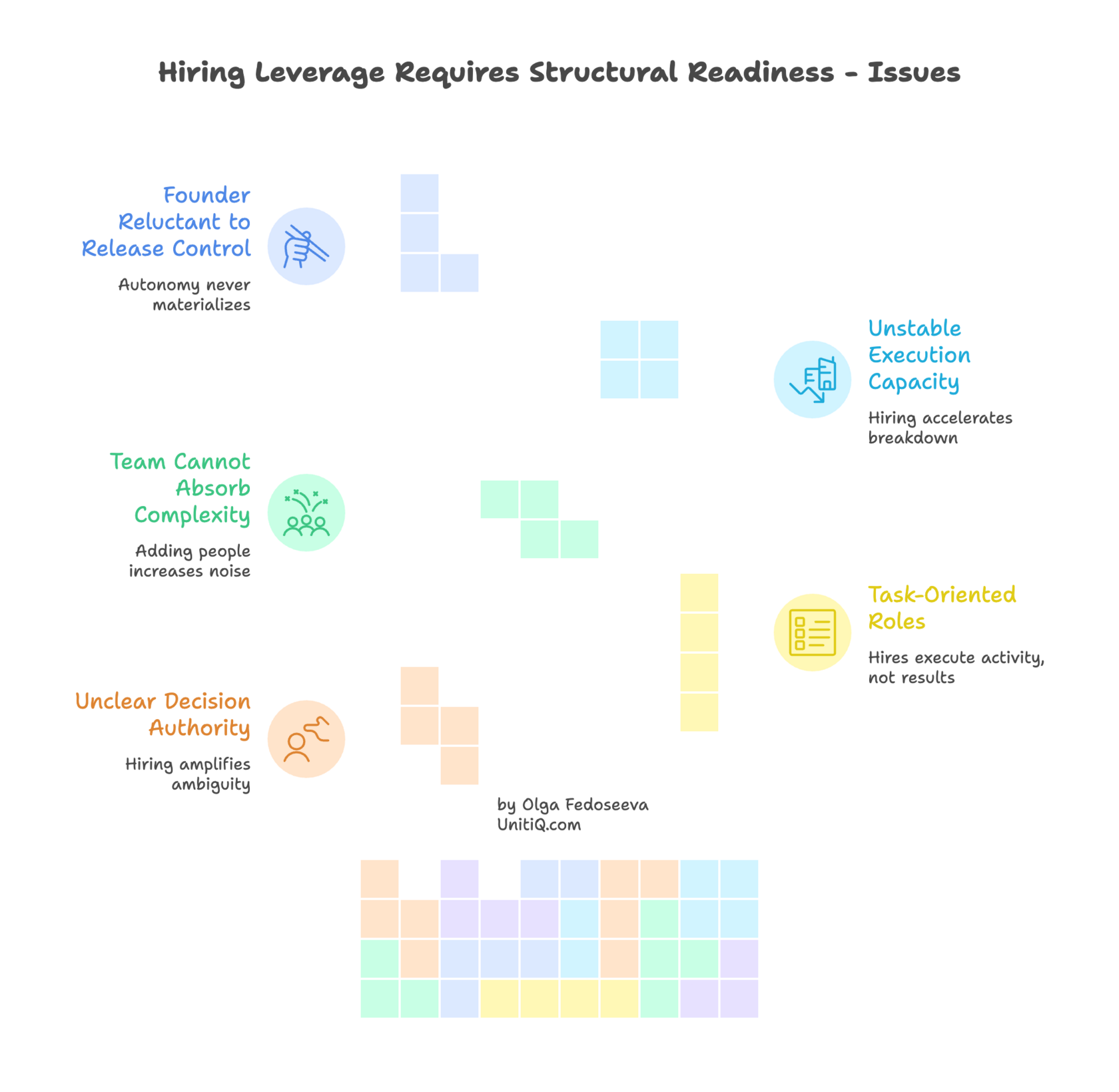
Without clarity, hiring amplifies ambiguity.
2. Is success defined in outcomes, not tasks?
If roles are defined by responsibilities instead of impact, hires execute activity — not results.
Leverage requires outcome ownership.
3. Can the team absorb complexity without founder re-entry?
If every ambiguity escalates upward, adding people increases noise.
Leverage requires containment.
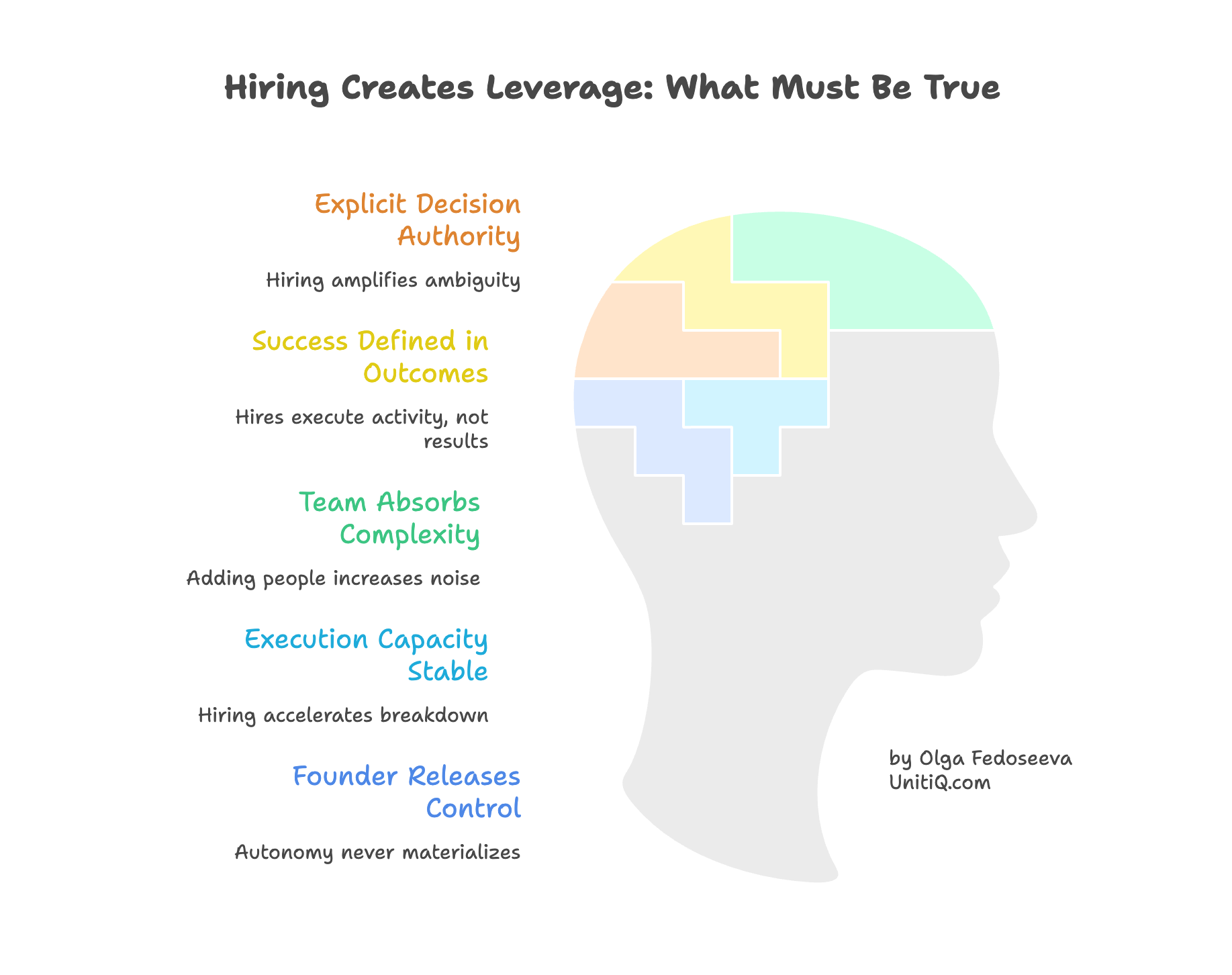
4. Is execution capacity stable before expanding it?
If the system is already overloaded, hiring accelerates breakdown.
Leverage requires structural readiness.
5. Is the founder truly ready to release control?
Hiring cannot compensate for unresolved ownership.
If authority is retained emotionally, not just operationally, autonomy never materializes.
The Reframe
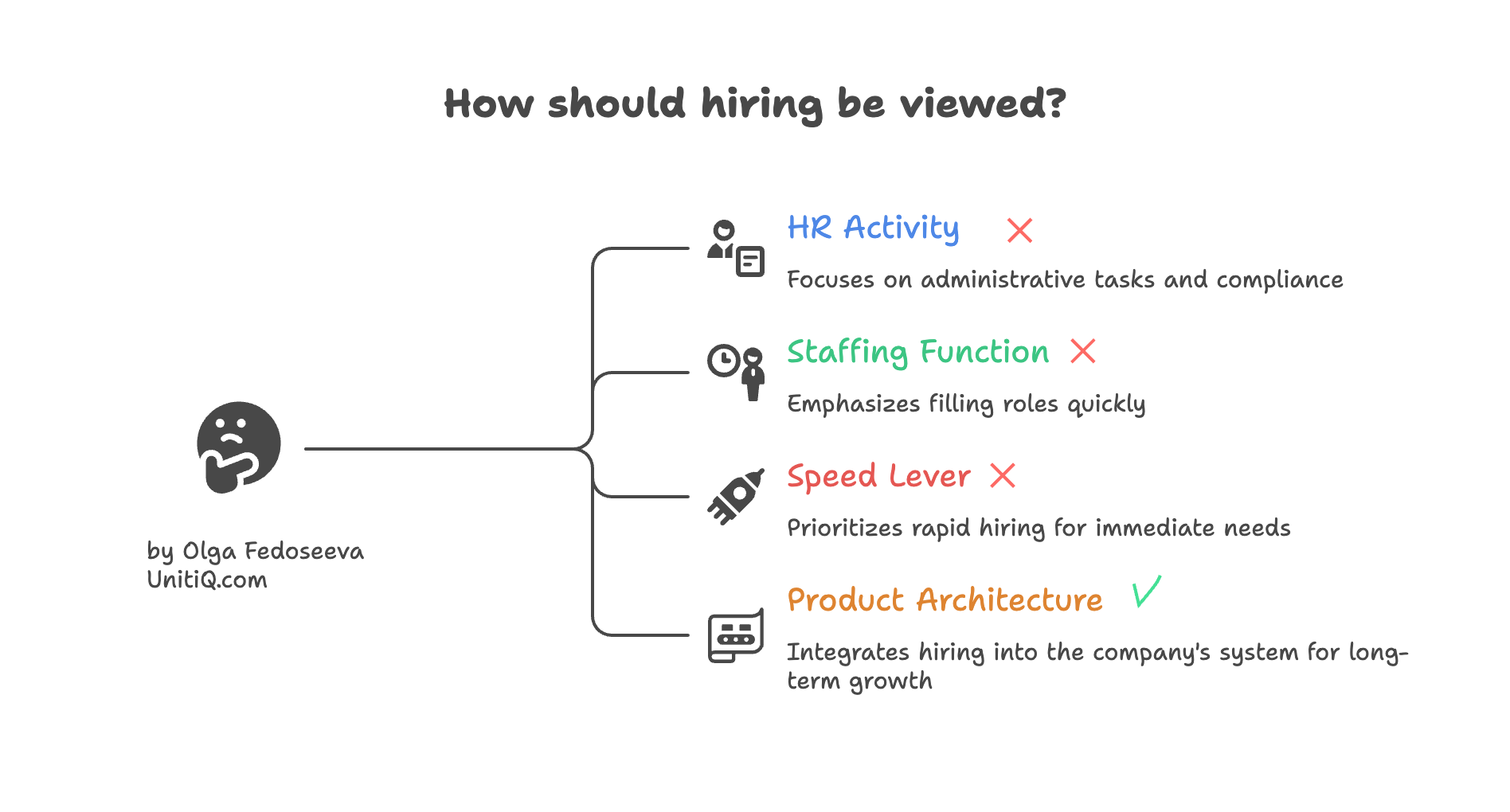
Hiring is not an HR activity.
It is not a staffing function.
It is not a speed lever.
Hiring is product architecture.
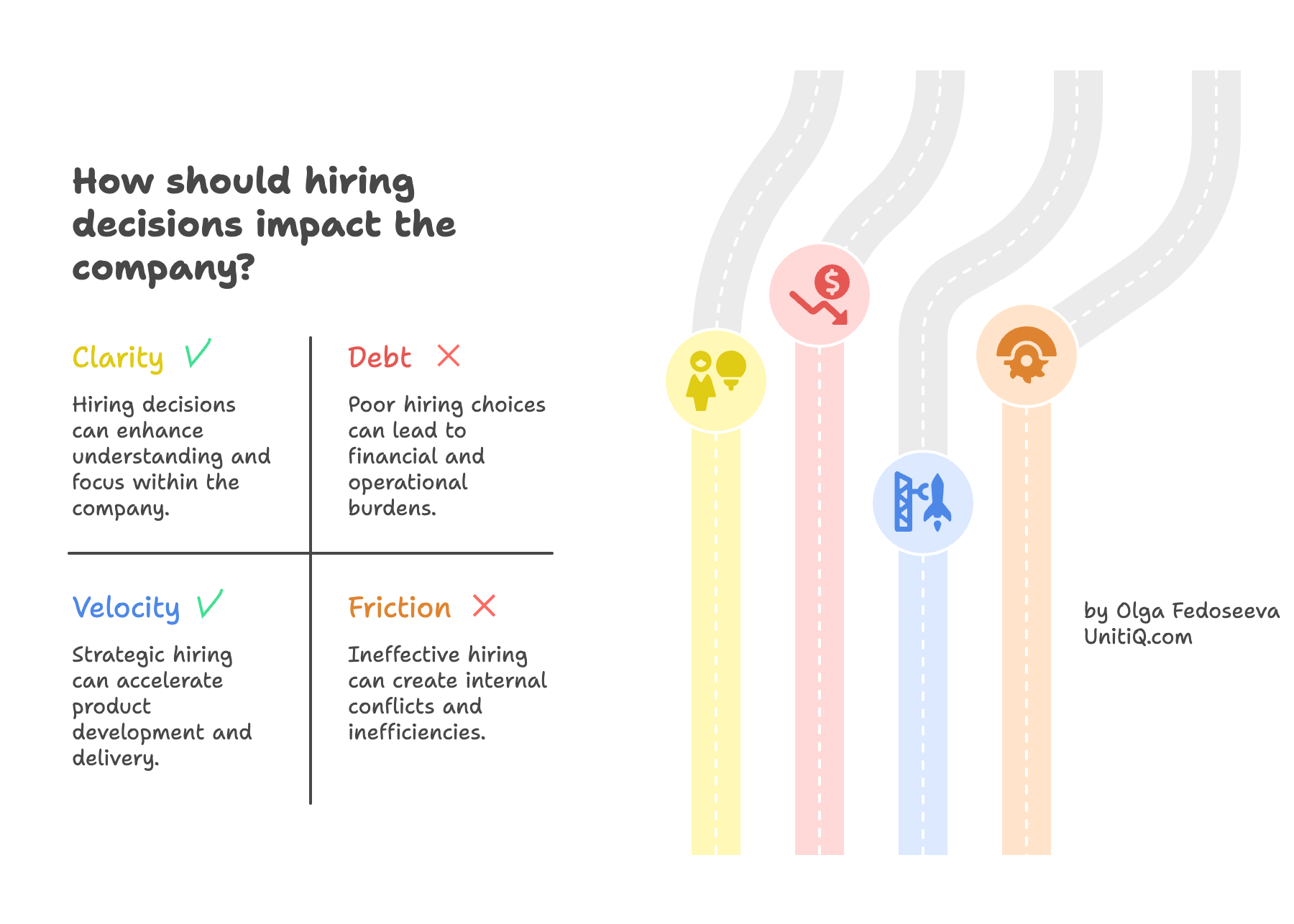
It determines whether your company:
- compounds clarity
- compounds debt
- compounds velocity
- or compounds friction
The highest-leverage product decisions founders make are rarely roadmap features.
They are hiring decisions that change how the system decides, ships, and scales.
And once made, those decisions compound — in either direction.
Choose accordingly.
If you want to sanity-check which model fits your current stage — and where execution is actually breaking — we can walk through it together.
About the author
Olga Fedoseeva is the Founder of UnitiQ, a global HR executive, and a talent acquisition and people strategy leader with 20+ years of experience across EMEA, the US, and APAC. She has personally hired 1,500+ employees, led people strategy for organisations scaling from 30 to 700+ employees, and writes about hiring systems, execution risk, and people infrastructure in growth-stage startups.
Read full author profile
LinkedIn
Read full author profile


