
Why Team Planning Is as Important as Product Strategy (and Why Execution Slows Without It)
Founders rarely think of team planning as a strategic lever.
Product strategy feels tangible.
Roadmaps exist. Metrics move. Customers respond.
Team planning, by contrast, often feels like coordination work — something to “sort out later”, once the product is clearer or hiring is done.
But in scaling startups, execution rarely slows because the product is wrong.
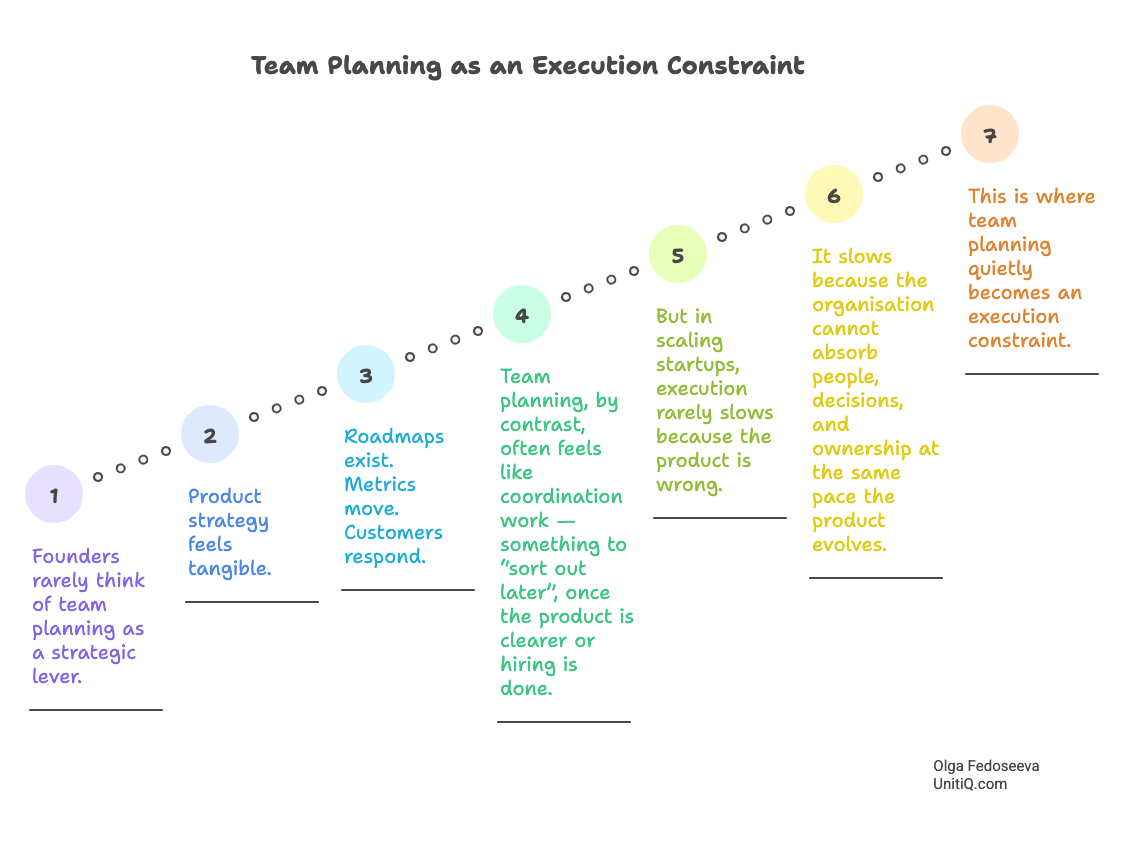
It slows because the organisation cannot absorb people, decisions, and ownership at the same pace the product evolves.
This is where team planning quietly becomes an execution constraint.
Why does execution slow even as teams grow?
Founders often describe the same pattern at Series A–B:
- Headcount increases
- Hiring activity accelerates
- More meetings appear
- Decision-making slows
- Founders stay deeply involved
- Progress feels heavier, not faster
This isn’t a productivity issue.
And it isn’t a talent shortage.
It’s a planning gap.
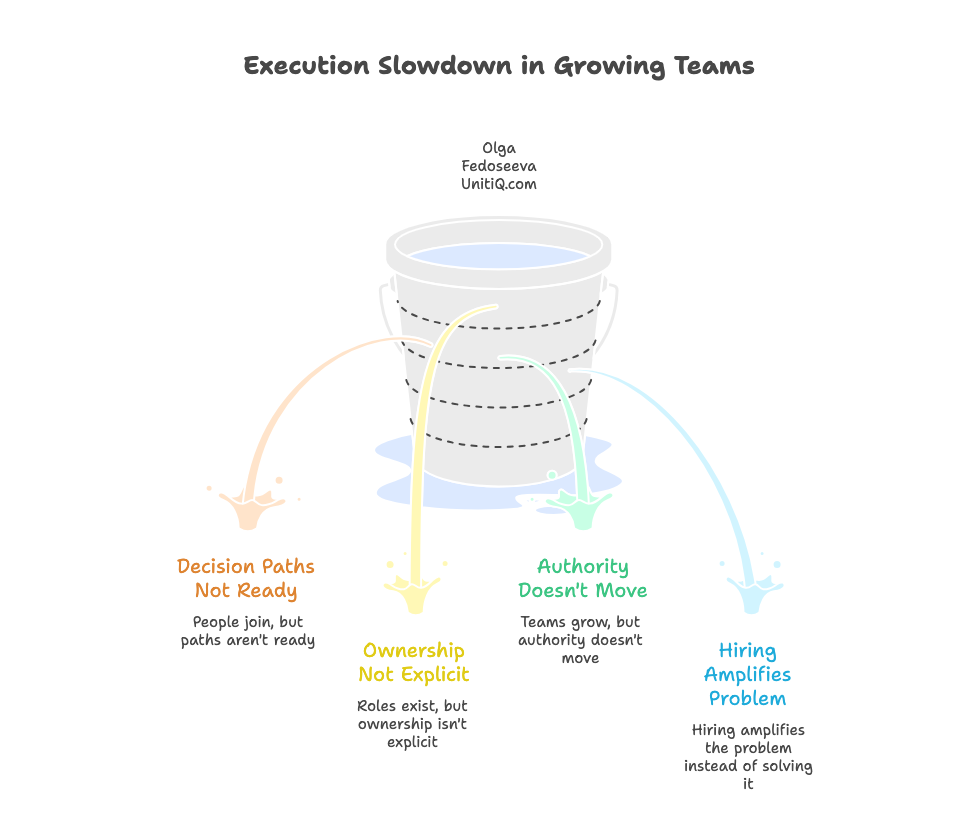
When team planning lags behind product ambition, the organisation accumulates friction faster than execution capacity.
People join — but decision paths aren’t ready.
Roles exist — but ownership isn’t explicit.
Teams grow — but authority doesn’t move.
Hiring amplifies the problem instead of solving it.
Team planning is execution design, not coordination
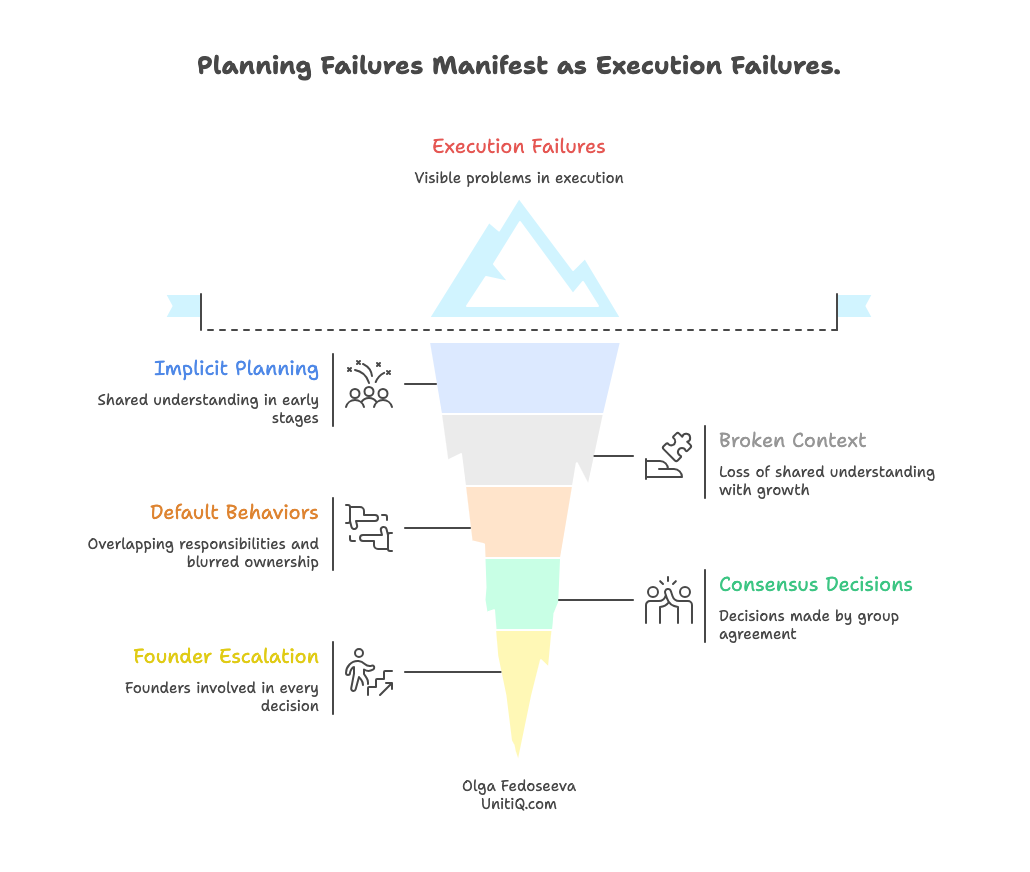
In early stages, planning happens implicitly.
Everyone knows:
- who decides
- what matters
- where trade-offs live
As the company grows, that shared context breaks.
Without deliberate team planning, startups default to:
- overlapping responsibilities
- blurred ownership
- consensus-driven decisions
- founder escalation
This is why planning failures show up as execution failures, not as organisational complaints.
Founders don’t say:
“Our team planning is weak.”
They say:
“Everything takes longer than it should.”
“I’m still in every decision.”
“Hiring didn’t give us leverage.”
Why poor team planning increases founder dependency
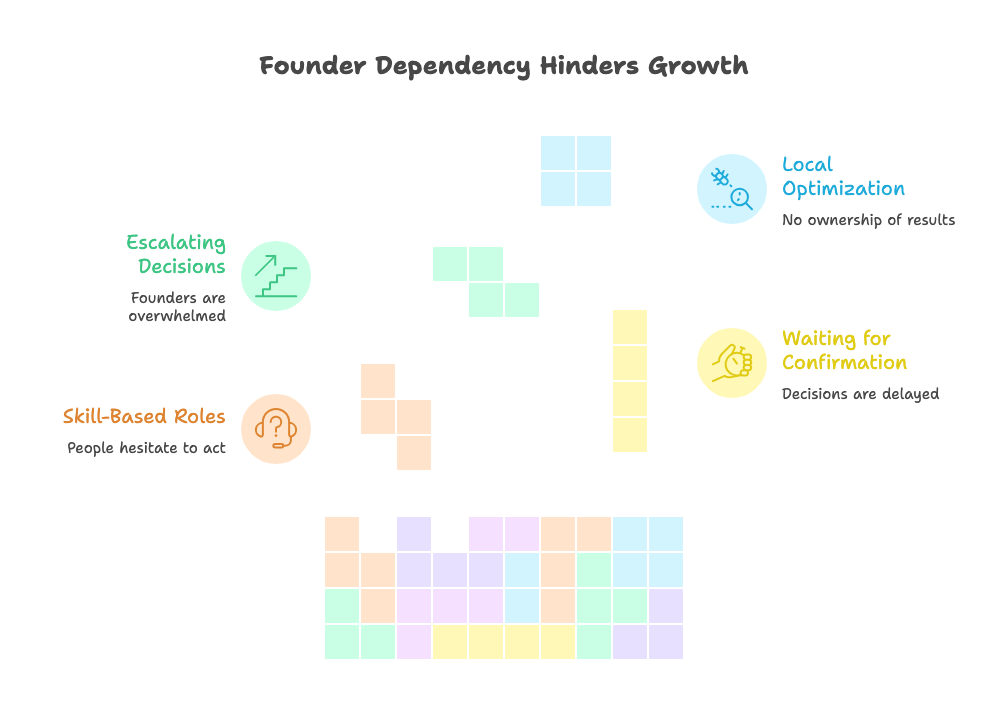
When roles are defined by skills instead of outcomes, people hesitate.
They wait for confirmation.
They escalate decisions.
They optimise locally instead of owning results.
Founders step in — not because they want to, but because the system requires it.
This is the moment when:
- leadership load spikes
- decision velocity drops
- execution becomes founder-dependent
Team planning isn’t about headcount allocation.
It’s about moving decision authority away from founders without losing control.
When that doesn’t happen, growth stalls — quietly.
The hidden link between team planning and hiring failure
This is where many startups misdiagnose the problem.
Execution slows → hiring feels slow → recruiters are blamed → pipelines expand.
But hiring more people into an unplanned execution system does not increase output.
It increases coordination cost.
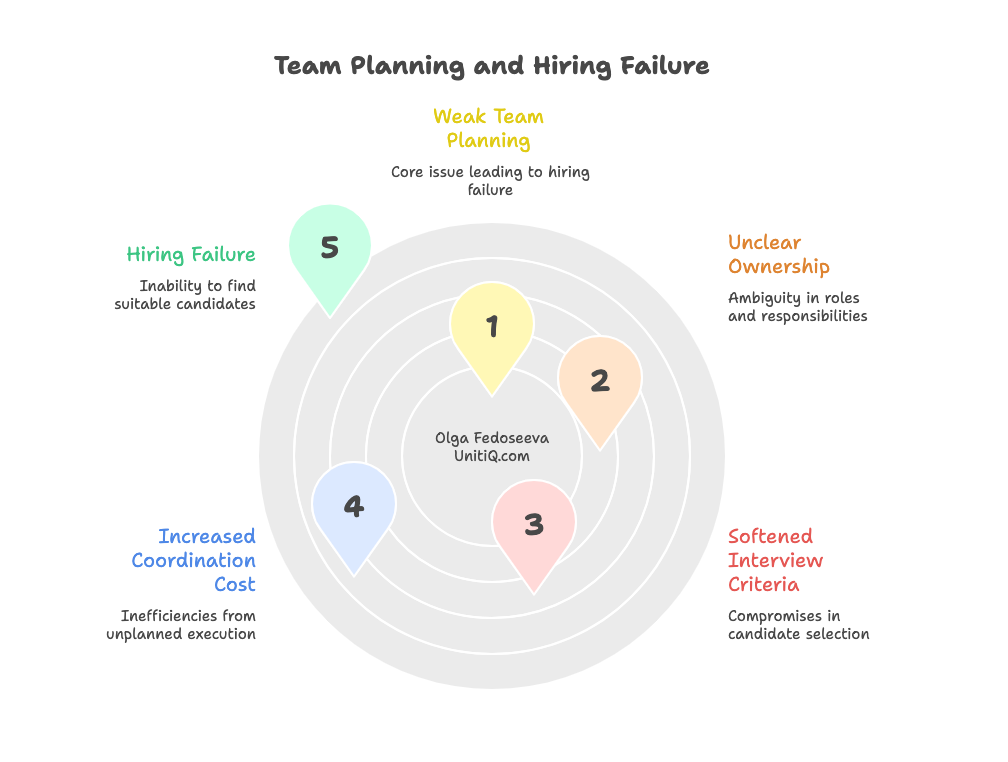
Without clear team planning:
- interview criteria soften
- “almost right” candidates move forward
- roles shift mid-process
- ownership expectations stay implicit
Hiring becomes harder, not because talent is scarce, but because the organisation cannot clearly answer:
“What will this person own — and what decisions move with them?”
This is why hiring stops working when team planning is weak.
What effective team planning looks like in scaling startups
Strong team planning answers execution questions before hiring begins:
- What outcomes must this role own?
- Where does decision authority sit?
- What problems should not come back to founders?
- How does this role reduce coordination load elsewhere?
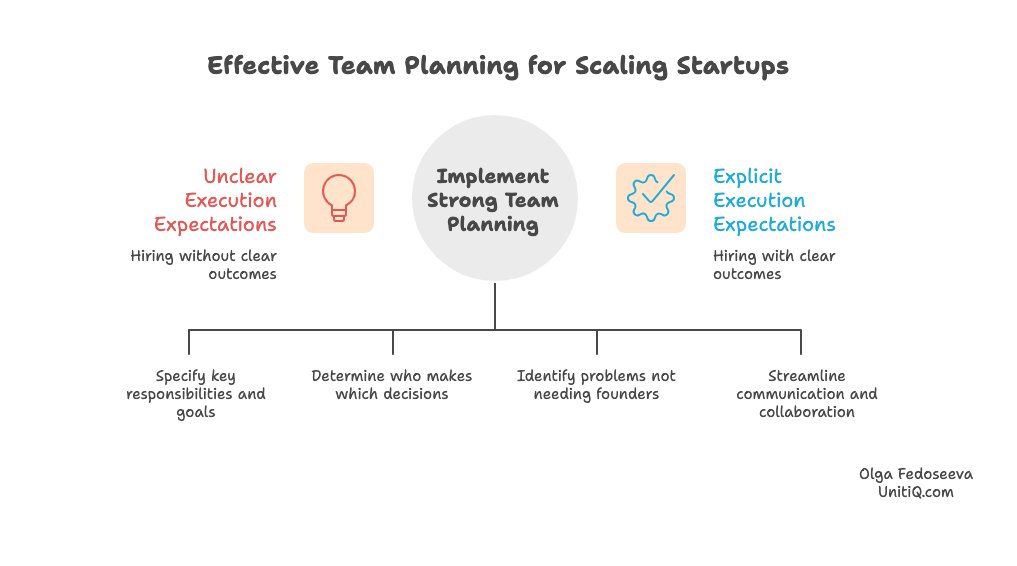
This clarity does three things:
- Improves candidate self-selection
- Sharpens interview signals
- Reduces post-hire execution drag
Hiring becomes lighter because execution expectations are explicit.
Planning versus product strategy is a false trade-off
Founders often treat planning as something that competes with product focus.
In reality:
- Product strategy defines what should exist
- Team planning defines who owns what when it exists
Without both, execution collapses under its own complexity.
This is why companies with strong products still stall — and why adding people doesn’t automatically add speed.
When founders start feeling the cost
Planning failures don’t announce themselves.
They appear as:
- longer feedback loops
- more meetings
- decision fatigue
- rework
- founder exhaustion
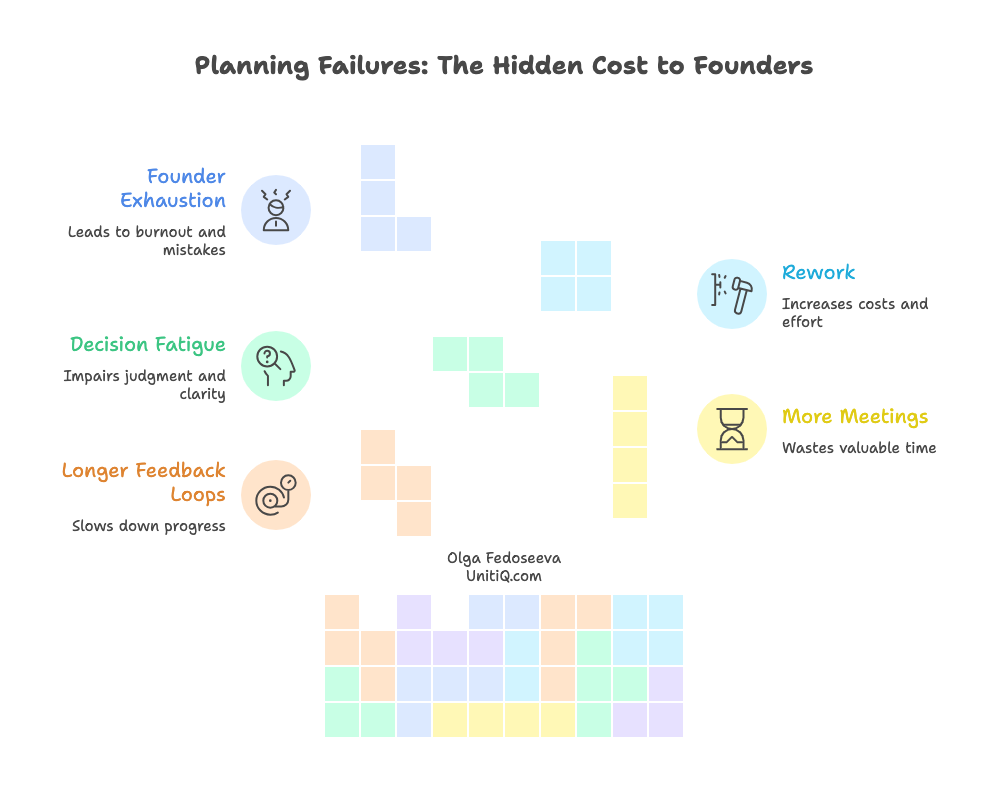
By the time hiring feels broken, the problem started upstream.
This is also the moment many founders reach for external hiring support — without realising that the hiring model cannot fix a planning problem on its own.
If you want to sanity-check which model fits your current stage — and where execution is actually breaking — we can walk through it together.
👉 Book a conversation
👉 Book a conversation
Why this matters more than it looks
Every planning decision compounds.
Poor planning:
- increases leadership load
- slows future hiring
- erodes execution confidence
Clear planning:
- shortens decisions
- reduces founder involvement
- stabilises execution
That’s why team planning isn’t an internal hygiene exercise.
It’s a core execution lever — as important as product strategy at scale.
The quiet signal that it’s working
When team planning is right:
- interviews get shorter
- decisions feel easier
- roles stop shifting mid-hire
- founders regain leverage
Hiring doesn’t disappear.
It becomes boring.
And boring, at this stage, is a sign that execution is finally carrying its own weight.
About the author
Olga Fedoseeva is the Founder of UnitiQ, a talent acquisition and People Projects partner for Tech Startups across EU, UKI, and MENA.
She works with founders in Fintech, AI, Crypto, and Robotics to prevent mis-hires before they compound — restoring execution momentum and protecting teams from quiet burnout.


