
Crypto startups don’t fail hiring because they move too slowly.
They fail because they move too confidently, too fast, with the wrong signals.
In an industry defined by irreversible mistakes — security breaches, regulatory missteps, protocol failures — hiring errors aren’t just expensive. They’re existential.
Yet across Web3, DeFi, infra, and crypto fintech, we see the same patterns repeat. Different founders. Different markets. Same outcomes.
Let’s unpack why.
Crypto Hiring Is Optimized for Belief - Not Execution
Crypto attracts people with strong conviction.
Founders, engineers, investors — belief is fuel here.
But belief is also what distorts hiring decisions.
In early crypto teams, candidates are often evaluated on:
- narrative fluency (“I deeply believe in this protocol”)
- reputation signals (ex-FAANG, ex-Top-20 exchange, ex-DAO contributor)
- speed (“we need to move now before the market shifts”)
- confidence under uncertainty
What’s rarely tested properly is execution capability under real crypto constraints:
security, adversarial environments, compliance ambiguity, and irreversible outcomes.
This creates a dangerous mismatch:
teams full of conviction, but short on dependable execution.
These issues aren’t unique to Web3 - they’re an intensified version of the same mistakes many startups make when hiring under pressure. We see these patterns repeat long before teams realise execution is slowing.
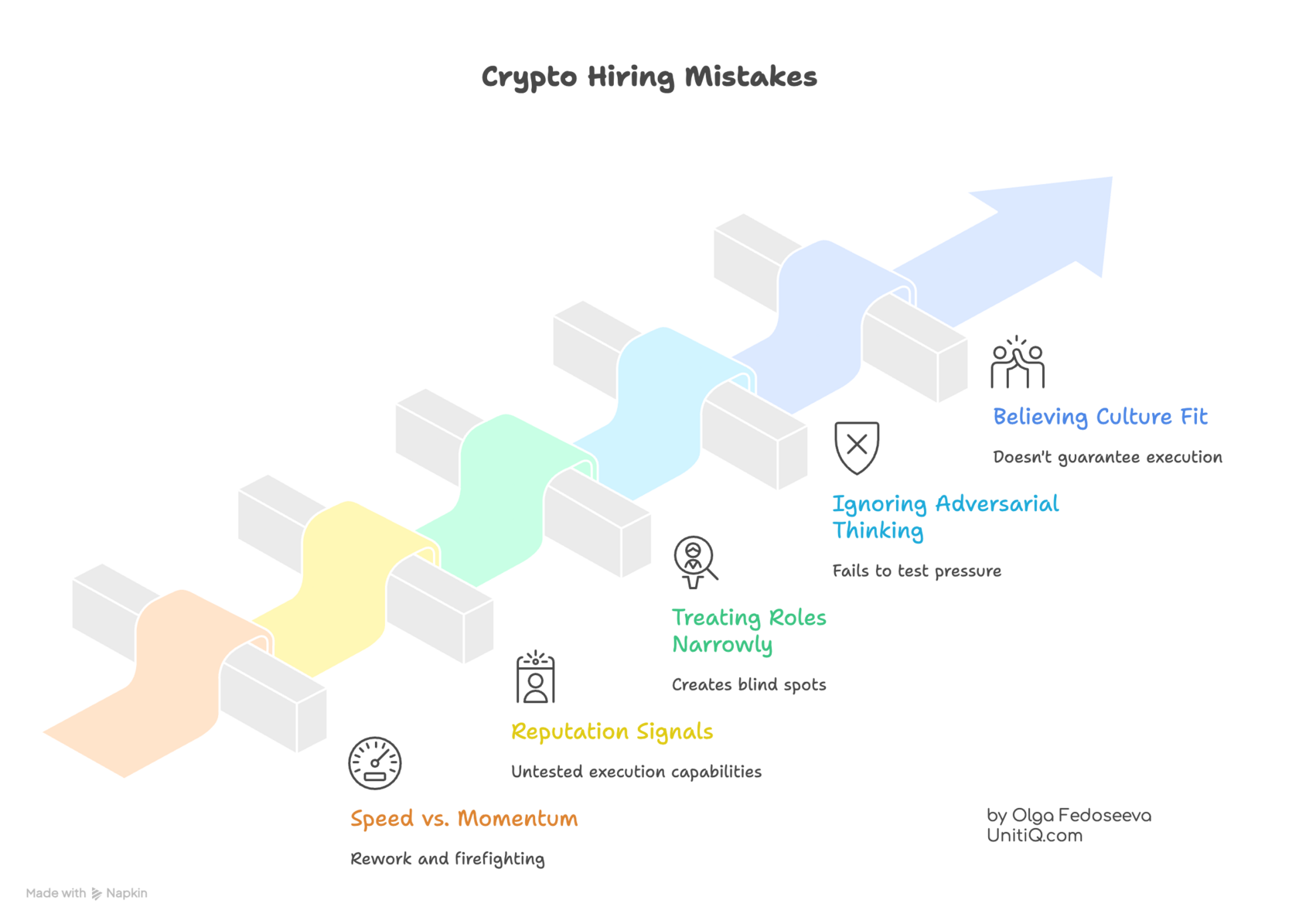
Mistake #1: Confusing Speed With Momentum
Crypto rewards speed — until it doesn’t.
Founders often compress hiring cycles because:
- competitors are moving
- funding windows are short
- product timelines feel existential
So decisions are made quickly, often after:
- one strong technical interview
- one culture conversation
- a gut feeling that “this person gets crypto”
But speed without execution alignment doesn’t create momentum.
It creates rework, firefighting, and silent drag.
Weeks later, founders find themselves:
- re-reviewing code
- re-explaining priorities
- double-checking security decisions
- stepping back into execution instead of strategy
Momentum stalls — quietly.
Mistake #2: Over-Indexing on Reputation Signals
Crypto hiring leans heavily on proxies:
- “They worked on a well-known protocol”
- “They were early at a big exchange”
- “They’ve shipped something visible on-chain”
But reputation doesn’t tell you how someone executes — only where they’ve been.
What often goes untested:
- how they make decisions under incomplete information
- how they handle security trade-offs
- how they escalate risk
- how they operate when incentives are misaligned
- how they behave when something breaks publicly
In crypto, the cost of poor judgment isn’t internal inefficiency.
It’s public failure.
In crypto, reputation signals don’t start at the CV. They’re shaped much earlier by the execution signals your employer brand sends - often attracting confident storytellers instead of execution owners.
Mistake #3: Treating Crypto Roles as “Just Engineering”
Crypto roles are rarely “just” technical.
A senior Web3 engineer isn’t only writing code.
They’re implicitly making decisions about:
- attack surfaces
- user trust
- regulatory exposure
- upgrade paths
- incident response
Yet many hiring processes still treat these roles as:
- generic backend
- generic infrastructure
- generic product engineering
Execution capability in crypto is cross-disciplinary by default.
Hiring for narrow skill sets creates blind spots that only appear when it’s too late.
Most crypto hiring still relies on traditional skills-based hiring models - even though skill alone says very little about how someone executes under ambiguity, risk, and public failure.
Mistake #4: Ignoring Adversarial Thinking
Most interviews test how candidates perform in cooperative environments.
Crypto operates in adversarial ones.
Attackers, exploits, market manipulation, governance abuse — these aren’t edge cases.
They’re the environment.
But interviews rarely test:
- how candidates think about failure modes
- how they assume systems will be attacked
- how they respond to pressure when there’s no rollback
Confidence in a whiteboard session is not the same as calm judgment during an exploit.
When interviews focus on confidence and theory, they miss how candidates think under adversarial pressure. We break this failure down in How Startups Interview for Execution Capability (And Why Most Don’t).
Mistake #5: Believing “Crypto Culture Fit” Solves Everything
“Culture fit” is often used as a shortcut for alignment.
In crypto, that usually means:
- shared beliefs
- similar risk appetite
- similar narratives about decentralization or disruption
But shared beliefs don’t guarantee shared execution standards.
We see teams that agree philosophically — yet clash daily on:
- what “done” means
- how much risk is acceptable
- when to ship vs pause
- who owns decisions under pressure
Execution friction emerges not because people disagree — but because ownership was never clearly designed.
The Hidden Cost: Founders Pulled Back Into Execution
When hiring fails in crypto, the damage isn’t always immediate.
What we hear from founders weeks or months later sounds like this:
“I thought this hire would free me up. Instead, I’m back reviewing everything.”
This is the real cost:
- founders re-entering decision loops
- leadership attention pulled from strategy
- execution slowing without anyone explicitly failing
Hiring was supposed to remove constraints.
Instead, it created new ones.
Why This Keeps Repeating
Because crypto hiring often optimizes for:
- speed
- belief
- surface-level competence
Instead of:
- execution under ambiguity
- risk ownership
- decision-making quality
Until teams explicitly design for execution capability — not just skills or conviction — the same mistakes will continue to repeat, cycle after cycle.
If you want to sanity-check what’s breaking in your hiring system, we can walk through it together.
👉 Book a conversation
About the author
Olga Fedoseeva is the Founder of UnitiQ, a talent acquisition partner for Series A–pre-IPO companies in Crypto, Blockchain, Fintech, Robotics, and Mobility across EU, UKI, and MENA.
She works with founders who are stuck in hiring or execution mode — helping teams regain momentum through precision hiring and focused People Projects that align people decisions with execution reality.


