Why founders scaling fast can’t rely on traditional recruiting anymore
Hiring speed used to mean compromise.
Post a role.
Collect applications.
Interview a lot of people.
Hope the right one appears.
That approach worked when hiring was mostly about filling roles.
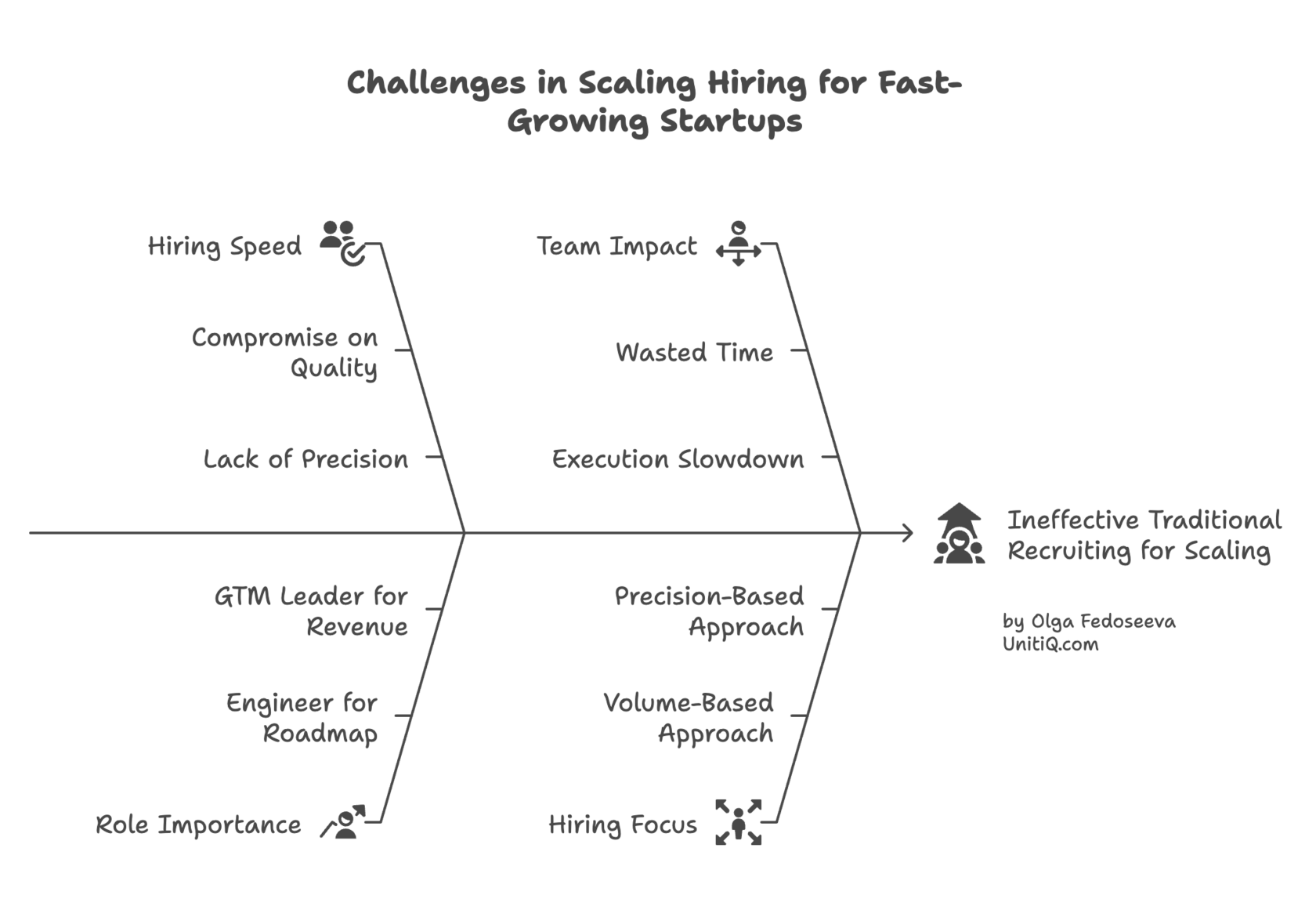
But for startups moving from 10 to 50 or 50 to 150, hiring decisions carry a very different weight.
The next engineer may unblock the roadmap.
The next GTM leader may define revenue velocity.
The next operator may remove months of founder workload.
At that stage, hiring isn’t about volume.
It’s about precision.
Because when a company is scaling fast, one misaligned hire doesn’t just waste time — it slows execution across the entire team.
Why Traditional Hiring Breaks in Startups
Most hiring advice still assumes companies operate in stable environments.
Roles are predefined.
Processes are standardized.
Responsibilities are clearly documented.
Startups operate differently.
Roles evolve quickly.
Ownership boundaries shift.
The company is still discovering how it executes.
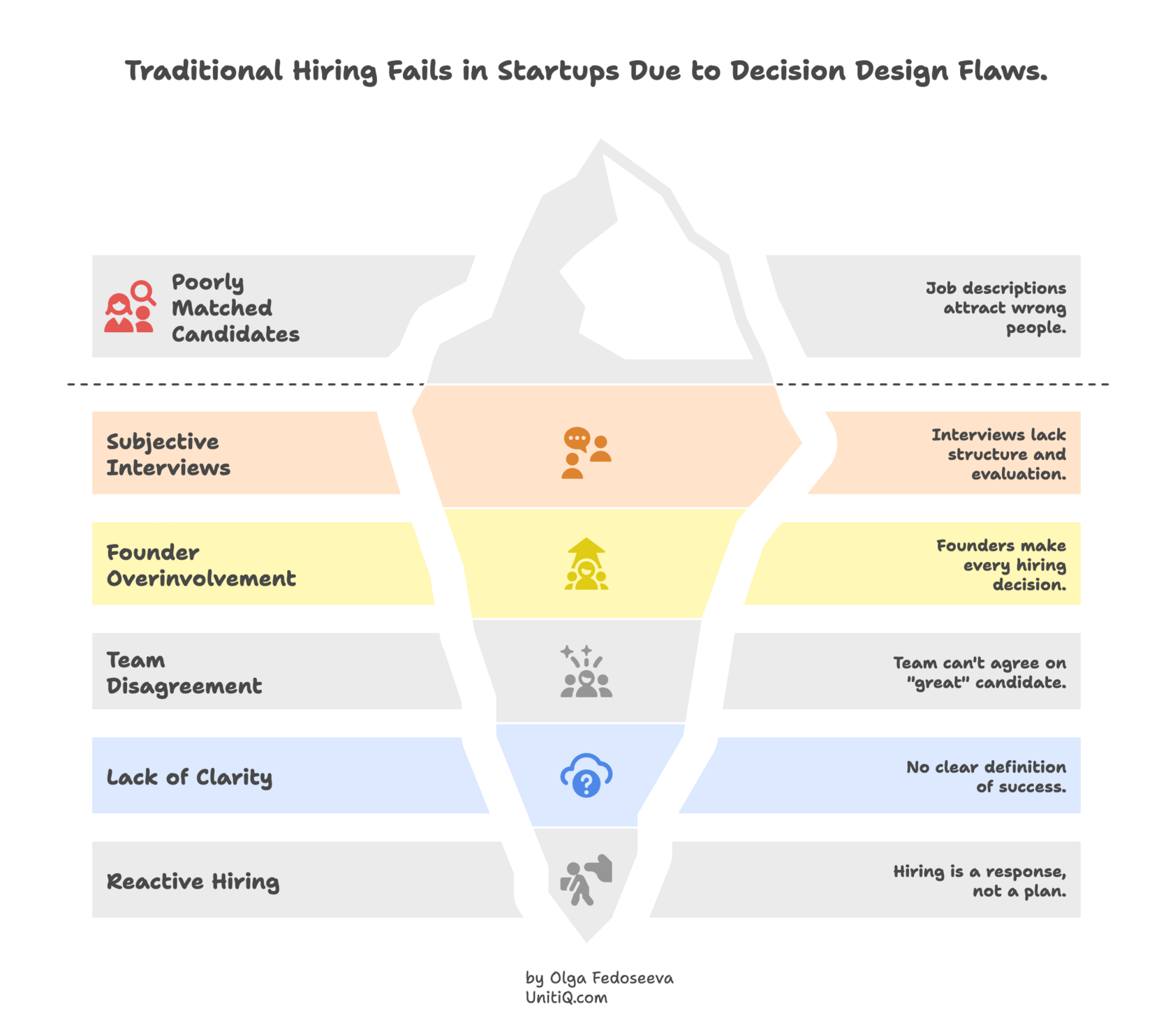
When hiring is approached with traditional methods, several problems appear quickly:
- job descriptions attract large volumes of poorly matched candidates
- interviews become subjective conversations instead of structured evaluation
- founders remain involved in every hiring decision
- the team struggles to agree on what “great” actually looks like
From the outside, this appears to be a recruiting challenge.
In reality, it is usually a decision design problem.
Without clarity around what success looks like, hiring becomes reactive.
And reactive hiring rarely produces strong teams.
What Precision Hiring Actually Means
Precision hiring flips the traditional model.
Instead of starting with candidates, it starts with execution clarity.
The goal is not to generate more applicants.
The goal is to identify the specific type of operator who will solve the problem the company currently faces.
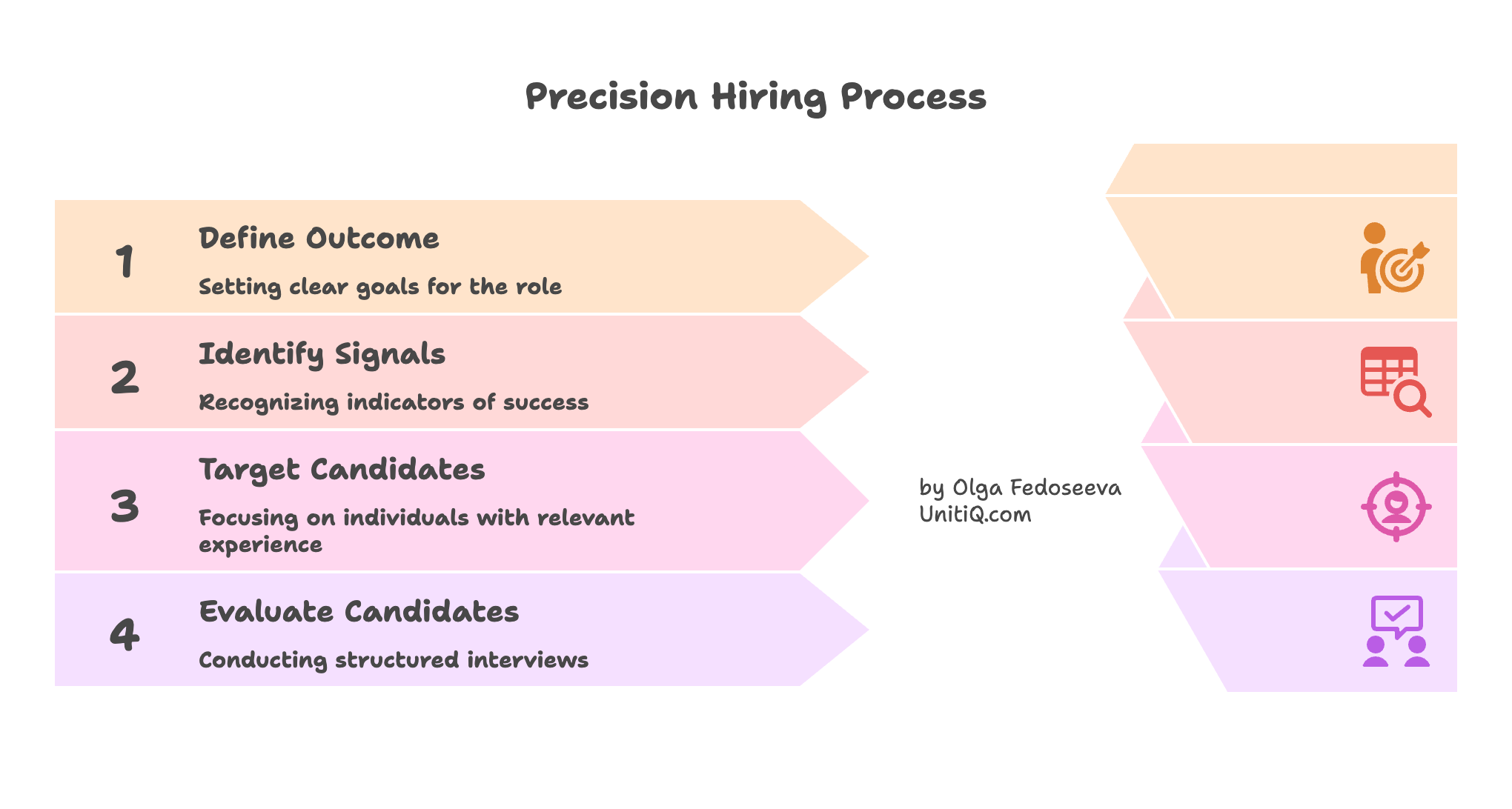
In practice, precision hiring means:
- defining the outcome the role must deliver
- identifying signals that predict success in that environment
- targeting candidates whose experience matches that context
- evaluating them through structured, high-signal interviews
In other words, precision hiring treats hiring the way product teams treat product development.
Start with the problem.
Define success.
Then build the process that finds the right solution.
The Precision Hiring Framework (UnitiQ)
Precision hiring is not a sourcing tactic.
It is a structured way of turning business needs into hiring decisions.
At UnitiQ, this process typically unfolds in four stages.
1. Role Clarity Before Candidate Search
Most hiring processes begin with a job description.
Precision hiring begins with a business question:
What must change in the company once this person joins?
Before any interview starts, founders must ensure the company is ready for the hire — with clear ownership, decision boundaries, and execution expectations. (Read: What Must Be True Before You Hire)
Instead of writing responsibilities immediately, founders define:
- the business objective this role must unlock
- the decisions the person must own independently
- what success should look like within the first year
Once that clarity exists, the role definition becomes far more precise.
And precision dramatically improves candidate fit.
Without clear role definition, startups often hire “almost right” candidates who look strong but never fully create leverage. (Read: How Startups Define Roles Wrong (And Why They Keep Hiring “Almost Right” People).
2. Context-Driven Candidate Targeting
Traditional recruiting searches for keywords.
Precision hiring searches for patterns of success in similar environments.
Instead of asking:
“Who has this title?”
The question becomes:
“Who has solved this problem in a similar company stage?”
That means evaluating candidates through signals such as:
- company stage they operated in
- complexity of decisions they handled
- pace of execution they are accustomed to
- environments where they performed best
This dramatically reduces noise in the hiring funnel.
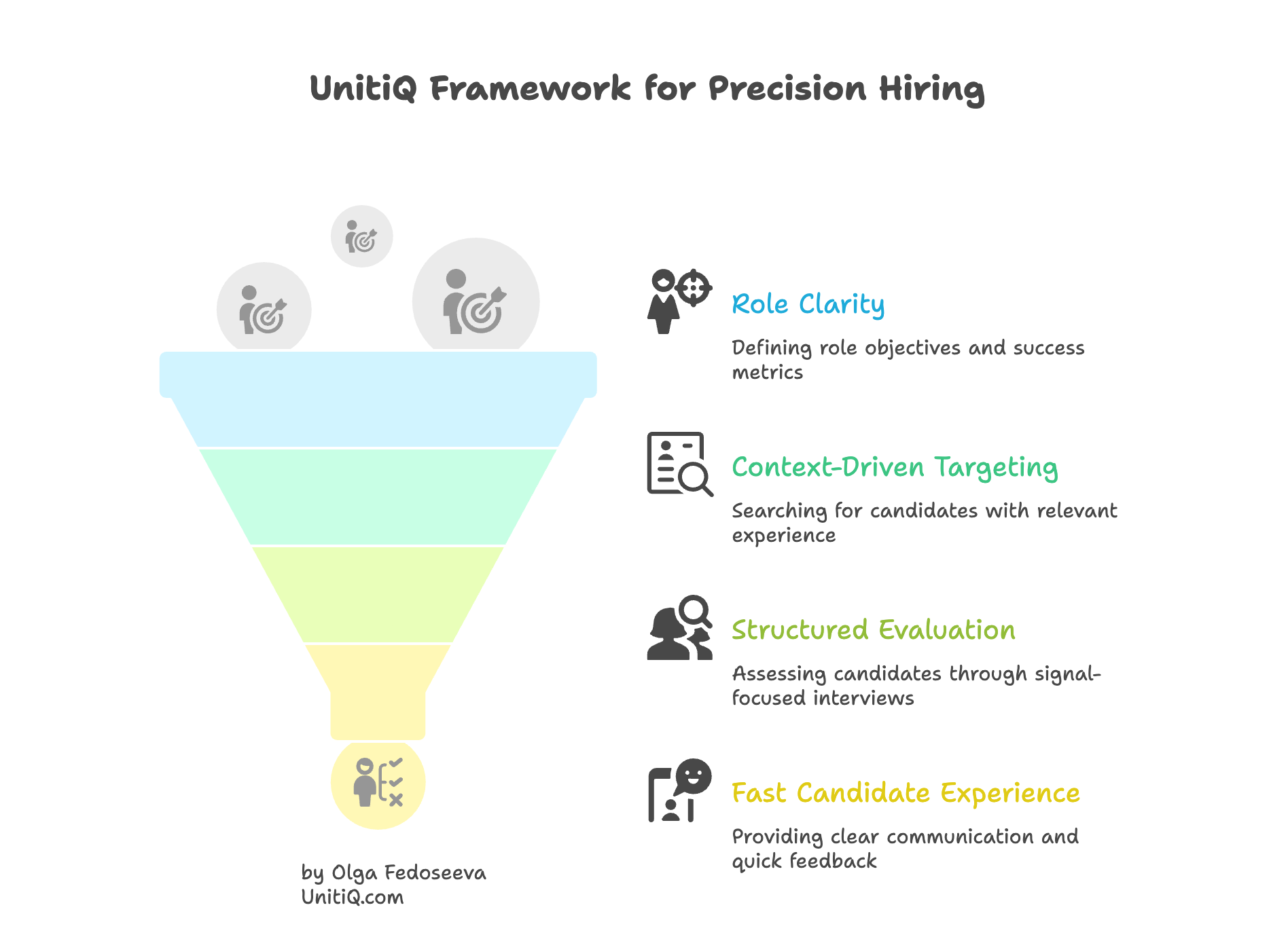
3. Structured Evaluation for Real Signals
Many interviews in startups are still conversation-based.
That often produces strong impressions but weak decisions.
Precision hiring replaces intuition-heavy interviews with signal-focused evaluation.
Interviews are designed to uncover:
- decision-making ability under ambiguity
- problem-solving approaches in real scenarios
- ownership and accountability patterns
- how candidates learn and adapt
Strong hiring decisions depend on evaluating how candidates think and operate under pressure — not just their past titles or credentials. (Read: Hiring in a Post-Resume World: What Founders Should Really Be Screening For)
This reduces bias and improves decision confidence.
Instead of debating opinions after interviews, the team evaluates consistent signals.
4. Fast, Transparent Candidate Experience
Speed still matters in hiring.
But speed without clarity often leads to mistakes.
Many founders believe hiring faster will solve their team bottlenecks, but speed without role clarity usually increases coordination cost and post-hire friction. (Read: Speed vs. Precision in Hiring: What Founders Get Wrong)
Precision hiring combines structured evaluation with fast communication.
Candidates receive:
- a clear interview process
- quick feedback loops
- transparency about role expectations
This creates a stronger candidate experience and increases the likelihood that strong candidates accept offers.
Why Precision Hiring Works
When startups shift from volume hiring to precision hiring, several things change.
The hiring funnel becomes smaller but stronger.
Instead of dozens of poorly matched candidates, teams engage with a smaller set of highly relevant operators.
Internal decision-making improves.
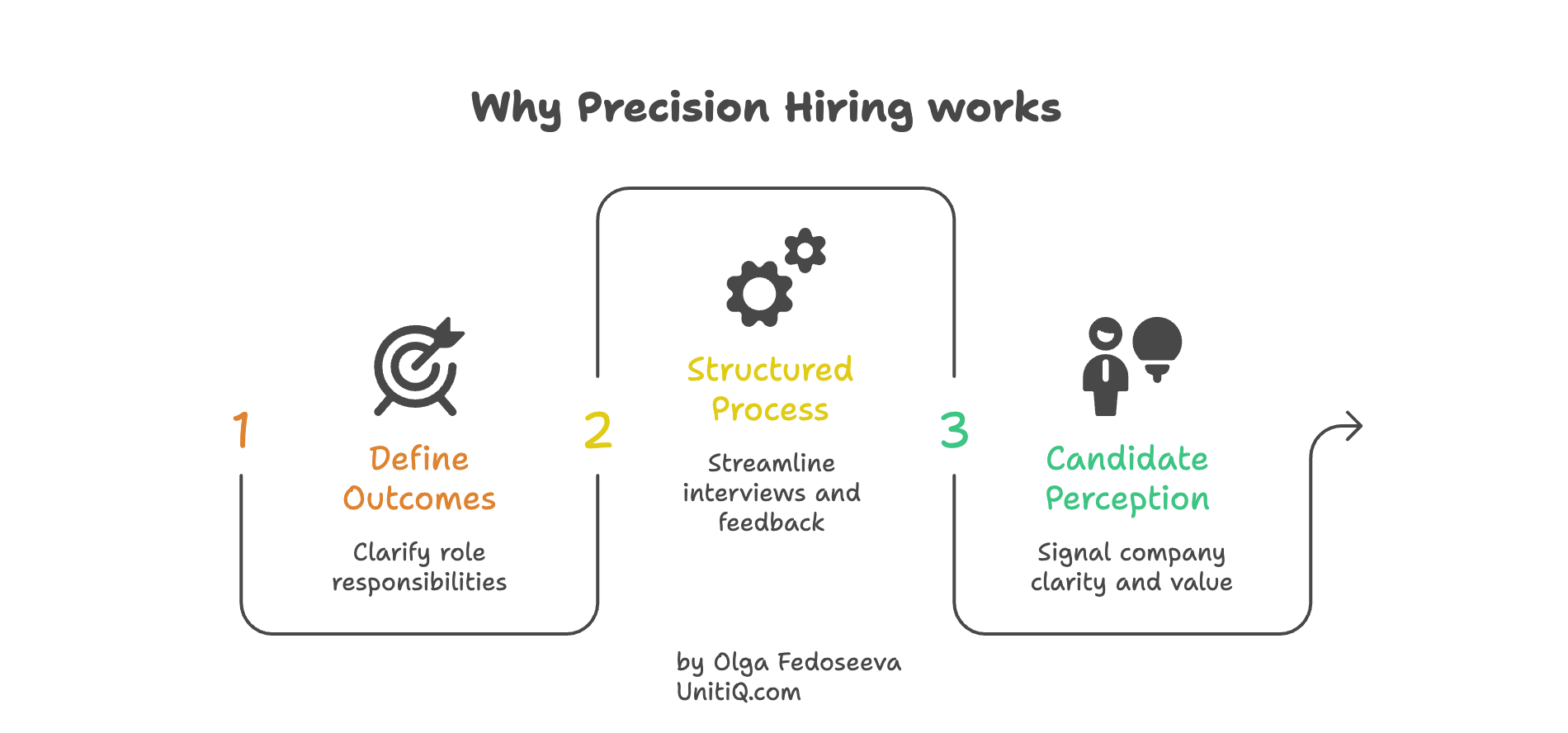
When success signals are defined early, interview feedback becomes clearer and faster.
Candidate perception improves.
Structured hiring processes signal that the company understands what it needs and how decisions are made.
Most importantly, new hires create execution leverage faster.
Measuring hiring success requires looking beyond time-to-hire or cost-per-hire and focusing on signals that reflect autonomy, decision ownership, and execution speed. (Read: Talent Acquisition Metrics That Actually Matter in Startups)
Because the role was defined around outcomes, not vague responsibilities.
A Founder’s Precision Hiring Checklist
For founders scaling teams in 2026, the hiring playbook looks different.
Instead of focusing on volume, the focus shifts to clarity.
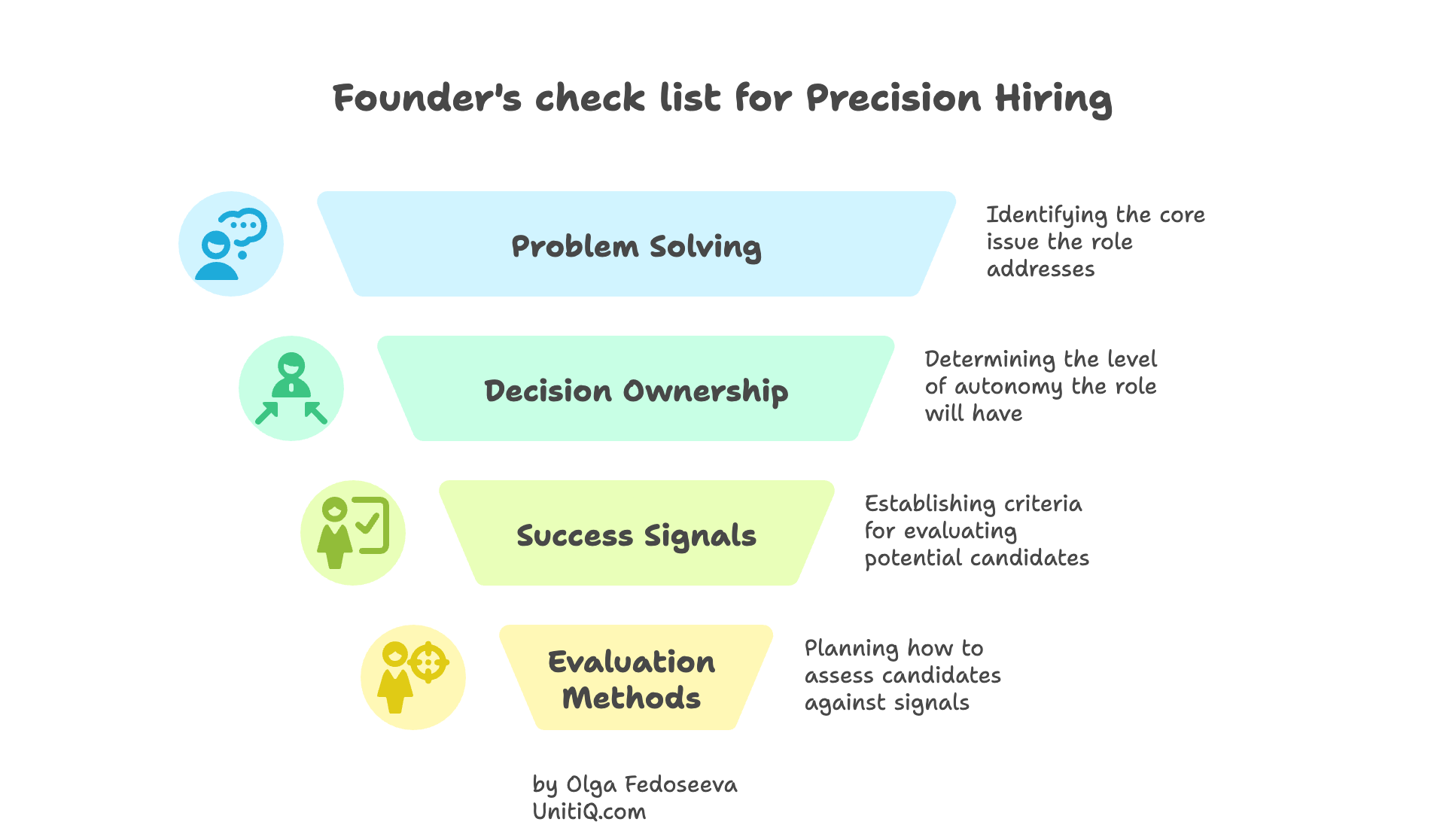
Before starting a hiring process, founders should ask:
- What problem must this role solve for the company?
- What decisions should this person own independently?
- What signals would prove someone can succeed here?
- How will we evaluate those signals during interviews?
If those questions are answered clearly, hiring becomes dramatically easier.
If they are not, more candidates rarely solve the problem.
Final Thought
In fast-moving startups, hiring decisions compound quickly.
The next few hires may determine whether the company accelerates or slows.
In many startups the real constraint isn’t hiring volume but the company’s ability to absorb new people without slowing execution. (Read: Hiring Is Not the Bottleneck — Execution Capacity Is)
Precision hiring exists to remove uncertainty from those decisions.
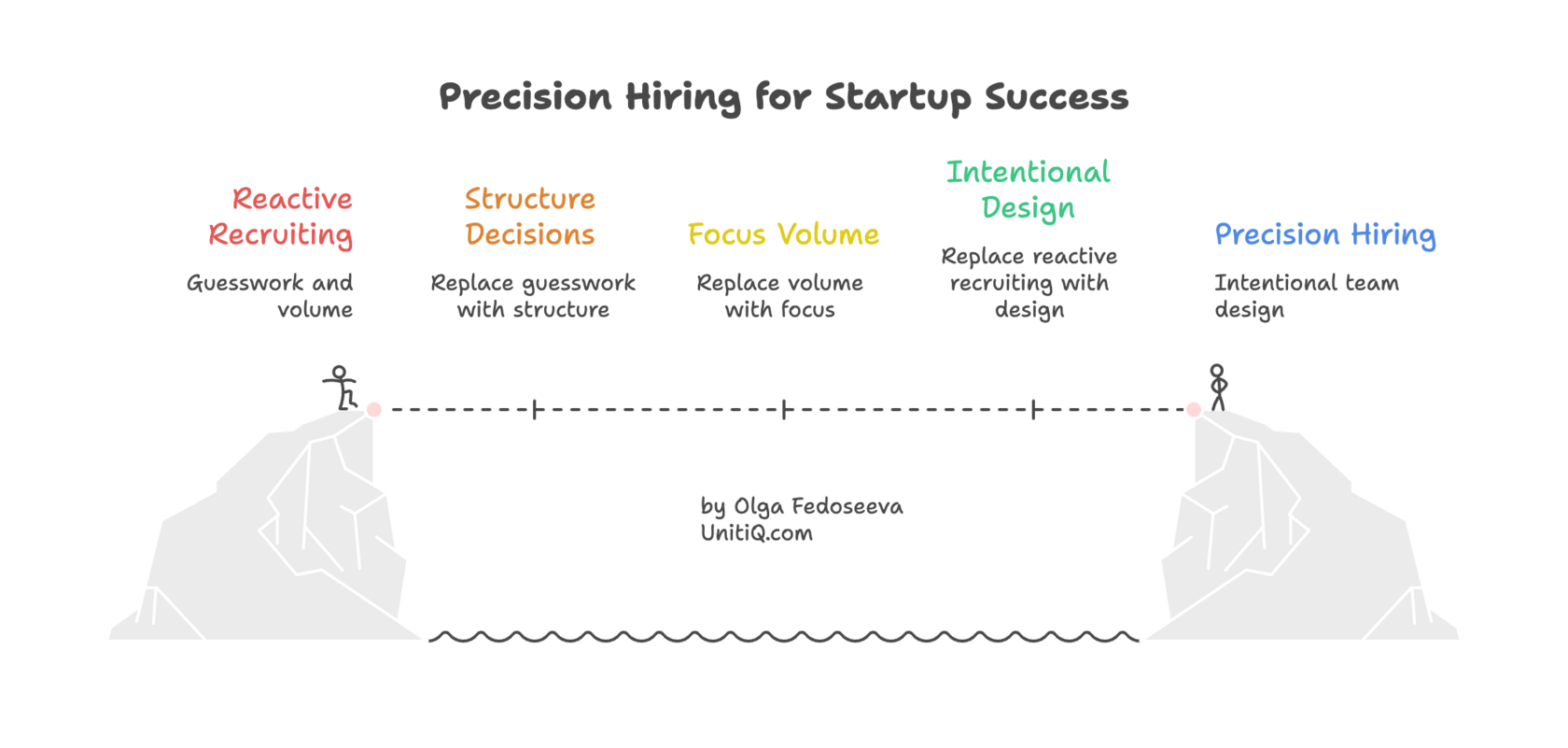
It replaces guesswork with structure, volume with focus, and reactive recruiting with intentional team design.
Because building a strong startup team is not about meeting more candidates.
It’s about finding the few people who will change how the company executes.
If you want to sanity-check which model fits your current stage — and where execution is actually breaking — we can walk through it together.
About the author
Olga Fedoseeva is the Founder of UnitiQ, a talent acquisition and People Projects partner for Tech Startups across EU, UKI, and MENA.
She works with founders in Fintech, AI, Crypto, and Robotics to prevent mis-hires before they compound — restoring execution momentum and protecting teams from quiet burnout.


