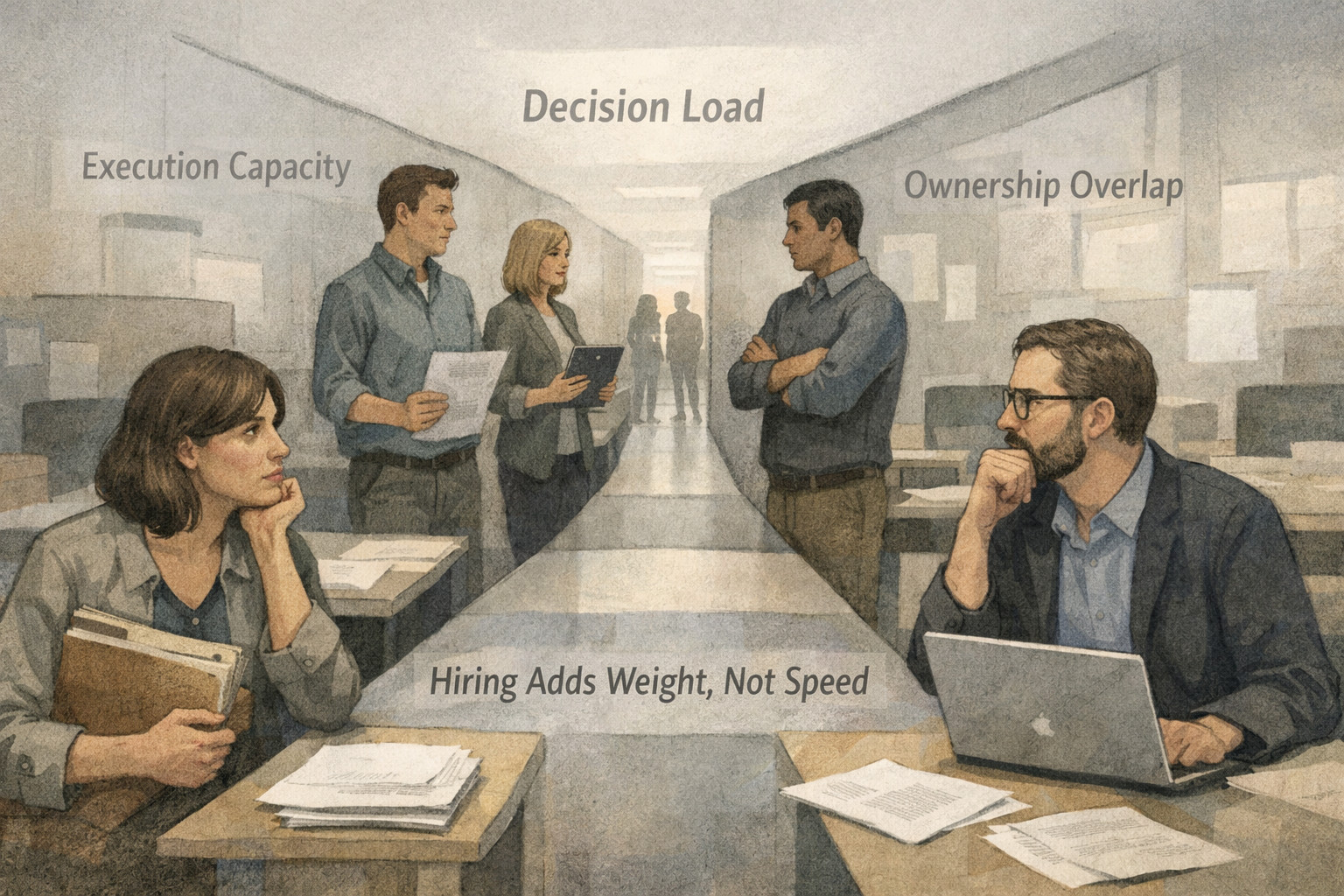
Most Series A–C founders describe the same frustration in different words:
“We’re hiring, but things aren’t moving faster.”
“We added strong people, but I’m still deeply involved.”
“The team is bigger, yet execution feels heavier.”
The instinctive conclusion is obvious — we still don’t have the right people.
In reality, that’s rarely the problem.
The real constraint isn’t talent.
It’s execution capacity.
And hiring without understanding that capacity is how teams quietly stall.
The Misdiagnosis: Treating Hiring as a Universal Fix
Hiring feels like progress because it’s concrete:
- interviews are scheduled
- offers are sent
- headcount goes up
From the outside, the company looks like it’s scaling.
From the inside, something else happens:
- decisions don’t move faster
- ownership remains fuzzy
- founders stay pulled into details they thought they’d delegated
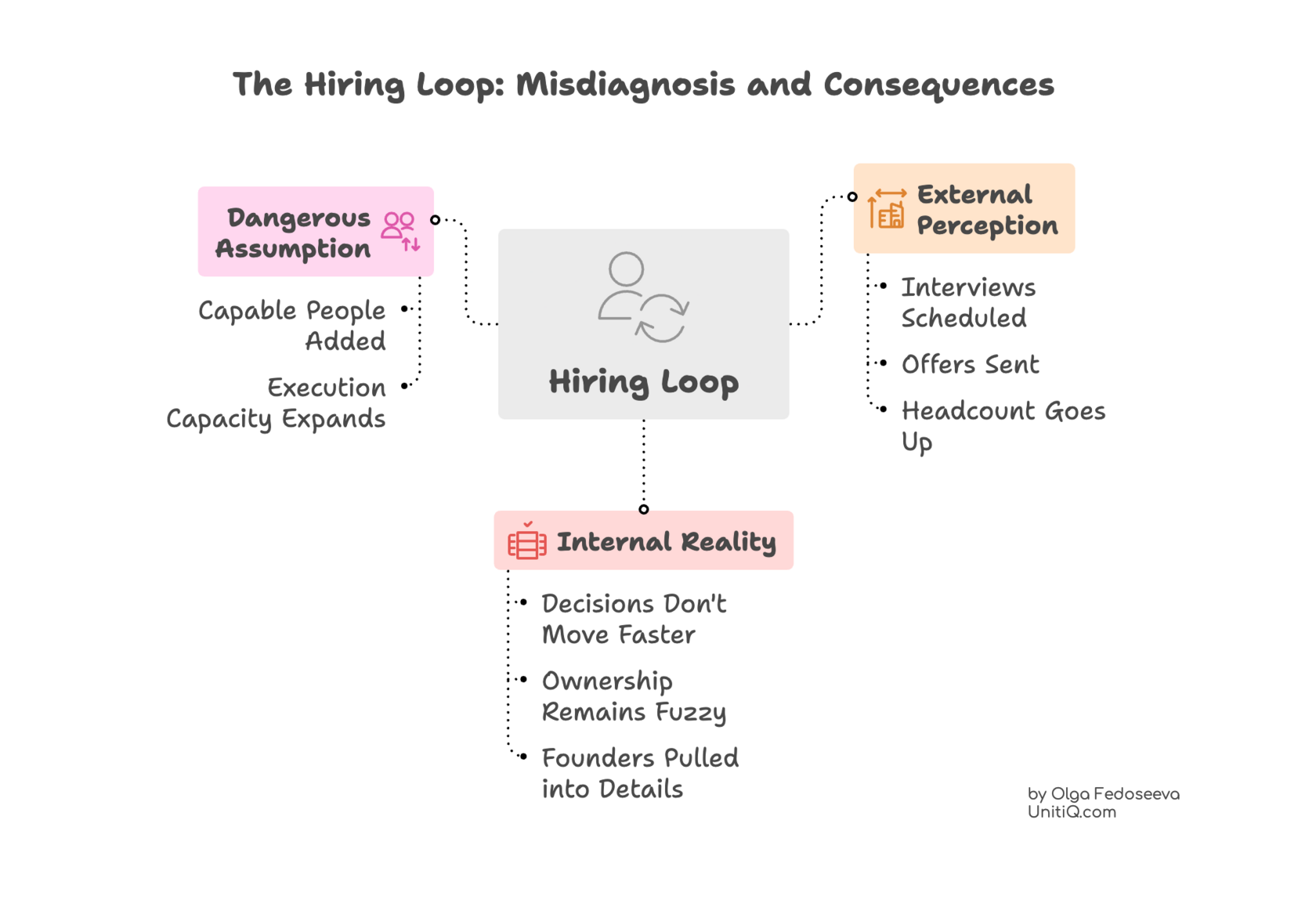
So the hiring loop repeats.
More roles.
More interviews.
More “almost right” candidates.
The assumption underneath is dangerous but common:
If we add capable people, execution capacity will expand automatically.
Hiring only creates leverage when specific conditions are already true before you hire.
It doesn’t.
What Execution Capacity Actually Means (And Why It’s Invisible)
Execution capacity is not:
- number of employees
- seniority level
- years of experience
- how impressive the CVs look
Execution capacity is the system’s ability to:
- absorb decisions without escalation
- translate intent into action without reinterpretation
- handle ambiguity without freezing or fragmenting
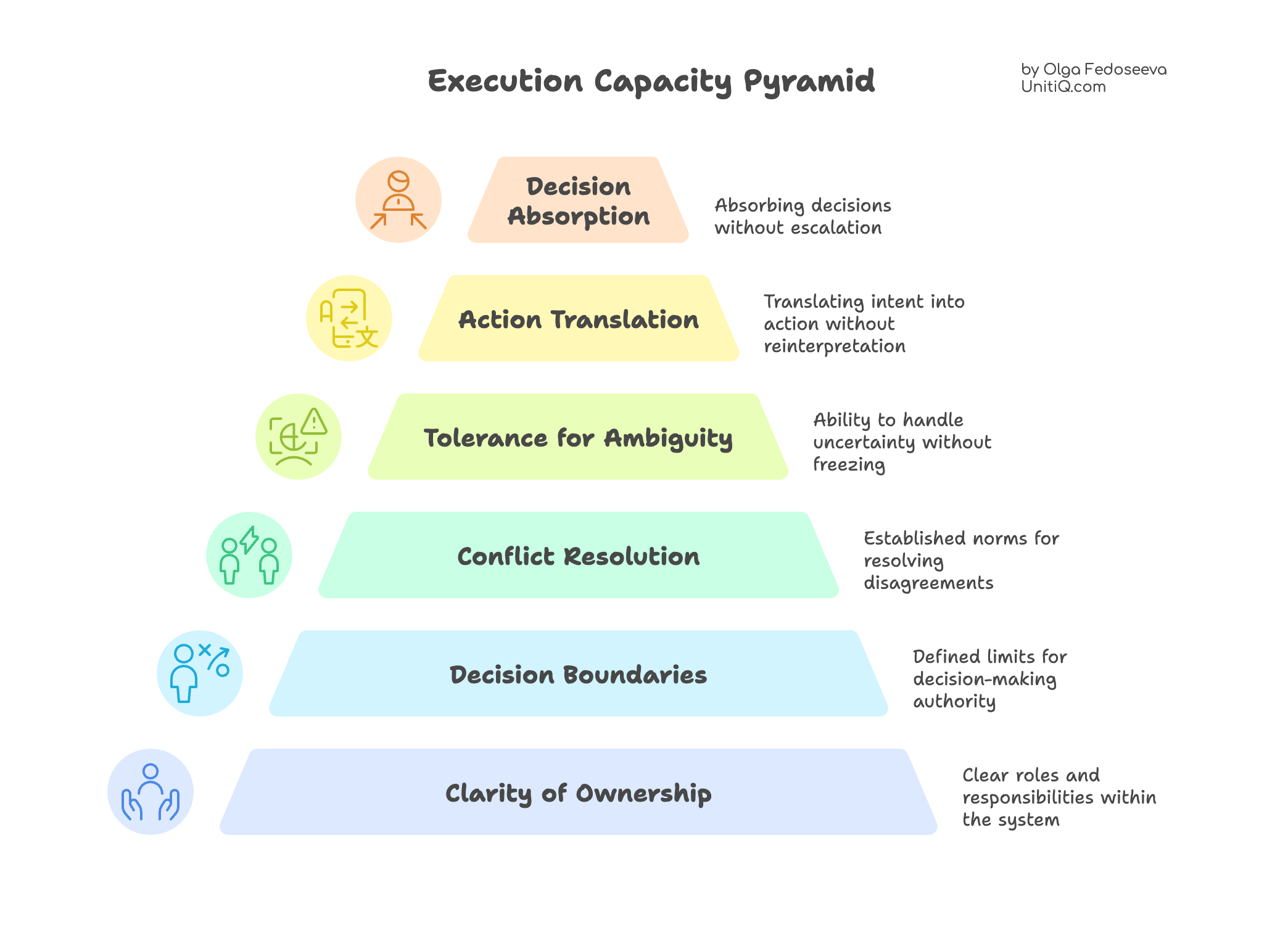
It’s shaped by:
- clarity of ownership
- decision boundaries
- conflict resolution norms
- tolerance for unfinished information
None of these show up in hiring metrics.
Which is why teams overshoot capacity without realizing it.
The Early Warning Signal Founders Miss
Here’s the pattern that shows up again and again:
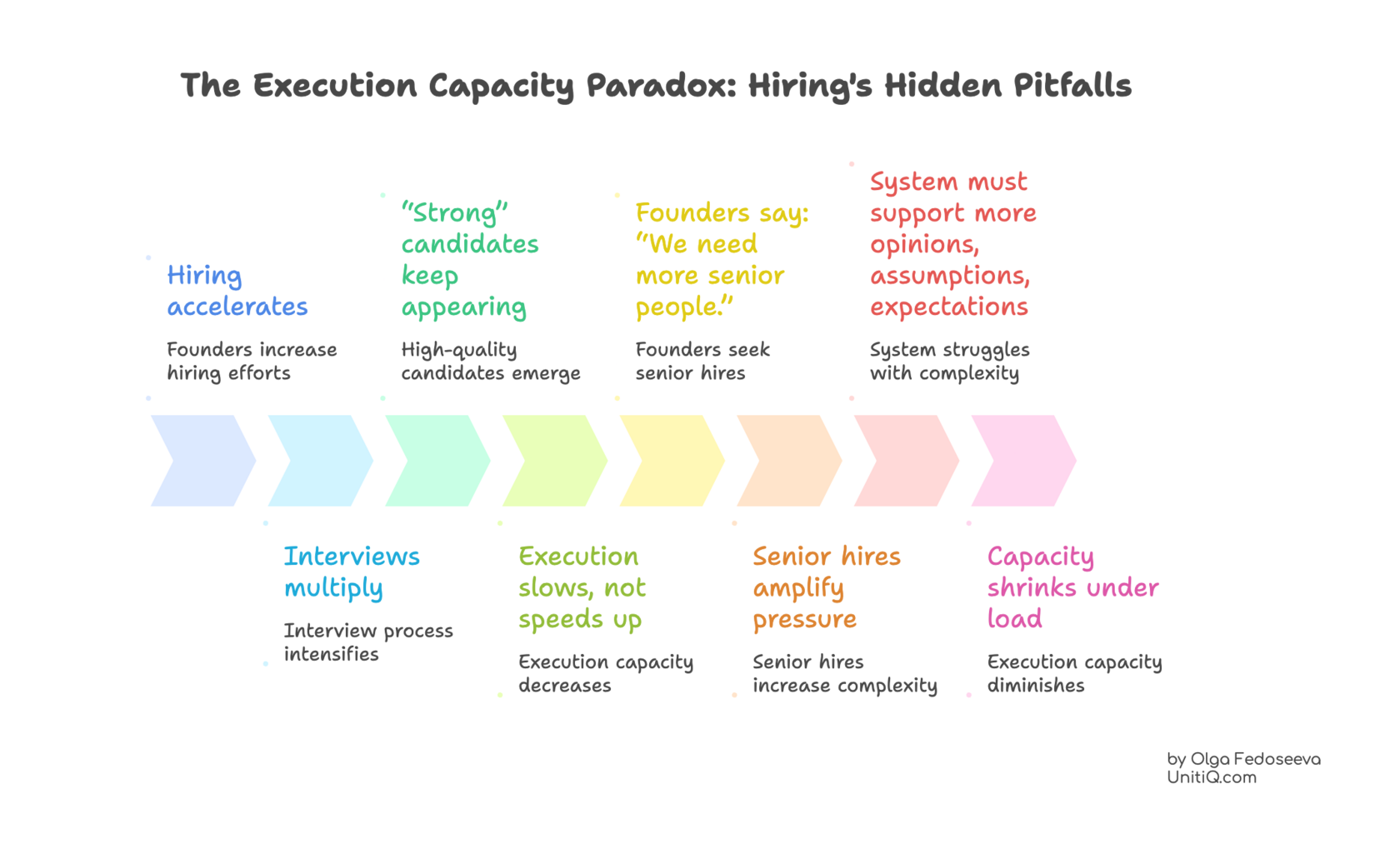
- Hiring accelerates
- Interviews multiply
- “Strong” candidates keep appearing
- Yet execution slows, not speeds up
At this point, founders often say:
“We need more senior people.”
But seniority doesn’t expand execution capacity if:
- priorities are unresolved
- decision rights are implicit
- success criteria change mid-flight
In those environments, senior hires don’t relieve pressure — they amplify it.
This is why great senior hires fail in Series A–B startups, even when they look perfect on paper.
Because now the system must support:
- more opinions
- more assumptions
- more implicit expectations
Without stronger execution scaffolding, capacity shrinks under load.
Why Adding Headcount Often Reduces Speed
This is the part most teams resist.
Every new hire:
- introduces new interpretation paths
- adds coordination overhead
- consumes attention before returning leverage
If execution rules aren’t explicit, each hire increases:
- clarification loops
- alignment meetings
- founder intervention
So instead of leverage, you get drag.
The organization feels busier, not faster.
And hiring continues — not to scale execution, but to compensate for its breakdown.
The Hiring Paradox at Series A–C
This is the paradox:
Teams hire to increase execution capacity —
but exceed execution capacity by hiring.
Once that happens:
- decisions slow
- accountability blurs
- founders step back in
- confidence in hiring drops
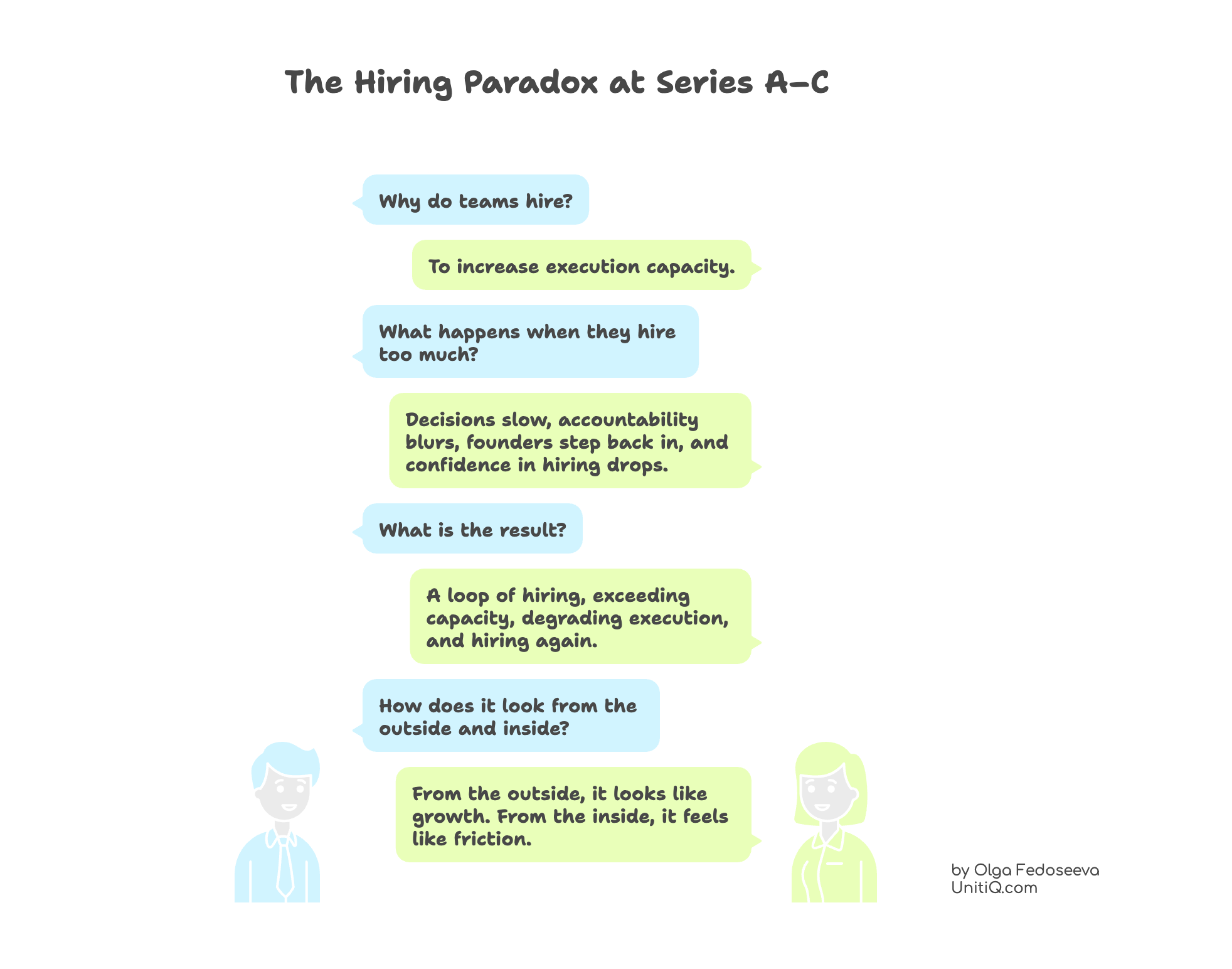
The result is a loop:
- Execution feels constrained
- Hiring is triggered
- Capacity is exceeded
- Execution degrades
- Hiring is triggered again
From the outside, it looks like growth.
From the inside, it feels like friction.
This dynamic explains why startup hiring feels broken, even when the process itself looks busy and structured.
What Changes When Execution Capacity Is Addressed First
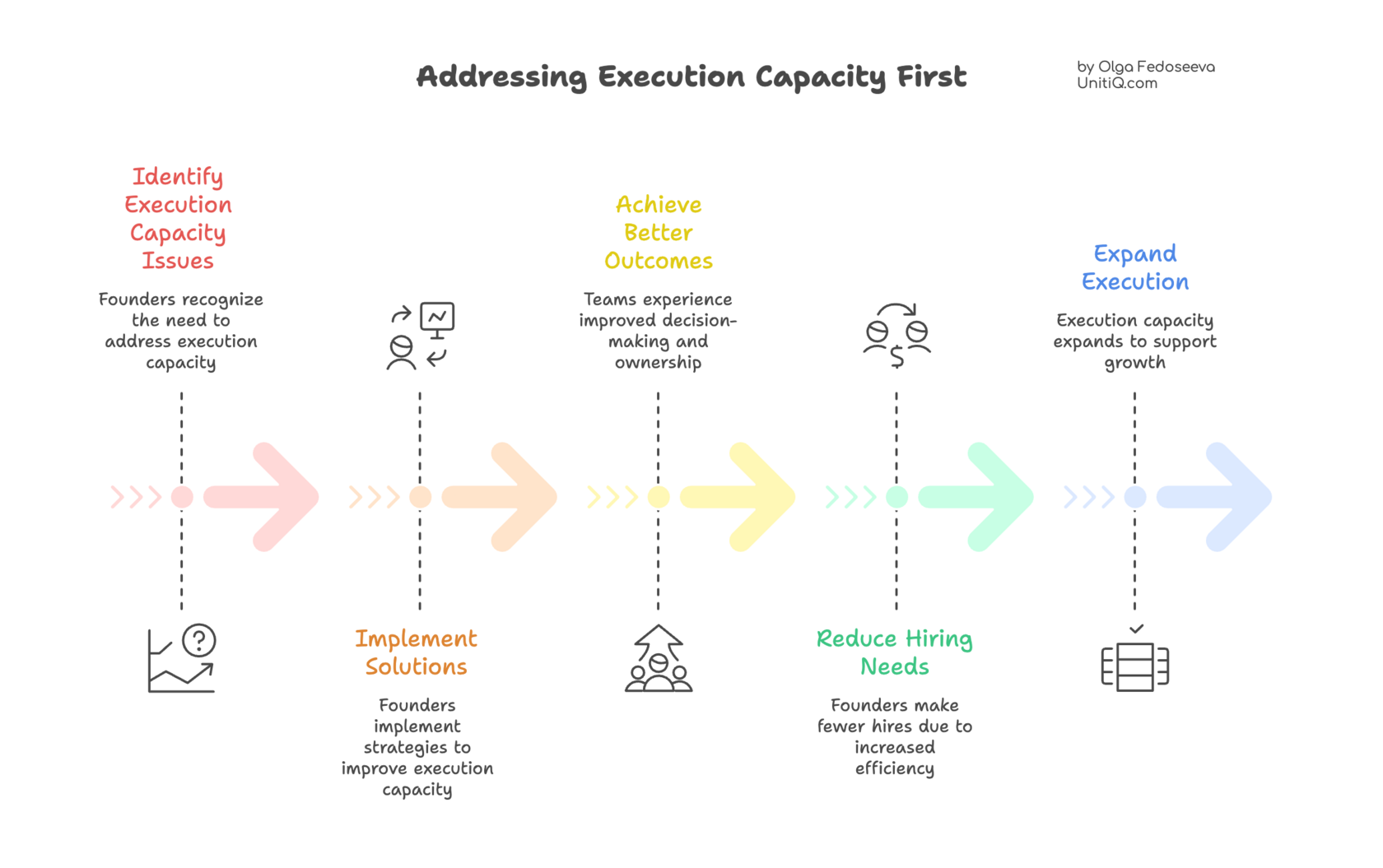
In teams where this is solved, founders describe the shift very differently:
- Fewer hires, better outcomes
- Faster decisions with less debate
- Clear ownership without constant checking
- Hiring becomes obvious instead of urgent
Not because they found “better people”.
But because the system could finally support the people it already had.
Only then does hiring expand execution — instead of exposing its limits.
When teams reach this point, hiring finally starts to feel easy — not because the process improved, but because execution capacity is in place.
The longer teams stay in this state, the more uncertainty quietly compounds and erodes momentum.
Why This Matters for Hiring (And Not Just Ops)
When execution capacity is ignored:
- “almost right” candidates feel acceptable
- hiring criteria drift
- interviews become longer, not clearer
- decisions feel risky no matter how much data you gather
This is why hiring stalls execution — not the other way around.
Until execution capacity is explicit, hiring will always feel harder than it should.
What Comes Next in This Series
This pillar sets the foundation.
The follow-up articles will zoom in on specific failure modes, including:
- why “almost right” candidates are a warning sign
- how decision avoidance hides inside rigorous hiring
- why senior hires fail even when they’re objectively strong
- how speed without clarity creates silent damage
Each of those deserves its own lens.
But they all point back to the same truth:
Hiring is not the bottleneck.
Execution capacity is.
If you want to sanity-check what’s breaking in your hiring system, we can walk through it together.
👉 Book a conversation
👉 Book a conversation
TL;DR — Key Takeaways
- Hiring is rarely the real constraint.
- Most Series A–C teams slow down because their execution capacity is exceeded — not because they lack talent.
- Execution capacity is not headcount.
- It’s the system’s ability to absorb decisions, clarify ownership, and turn intent into action without constant founder intervention.
- Adding people doesn’t automatically increase capacity.
- When roles, decision rights, and success criteria are unclear, every new hire increases coordination overhead and reduces speed.
- Senior hires don’t fix broken execution systems.
- They amplify ambiguity, opinion load, and decision friction when execution capacity is already stretched.
- “Almost-right” candidates and hiring uncertainty are signals.
- They indicate that the system can no longer support decisive hiring — not that candidate quality suddenly dropped.
- When execution capacity is addressed first, hiring becomes obvious.
- Fewer hires create more leverage, decisions move faster, and founders finally get out of hiring mode.
If you want to sanity-check which model fits your current stage — and where execution is actually breaking — we can walk through it together.
About the author
Olga Fedoseeva is the Founder of UnitiQ, a global HR executive, and a talent acquisition and people strategy leader with 20+ years of experience across EMEA, the US, and APAC. She has personally hired 1,500+ employees, led people strategy for organisations scaling from 30 to 700+ employees, and writes about hiring systems, execution risk, and people infrastructure in growth-stage startups.


