
At Series A–B, senior hires are rarely made casually.
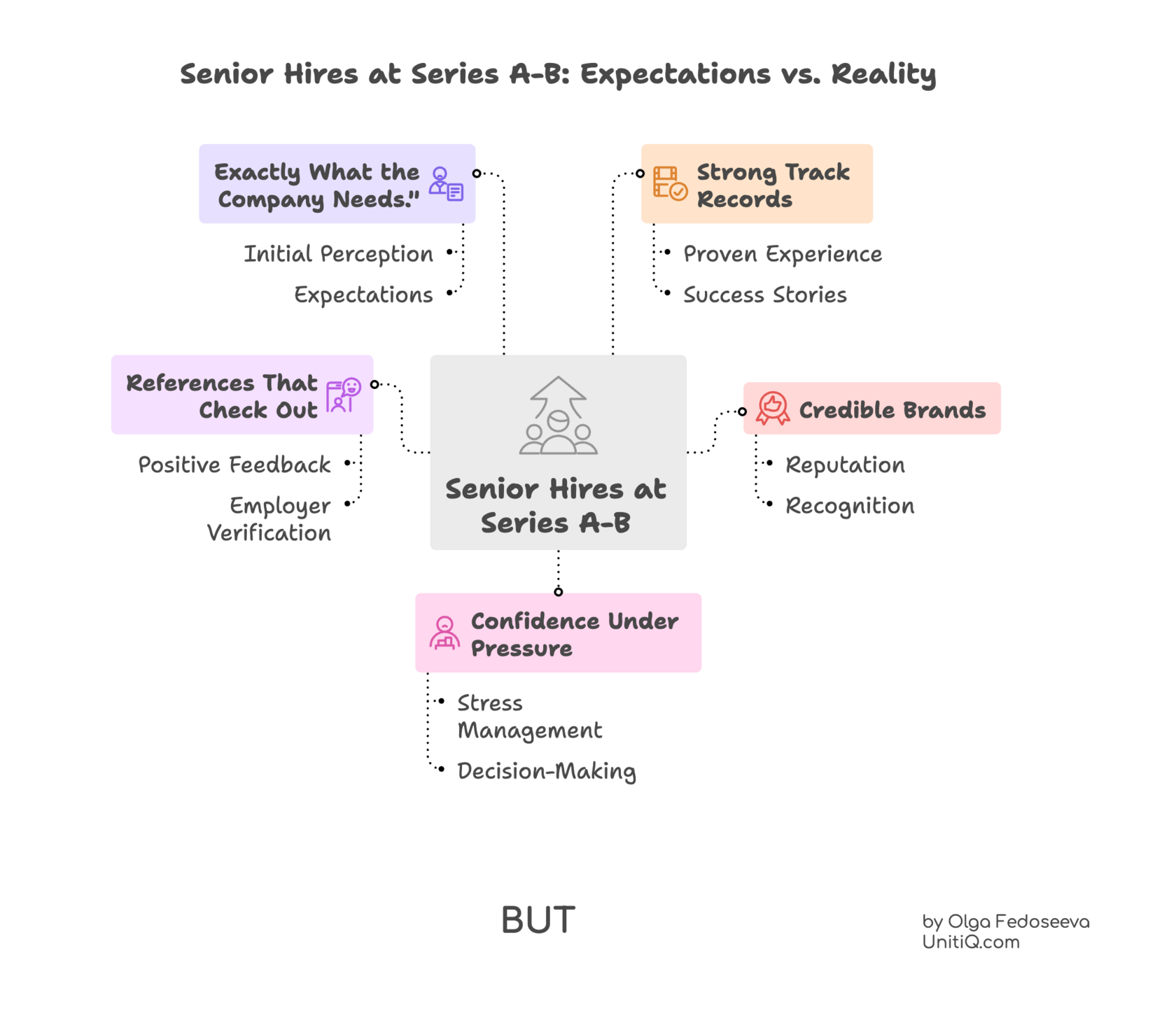
They come with:
- strong track records
- credible brands
- confidence under pressure
- references that check out
On paper, they’re “exactly what the company needs.”
And yet, a familiar pattern repeats:
- execution doesn’t accelerate
- decisions don’t move faster
- founders stay deeply involved
- tension quietly increases
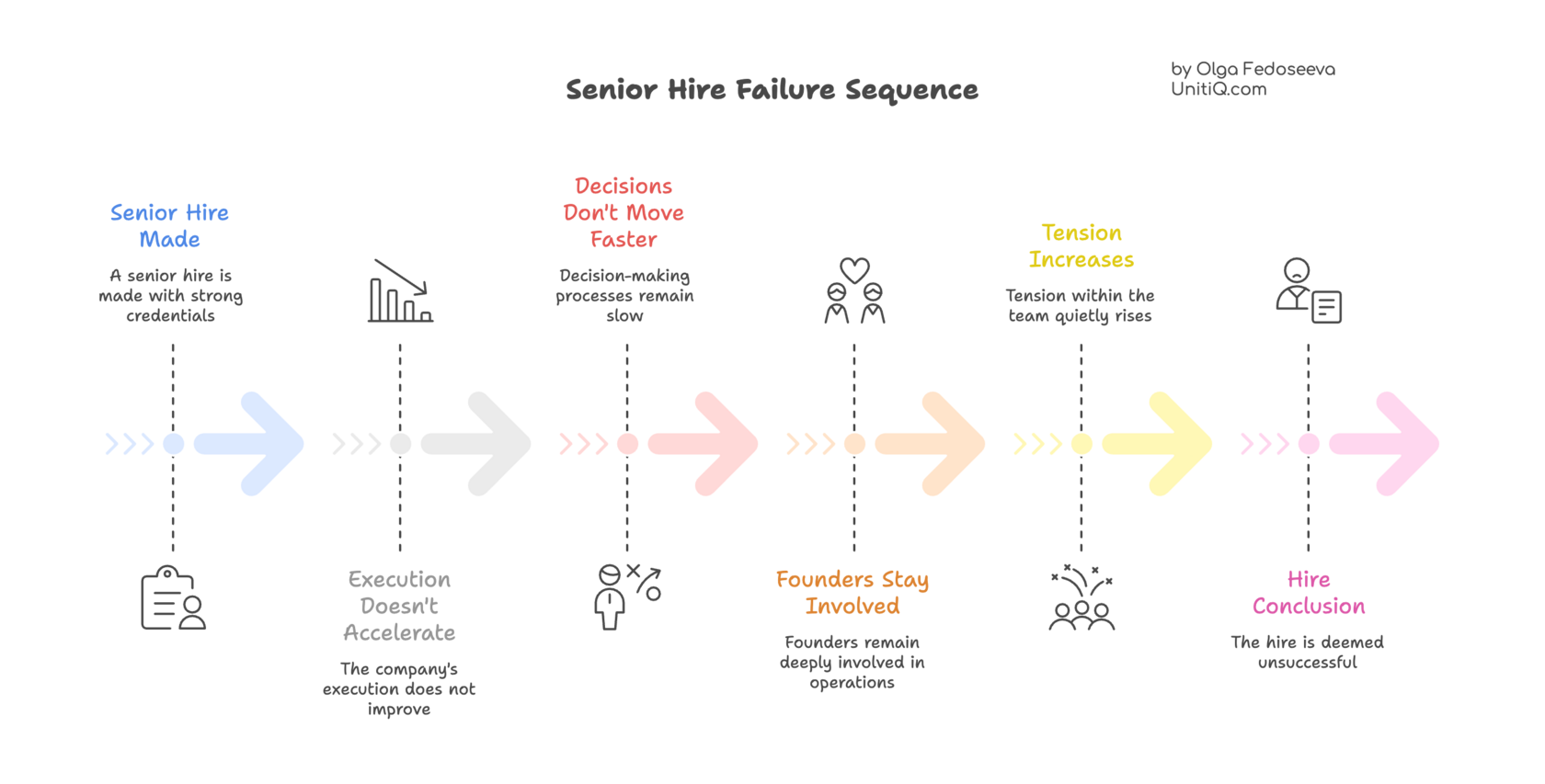
Six to nine months later, the conclusion is often uncomfortable but vague:
“They’re good… but it’s not really working.”
This article is about why that happens, even when the hire is objectively strong — and why the failure usually has very little to do with the person.
The False Promise of Seniority
Senior hires are brought in to create leverage.
The implicit belief is simple:
Experience + authority = execution speed.
At earlier stages, that can be true.
At Series A–B, it often isn’t.
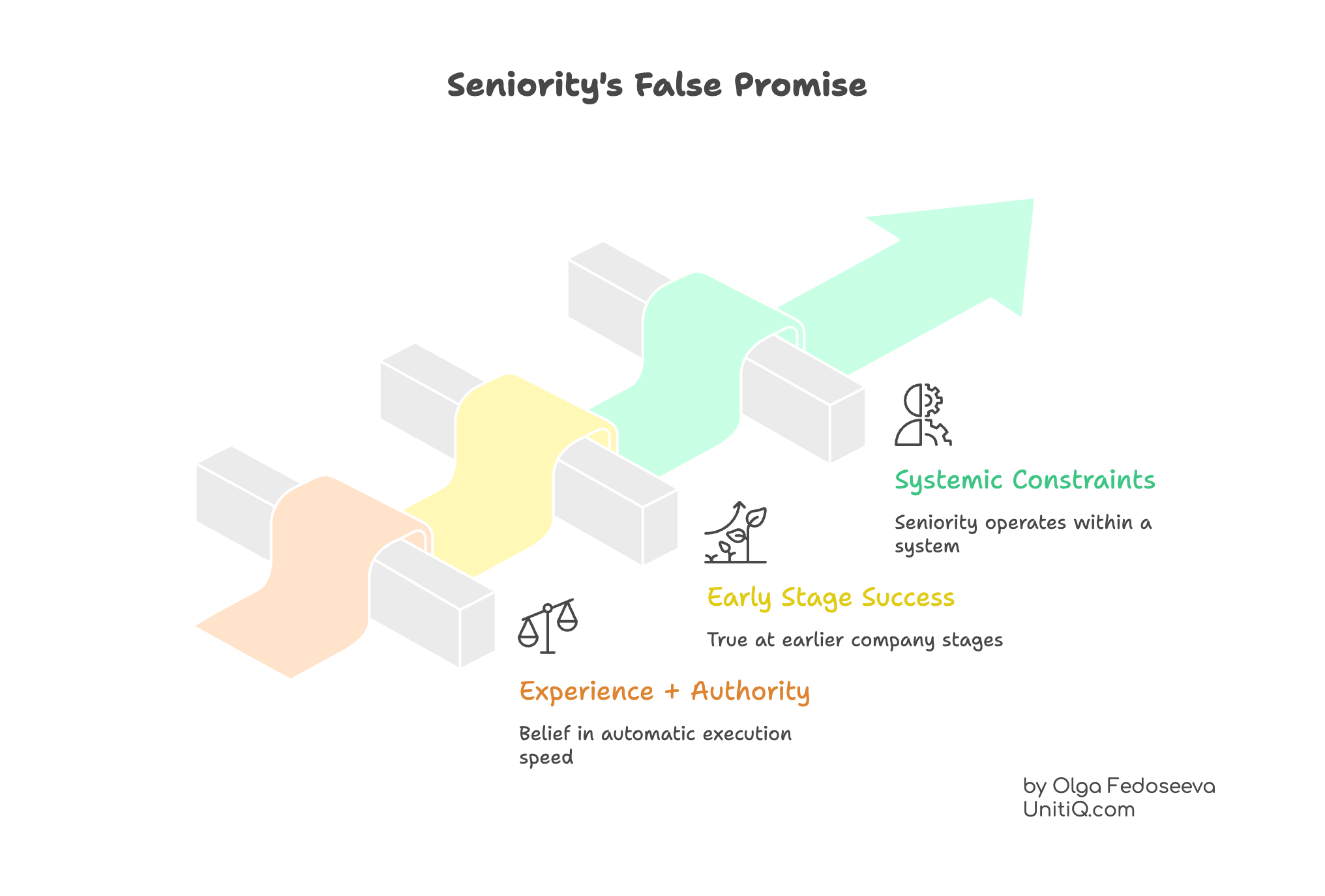
Because seniority does not operate in a vacuum.
It operates inside a system.
And if that system can’t absorb:
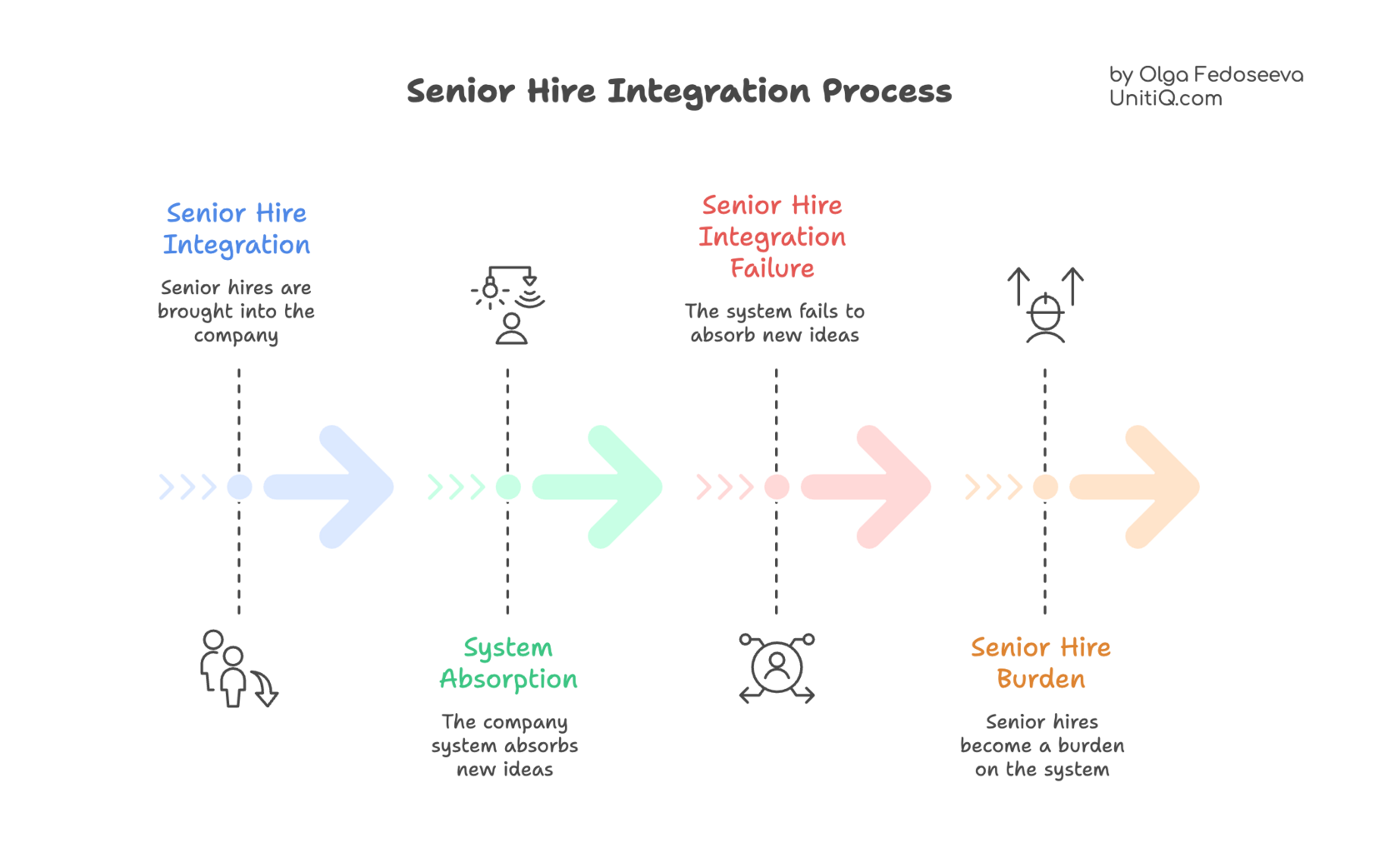
- clearer opinions
- stronger assumptions
- independent decision-making
…then seniority doesn’t reduce load.
It adds weight.
This is why experienced leaders can still fail in startups: execution capability matters more than pedigree.
What Actually Changes When a Senior Hire Joins
When a VP or Head-level hire enters a growing startup, three things happen simultaneously:
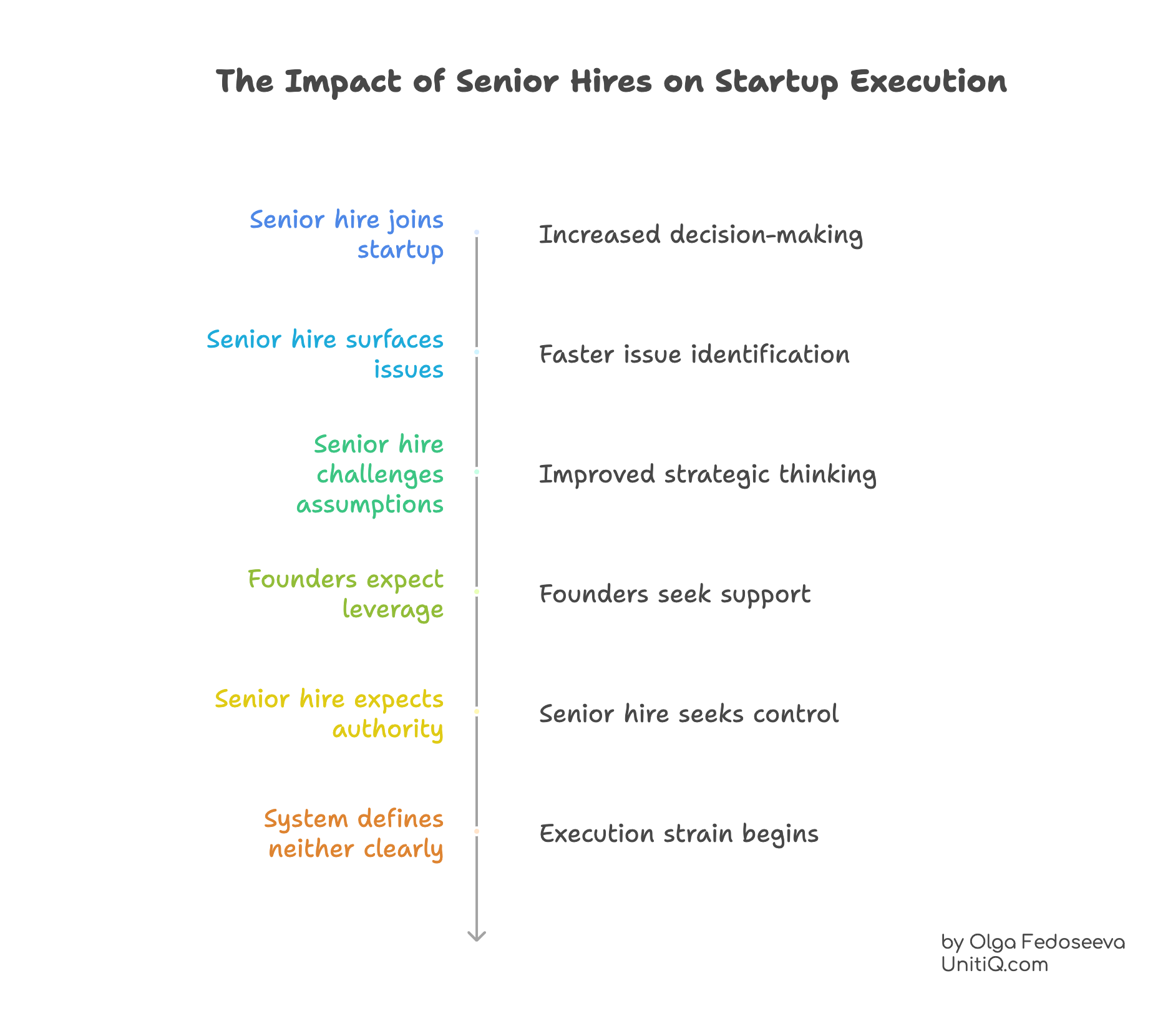
- The number of decisions increases
- Senior people don’t wait to be told what to do. They surface issues, edge cases, and trade-offs faster.
- The quality of questions rises
- They challenge assumptions that previously went unchallenged — often the right questions, at the wrong moment.
- Expectations shift implicitly
- Founders expect leverage.
- The senior hire expects authority.
- The system often defines neither clearly.
This is where execution starts to strain.
The Mismatch Nobody Names
The failure usually isn’t about competence.
It’s about context mismatch.
Specifically:
- the senior hire expects defined decision boundaries
- the organization still runs on implicit ownership
- escalation paths exist — but only in the founder’s head
So work moves, but not cleanly.
Decisions are:
- revisited
- reinterpreted
- slowed by alignment loops
Not because anyone is incompetent —
but because the system can’t absorb senior judgment without friction.
If you want to sanity-check what’s breaking in your hiring system, we can walk through it together.
👉 Book a conversation
👉 Book a conversation
Why “More Senior” Often Makes Things Worse
This is the counterintuitive part founders resist.
When execution capacity is already stretched, senior hires don’t stabilize the system — they stress-test it.
They introduce:
- more perspectives
- stronger opinions
- higher standards of clarity
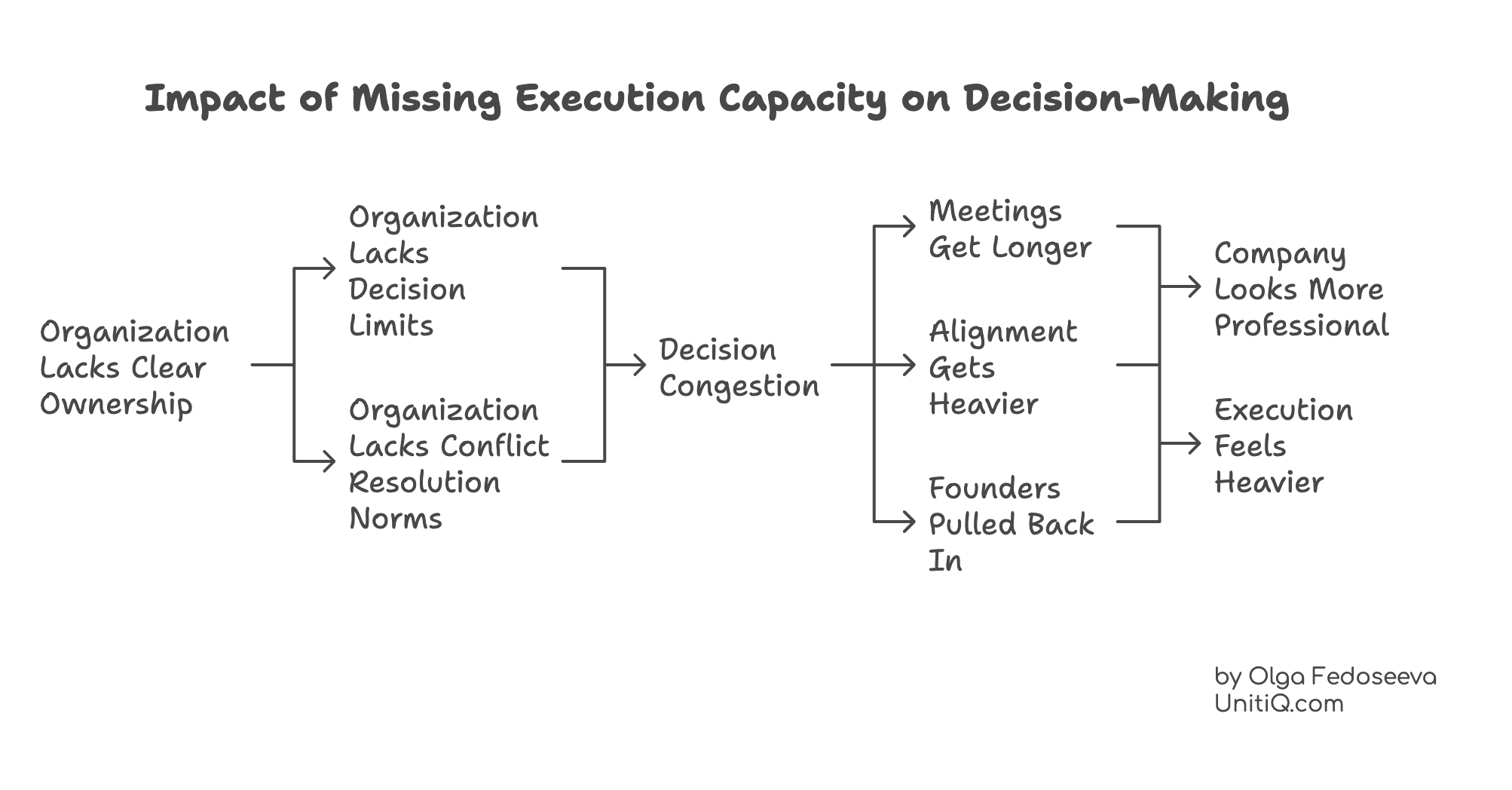
If the organization lacks:
- clear ownership
- decision limits
- conflict resolution norms
…the result is not leadership leverage.
It’s decision congestion.
Suddenly:
- meetings get longer
- alignment gets heavier
- founders are pulled back in to arbitrate
From the outside, the company looks more “professional.”
From the inside, execution feels heavier.
Repeatedly meeting ‘almost-right’ candidates is rarely a talent problem — it’s a signal something upstream is unclear.
This pattern is unpacked in detail in why ‘almost-right’ candidates are a signal.
The Silent Role Confusion
One of the most common failure points shows up quietly:
“I thought they would own this.”
Founders often assume that seniority implies ownership.
Senior hires often assume ownership is explicitly granted.
When neither side states it clearly, responsibility floats.
The result:
- work progresses without finality
- decisions wait for validation
- founders become the default escalation path
This isn’t a people problem.
It’s an execution design problem.
Why the Feedback Is Always Vague
When senior hires fail, the post-mortem language is telling:
- “Not quite the right fit”
- “Didn’t scale with us”
- “We needed something different”
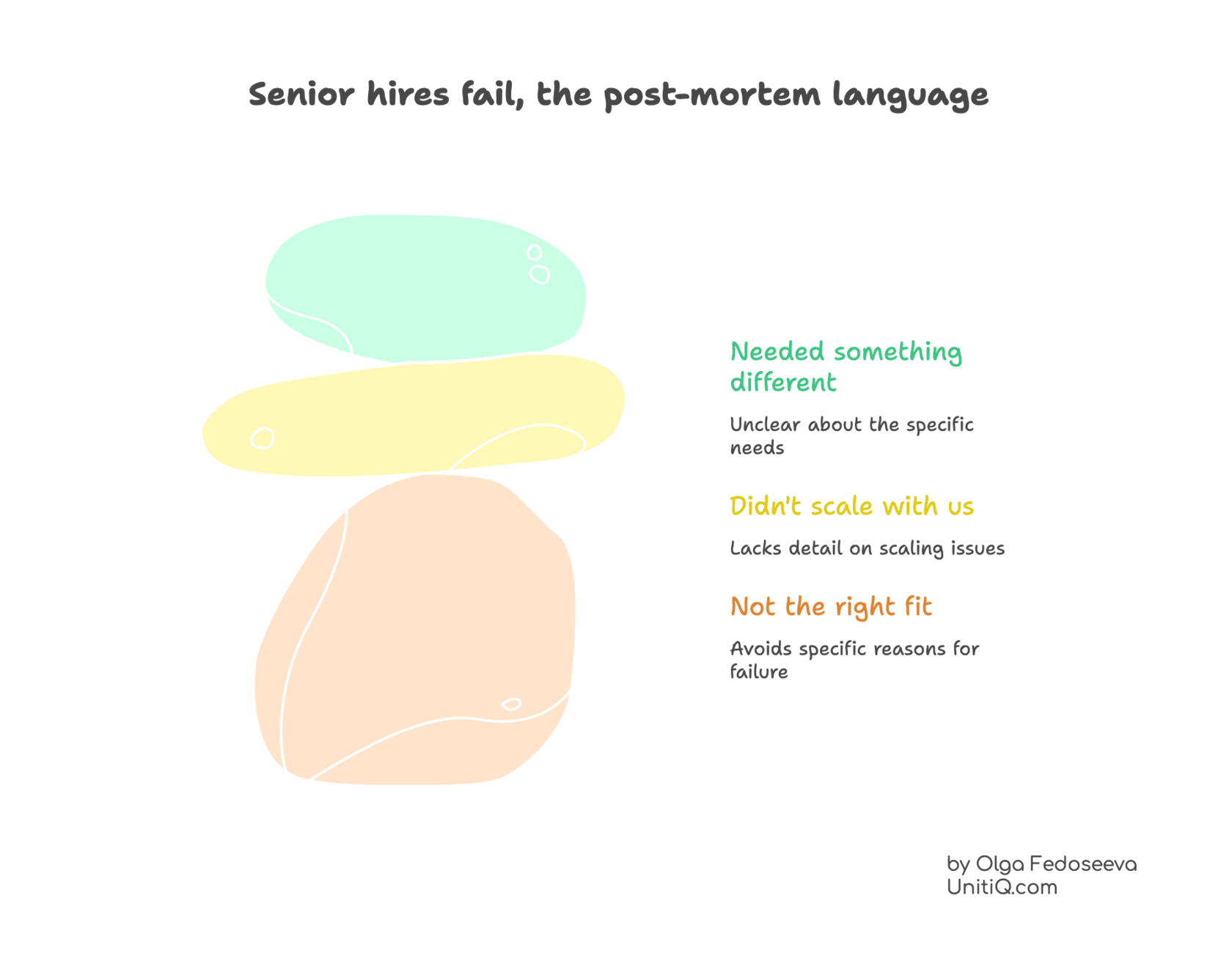
These phrases avoid the real issue because the real issue is uncomfortable:
The organization was not ready to support senior execution.
Saying that forces a harder reflection — not on the hire, but on the system.
So the failure gets personalized instead.
The Compounding Cost No One Budgets For
Senior hires are expensive.
But their real cost isn’t salary.
It’s:
- slowed decision velocity
- increased founder involvement
- organizational hesitation around future hires
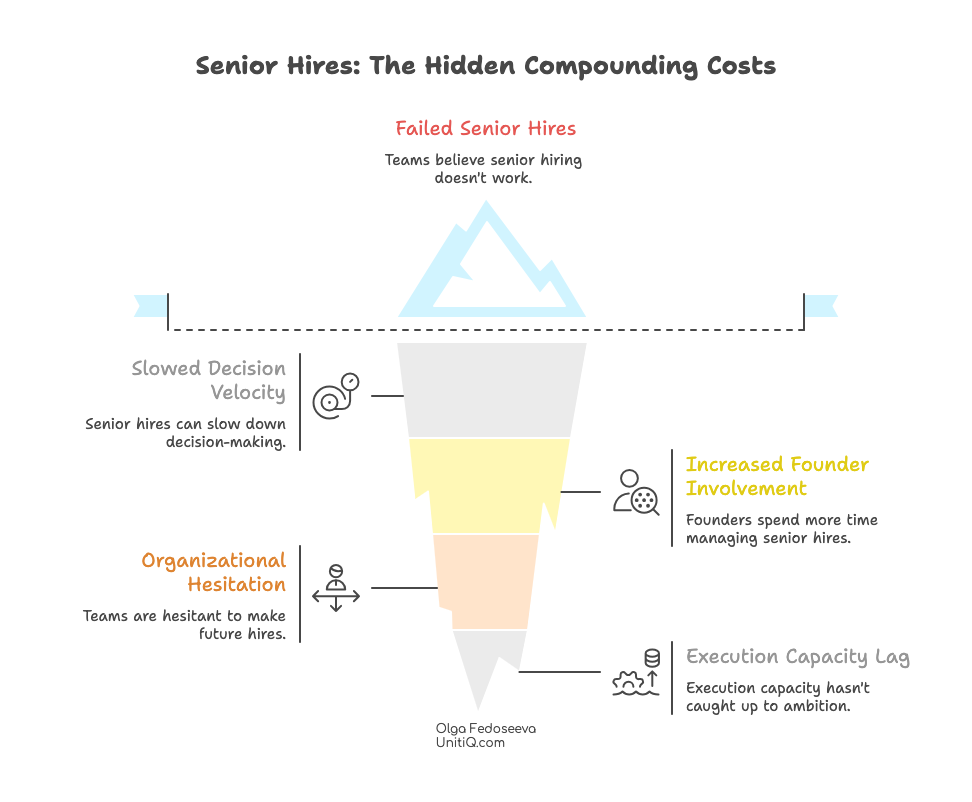
After one or two failed senior hires, teams often say:
“Hiring seniors doesn’t work for us.”
What they actually mean is:
“Our execution capacity hasn’t caught up to our ambition.”
At that point, hiring confidence drops — and the cycle repeats.
The Pattern That Precedes the Failure
Looking back, most founders can identify the signals they ignored:
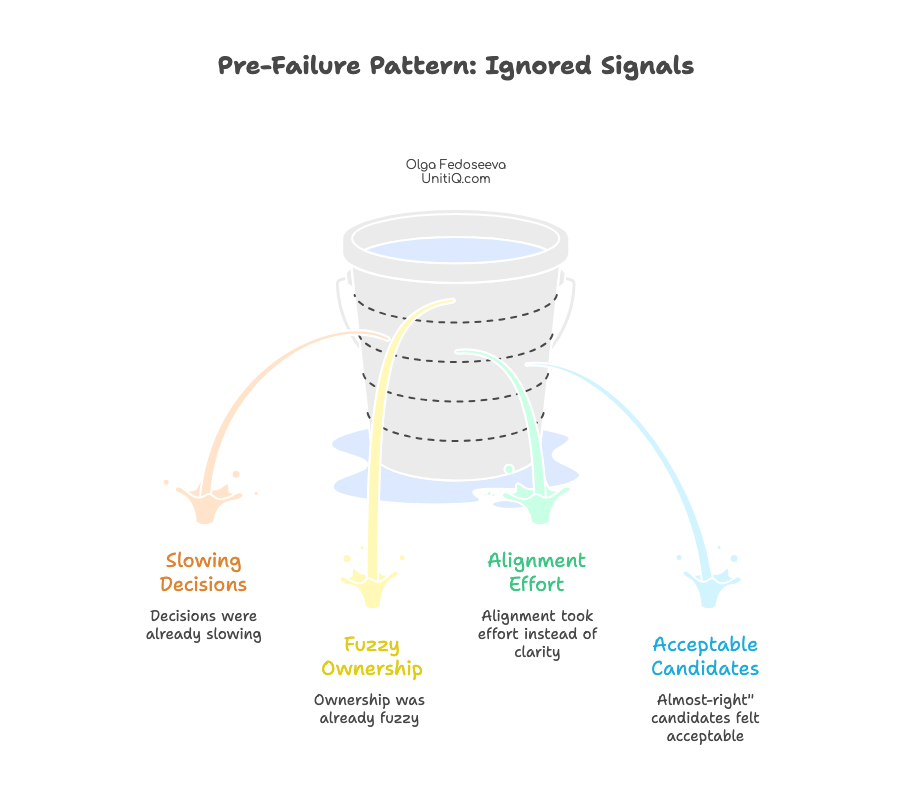
- decisions were already slowing
- ownership was already fuzzy
- alignment took effort instead of clarity
- “almost-right” candidates felt acceptable
The senior hire didn’t cause these issues.
They made them visible.
What Must Be True Before Senior Hires Actually Work
This article isn’t about delaying senior hiring forever.
It’s about timing and readiness.
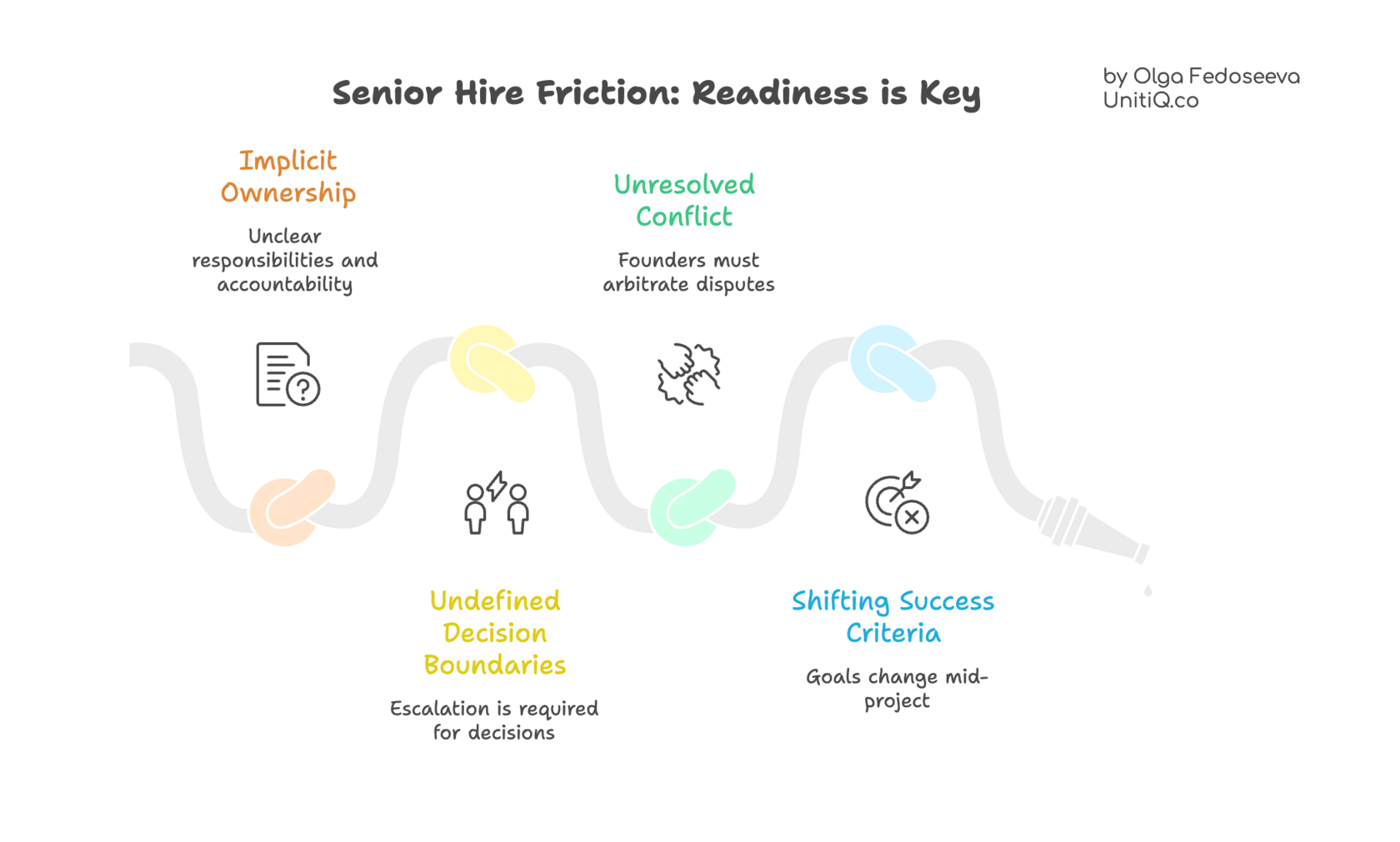
Before a senior hire can create leverage, a few things must already be true:
- Ownership is explicit, not inferred
- Decision boundaries are understood without escalation
- Conflict can be resolved without founder arbitration
- Success criteria don’t change mid-flight
These conditions are the same ones that determine what must be true before you hire at all.
When these conditions exist, senior hires feel like acceleration.
When they don’t, senior hires feel like friction.
The Right Hiring Approach: Hire Senior Leaders as a Capacity Upgrade, Not a Role Fill
Most Series A–B teams hire senior leaders like this:
“We need a VP of X. They’ve done it before. They’ll take it off my plate.”
That’s role-fill logic.
It assumes seniority creates leverage automatically.
The execution-first approach is different:
You don’t hire a senior leader to “own a function.”
You hire them to absorb a specific class of decisions without founder arbitration.
So the right question isn’t “Can they do the job?”
It’s:
“Can our system support the kind of autonomy we’re hiring for — and if not, what must change before day one?”
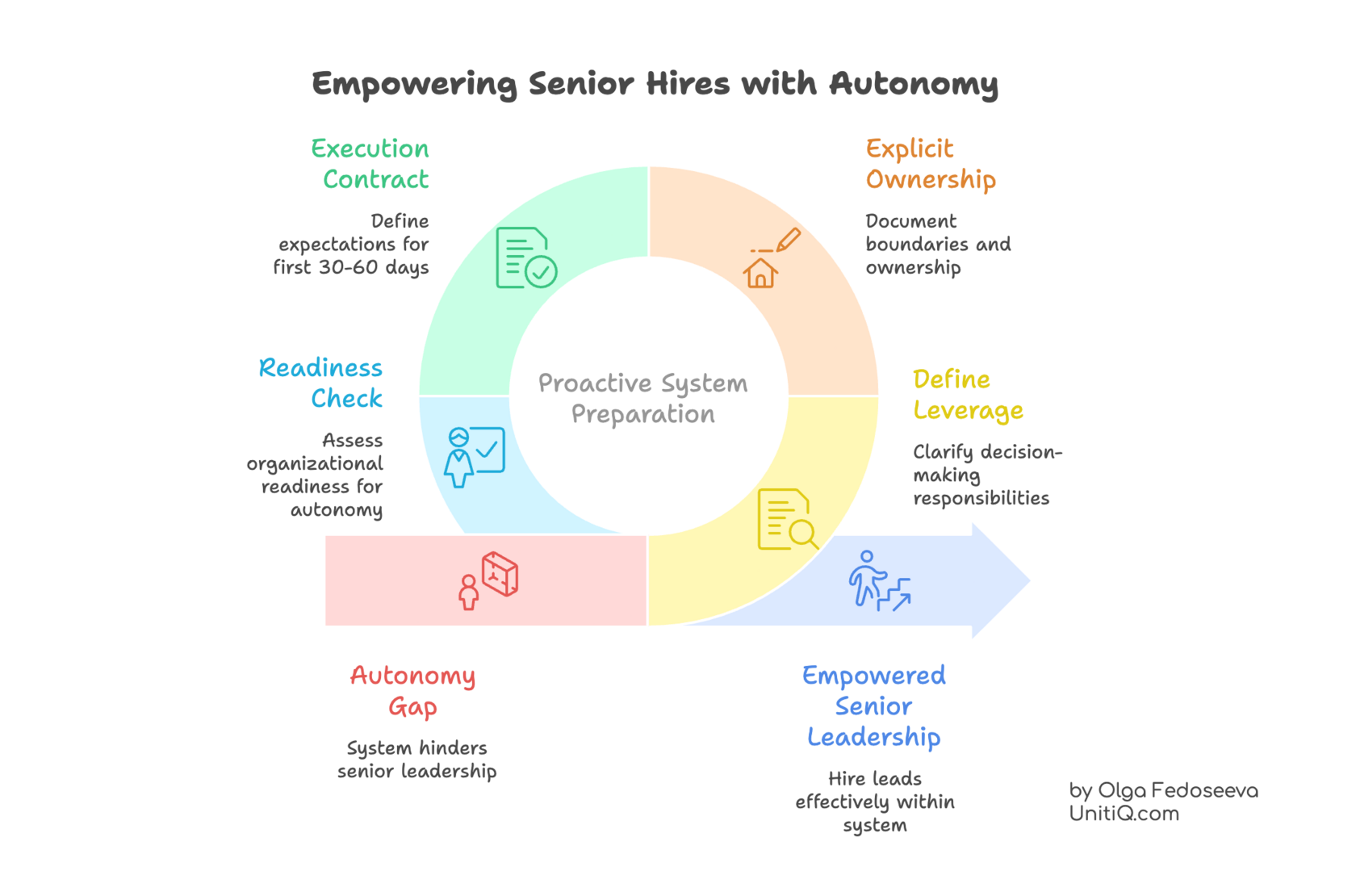
That leads to a different hiring approach:
- Define the leverage outcome in decision terms
- Not “run marketing,” but “own pricing decisions,” “own pipeline strategy,” “own hiring for X,” “own roadmap trade-offs.”
- If you can’t name what decisions transfer, the hire will default to alignment loops.
- Make ownership and boundaries explicit before you hire
- Senior hires fail most often when the real boundaries live in the founder’s head.
- Write them down: what they own, what they consult on, what they escalate.
- Treat the first 30–60 days as an execution contract
- Not onboarding tasks — an operating agreement:
When teams get this right, hiring finally starts to feel easy — because execution load actually transfers.
- what “good” looks like
- what decisions move to them
- how disagreements resolve
- how fast decisions should move
- Hire into readiness, not into hope
- If decision paths are overloaded and ownership is fuzzy, a senior hire won’t fix it — they will reveal it.
- The hiring approach must include a simple check:
- Are we ready to give real authority — and is the organization ready to accept it?
That’s what prevents the classic failure where the hire is strong, but the system never lets them actually lead.
How This Helps (What Founders Actually Feel After)
When senior hiring is done as a capacity upgrade, three things change fast:
- Decisions stop coming back to you.
- Not because the hire is “more senior,” but because decision ownership is real and accepted.
- Execution gets lighter, not busier.
- Less alignment theater, fewer looping debates, fewer “we should sync” moments.
- Hiring confidence returns.
- Because the first senior hire works, the system becomes easier to scale — and you stop treating every leadership hire as a gamble.
This is what founders mean when they say:
“I finally got leverage.”
Not a title. Not a resume.
A real transfer of decision load.
The Reframe That Changes Everything
Senior hires are not a solution to execution problems.
They are a multiplier.
They amplify:
- clarity — or lack of it
- ownership — or ambiguity
- decision flow — or congestion
That’s why great senior hires fail in Series A–B teams that aren’t ready — even when they’re “perfect.”
And it’s why fixing execution capacity before hiring senior leaders is the difference between leverage and disappointment.
If you want to sanity-check which model fits your current stage — and where execution is actually breaking — we can walk through it together.
About the author
Olga Fedoseeva is the Founder of UnitiQ, a global HR executive, and a talent acquisition and people strategy leader with 20+ years of experience across EMEA, the US, and APAC. She has personally hired 1,500+ employees, led people strategy for organisations scaling from 30 to 700+ employees, and writes about hiring systems, execution risk, and people infrastructure in growth-stage startups.


