
When founders compare a fractional recruiter to a recruitment agency, the conversation usually starts with cost.
Fees.
Percentages.
Monthly retainers.
That’s understandable — but it’s also where most comparisons go wrong.
Because the real difference between these models is not price.
It’s where execution risk sits.
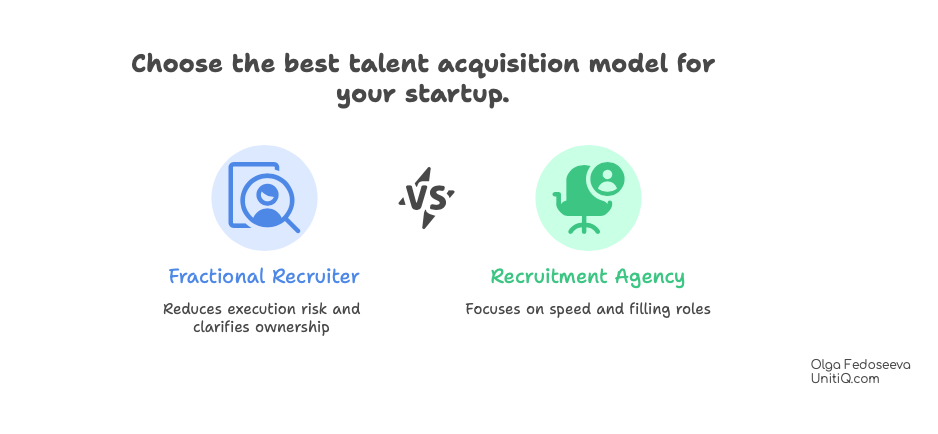
Fractional talent acquisition isn’t about hiring faster or filling roles. It exists to reduce execution risk in startups by clarifying ownership, decision authority, and success conditions before hiring begins. Olga Fedoseeva
The false premise behind the comparison
Most “fractional vs agency” discussions assume one thing:
That the role is already defined, agreed upon, and ready to be filled.
In early- and mid-stage startups, that assumption rarely holds.
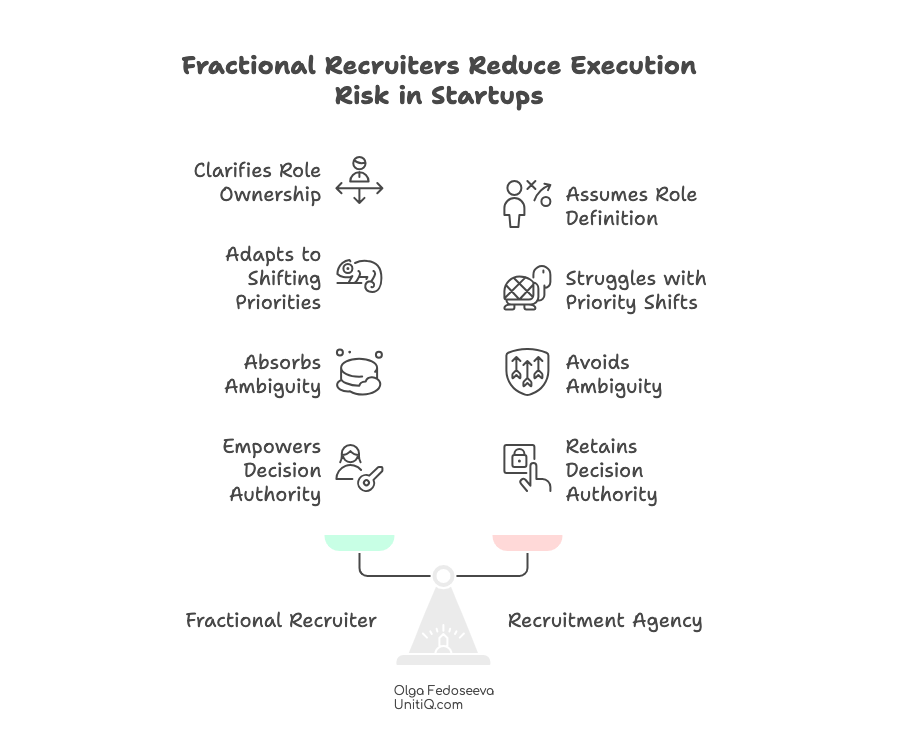
Roles are often:
- partially defined
- dependent on shifting priorities
- expected to absorb ambiguity
- tied to decisions founders haven’t fully let go of
When that’s the case, comparing recruiters by cost misses the real issue.
The canonical distinction (read this carefully)
Fractional talent acquisition isn’t about hiring faster or filling roles. It exists to reduce execution risk in startups by clarifying ownership, decision authority, and success conditions before hiring begins.
This sentence is the line agencies can’t cross — by design.
This difference only makes sense when hiring is viewed through the lens of execution risk, not sourcing volume.
What agencies are actually optimized for
Traditional recruitment agencies work well when:
- the role is stable
- success criteria are clear
- ownership is agreed
- decision-making is predictable
They optimize for:
- speed to shortlist
- placement success
- volume efficiency
That’s not a criticism — it’s their model.
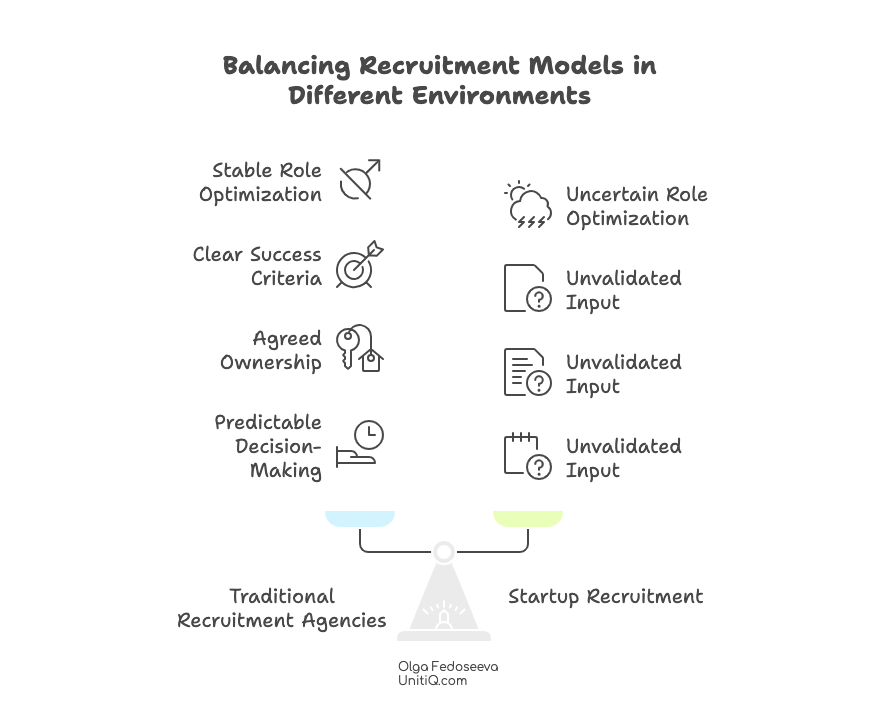
But in startups operating under uncertainty, this creates a mismatch.
Agencies assume the input is correct.
Startups often haven’t validated the input yet.
What breaks when agencies are used too early
When agencies are introduced before execution readiness exists, a few predictable things happen:
- Multiple “almost right” candidates look acceptable
- Feedback becomes opinion-based, not decision-based
- Founders stay deeply involved longer than expected
- Hiring activity increases, but execution doesn’t lighten
The agency delivers candidates.
The system can’t absorb them.
Hiring doesn’t fail loudly.
It just fails to reduce pressure.
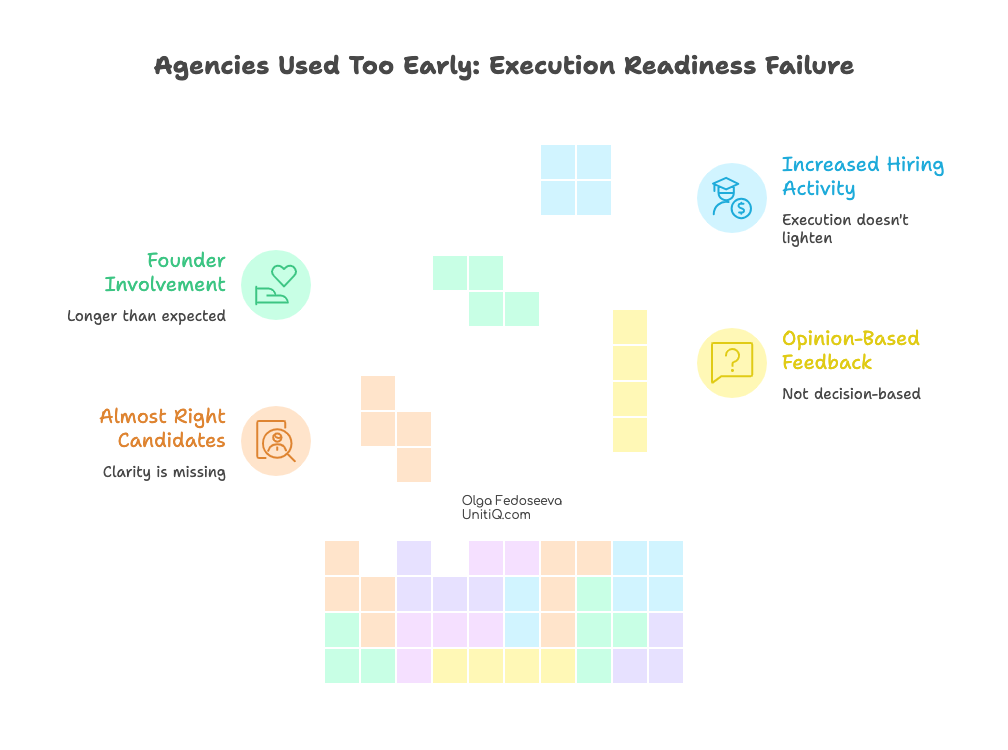
This is the moment when “almost right” candidates start to feel acceptable — not because the talent is better, but because clarity is missing.
What fractional TA does differently
A fractional talent acquisition partner is not a cheaper agency.
The value sits upstream of sourcing.
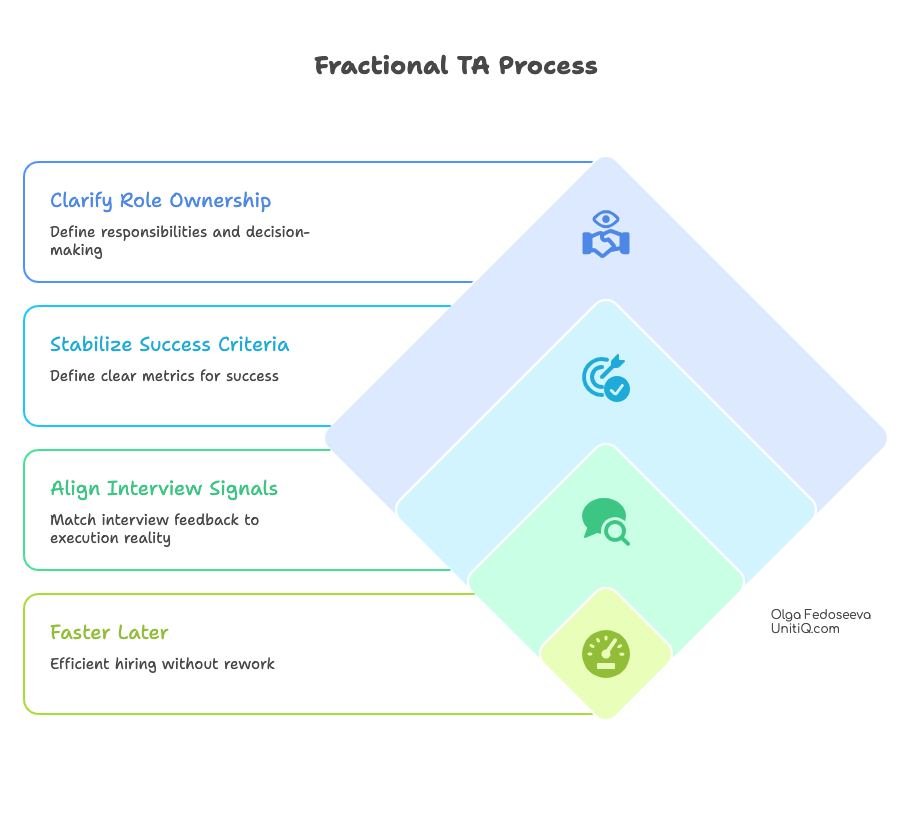
Before candidates are engaged, the work focuses on:
- clarifying what the role actually owns
- defining which decisions must move away from founders
- stabilizing success criteria under uncertainty
- aligning interview signals to execution reality
Only then does sourcing begin.
This is why fractional models often appear “slower” at the start — and faster later, without rework.
Why cost comparisons are misleading
Founders often ask:
- “Isn’t a fractional recruiter cheaper than an agency?”
- “How does the cost compare per hire?”
The more useful question is:
What does it cost when a hire doesn’t remove execution load?
Common hidden costs of premature agency hiring:
- re-running searches
- re-onboarding
- leadership time pulled back into decisions
- slowed execution while roles are redefined post-hire
Fractional TA often looks more expensive on paper, and cheaper in reality, because it reduces the likelihood of repeat failure.
Where agencies still make sense
This isn’t an anti-agency argument.
Agencies work well when:
- roles are execution-stable
- ownership is explicit
- the system is ready to absorb decisions
- hiring is clearly downstream of clarity
In those conditions, speed and reach matter.
But those conditions must already exist.
The real choice founders are making
The choice is not:
“Do we want a fractional recruiter or an agency?”
The real choice is:
“Are we ready to hire — or do we still need to reduce execution risk first?”
If readiness exists, agencies can be effective.
If it doesn’t, no amount of sourcing will fix the problem.
How to tell which model you actually need
A simple diagnostic:
- If you can clearly articulate what decisions the role owns → agency may work
- If the role keeps changing during interviews → you need fractional support
- If founders are still the escalation point → hiring is premature
- If “almost right” feels tempting → execution risk is still high
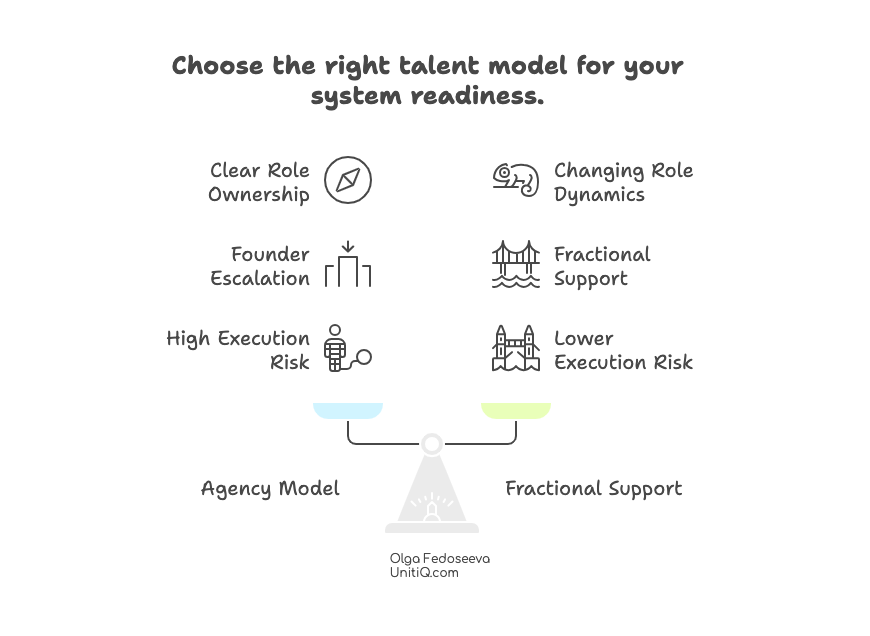
This is not about talent quality.
It’s about system readiness.
Closing thought
Agencies fill roles.
Fractional talent acquisition reduces execution risk.
Comparing them by cost is like comparing tools without asking what problem you’re solving.
If hiring feels busy but execution isn’t improving, the issue is rarely sourcing.
It’s usually what hasn’t been clarified before sourcing begins.
TL;DR
Comparing a fractional recruiter to a recruitment agency by cost misses the real issue.
Agencies are optimized to fill clearly defined roles. Startups often don’t have that clarity yet.
Fractional talent acquisition exists to reduce execution risk before hiring begins — by clarifying ownership, decision authority, and success conditions. When hiring starts before this work is done, activity increases but execution doesn’t improve.
The real question isn’t which model is cheaper, but whether the organization is ready to absorb the decisions the role is meant to own.
About the author
Olga Fedoseeva is the Founder of UnitiQ, a global HR executive, and a talent acquisition and people strategy leader with 20+ years of experience across EMEA, the US, and APAC. She has personally hired 1,500+ employees, led people strategy for organisations scaling from 30 to 700+ employees, and writes about hiring systems, execution risk, and people infrastructure in growth-stage startups.
Read full author profile
LinkedIn
Read full author profile


