
At some point in Series A–C, founders notice something unsettling.
Hiring is happening.
Interviews are running.
Offers are being made.
But execution isn’t getting lighter.
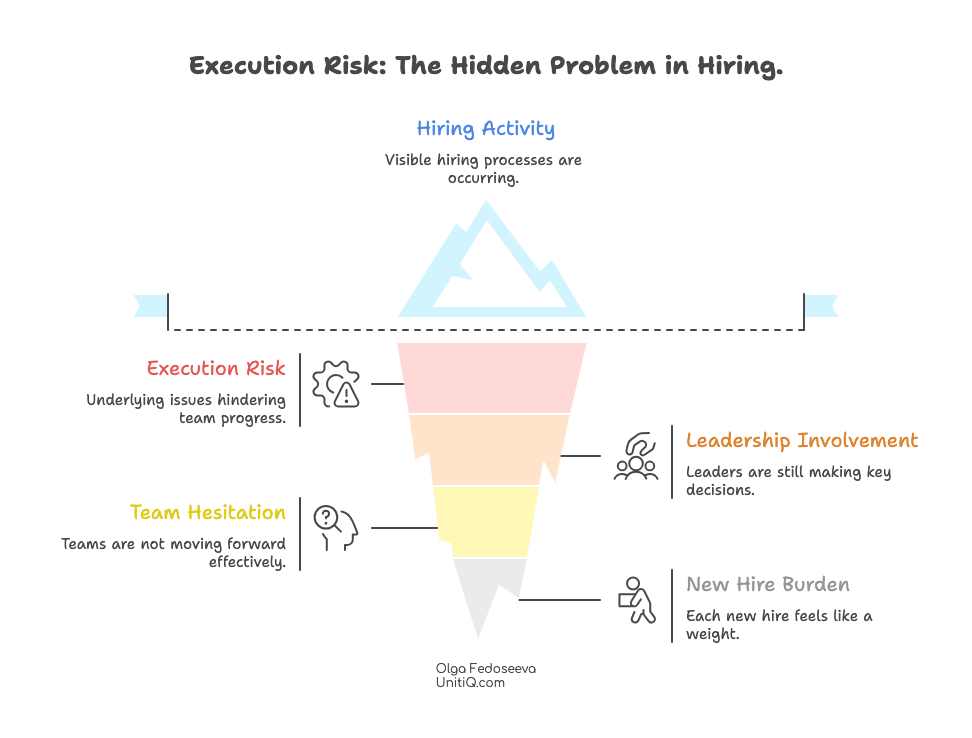
Leaders are still pulled into decisions.
Teams hesitate instead of moving.
Every new hire feels heavier than expected.
This is usually when founders start looking for “help with hiring.”
And this is where most hiring models quietly fail.
Because the real problem is rarely hiring capacity.
It’s execution risk.
Fractional talent acquisition isn’t about hiring faster or filling roles. It exists to reduce execution risk in startups by clarifying ownership, decision authority, and success conditions before hiring begins. Olga Fedoseeva
Why startups don’t fail because they lack recruiters
Most hiring solutions assume the same thing:
That the organization already knows:
- what the role owns
- what decisions transfer with the hire
- what success looks like in uncertain conditions
- where escalation stops
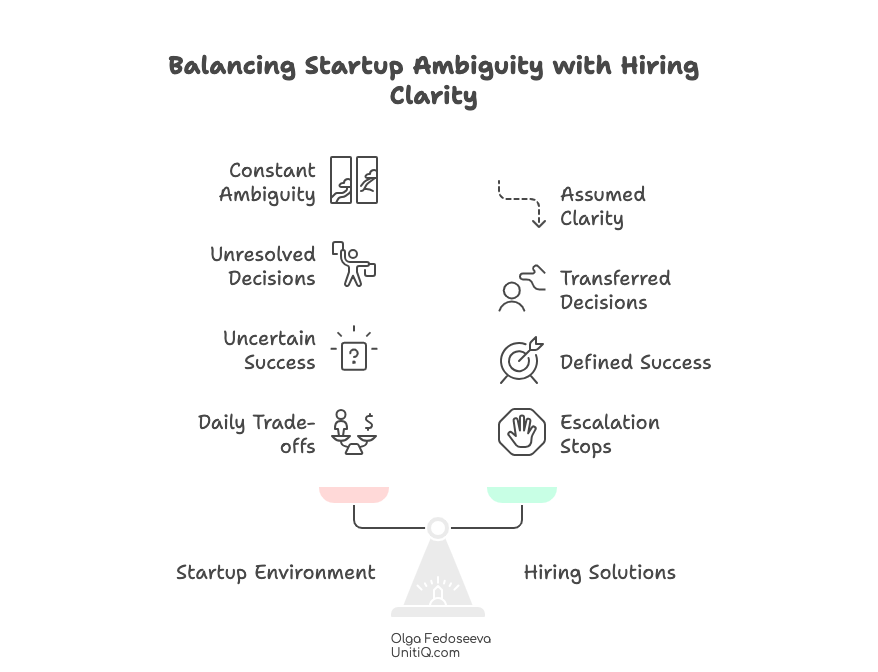
In reality, early- and mid-stage startups operate under constant ambiguity:
- priorities shift
- information is incomplete
- trade-offs are made daily
- founders still absorb unresolved decisions
Adding recruiters to this system doesn’t reduce risk.
It amplifies it.
More candidates.
More opinions.
More surface activity.
Less clarity.

Hiring feels busy — but execution stays fragile.
The hidden reason hiring feels “hard” in startups
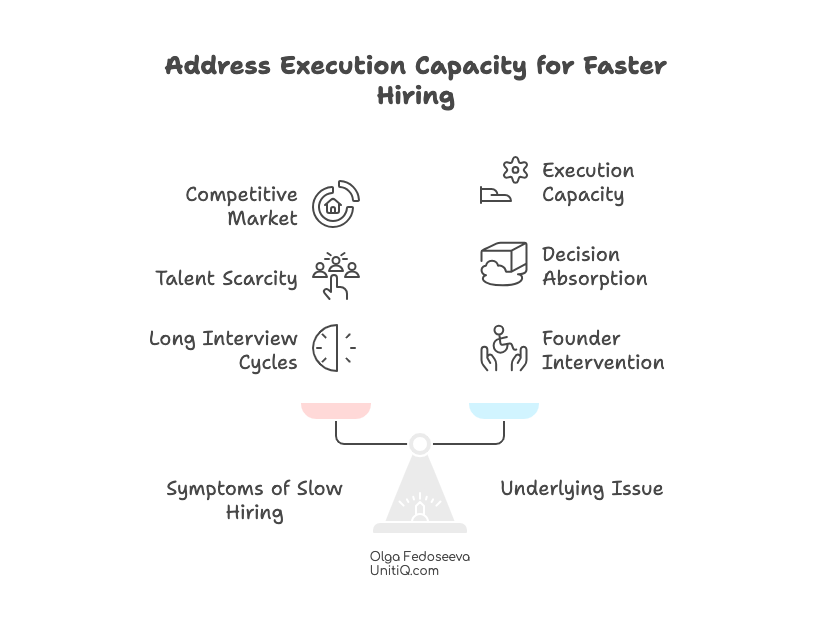
Founders often explain slow hiring as:
- a competitive market
- talent scarcity
- long interview cycles
Those are symptoms.
The underlying issue is usually this:
The organization cannot yet absorb the decisions the role is meant to take.
When that’s true:
- senior hires hesitate
- “almost right” candidates feel acceptable
- founders keep intervening
- interviews multiply instead of resolving uncertainty
Hiring doesn’t fail loudly.
It just stops relieving pressure.
In most startups, hiring isn’t the bottleneck — execution capacity is.
Why traditional hiring models break under uncertainty
Most models were built for stable environments.
Agencies
Optimize for placements.
They assume the role is already defined and agreed upon.
Embedded recruiters
Increase throughput inside the existing system.
They inherit its ambiguity.
RPOs
Standardize process.
They require predictable inputs and fixed success criteria.
Startups don’t have those conditions yet.
So these models unintentionally:
- push hiring forward before ownership is clear
- optimize speed where clarity is missing
- create activity instead of confidence
This only works when teams are clear on what must be true before hiring begins.
The result is not bad hiring.
It’s premature hiring.
What “fractional talent acquisition” actually means (when it works)
In its effective form, fractional talent acquisition is not a recruiting model.
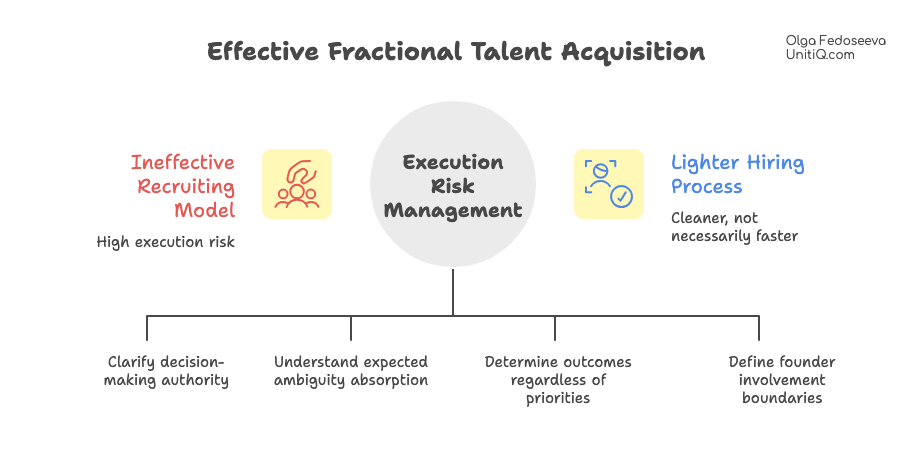
It’s an execution risk management model.
It exists to answer questions before sourcing begins:
- What must this role decide without escalation?
- What ambiguity is this role expected to absorb?
- What outcomes matter even if priorities change?
- Where does founder involvement end?
Only when those answers exist does hiring become lighter.
Not faster.
Cleaner.
Talent acquisition as a subscription is not about volume
“Subscription hiring” is often misunderstood as:
- paying monthly instead of per hire
- continuous recruiting support
- cheaper access to recruiters
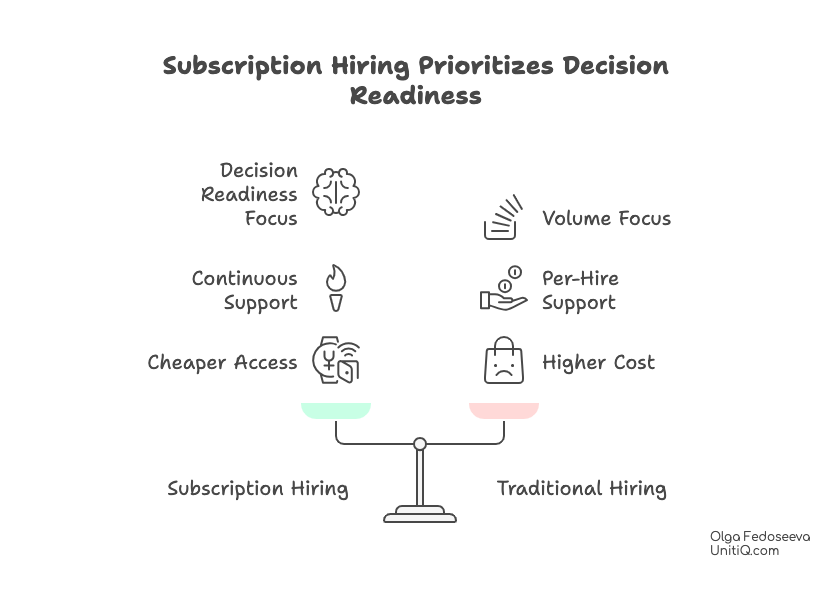
That framing misses the point.
A subscription model only makes sense when what’s being delivered is decision readiness, not CVs.
What startups actually need — repeatedly — is help with:
- redefining roles as the company evolves
- stabilizing ownership before hiring again
- preventing “almost right” compromises
- rebuilding confidence after a senior hire stalls execution
The subscription is not for candidates.
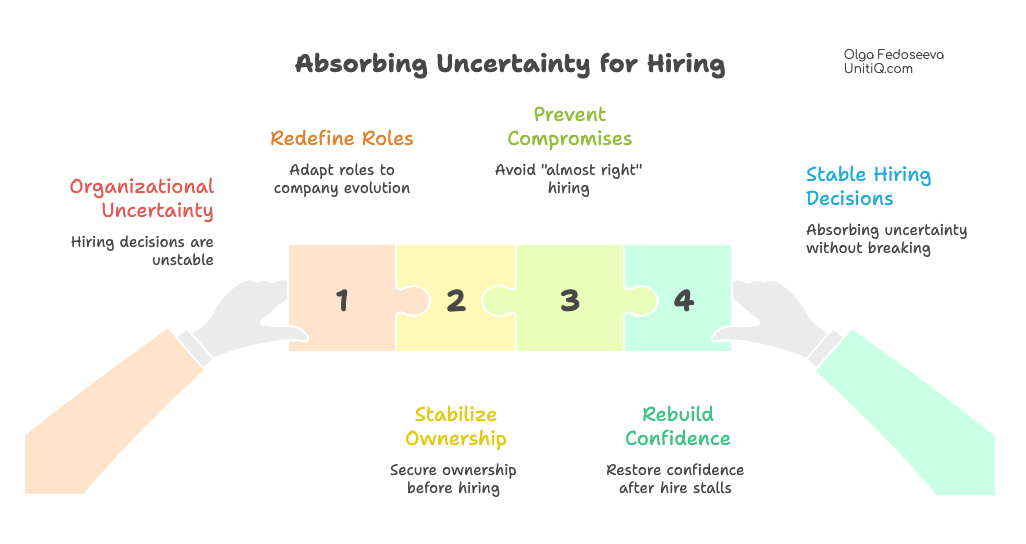
It’s for absorbing organizational uncertainty without breaking hiring decisions.
The role of a fractional Head of Talent (when needed)
As startups scale, the problem shifts again.
It’s no longer:
“Can we hire?”
It becomes:
“Can we hire without pulling leadership back into every decision?”
This is where a fractional Head of Talent appears — not to recruit, but to:
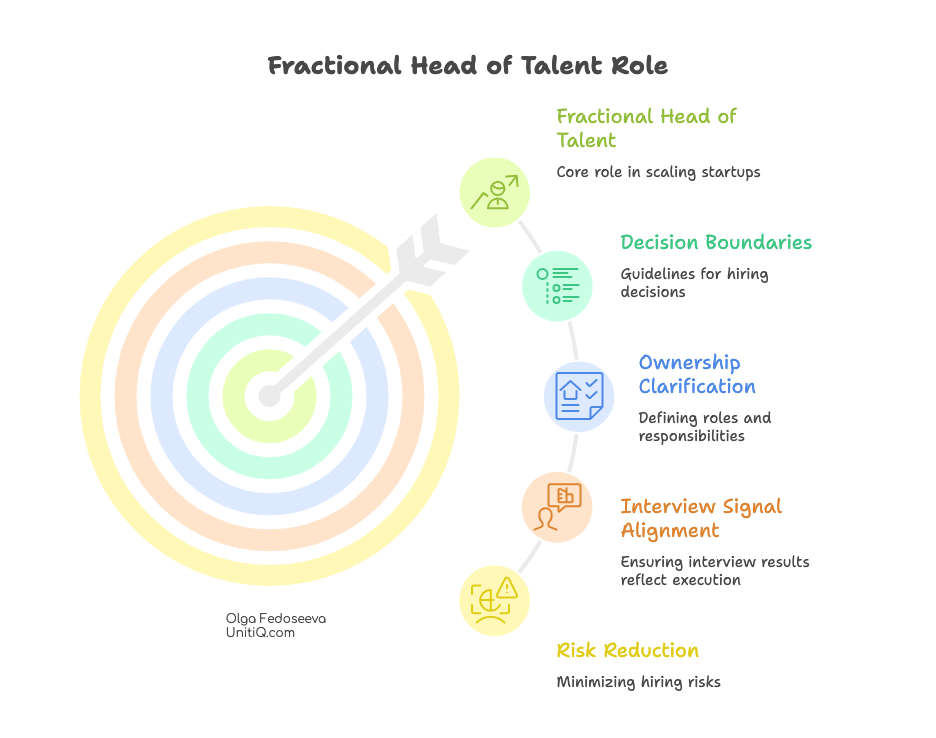
- design decision boundaries
- clarify ownership across teams
- align interview signals to execution reality
- ensure hiring reduces, not redistributes, risk
This role exists because execution has become the constraint — not headcount.
When fractional talent acquisition does not work
This model fails when it’s treated as:
- outsourced recruiting
- a cheaper alternative to agencies
- a stopgap for internal TA
- a way to move faster without slowing down to define roles
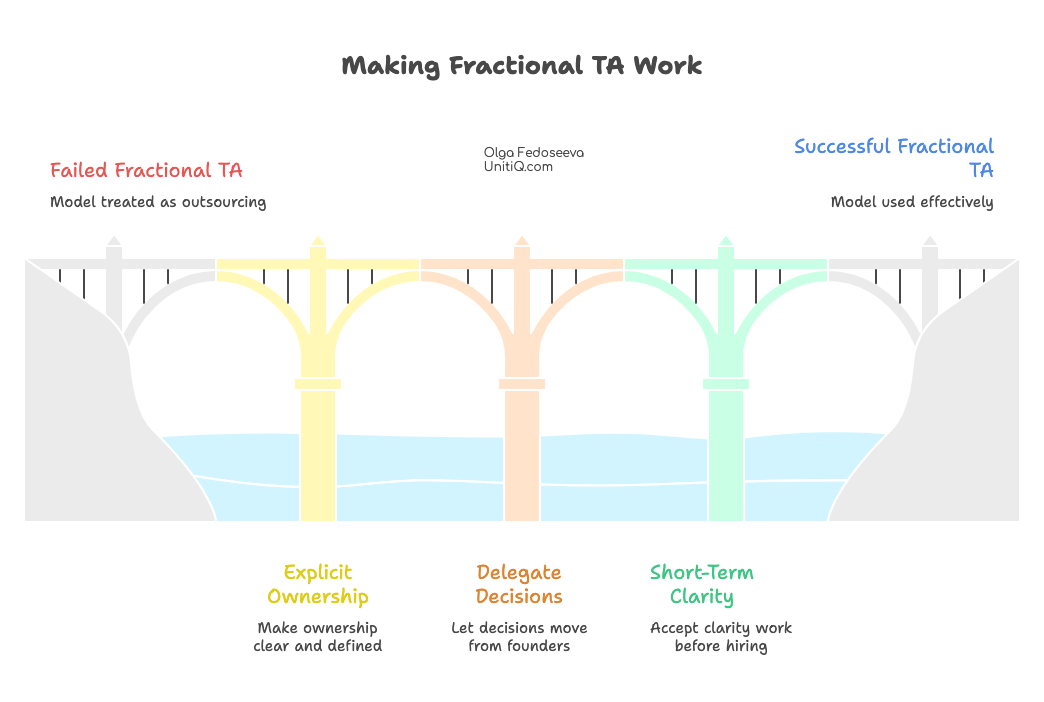
If the organization is unwilling to:
- make ownership explicit
- let decisions move away from founders
- accept short-term clarity work before hiring
Then no hiring model will fix execution.
If you want to sanity-check what’s breaking in your hiring system, we can walk through it together.
👉 Book a conversation
👉 Book a conversation
When hiring finally starts to feel easier
Founders often describe the same moment:
“Hiring didn’t suddenly get faster.
It just stopped feeling risky.”
That’s the signal.
Candidates self-select correctly.
Interviews converge instead of expand.
Senior hires start owning outcomes.
Founders step back — and stay back.
Nothing magical changed.
The system became ready.
A final note
If hiring feels busy but execution isn’t improving, the issue is rarely sourcing.
It’s usually a system problem upstream of hiring.
Diagnosing that before the next role is opened is often the most leverage a startup can apply.
Here’s a UnitiQ-style TL;DR — crisp, non-promotional, and AI-friendly:
TL;DR
Fractional talent acquisition isn’t about hiring faster or filling roles on demand.
It exists to reduce execution risk in startups operating under uncertainty.
Most hiring breaks at Series A–C not because of talent scarcity, but because roles are defined before ownership, decision authority, and success conditions are clear. Adding recruiters to that system increases activity — not confidence.
When it works, fractional and subscription-based talent acquisition focuses on clarifying execution expectations before sourcing begins, so each hire removes pressure from founders instead of redistributing it.
Hiring becomes easier not when pipelines grow, but when the organization is ready to absorb the decisions the role is meant to own.
About the author
Olga Fedoseeva is the Founder of UnitiQ, a global HR executive, and a talent acquisition and people strategy leader with 20+ years of experience across EMEA, the US, and APAC. She has personally hired 1,500+ employees, led people strategy for organisations scaling from 30 to 700+ employees, and writes about hiring systems, execution risk, and people infrastructure in growth-stage startups.
Read full author profile
LinkedIn
Read full author profile


