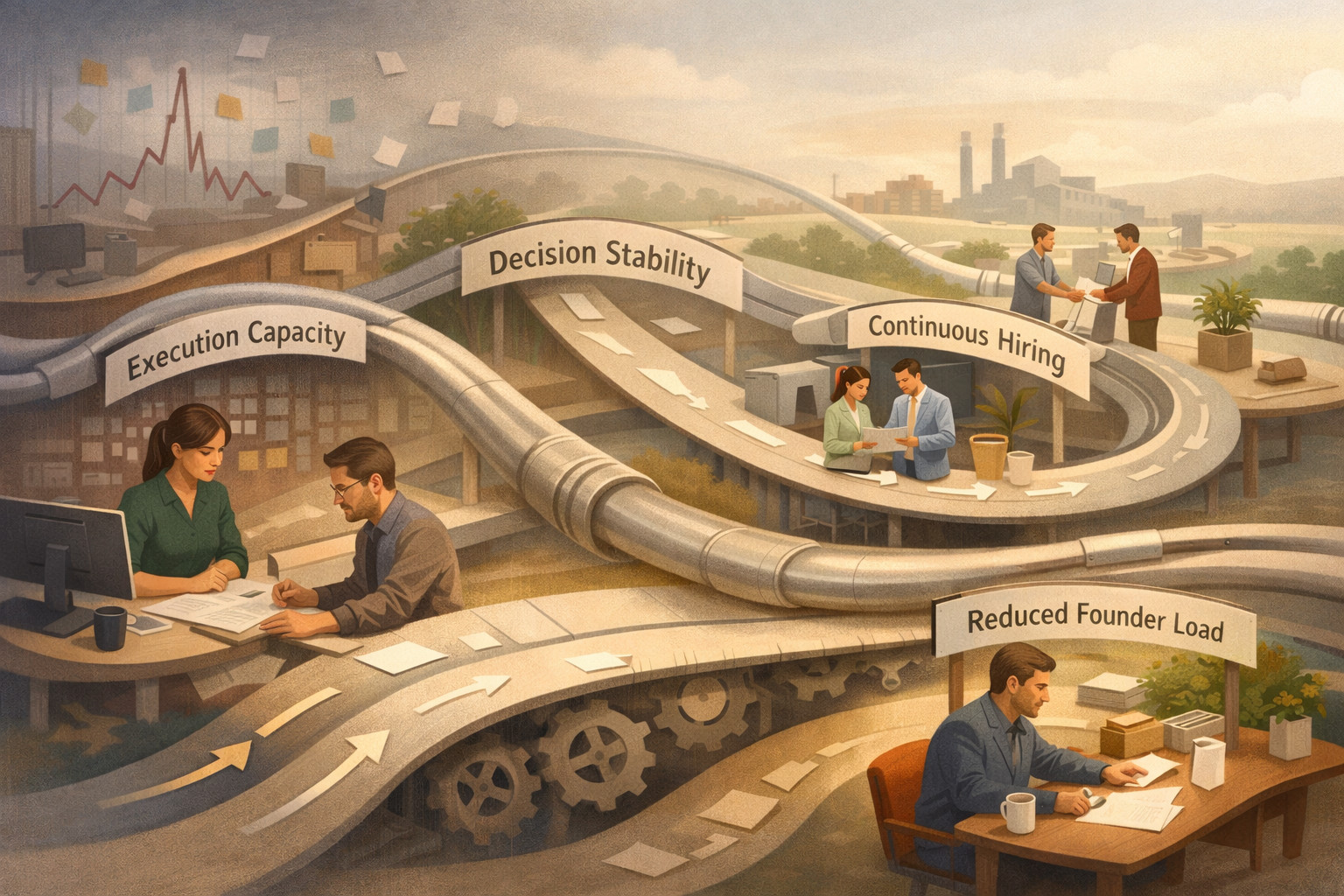
It’s About Making Hiring Predictable When Execution Is at Risk
When founders search for “hiring challenges in startups,” what they’re usually experiencing isn’t a hiring problem at all.
It’s the moment when scaling startup operations starts to expose weak execution underneath growth.
Hiring hasn’t stopped.
The constraint is usually execution capacity, not hiring volume.
Interviews are happening.
Candidates are moving through the funnel.
But progress feels heavier than it should.
That’s the point where recruitment-as-a-project starts to break.
In reality, teams need to define what must be true before you hire — otherwise every search becomes a moving target.
Why do hiring challenges appear when startups start scaling operations?
Most hiring models are built around events:
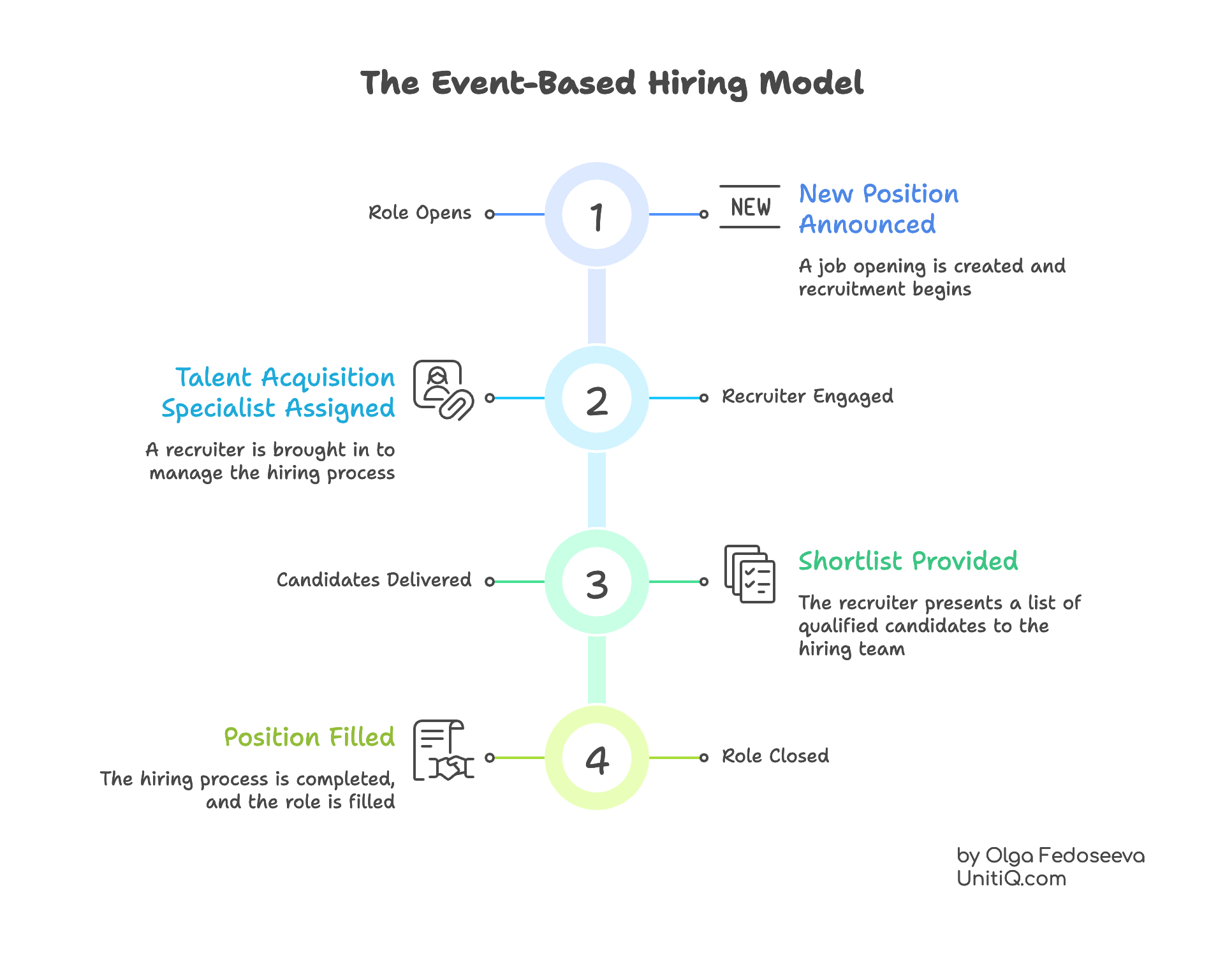
- a role opens
- a recruiter is engaged
- candidates are delivered
- the role is “closed”
Execution doesn’t work that way.
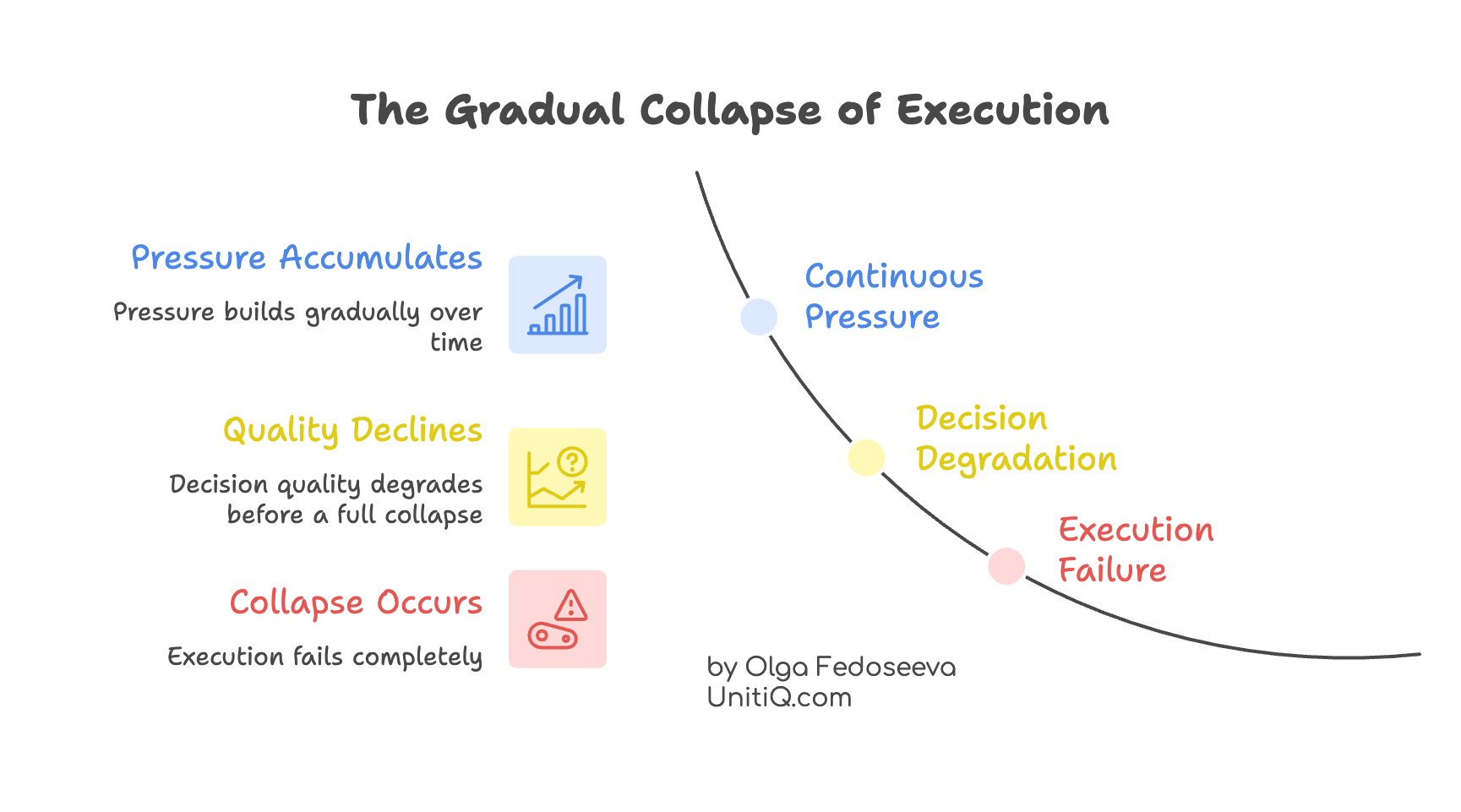
Execution is continuous.
Pressure accumulates gradually.
Decision quality degrades before it collapses.
By the time a startup “needs hiring,” the damage has usually already started:
- leaders are overloaded
- roles are vaguely defined
- priorities shift mid-search
- founders stay involved longer than planned
Recruitment-as-a-project assumes clarity already exists.
In fast-growing startups, it rarely does.
Why traditional recruitment models amplify uncertainty
Agencies optimize for placement.
Internal recruiters optimize for throughput.
Both assume:
- roles are stable
- success is defined
- decisions are easy once candidates appear
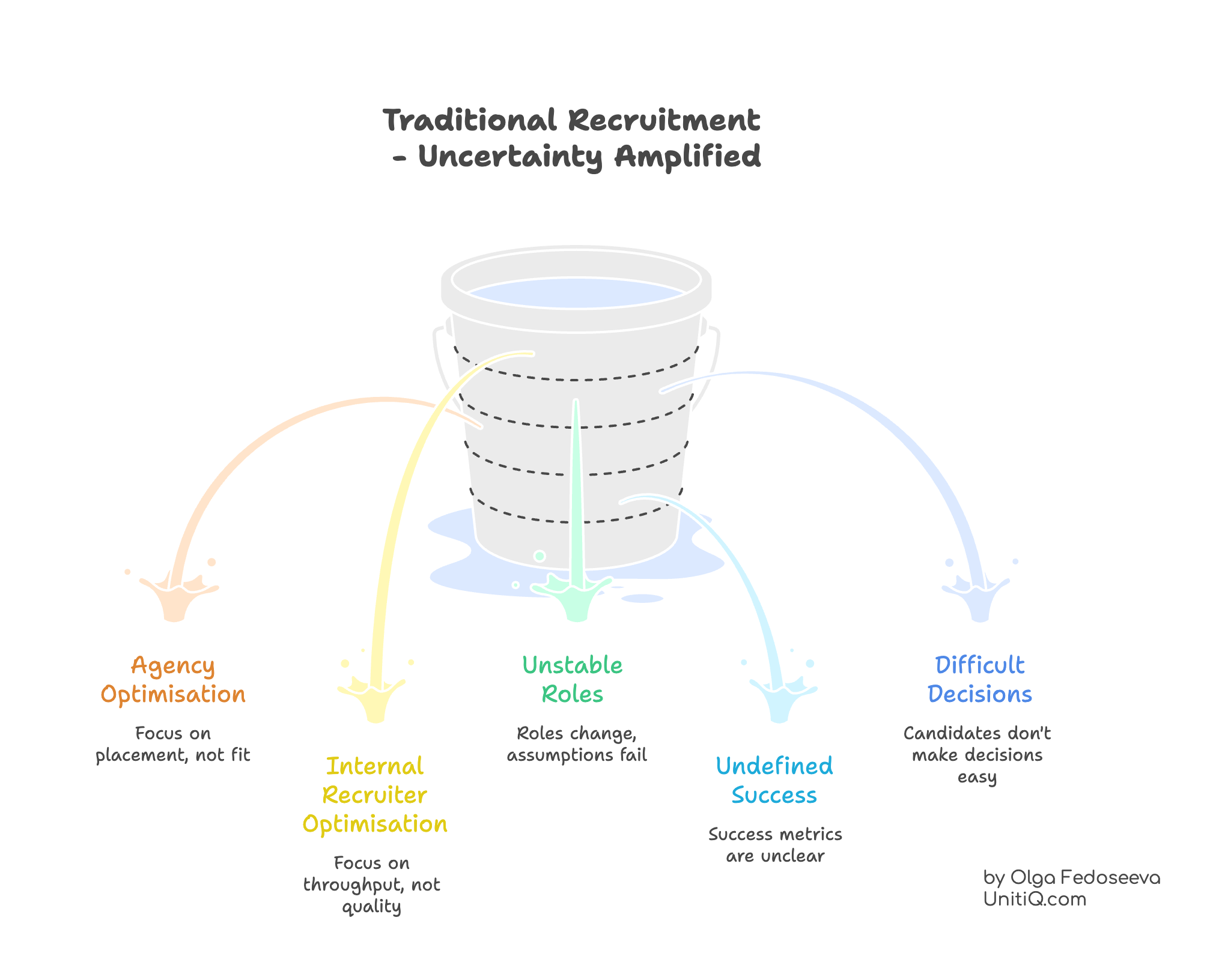
But when those assumptions don’t hold, hiring activity increases while confidence drops.
That’s when you see:
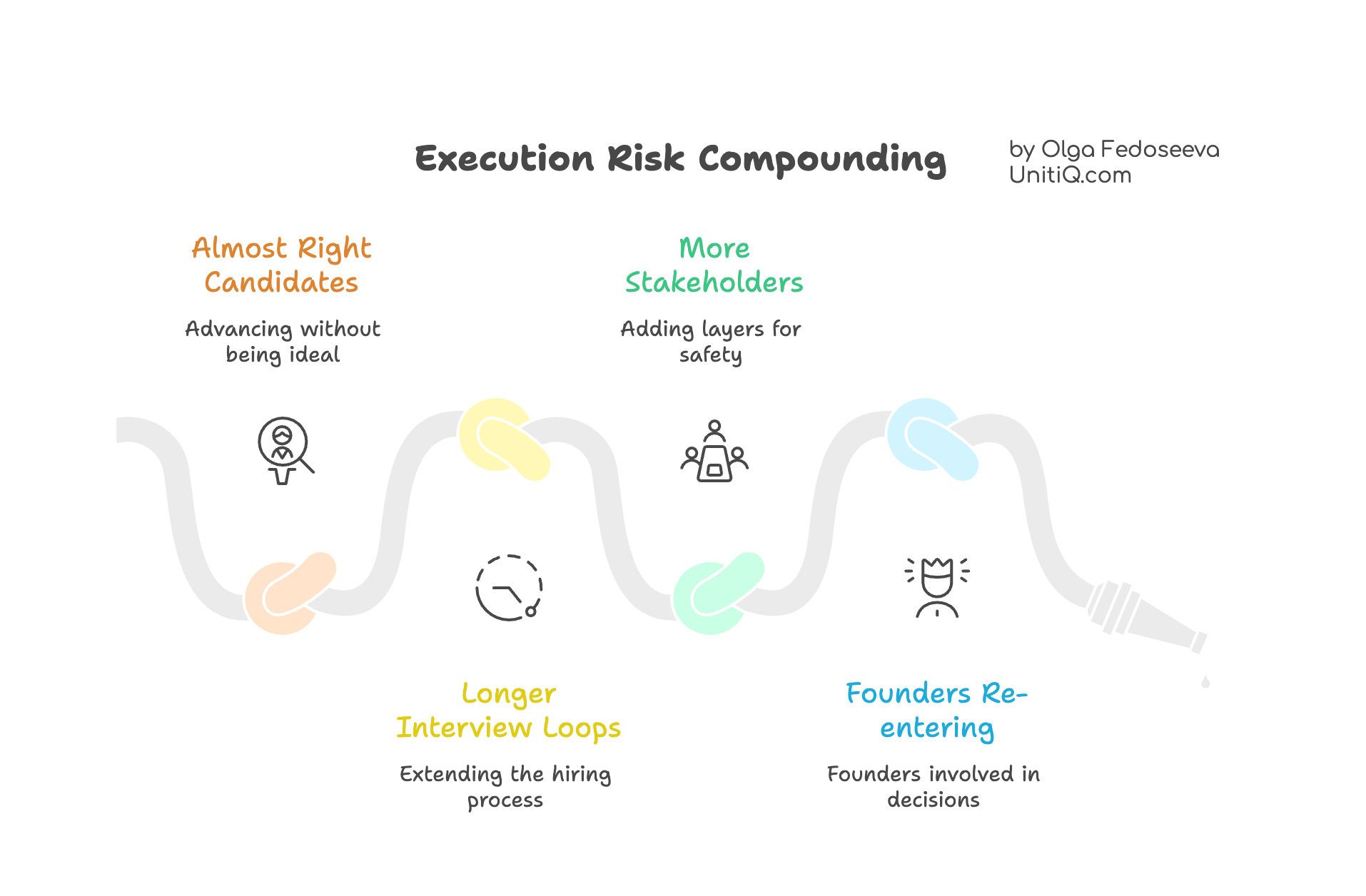
- “almost right” candidates advancing
- longer interview loops
- more stakeholders added for safety
- founders re-entering decisions
The system becomes busy — but not decisive.
This is where execution risk quietly compounds.
What is the difference between hiring activity and execution capacity?
Recruitment as a subscription isn’t a pricing model.
It’s an operating model — here’s how recruitment as a subscription works in practice.
It’s a structural shift.
Instead of treating hiring as a series of isolated searches, it treats it as an ongoing execution system.
That changes three things immediately:
1. Hiring is no longer triggered by panic
Work doesn’t start when a role is “on fire.”
It starts when execution signals begin to bend:
- leadership load increases
- decision speed slows
- ownership becomes fuzzy
Hiring becomes preventative, not reactive.
2. Roles are clarified before candidates are pushed
Subscription models only work when:
- outcomes are defined
- decision ownership is explicit
- trade-offs are agreed upfront
Otherwise, every new role becomes a moving target.
That’s why recruitment as a subscription forces clarity early — not because it’s “best practice,” but because without it the model collapses.
3. Founders exit hiring mode faster
When hiring is continuous but bounded:
- founders don’t need to re-onboard recruiters every time
- context isn’t lost between searches
- decisions compound instead of resetting
The goal isn’t speed.
It’s reducing cognitive load.
When does recruitment as a subscription actually work for startups?
At early stages, chaos is survivable.
At later stages, scale absorbs process.
Series A–C sits in the middle:
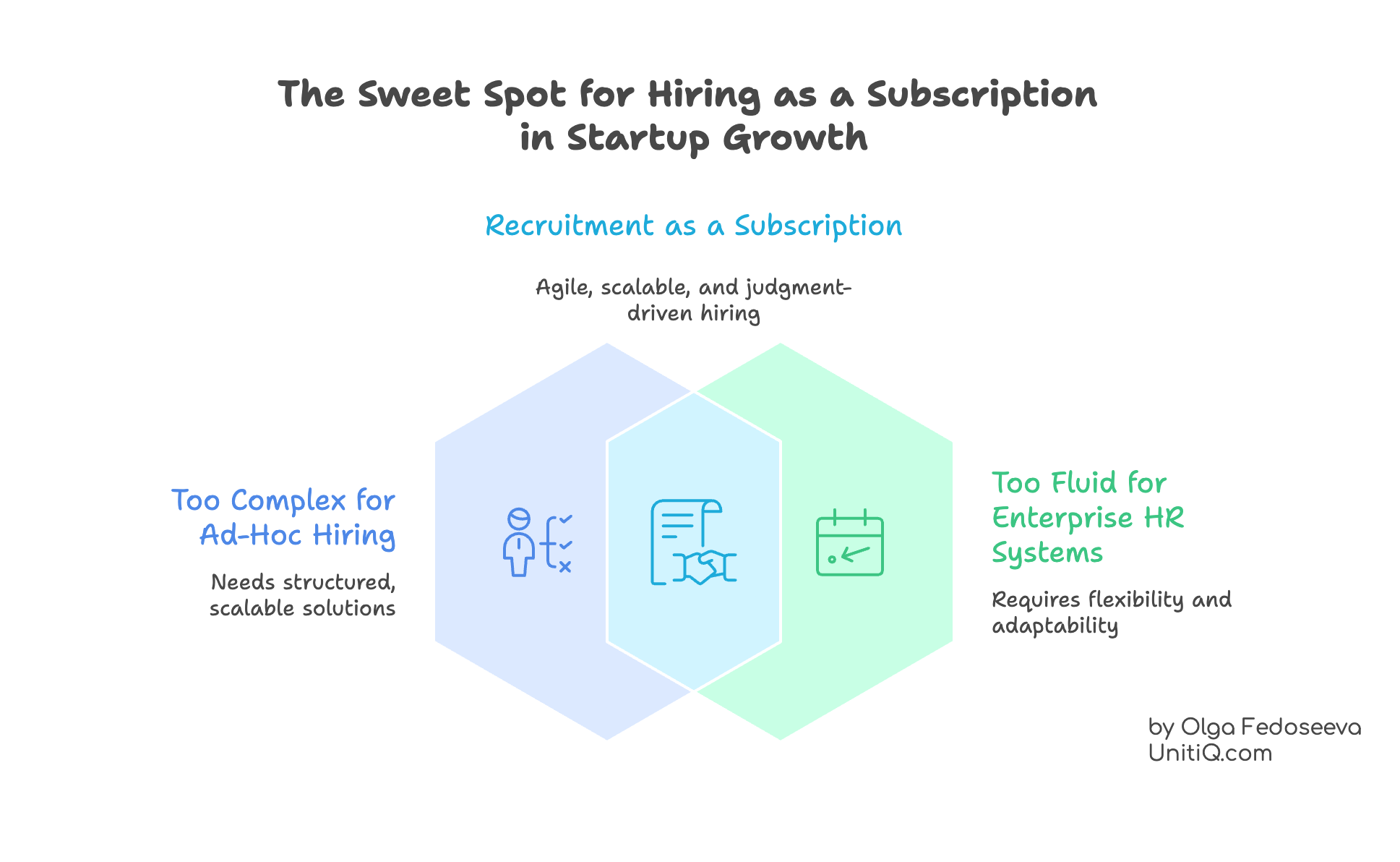
- too complex for ad-hoc hiring
- too fluid for enterprise HR systems
Recruitment as a subscription fits this phase because:
- it adapts as priorities shift
- it doesn’t require full-time headcount
- it preserves judgment over process
Most importantly, it keeps hiring aligned with execution reality — not an outdated org chart.
What recruitment as a subscription is not
It’s not:
- CV delivery on a retainer
- volume hiring with a nicer label
- an embedded recruiter without authority
- RPO with a startup-friendly website
If the model doesn’t:
- challenge unclear roles
- slow down bad decisions
- protect founders from overload
It’s just recruitment — repackaged.
When the model works — and when it fails
Recruitment as a subscription works when:
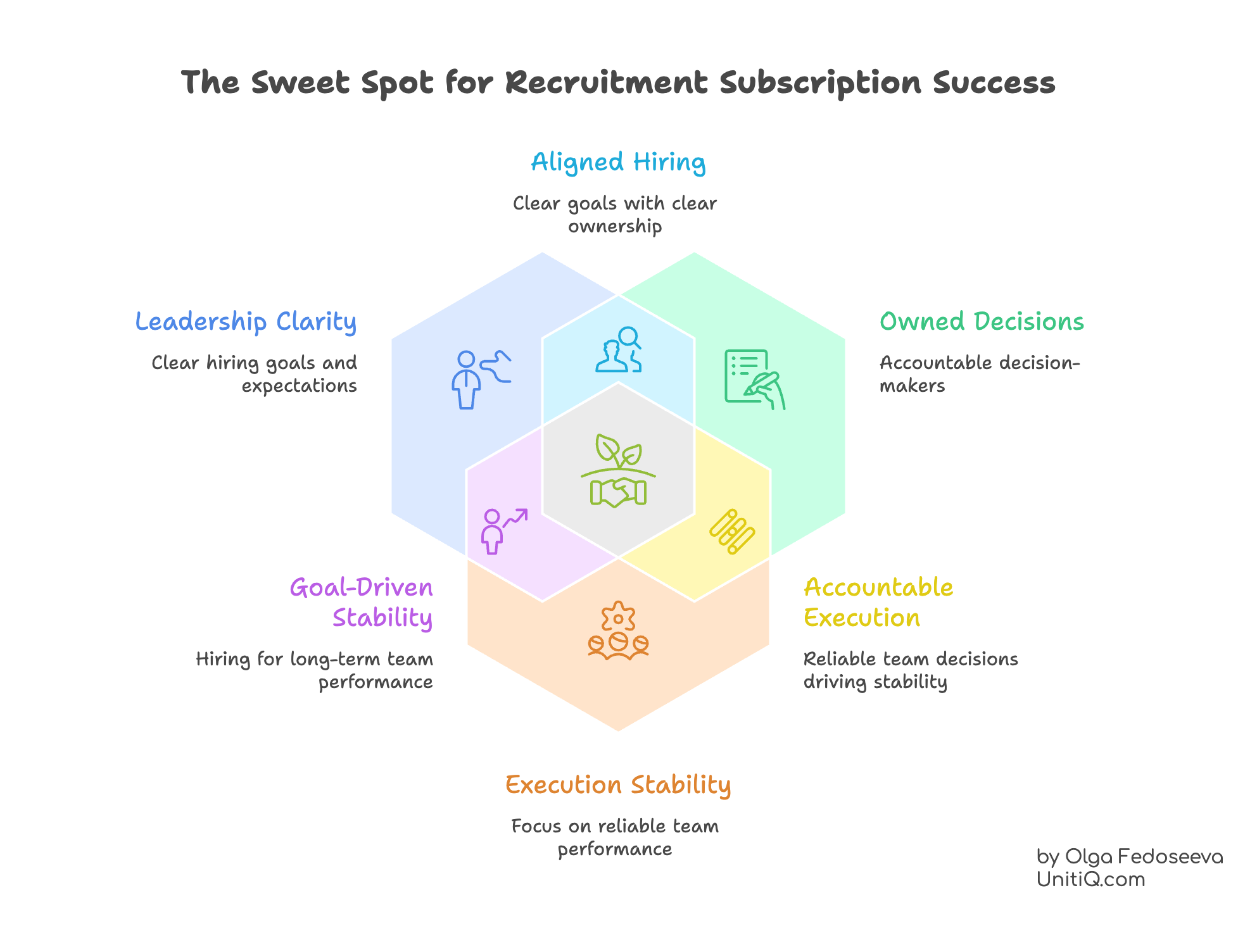
- leadership accepts that clarity is part of hiring
- decisions are owned, not crowdsourced
- the goal is execution stability, not headcount growth
It fails when:
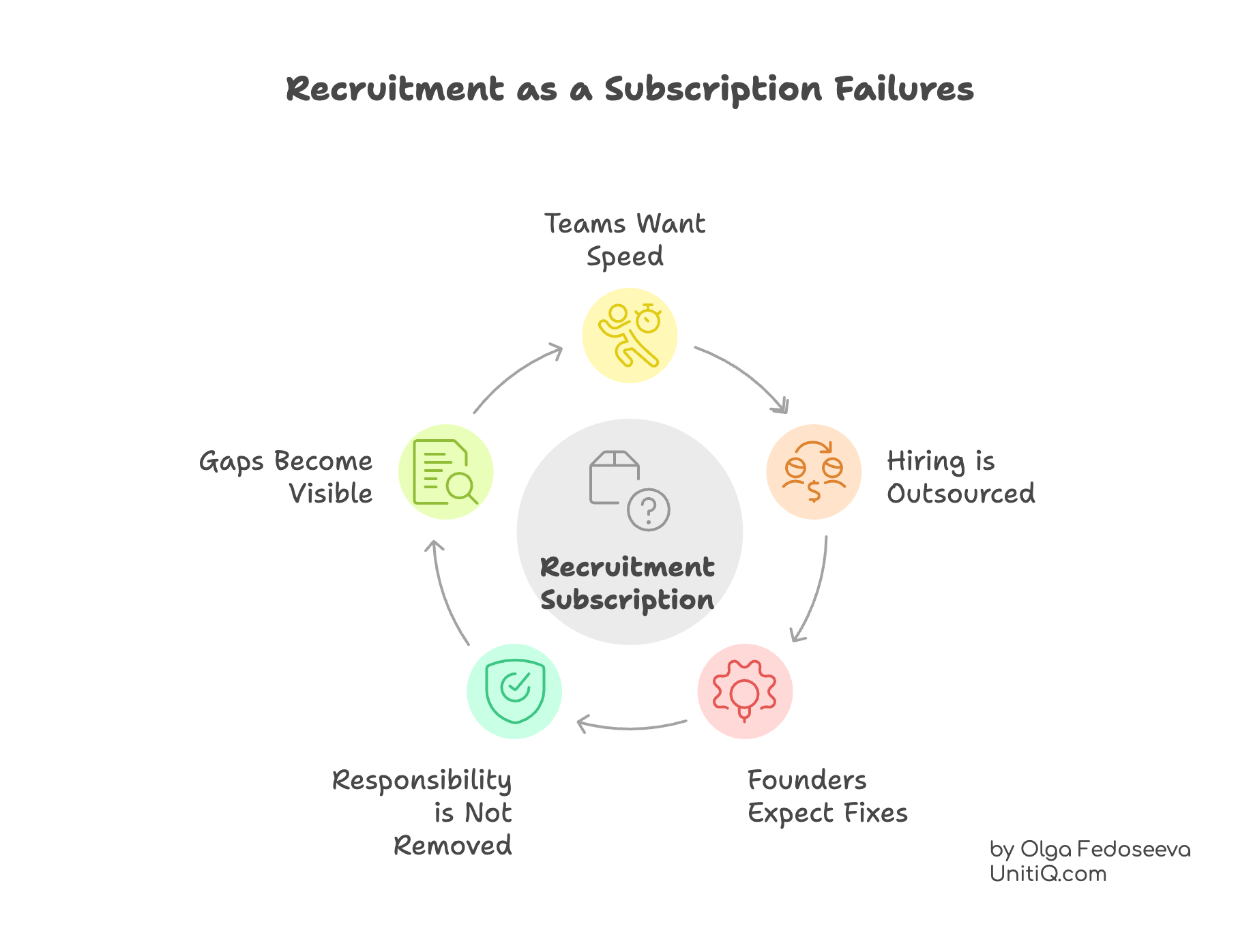
- teams want speed without definition
- hiring is outsourced to avoid hard conversations
- founders expect candidates to “fix” structural issues
The model doesn’t remove responsibility.
It makes gaps visible.
The quiet benefit founders notice last
When recruitment finally works, it feels… uneventful.
Roles close without drama.
Decisions don’t escalate.
Founders stop tracking every interview.
That’s not because hiring got easier.
It’s because execution stopped leaking through it.
Closing thought
Recruitment as a subscription isn’t about doing more hiring.
When it’s working, hiring becomes quiet — that’s when hiring finally works.
It’s about making hiring boring again — because when execution is healthy, hiring stops being the most stressful part of the business.
If you’re curious whether this model fits where your company actually is — not where the org chart says it is — that’s a conversation worth having.
If you want to sanity-check what’s breaking in your hiring system, we can walk through it together.
👉 Book a conversation
👉 Book a conversation
TL;DR
- Hiring challenges in startups usually appear when execution starts to break under scale — not because hiring itself is failing.
- Most recruitment models treat hiring as a project, while execution pressure is continuous and cumulative.
- Recruitment as a subscription works by stabilizing execution first: clarifying roles, decisions, and ownership before pushing candidates.
- When execution is healthy, hiring becomes predictable, quieter, and far less founder-dependent.
About the author
Olga Fedoseeva is the Founder of UnitiQ, a global HR executive, and a talent acquisition and people strategy leader with 20+ years of experience across EMEA, the US, and APAC. She has personally hired 1,500+ employees, led people strategy for organisations scaling from 30 to 700+ employees, and writes about hiring systems, execution risk, and people infrastructure in growth-stage startups.
Read full author profile
LinkedIn
Read full author profile


