
How to Build the Right Team: Hiring That Actually Improves Execution
For Series A–C startups, building the right team is rarely a hiring problem.
It’s an execution problem.
Founders don’t struggle because they can’t attract talent. They struggle because, as teams grow, the organisation can no longer absorb people, decisions, and ownership at the same pace as product ambition.
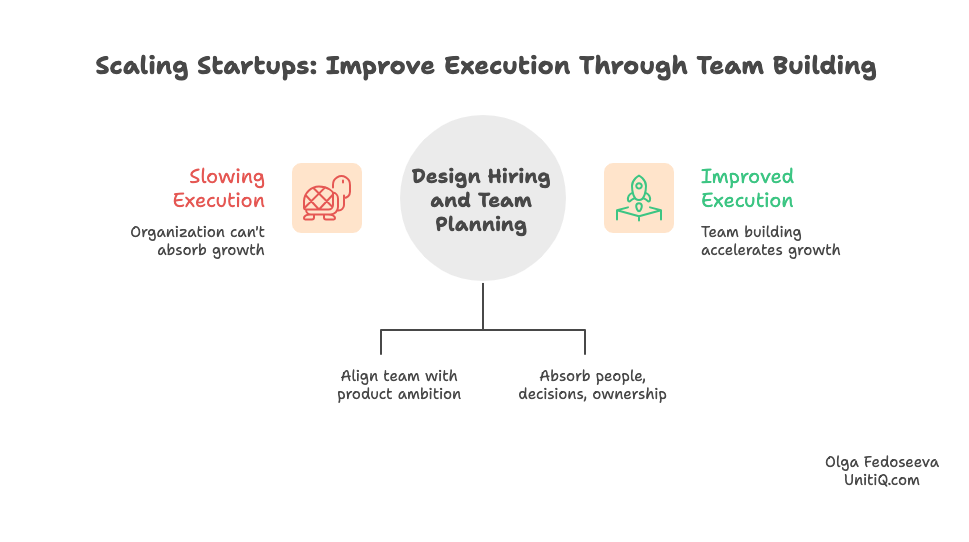
This is why hiring often slows execution instead of accelerating it.
This article explains why team building fails as startups scale — and how to design hiring and team planning so execution actually improves.
Why execution slows even when teams grow
Founders often describe the same pattern:
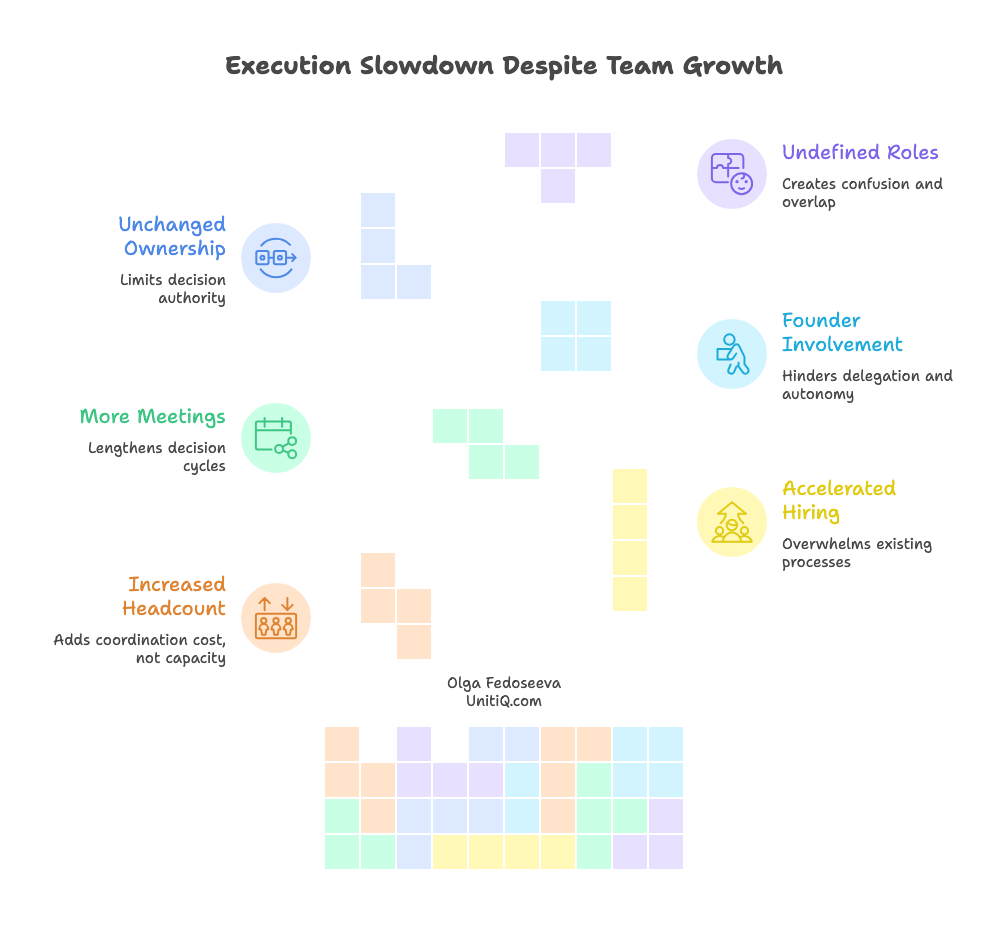
- Headcount increases
- Hiring activity accelerates
- More meetings appear
- Decision cycles lengthen
- Founders stay deeply involved
- Progress feels heavier, not faster
This is not a productivity issue.
It is not a talent shortage.
It is a capacity mismatch between execution demand and execution design.
When ownership, decision authority, and role boundaries do not evolve with growth, every new hire adds coordination cost instead of execution capacity.
What “building the right team” actually means in a scaling startup
In early stages, teams work despite ambiguity.
Execution holds because:
- decision authority is concentrated
- context lives with founders
- coordination paths are short
As the organisation grows, this breaks.
Building the right team does not mean hiring more capable individuals.
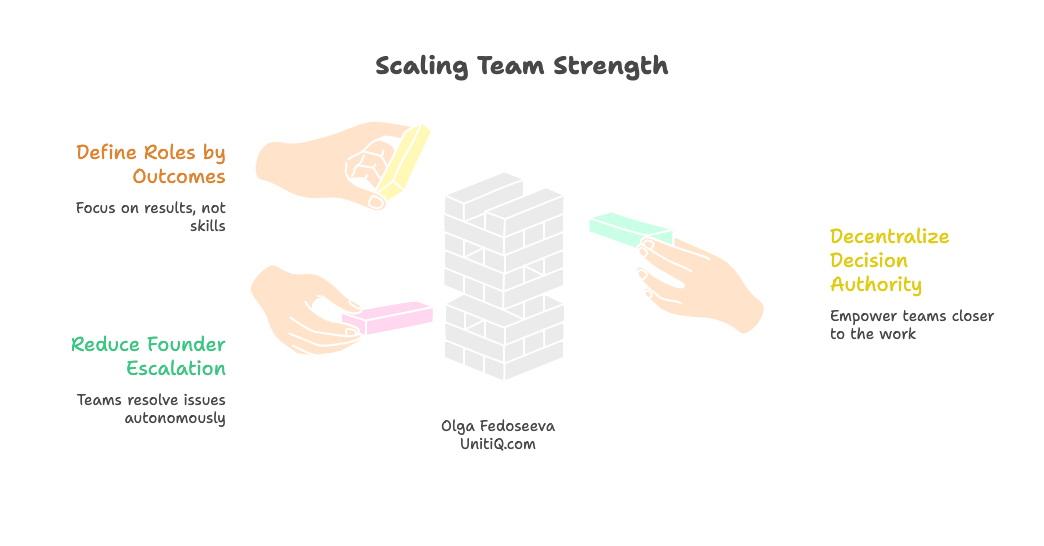
It means designing a system where:
- roles are defined by outcomes, not skills
- decision authority moves closer to the work
- founders are no longer the default escalation point
Team strength is not a hiring outcome.
It is an execution property.
Why hiring fails when execution is not ready
Most hiring frameworks assume a simple sequence:
- Define the role
- Hire the person
- Expect execution to improve
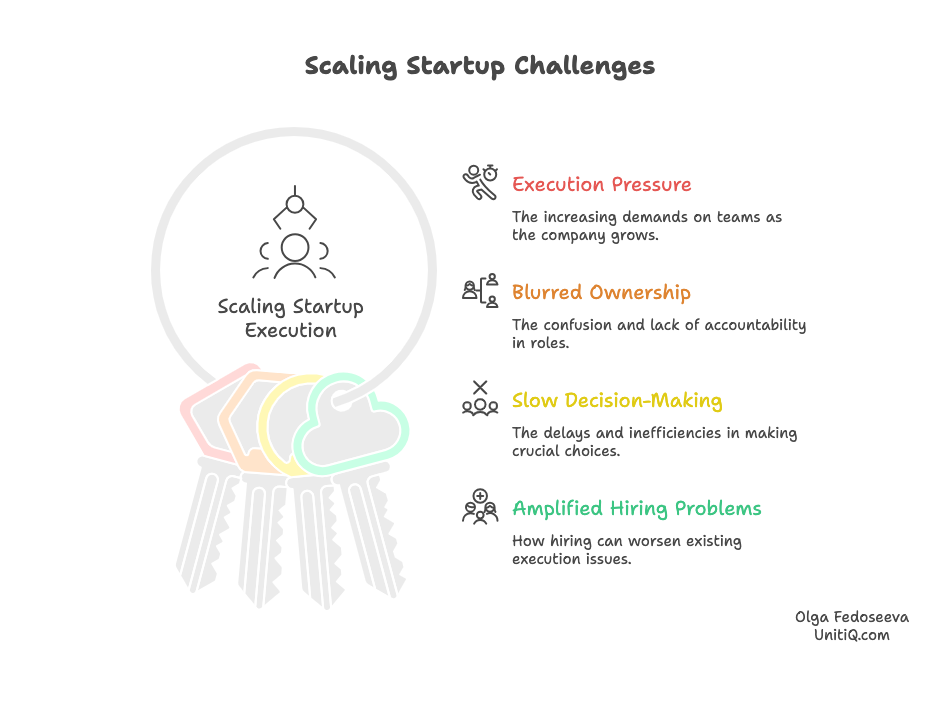
Scaling startups experience the opposite:
- Execution pressure increases
- Ownership becomes blurred
- Decision-making slows
- Hiring amplifies the problem
People join unclear systems.
They hesitate.
They escalate decisions.
Founders step back in.
Hiring didn’t fail.
The execution system did.
This is also where “almost right” candidates start moving forward — not because they fit, but because the system is exhausted.
Why skills-based hiring increases coordination cost
As companies scale, hiring becomes increasingly skills-driven:
- more detailed role requirements
- longer interview loops
- deeper assessments
This creates the illusion of rigour.
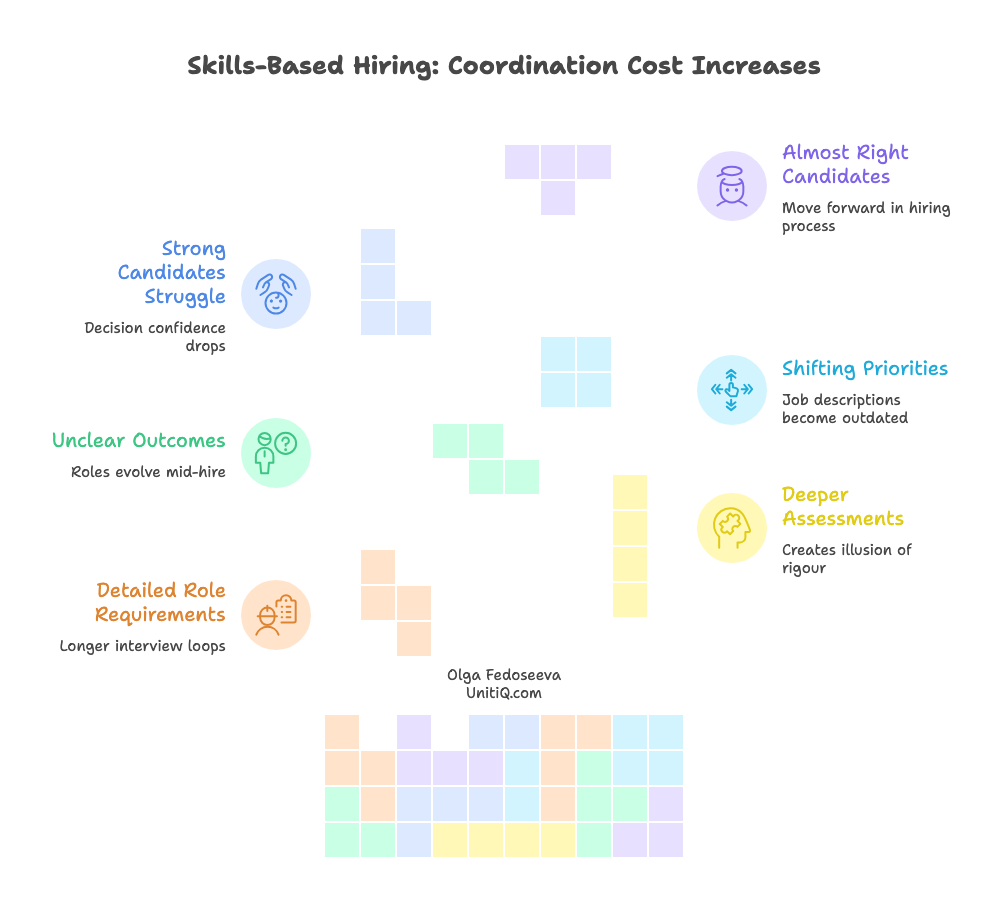
But skills-based hiring breaks when:
- outcomes are unclear
- roles evolve mid-hire
- priorities shift faster than job descriptions
The result is predictable:
- strong candidates struggle
- decision confidence drops
- “almost right” candidates move forward
This is not a people problem.
It is a misalignment between hiring signals and execution reality.
Skills-Based Hiring for Startups: Building Agile Teams for the Future — why skills checklists create confidence, but not execution ownership.
Hiring is execution design
Hiring that improves execution starts upstream.
Before sourcing begins, execution-first teams answer:
- What outcome must this role own?
- Which decisions sit with this role without escalation?
- What problems should not come back to founders?
- What must be true after 90 days for this hire to be successful?
Without these answers, no interview process produces confidence.
How execution-first team building works
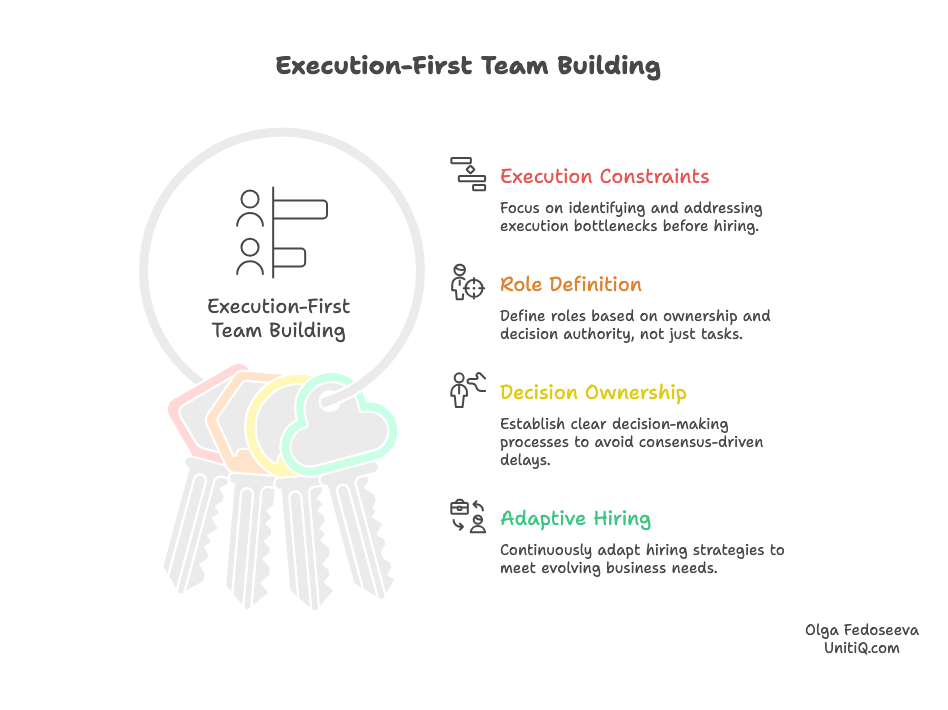
1. Start with execution constraints, not headcount
Instead of asking:
“Who should we hire next?”
Ask:
“Where is execution breaking today?”
Common signals:
- decisions bottleneck at founders
- teams wait for alignment instead of acting
- priorities shift faster than ownership
These constraints define roles more accurately than any org chart.
These are the conditions that must be in place before hiring creates leverage — not after.
2. Define roles by ownership and decision authority
Execution-ready roles are defined by:
- problems owned end-to-end
- decisions made without permission
- outcomes delivered, not tasks completed
This clarity:
- sharpens interviews
- improves candidate self-selection
- reduces mis-hires that look strong on paper
When roles are defined by skills or activities instead of ownership, execution fragments and hiring confidence drops — a pattern we unpack in how startups define roles wrong.
3. Make decision ownership explicit
Hiring slows when:
- everyone has input
- no one owns the decision
Strong teams establish:
- a clear decider
- defined escalation boundaries
- explicit trade-offs
Without this, hiring becomes consensus-driven — and execution pays the price.
This is the failure mode where opinions multiply, confidence drops, and hiring stalls — the moment when talent acquisition breaks because no one owns the decision.
4. Adapt hiring as the system evolves
In scaling companies, roles are not static.
Execution-first hiring adapts as:
- priorities shift
- leadership load changes
- ownership must move with growth
This is why continuous, embedded hiring models outperform one-off placements at Series A–C.
When hiring more people makes execution worse
Hiring becomes dangerous when:
- execution problems are denied
- founders want speed without clarity
- hiring is treated as delegation
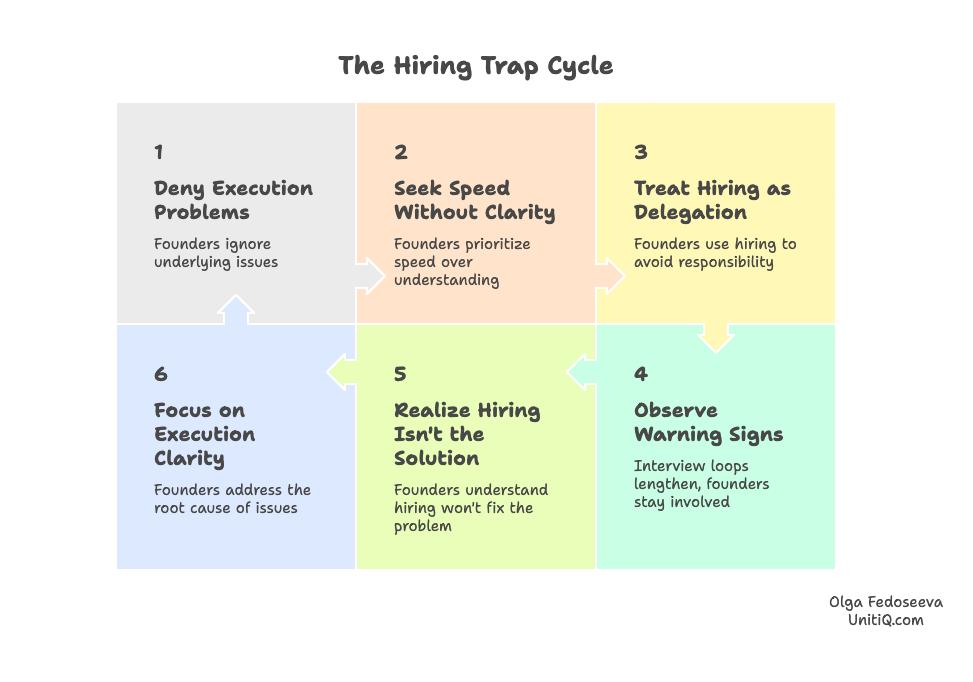
Warning signs include:
- interview loops getting longer
- founders staying in every decision
- confidence dropping despite more candidates
At this point, the solution is not more hiring.
It is execution clarity.
Adding people to an overloaded system doesn’t increase output — it exposes the organisation’s execution limits.
Building teams that scale without breaking execution
The right team does not remove complexity.
It absorbs it.
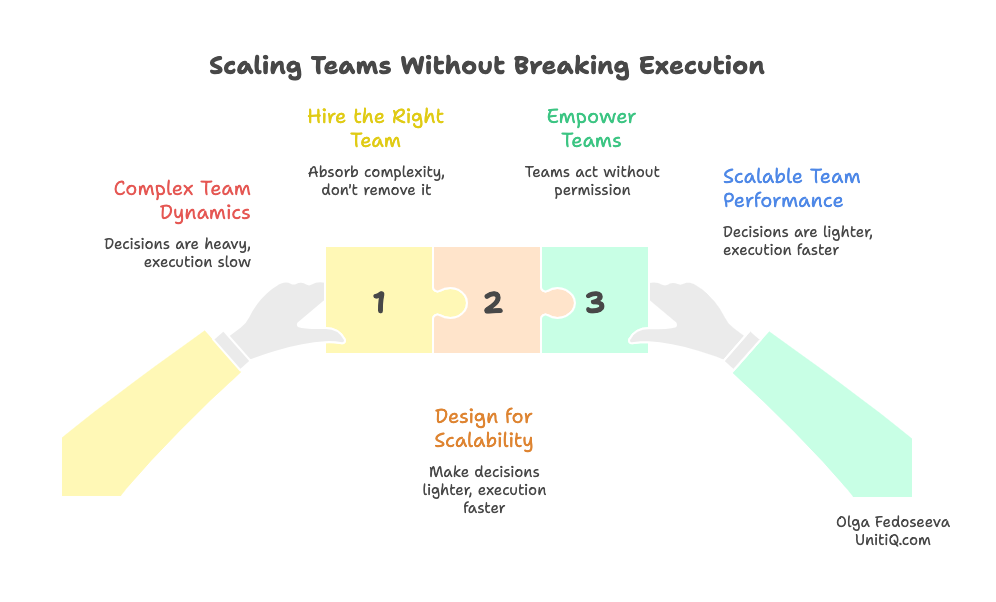
When hiring works:
- decisions feel lighter
- execution speeds up
- founders step back
- teams act without permission
This does not happen by accident.
It is designed.
This is the point where hiring stops feeling heavy and starts feeling easy — because execution is finally carrying its own weight.
The UnitiQ perspective
We’re called in when:
- hiring has not improved execution
- founders remain the bottleneck
- mis-hires feel expensive
Because hiring failures are rarely recruitment failures.
They are execution system failures.
If you want to sanity-check which model fits your current stage — and where execution is actually breaking — we can walk through it together.
About the author
Olga Fedoseeva is the Founder of UnitiQ, a talent acquisition and People Projects partner for Tech Startups across EU, UKI, and MENA.
She works with founders in Fintech, AI, Crypto, and Robotics to prevent mis-hires before they compound — restoring execution momentum and protecting teams from quiet burnout.


