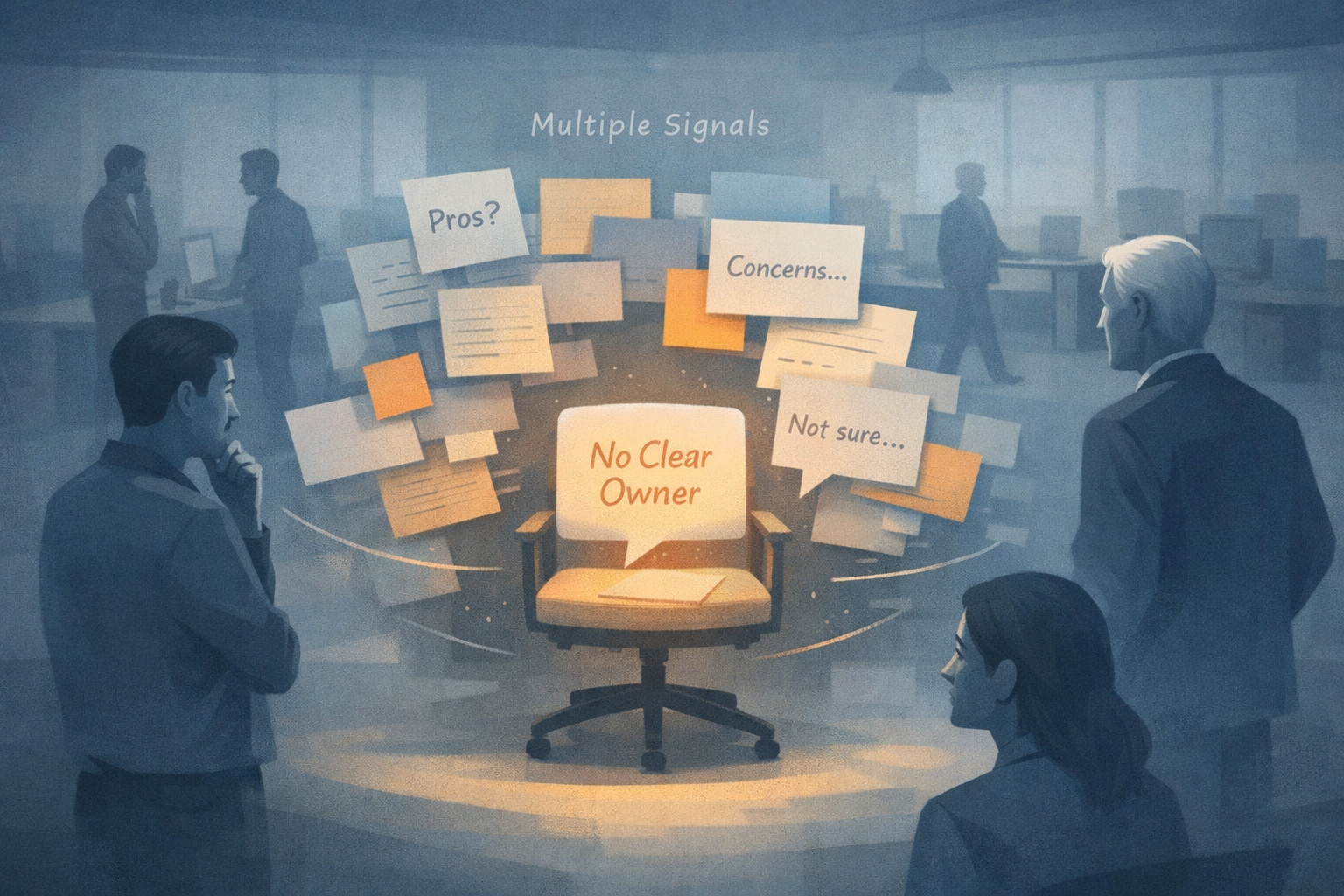
In many Series startup and scale up companies, hiring doesn’t fail because people don’t care.
It fails because too many people care in different ways.
Everyone interviews.
Everyone has feedback.
Everyone has an opinion.
And yet—no one truly owns the decision.
This is how talent acquisition quietly becomes uncertain, slow, and exhausting for leadership.
This failure mode is part of a broader pattern: uncertainty is the real enemy of talent acquisition, because it keeps leadership involved long after hiring should be delegated.
When Hiring Becomes a Signal Aggregation Exercise
Most teams believe more input leads to better decisions.
So they add:
- More interviewers
- More feedback rounds
- More “alignment” meetings
Many teams adopt these patterns because most mainstream hiring advice assumes stable, slow-moving organisations.
What they actually add is signal noise.
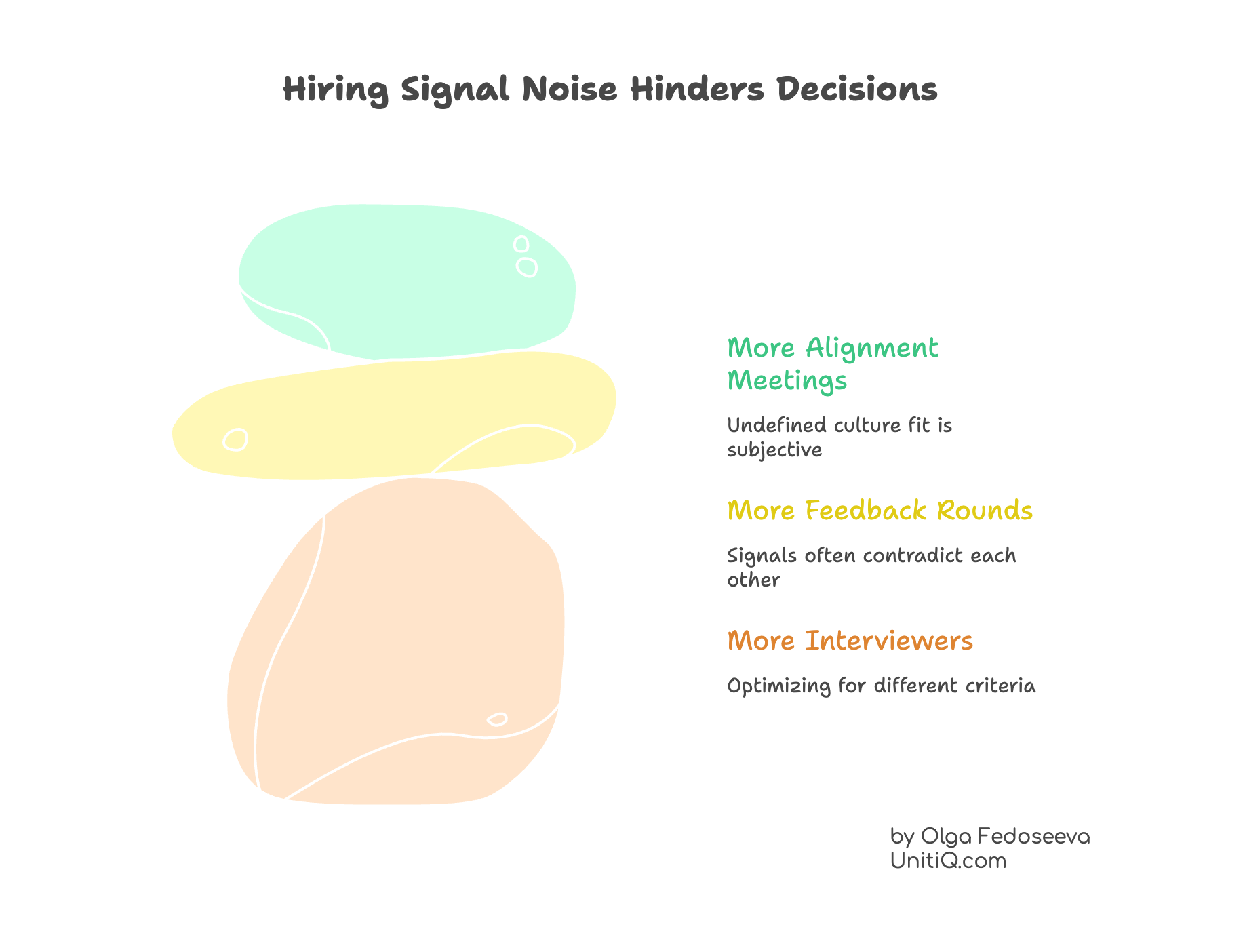
Different interviewers optimize for different things:
- One evaluates past pedigree
- Another evaluates communication style
- Another evaluates “gut feel”
- Another evaluates culture fit (undefined)
Each signal may be valid on its own.
Together, they often contradict each other.
The result isn’t clarity.
It’s hesitation.
This is why teams keep seeing candidates who feel close but never decisive. When signals multiply without ownership, “almost right” becomes the default outcome instead of a resolved decision.
Diffused Ownership Creates Hiring Paralysis
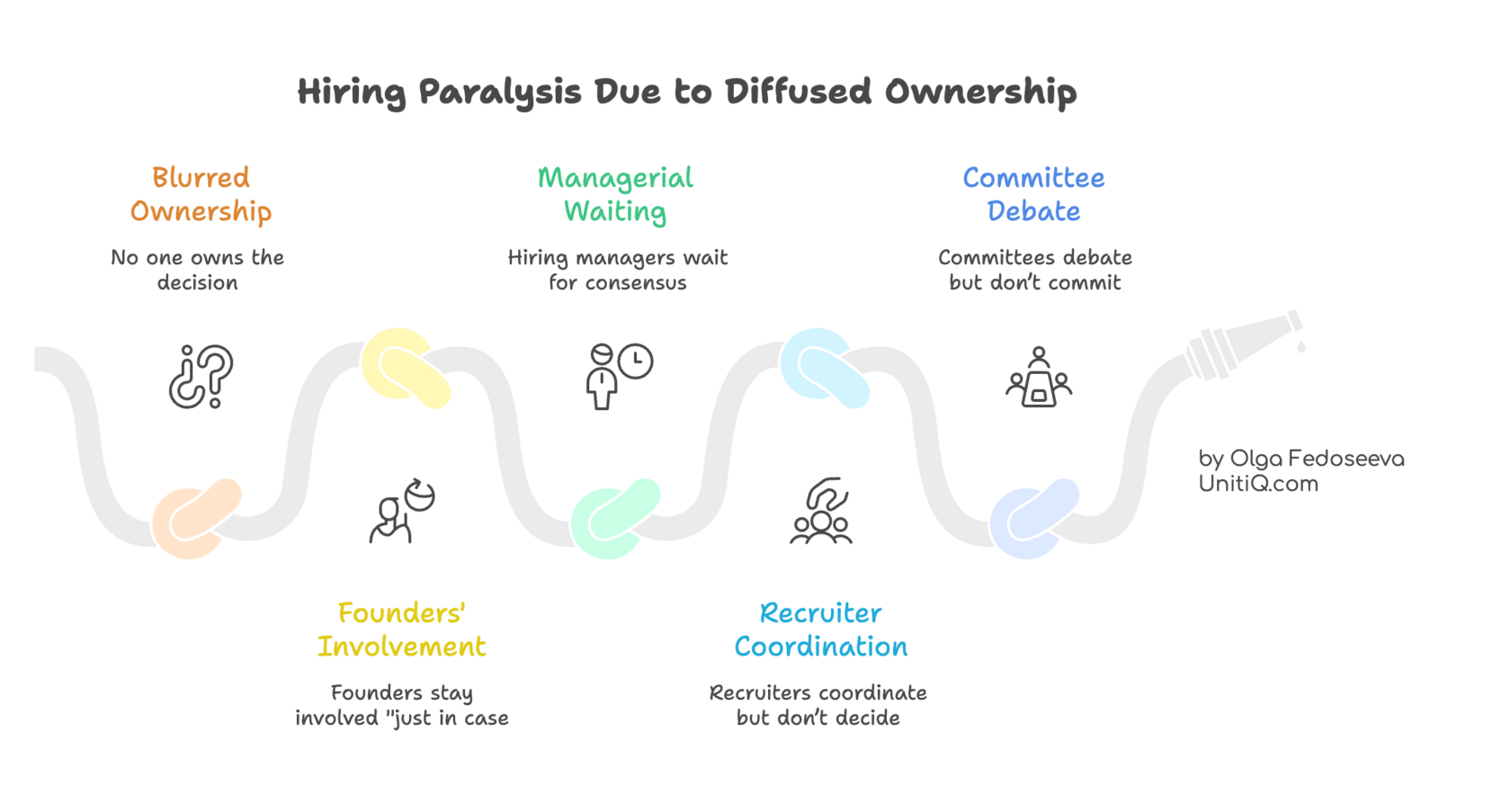
In high-uncertainty hiring systems, decision ownership is blurred:
- Founders stay deeply involved “just in case”
- Hiring managers wait for consensus
- Recruiters coordinate but don’t decide
- Committees debate but don’t commit
Clear ownership is easier to maintain when hiring is supported by a dedicated talent partner embedded over time, rather than fragmented across ad-hoc processes.
When no one owns the decision:
- Risk silently flows upward to leadership
- Decisions slow down or stall
- “Almost right” becomes the default compromise
Hiring becomes something leaders hover over instead of delegating.
When no one owns the decision, leaders stay involved — and that involvement turns into a hidden operational cost that compounds over time.
Process Becomes a Substitute for Confidence
To compensate for low confidence, teams add process.
More interviews.
More scorecards.
More calibration sessions.
But process without ownership doesn’t reduce uncertainty —
it hides it behind structure.
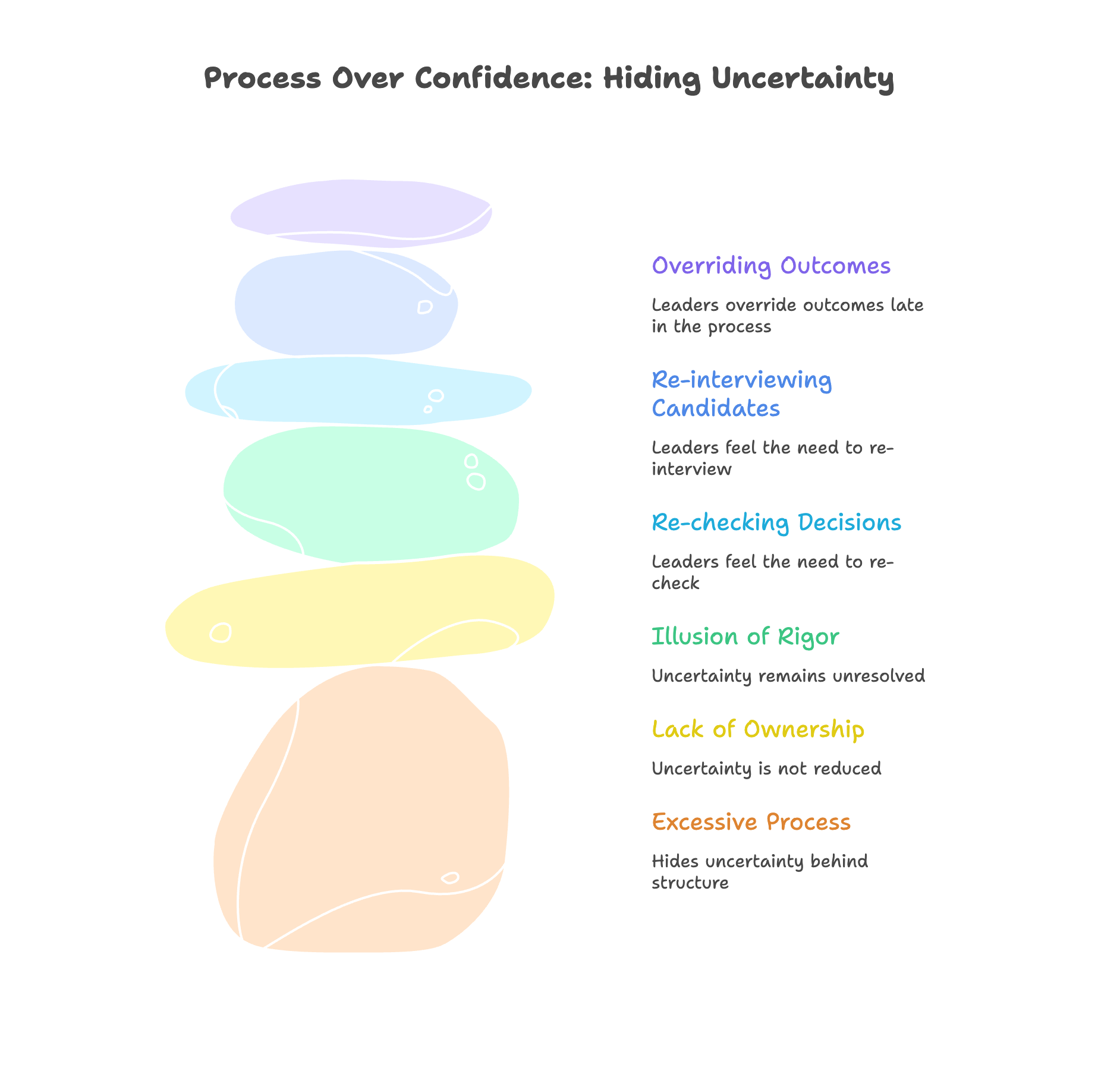
This creates the illusion of rigor while uncertainty remains unresolved.
Leaders still feel the need to:
- Re-check decisions
- Re-interview candidates
- Override outcomes late in the process
The system looks mature.
The confidence isn’t.
Why Committees Don’t Scale in Talent Acquisition
Committees feel safe because responsibility is shared.
In reality:
- Accountability gets diluted
- Decision quality becomes average, not sharp
- Risk avoidance replaces execution clarity
Committees don’t remove uncertainty.
They distribute it.
And distributed uncertainty is exactly what keeps founders and executives trapped in hiring decisions far longer than they should be.
What Actually Reduces Hiring Uncertainty
Uncertainty drops only when decision ownership is explicit.
That means:
- One clear owner per role
- Defined decision rights
- Clear criteria for what signals matter most
- Explicit escalation paths (not silent overrides)
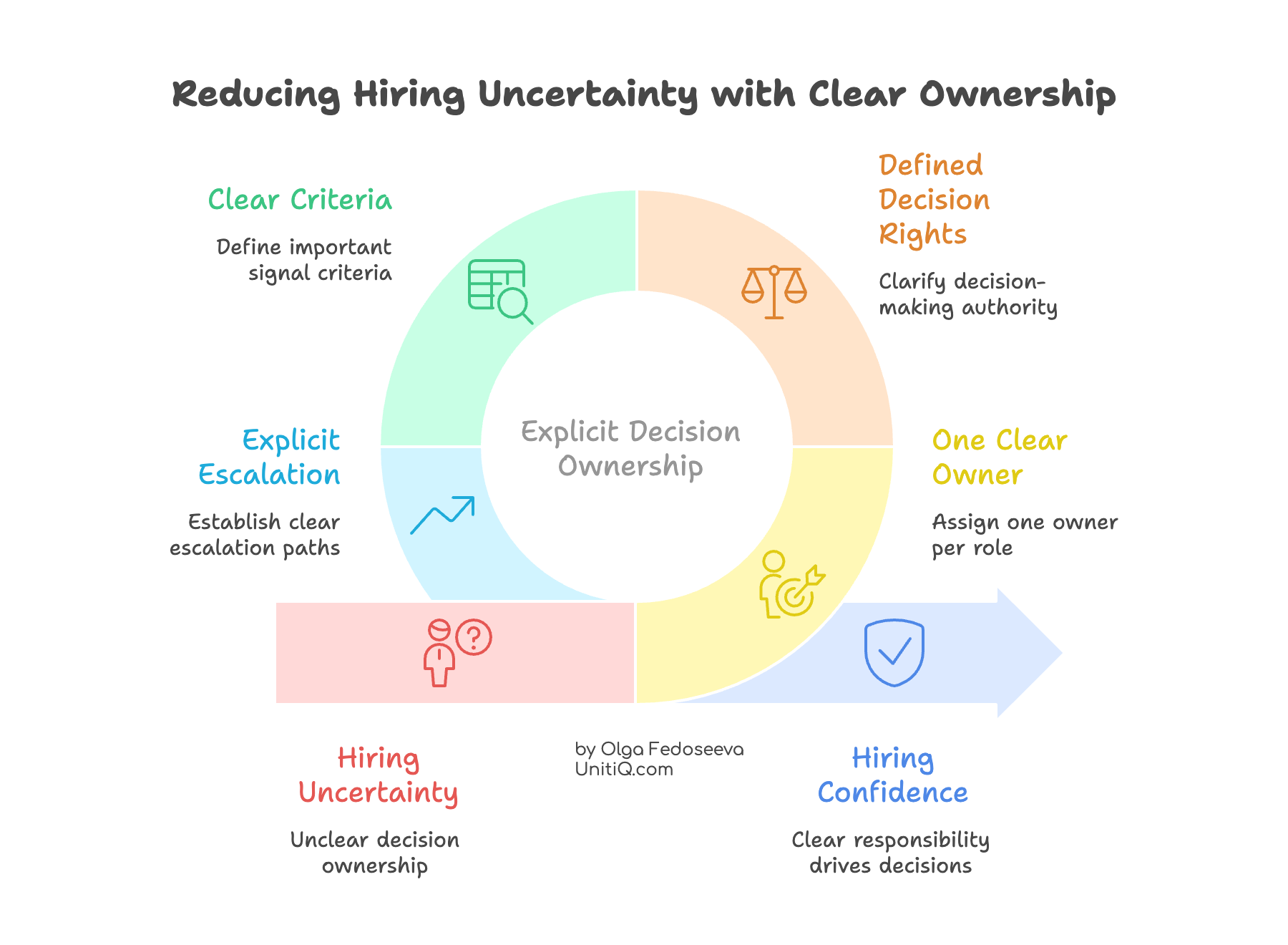
When ownership is clear:
- Signals align instead of compete
- Leaders step out earlier
- Hiring decisions regain momentum
Confidence doesn’t come from more opinions.
It comes from clear responsibility.
If you want to sanity-check what’s breaking in your hiring system, we can walk through it together.
👉 Book a conversation
👉 Book a conversation
How This Connects Back to Execution
This article builds directly on the pillar insight:
Uncertainty consumes more leadership energy than difficult work.
When ownership is unclear, leaders stay involved not because they want to—but because the system gives them no safe exit.
Execution suffers long before a bad hire is made.
This article is part of a series on reducing uncertainty in talent acquisition:
– Uncertainty Is the Real Enemy of Talent Acquisition
– Why “Almost Right” Candidates Are a Signal
– The Hidden Cost of Hiring Uncertainty
– Uncertainty Is the Real Enemy of Talent Acquisition
– Why “Almost Right” Candidates Are a Signal
– The Hidden Cost of Hiring Uncertainty
TL;DR / Key Takeaways
- Hiring uncertainty increases when signals multiply without clear ownership
- Committees and excessive process hide uncertainty rather than resolving it
- Diffused ownership keeps leaders stuck in hiring decisions
- Confidence comes from explicit decision ownership, not consensus
- Clear ownership is a prerequisite for scalable talent acquisition
About the author
Olga Fedoseeva is the Founder of UnitiQ, a global HR executive, and a talent acquisition and people strategy leader with 20+ years of experience across EMEA, the US, and APAC. She has personally hired 1,500+ employees, led people strategy for organisations scaling from 30 to 700+ employees, and writes about hiring systems, execution risk, and people infrastructure in growth-stage startups.


