
Why Founders Can’t Get Out of Hiring Mode
Founders don’t stay involved in recruitment because they enjoy interviewing.
They stay involved because they don’t trust the system.
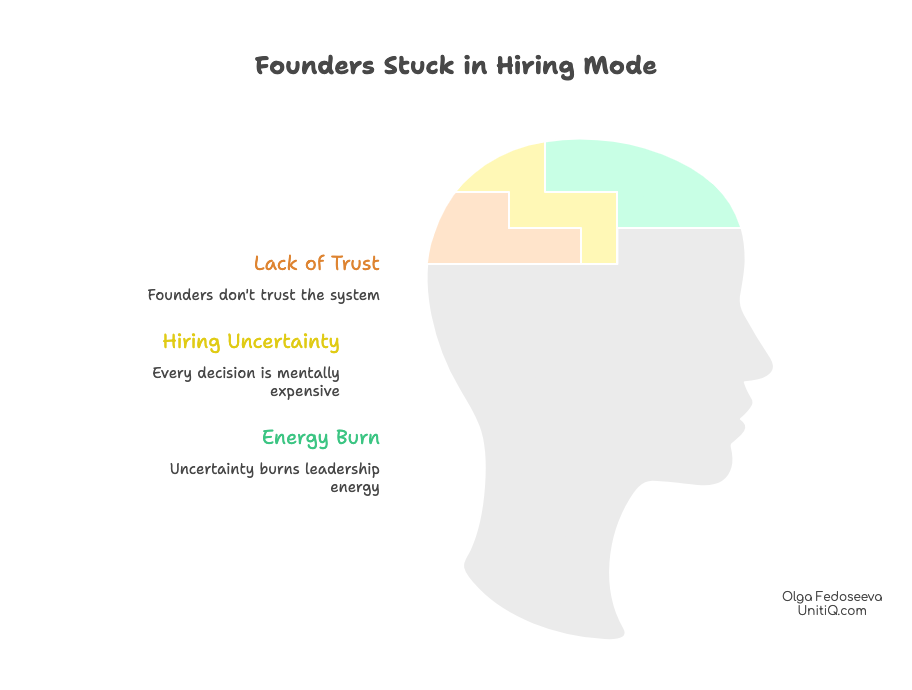
When talent acquisition lacks clarity, every hiring decision becomes mentally expensive. Not because it’s difficult — but because it’s uncertain. And uncertainty burns far more leadership energy than hard work ever will.
This is the hidden reason why founders feel “stuck in hiring mode,” even with recruiters, HR partners, and long interview processes in place.
Why Recruitment Feels Exhausting (Even When You’re Doing “Everything Right”)
Most leadership teams describe the same symptoms:
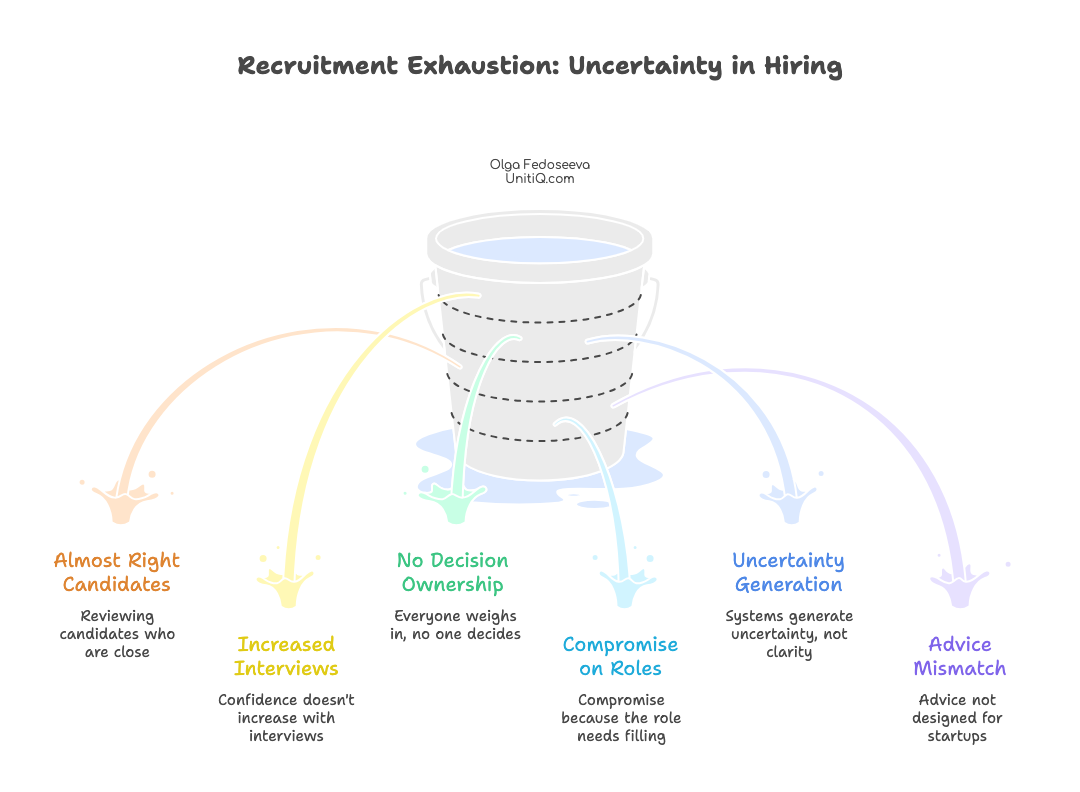
- “We keep reviewing candidates who are almost right.”
- “We add more interviews, but confidence doesn’t increase.”
- “Everyone weighs in, yet no one owns the decision.”
- “We compromise because the role needs to be filled.”
On the surface, these look like recruitment execution issues.
In reality, they all stem from the same root cause:
Talent acquisition systems are generating uncertainty instead of removing it.
Many founders follow well-known hiring advice — slow down, add structure, involve more people — without realizing that most hiring advice was never designed for startup conditions.
The “Almost Right” Candidate Is Not a Talent Problem — It’s a Signal Problem
Founders often describe the same pattern:
You review dozens of candidates.
They’re smart. Experienced. Good communicators.
And still… something doesn’t land.
They’re almost right.
This is usually treated as a sourcing problem (“market is weak”) or a standards problem (“we should compromise”).
But most of the time, it’s a system signal:
“Almost right” happens when the team cannot clearly define what ‘right’ means in execution terms.
When success is unclear, teams default to proxies:
- impressive CVs
- confidence in interviews
- familiarity (“they’ve done this before”)
- general intelligence
- subjective culture fit
Those proxies reduce discomfort in the moment — but they don’t reduce uncertainty.
So the pipeline fills with candidates who look right on paper and sound right in conversation…
but don’t map cleanly to the actual execution reality inside the company.
That’s why “almost right” becomes the default outcome — and why leadership stays stuck in review loops.
If you keep seeing ‘almost right’, don’t lower the bar. Fix the definition of the bar.
→ Read next: Why “Almost Right” Candidates Are a Signal
Once you treat “almost right” as a signal, the next question is what’s missing: usually execution definition and decision ownership — the two levers that reduce uncertainty fastest.
Even when execution is loosely understood, hiring still breaks down if no one clearly owns the decision. Signals multiply, opinions stack up, and leadership stays involved—not by choice, but because responsibility is diffused.
→ Talent Acquisition Breaks When Everyone Has a Signal — but No One Owns the Decision
→ Talent Acquisition Breaks When Everyone Has a Signal — but No One Owns the Decision
Difficulty vs. Uncertainty (Why This Matters)
There’s a critical difference leaders rarely articulate:
- Difficulty consumes effort.
- Uncertainty consumes attention.
Hard problems can be delegated, planned, and solved.
Uncertain problems force leaders to hover, double-check, and stay involved.
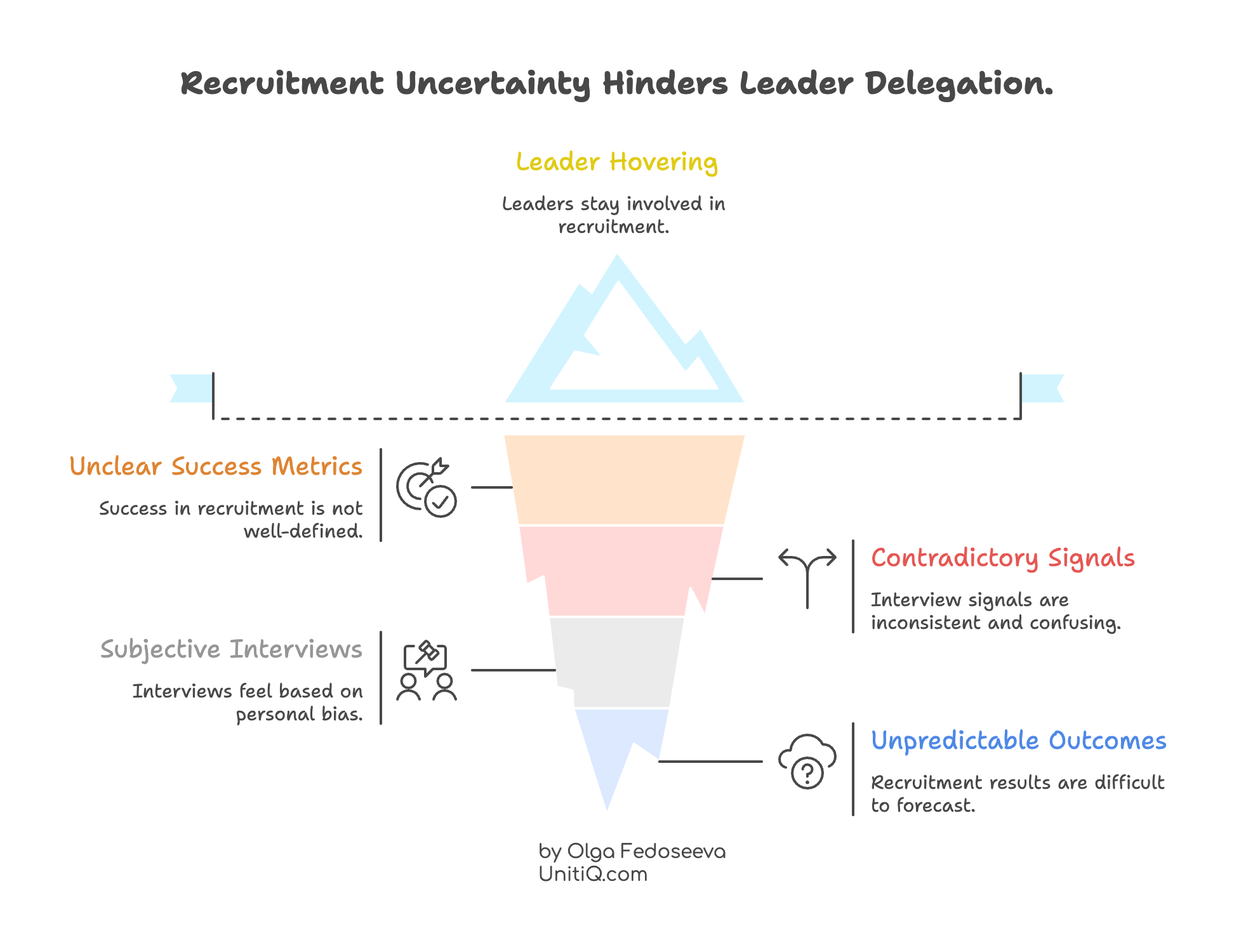
In recruitment, uncertainty shows up when:
- success isn’t clearly defined,
- signals contradict each other,
- interviews feel subjective,
- and outcomes are hard to predict.
The result? Founders can’t step back — not because they don’t trust people, but because they don’t trust the signals.
Uncertainty doesn’t stay contained — it becomes the real enemy of talent.
How Talent Acquisition Systems Create Uncertainty
Most recruitment processes unintentionally manufacture doubt in four ways:
1. Role-based hiring instead of outcome-based hiring
Roles describe responsibilities.
Execution requires results.
When talent acquisition focuses on titles, backgrounds, and years of experience, leaders are left guessing whether a candidate will actually perform in their environment.
2. Fragmented evaluation signals
CVs, interviews, take-home tasks, references, and opinions often tell different stories.
More data doesn’t reduce uncertainty when it isn’t aligned — it amplifies it.
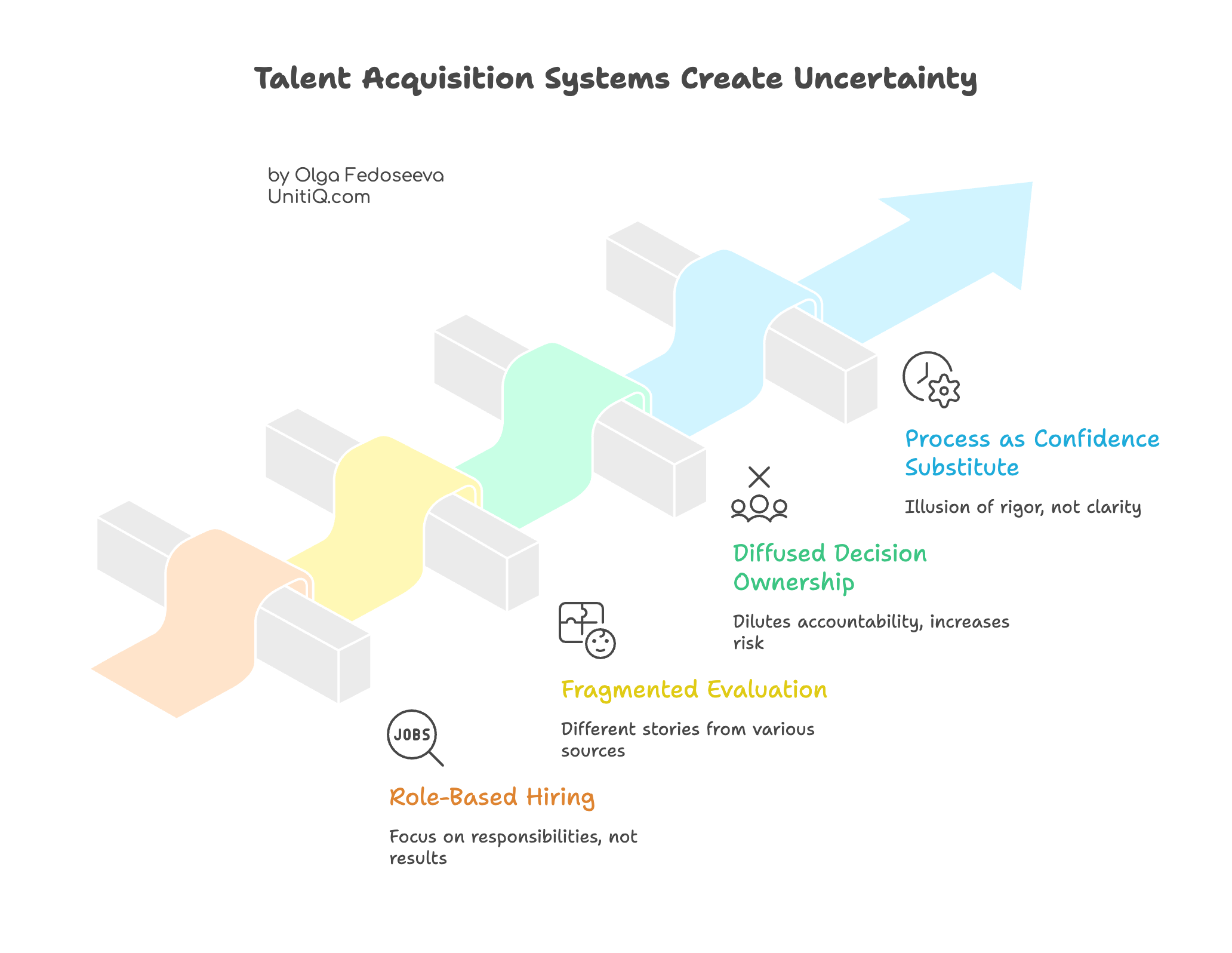
3. Diffused decision ownership
Committees feel safer than individuals, but they dilute accountability.
When no one owns the hiring decision, founders instinctively step in to reduce perceived risk.
4. Process as a substitute for confidence
Adding steps, interviews, and stakeholders creates the illusion of rigor — without increasing clarity.
Leaders don’t feel safer. They feel slower.
The real danger isn’t just slower hiring or compromised decisions. Unresolved uncertainty quietly drains leadership attention, shifts pressure onto high performers, and slows execution in ways most teams never measure.
→ The Hidden Cost of Hiring Uncertainty
Why Founders Stay Involved (Even When They Don’t Want To)
Founders are not micromanaging recruitment because they lack trust in their teams.
They stay involved because:
- execution expectations are unclear,
- hiring signals conflict,
- and the cost of a wrong hire is high and long-term.
Until uncertainty is removed from talent acquisition, founder involvement is a rational response, not a leadership failure.
Over time, this hesitation creates damage comparable to a bad hire — without the clarity of a single mistake.
The Real Cost of Uncertainty in Recruitment
Uncertainty doesn’t just slow hiring — it quietly damages the organization:
- Leadership attention is drained by constant checking
- Decisions are delayed or compromised
- Strong candidates walk away
- Teams lose momentum waiting for clarity
- Bad hires create downstream execution drag
This is why recruitment issues often show up later as:
- burnout,
- missed targets,
- and stalled execution — long after the hire was made.
What This Means for Talent Acquisition Leaders
Modern talent acquisition isn’t about sourcing faster or interviewing harder.
It’s about designing systems that reduce uncertainty for decision-makers.
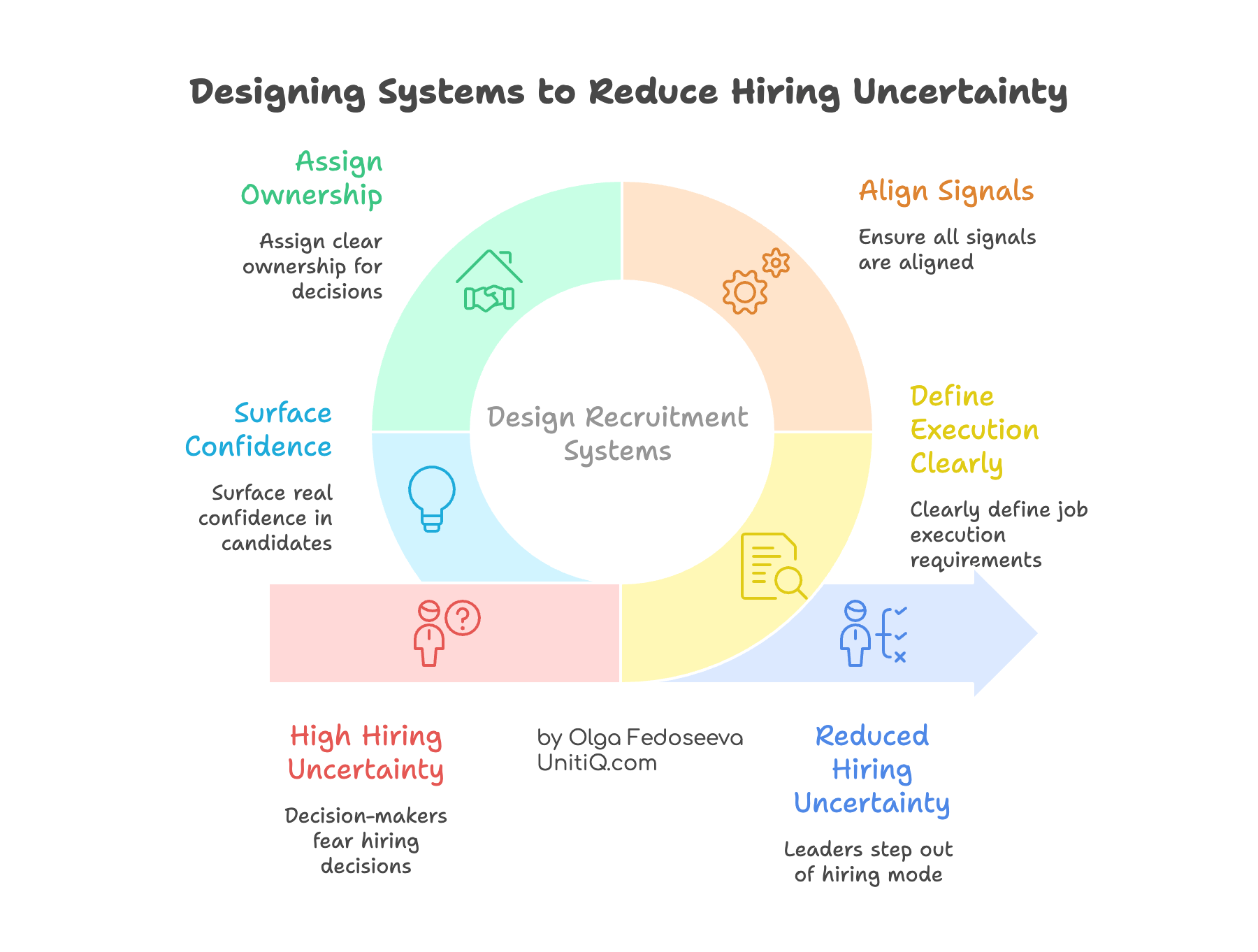
When recruitment systems:
- define execution clearly,
- align signals,
- assign ownership,
- and surface real confidence,
leaders can finally step out of hiring mode — without fear.
That’s when recruitment stops being a bottleneck and starts becoming an execution enabler.
TL;DR — Key Takeaways
- Founders stay involved in recruitment because uncertainty is high, not because hiring is hard.
- Uncertainty consumes leadership attention more than difficult work.
- Most talent acquisition systems increase uncertainty through unclear roles, fragmented signals, and diffused ownership.
- Adding more interviews and opinions doesn’t create confidence — it creates noise.
- Effective talent acquisition removes uncertainty so leaders can step back safely.
- Fixing recruitment is less about speed and more about trust in execution outcomes.
This article is part of a series on reducing uncertainty in talent acquisition:
– Why “almost right” candidates keep appearing
– Why decision ownership collapses as teams scale
– Why the real cost of hiring uncertainty is invisible
Each article explores one failure mode—and how to remove it at the system level.
Each bullet links to its respective follow-up.
– Why “almost right” candidates keep appearing
– Why decision ownership collapses as teams scale
– Why the real cost of hiring uncertainty is invisible
Each article explores one failure mode—and how to remove it at the system level.
Each bullet links to its respective follow-up.
If you want to sanity-check what’s breaking in your hiring system, we can walk through it together.
👉 Book a conversation
👉 Book a conversation
About the author
Olga Fedoseeva is the Founder of UnitiQ, a talent acquisition and People Projects partner for Series A–C tech startups across EU, UKI, and MENA.
She works with founders in Fintech, AI, Crypto, and Robotics who are stuck in hiring or execution mode — helping them restore momentum by redesigning hiring around execution, ownership, and real outcomes.
She works with founders in Fintech, AI, Crypto, and Robotics who are stuck in hiring or execution mode — helping them restore momentum by redesigning hiring around execution, ownership, and real outcomes.


