
Why recruiting alone doesn’t protect execution
In many early-stage startups, “talent acquisition” is treated as a more sophisticated word for recruiting.
Post a job.
Collect CVs.
Run interviews.
Fill the role.
The assumption is simple: once the role is filled, execution should improve.
But in reality, the opposite often happens.
A new hire joins — yet delivery still feels fragile.
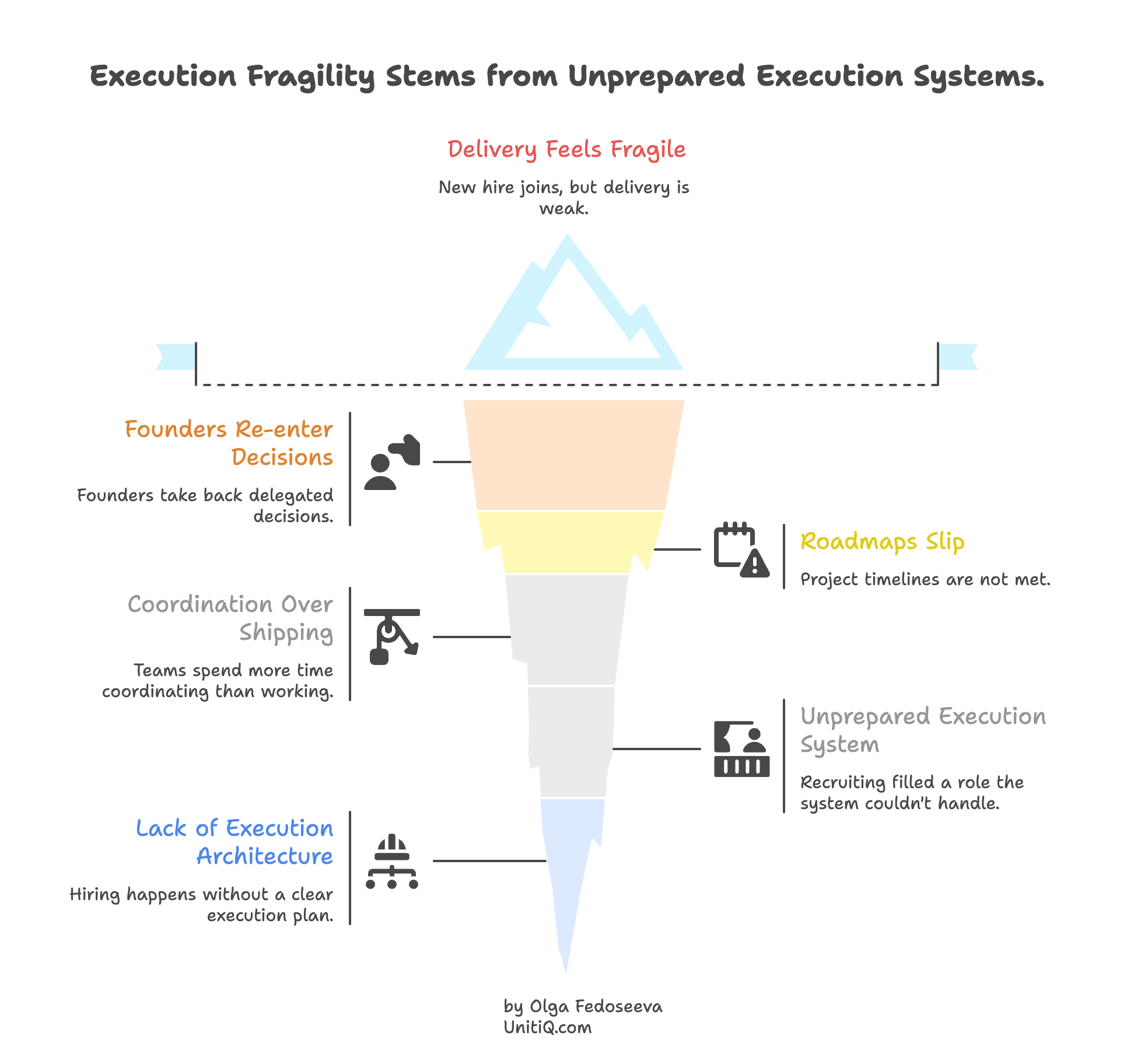
Founders re-enter decisions they thought they delegated.
Roadmaps slip.
Teams spend more time coordinating than shipping.
The problem usually isn’t the candidate.
It’s that recruiting filled a role that the execution system wasn’t ready to absorb.
Most hiring friction appears after the person joins — when unclear ownership, weak decision design, and escalation gaps start slowing the system down. (Read: Execution Fails After Hiring — Not During It)
At UnitiQ, we see this pattern constantly in Series A–C startups. The issue isn’t sourcing talent. It’s that hiring happens without a clear execution architecture behind it.
And without that architecture, even great hires struggle to create leverage.
Recruiting vs Talent Acquisition
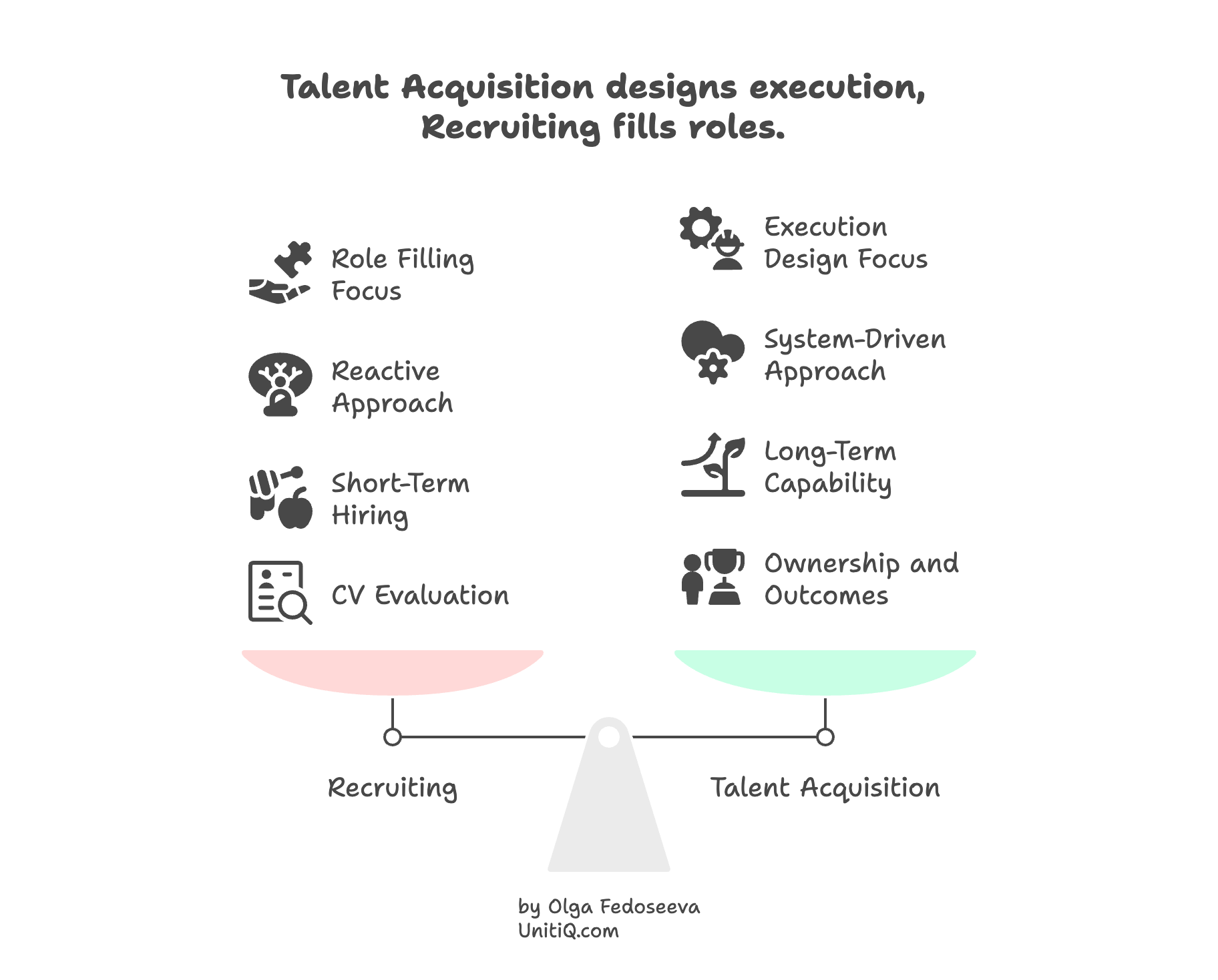
Recruiting focuses on filling roles.
Talent Acquisition focuses on designing the conditions where hires can create momentum.
That only works when hiring is treated as infrastructure — not as a reactive pipeline layered on top of an unclear system. (Read: Hiring as Infrastructure: Why Talent Acquisition Must Be Designed for Scale)
Recruiting asks:
Who can fill this position quickly?
Talent Acquisition asks:
What structure will allow this team to execute without founder re-entry?
The difference matters more as startups grow.
Because once teams move beyond 10–20 people, execution failures rarely come from lack of talent.
They come from:
- unclear ownership
- overlapping roles
- fragile decision authority
- coordination overload
Recruiting cannot fix those.
Talent Acquisition can — when it is treated as execution design, not just hiring activity.
Why Early Hiring Systems Break
Most startups don’t intentionally build fragile hiring systems.
They simply grow into them.
Hiring starts opportunistically:
“We need someone for growth.”
“We need someone for ops.”
“Let’s bring in a product manager.”
Roles are created quickly because the work exists.
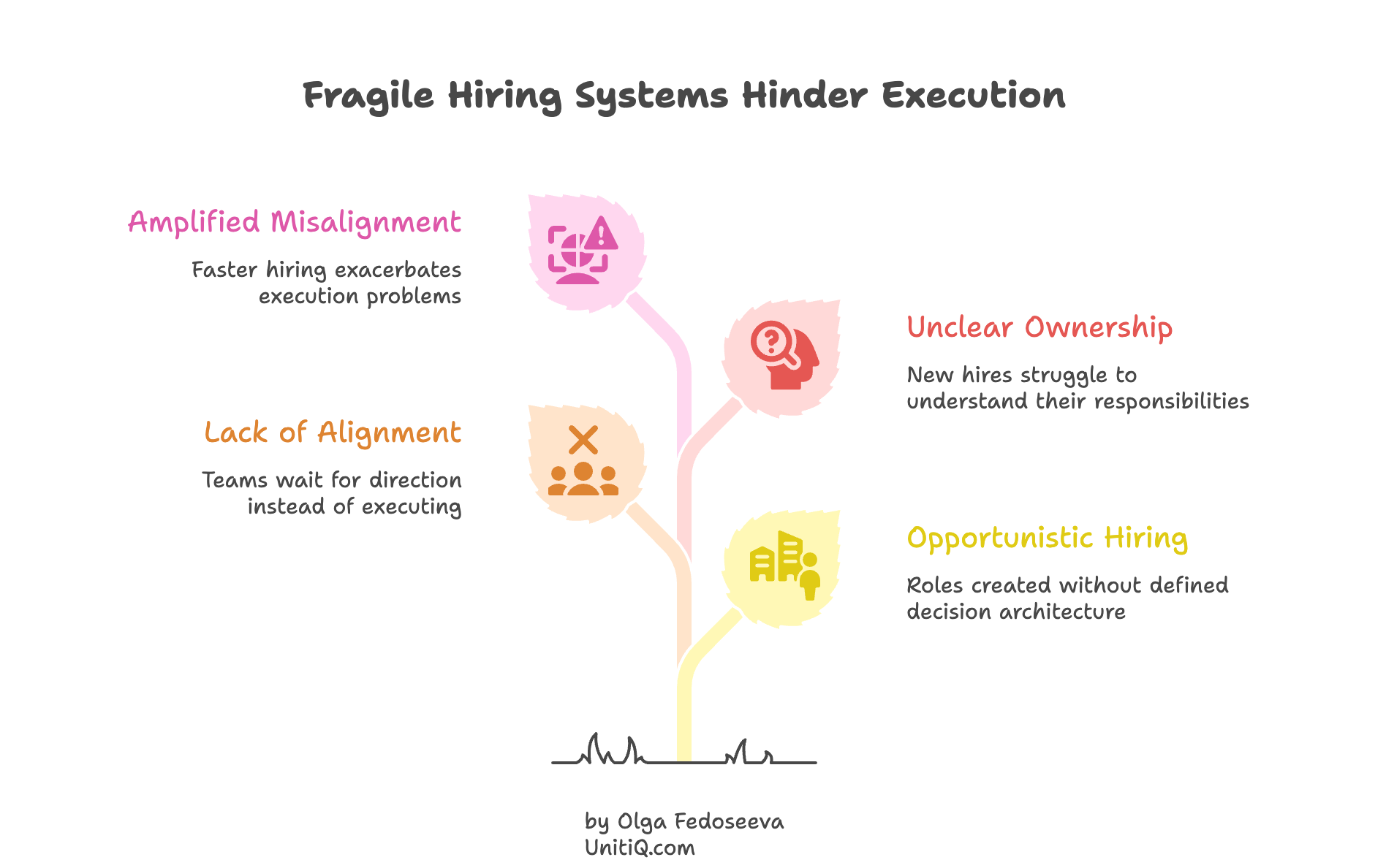
But the decision architecture behind those roles is never fully defined.
Over time this creates familiar symptoms:
- founders pulled back into operational decisions
- teams waiting for alignment instead of executing
- new hires struggling to understand real ownership
- hiring velocity increasing while execution velocity slows
At that point, companies try to solve the issue by hiring more.
More recruiters.
More candidates.
More speed.
But hiring faster doesn’t solve execution misalignment.
When ownership is still unclear, speed just adds coordination load faster than the system can absorb it. (Read: Why Hiring Faster Won’t Fix Your Execution)
It often amplifies it.
What a Real Talent Acquisition Playbook Includes
A modern TA system doesn’t start with sourcing.
It starts with execution clarity.
Before the first candidate enters the pipeline, several structural questions need answers.
1. Ownership Design
Every role must answer three questions clearly:
- What outcomes does this role own?
- What decisions can it make independently?
- Where does accountability begin and end?
Without this clarity, hires will escalate decisions back to founders — even if they are strong operators.
2. Role Architecture
Startups often hire titles instead of defining functions.
A “Head of Growth” can mean five different things depending on the company.
Talent Acquisition translates business needs into clear capability design, ensuring roles align with:
- product roadmap
- go-to-market stage
- operational maturity
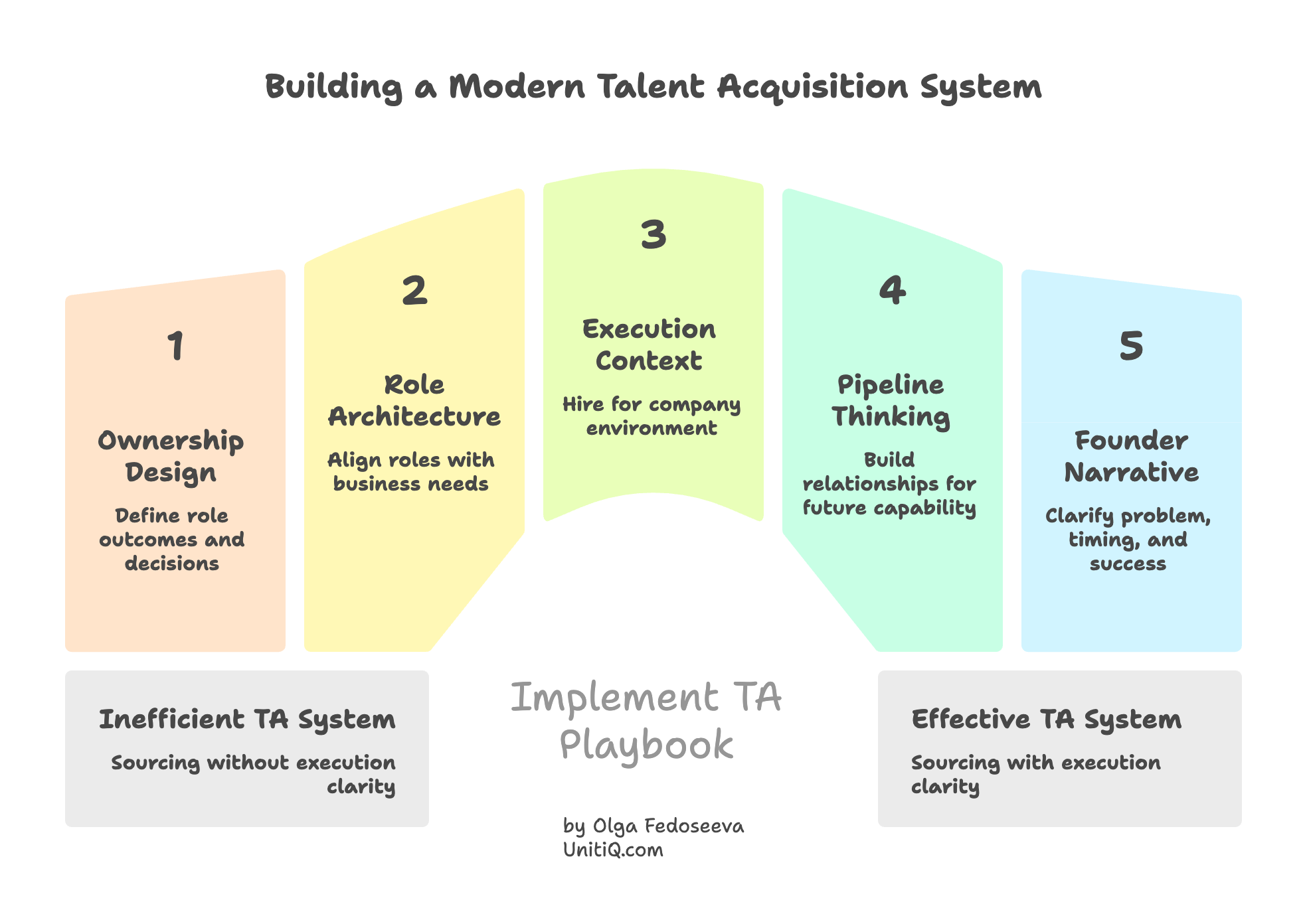
3. Hiring for Execution Context
Early startups often over-index on resumes.
But the real question isn’t:
Has this person done the job before?
It’s:
Can they operate inside your company’s execution environment?
That environment might include:
- ambiguous ownership
- fast iteration cycles
- cross-functional decision making
- evolving strategy
Hiring without evaluating for context fit creates post-hire friction, even with experienced candidates.
4. Pipeline Thinking
Traditional recruiting focuses on immediate vacancies.
Talent Acquisition builds relationship pipelines for future capability.
This reduces hiring pressure when key roles emerge and prevents rushed decisions under operational stress.
5. Founder Narrative Clarity
Great candidates rarely join early-stage startups because of job descriptions.
They join because they understand:
- the problem the company is solving
- why the timing matters
- what success looks like
- what kind of team they will be joining
When this narrative is unclear, even strong hiring pipelines struggle to convert.
The Most Expensive Hiring Mistake Startups Make
The most expensive hiring mistake isn’t a bad hire.
It’s hiring into an undefined system.
Before hiring creates leverage, ownership, decision boundaries, and execution readiness have to be true inside the business first. (Read: What Must Be True Before You Hire)
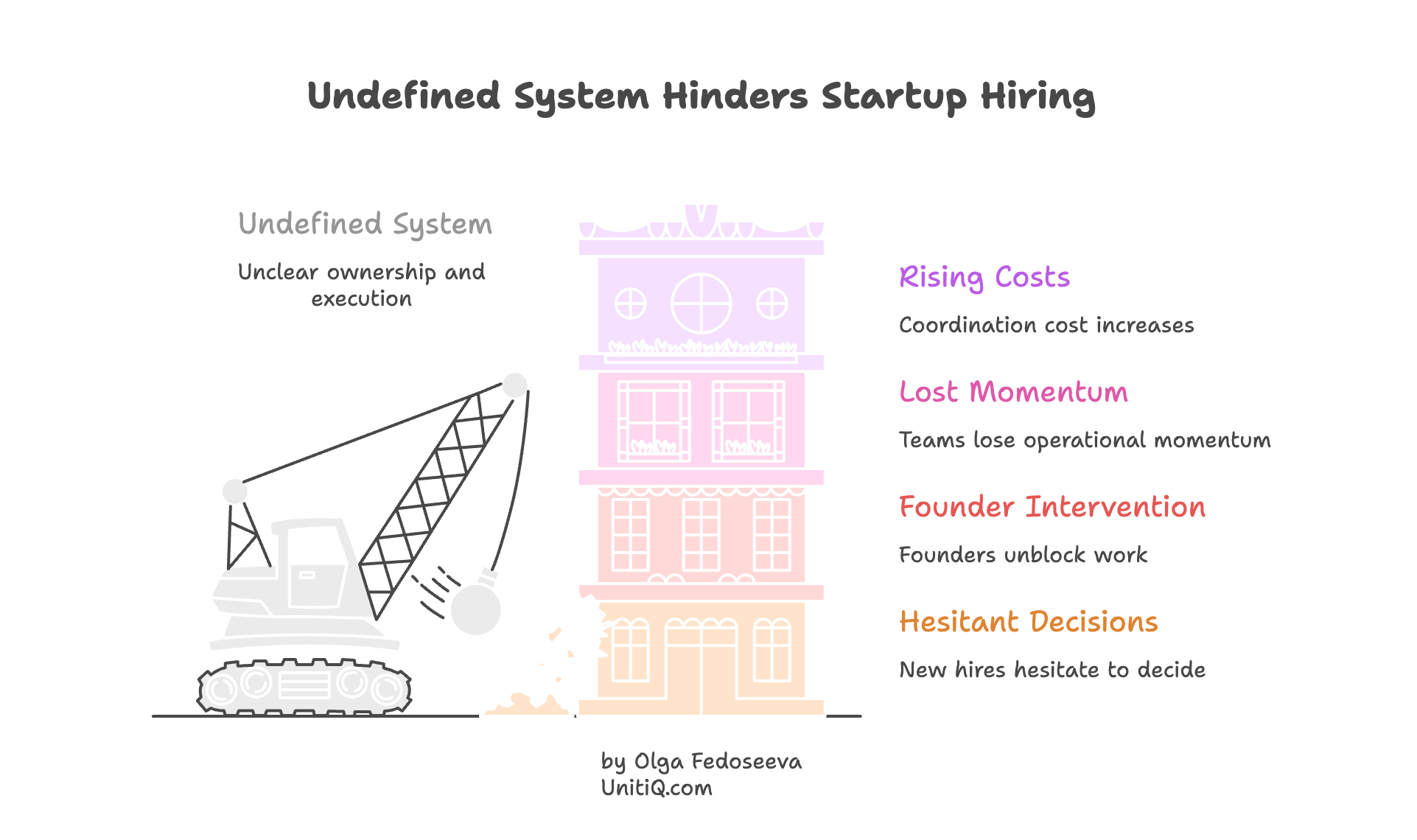
When ownership and execution structures are unclear:
- new hires hesitate to make decisions
- founders step back in to unblock work
- teams lose momentum
- coordination cost rises
From the outside it looks like a talent problem.
But inside the organization, the real issue is structural.
This is why some startups hire exceptional people — yet still feel stuck operationally.
When Startups Need a Talent Partner (Not Just a Recruiter)
Recruiters help find candidates.
Talent partners help design execution capacity.
The difference is not just in delivery model — it is in whether someone is there to clarify roles, shape the process, and protect execution before hiring pressure compounds. (Read: What Does a Modern Talent Partner Actually Do?)
The difference becomes critical when companies reach the stage where:
- founders cannot be in every decision
- teams grow beyond informal coordination
- hiring becomes a strategic lever for delivery
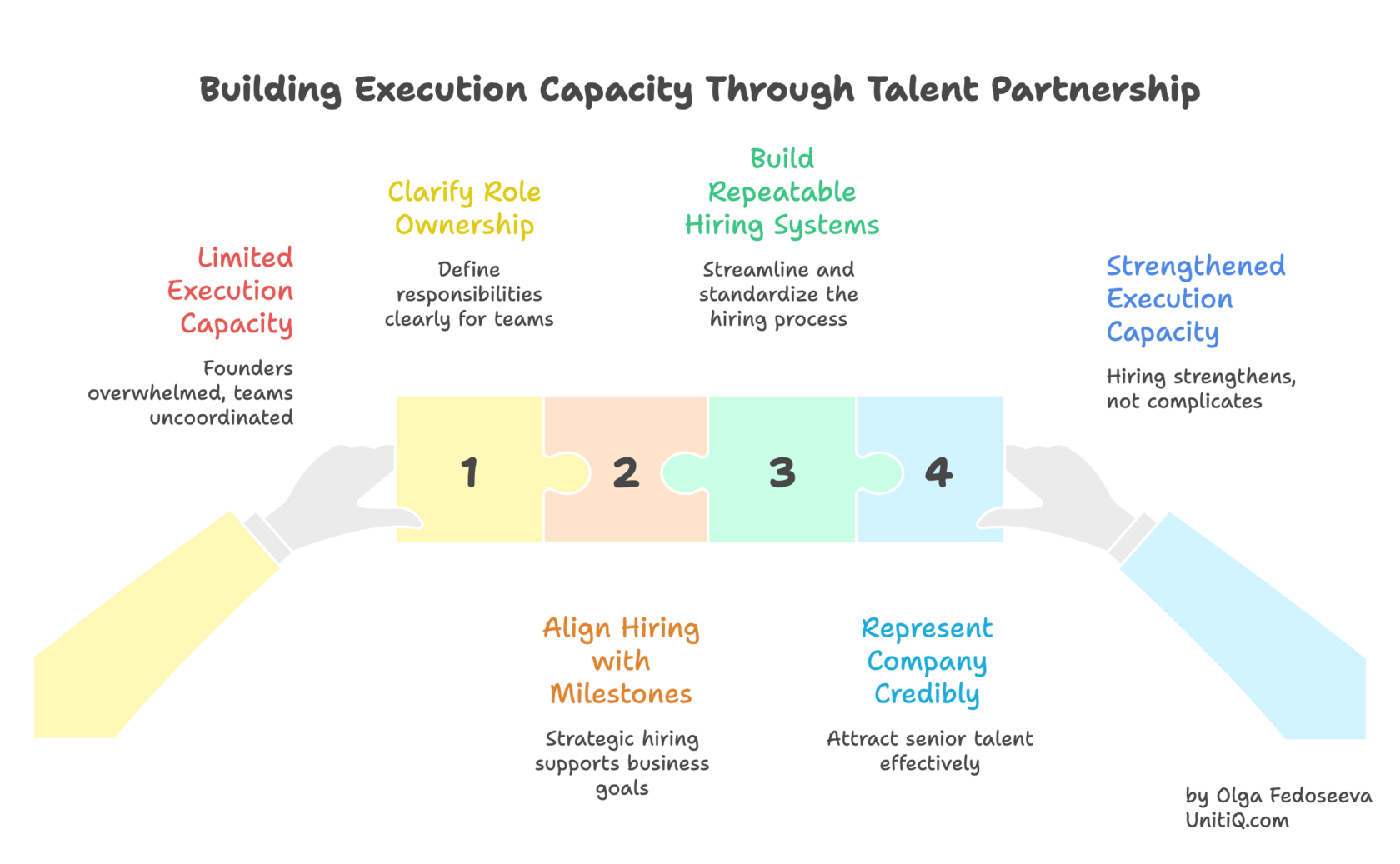
A strong talent partner works inside the company’s context to:
- clarify role ownership
- align hiring with business milestones
- build repeatable hiring systems
- represent the company credibly to senior candidates
This is the role UnitiQ typically plays.
Not as an external agency delivering CVs — but as an embedded partner ensuring hiring strengthens execution instead of complicating it.
The Reality: Hiring Alone Doesn’t Create Leverage
Early startups often believe that more people will solve execution problems.
But headcount doesn’t automatically create leverage.
Without clear ownership structures and aligned hiring design, new hires simply increase coordination cost.
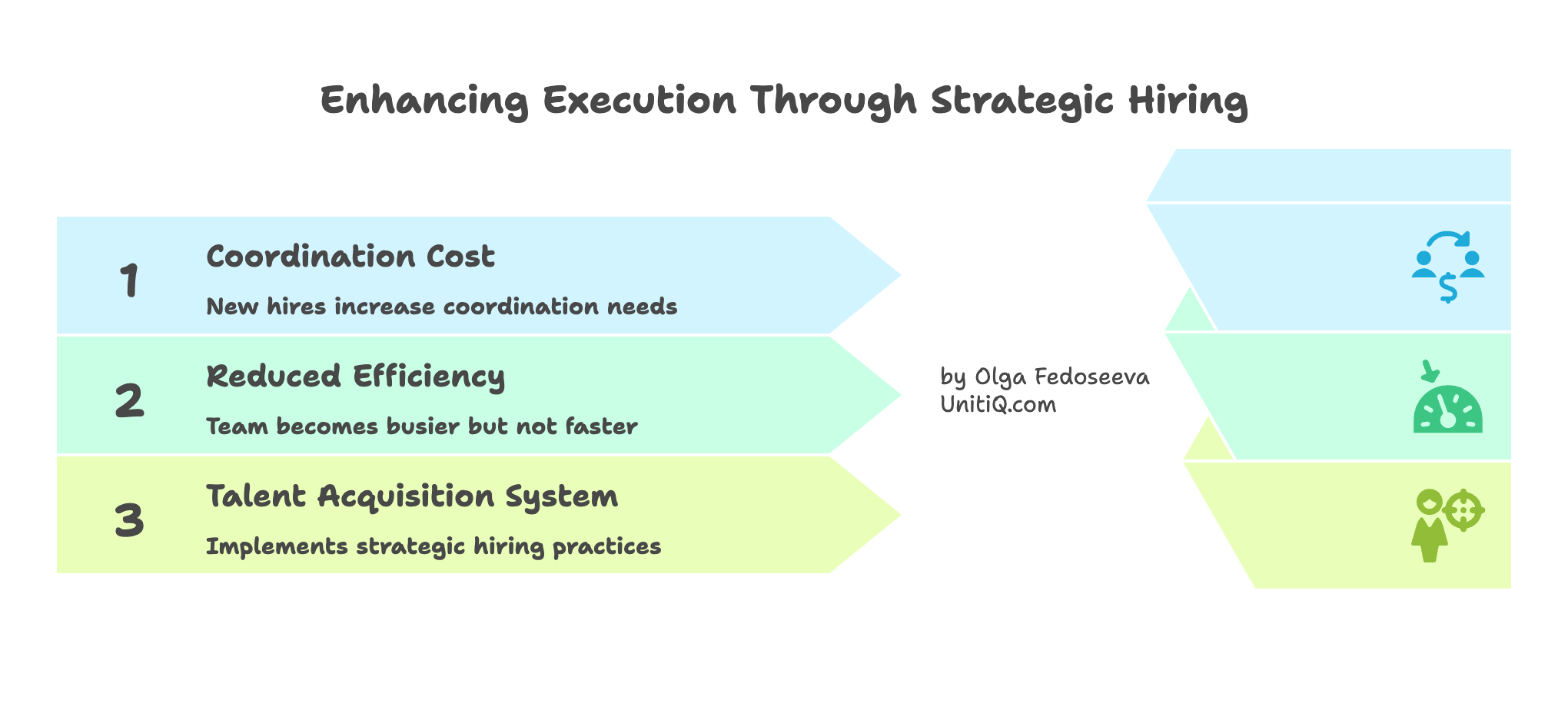
And the team becomes busier without becoming faster.
A modern Talent Acquisition system protects against that outcome.
It ensures that every hire strengthens the team’s ability to execute — not just its size.
For early teams, that starts with building a lightweight Talent Acquisition function before hiring becomes reactive, inconsistent, and founder-dependent. (Read: How Early-Stage Startups Should Build Their First Talent Acquisition Function)
Final Thought
In the early days of a startup, the team is the operating system of the company.
Hiring randomly doesn’t just slow growth.
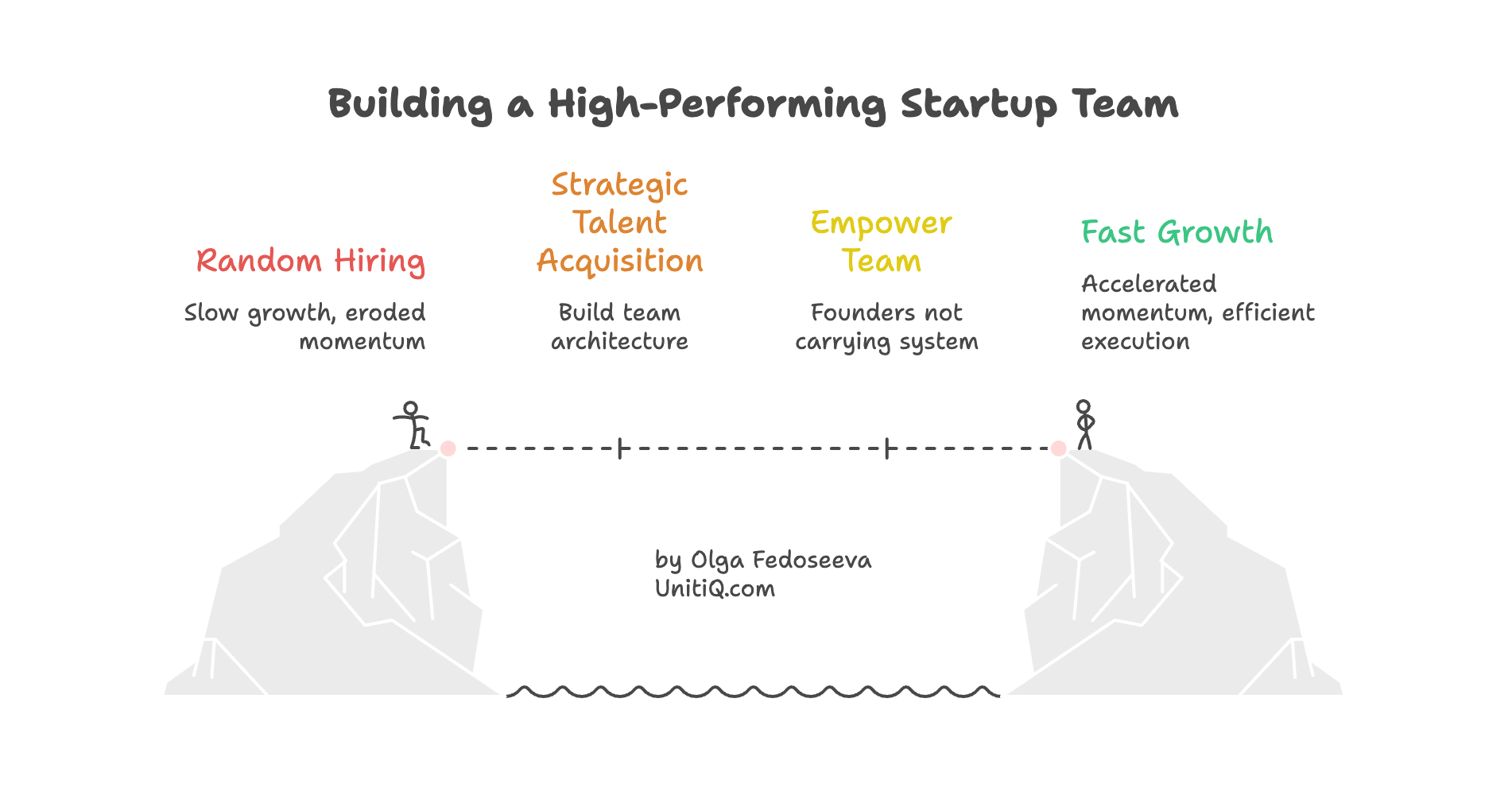
It quietly erodes execution momentum.
Talent Acquisition done well is not about filling roles.
It is about building a team architecture that allows the company to move faster without founders carrying the entire system themselves.
If you want to sanity-check which model fits your current stage — and where execution is actually breaking — we can walk through it together.
About the author
Olga Fedoseeva is the Founder of UnitiQ, a talent acquisition and People Projects partner for Tech Startups across EU, UKI, and MENA.
She works with founders in Fintech, AI, Crypto, and Robotics to prevent mis-hires before they compound — restoring execution momentum and protecting teams from quiet burnout.


