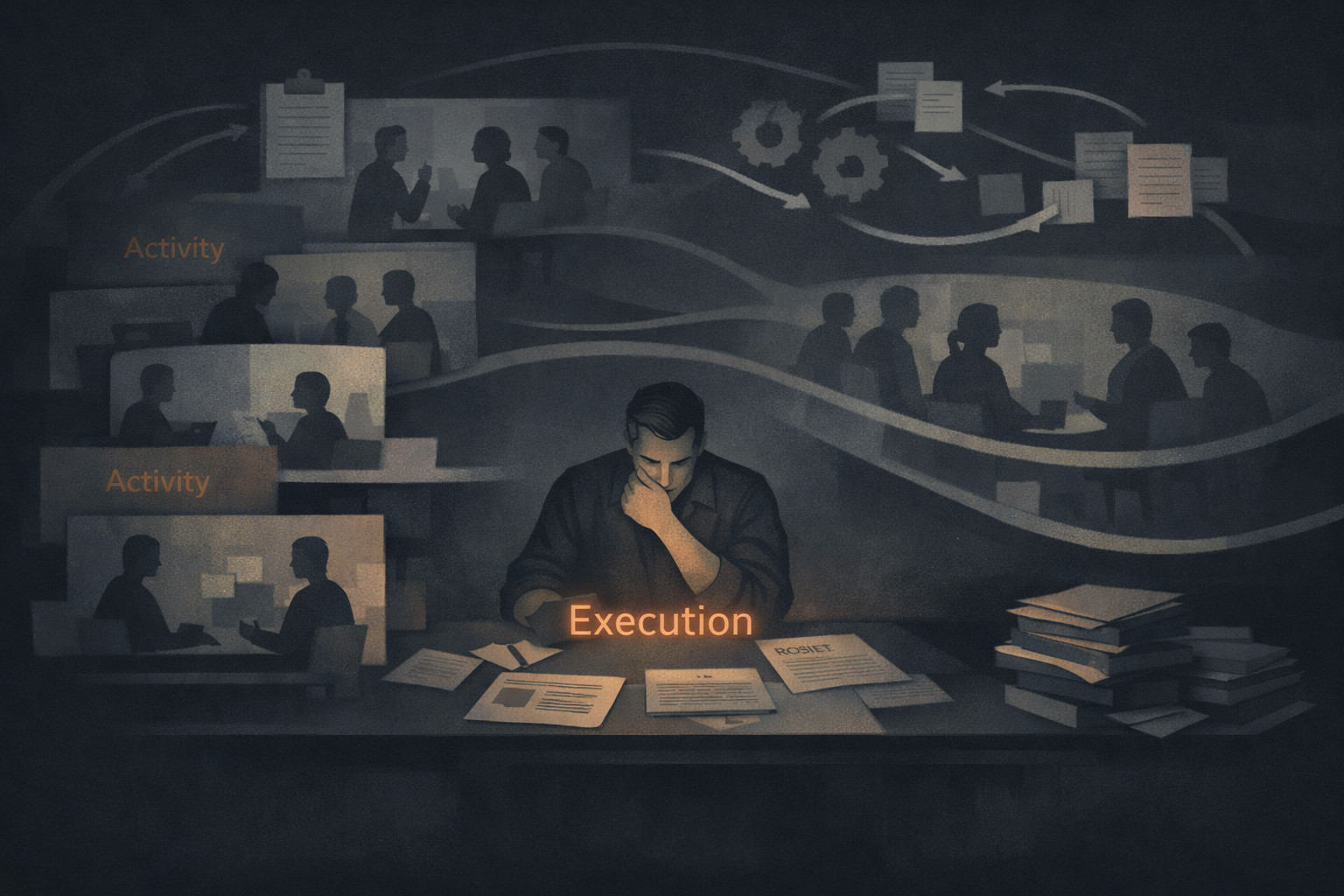
The HR Mistakes That Quietly Cost Startups Execution, Not Just Money
Most HR mistakes in startups don’t show up in reports.
They don’t trigger alarms.
They don’t fail loudly.
They don’t look like “HR problems” at all.
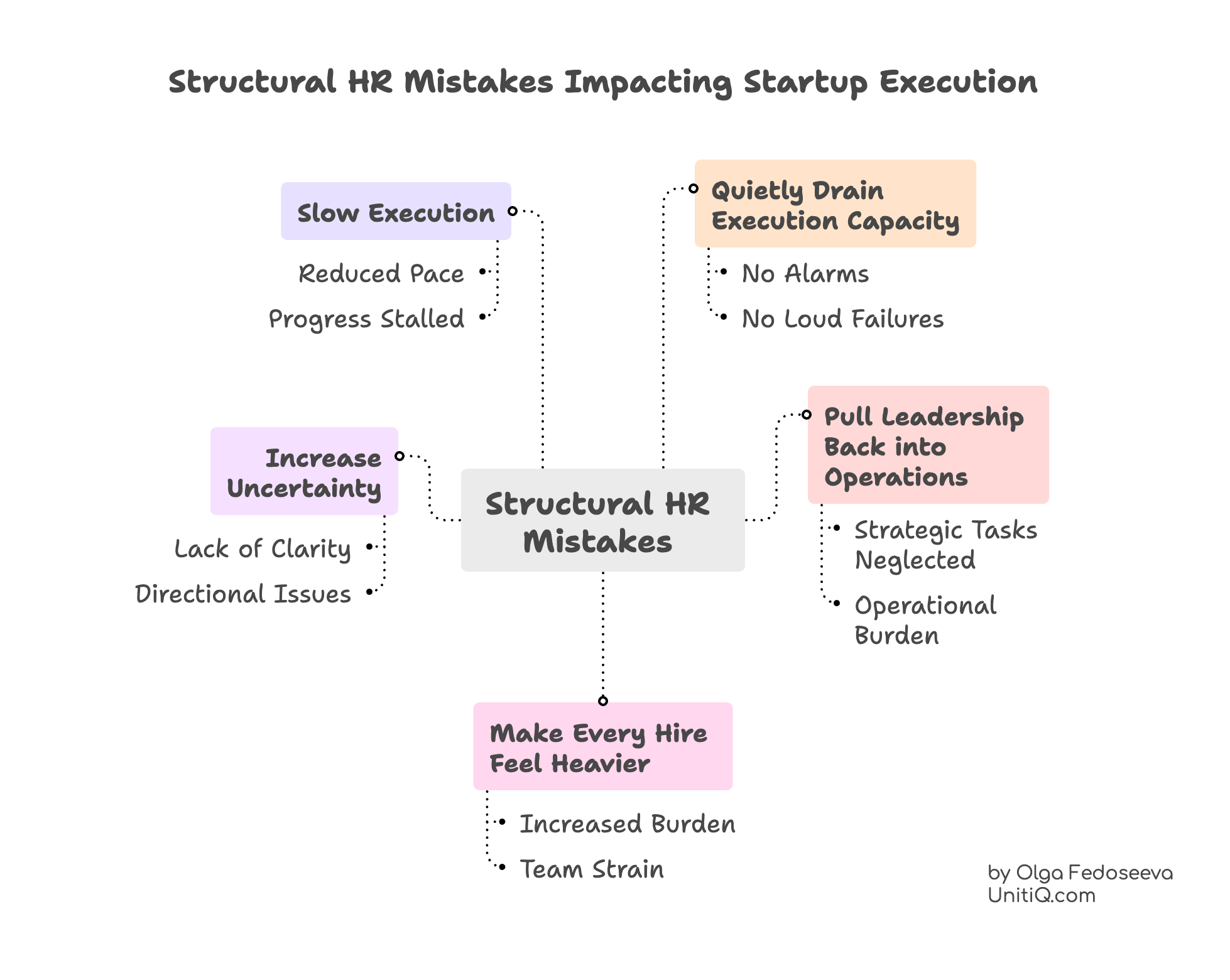
Instead, they quietly drain execution capacity, pull leadership back into operations, and make every hire feel heavier than the last.
This article isn’t about policies, benefits, or compliance gaps.
It’s about the structural HR mistakes that increase uncertainty and slow execution as startups scale.
Across all of these mistakes, one pattern shows up repeatedly: hiring activity increases, but execution does not — because hiring is not the real bottleneck, execution capability is.
Mistake #1: Treating Hiring as a Transaction Instead of a System
Many startups treat hiring as a sequence of isolated actions:
- open a role
- interview candidates
- make a decision
- move on
But in reality, every hire changes the system.
When hiring is treated as a transaction:
- mistakes don’t generate learning
- successes aren’t repeatable
- leaders stay involved “just in case”
The cost isn’t one bad hire.
The cost is starting from zero every time.
Execution suffers because the system never compounds.
Mistake #2: Confusing Activity With Progress
Startups often mistake visible HR activity for progress:
- more interviews
- more feedback rounds
- more alignment meetings
- more documentation
These activities feel responsible.
They rarely reduce uncertainty.
When roles are unclear and ownership is diffused, activity becomes a way to delay commitment, not improve decision quality.
Execution slows — not because teams are lazy, but because confidence never arrives.
Mistake #3: Allowing “Almost Right” to Become Normal
In high-pressure environments, “almost right” hires feel pragmatic.
They reduce short-term stress.
They keep projects moving.
They avoid restarting the search.
But “almost right” is not neutral.
In fact, almost-right candidates are usually a signal of upstream uncertainty, not a pragmatic compromise.
Over time it creates:
- increased oversight
- slower decision-making
- uneven performance standards
- hidden leadership involvement
The cost isn’t immediate.
It compounds quietly across execution.
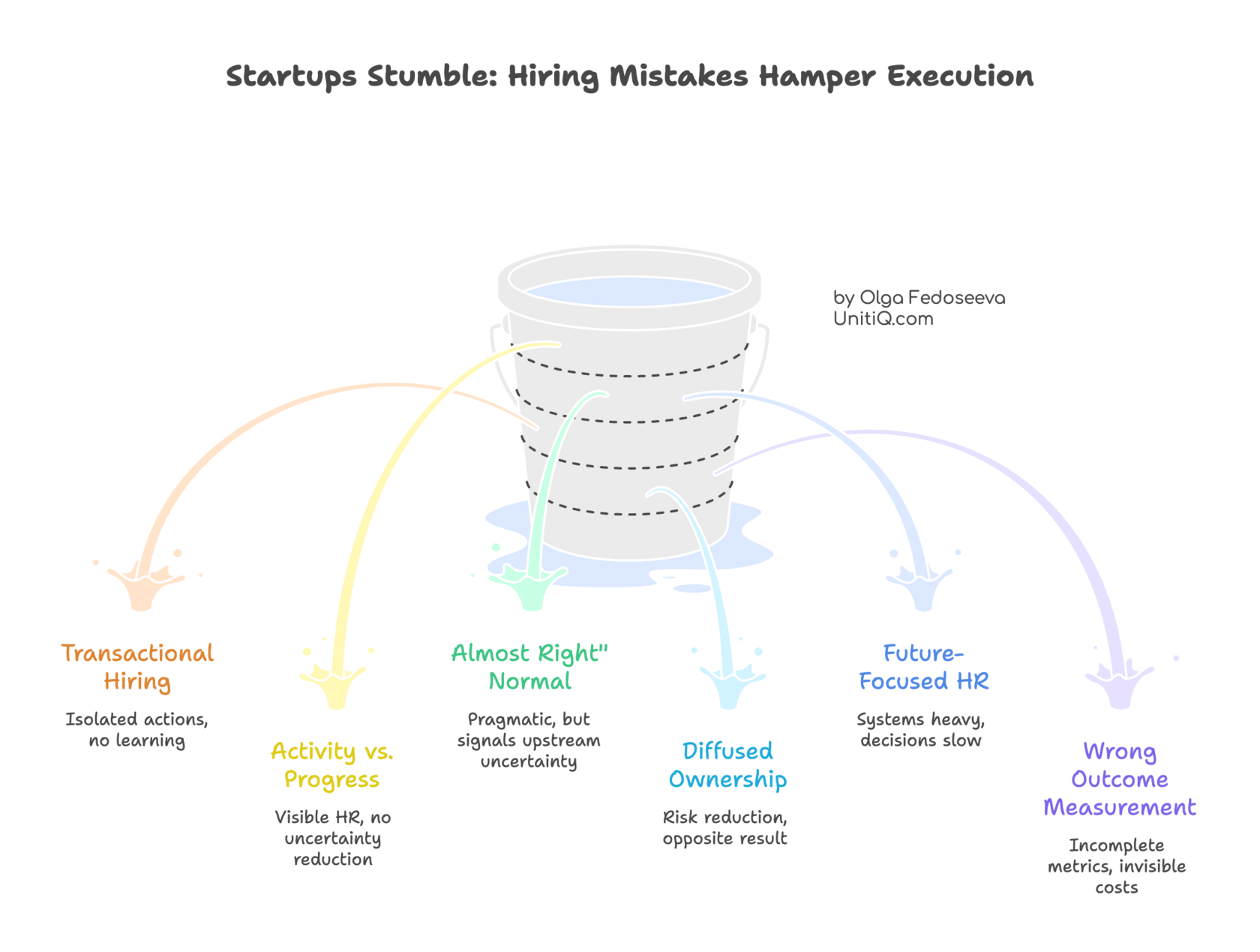
Mistake #4: Diffusing Ownership to Feel Safe
As teams grow, hiring decisions often become collective by default.
More interviewers.
More opinions.
More consensus-seeking.
The intention is risk reduction.
The result is the opposite.
When no one owns the decision:
- leaders stay involved
- accountability blurs
- signals conflict
- hesitation becomes the norm
This is the point where talent acquisition breaks when everyone has a signal but no one owns the decision.
Execution doesn’t fail.
It drags.
Mistake #5: Designing HR for the Company You Want to Be, Not the One You Are
Many HR systems are designed for future maturity:
- full frameworks
- multi-layer approvals
- best-practice templates
- long-term role architectures
But hiring breaks in the present.
When HR is designed for stability instead of ambiguity:
- systems become heavy
- decisions slow
- leaders override late explained processes
The cost is not “immature HR.”
The cost is misaligned HR.
Mistake #6: Measuring the Wrong Outcomes
Startups often track:
- time-to-hire
- cost-per-hire
- offer acceptance rate
These metrics are not wrong.
They’re incomplete.
What goes unmeasured:
- leadership attention spent on hiring
- rework caused by unclear roles
- execution delays caused by compromise
- time high performers spend absorbing ambiguity
These invisible costs are usually larger than the visible ones.
Over time, they accumulate into the hidden cost of hiring uncertainty..
If you want to sanity-check what’s breaking in your hiring system, we can walk through it together.
👉 Book a conversation
👉 Book a conversation
What These Mistakes Have in Common
They all increase uncertainty.
And uncertainty is the real enemy of talent acquisition in growing startups.
Not uncertainty about people —
uncertainty about outcomes, ownership, and execution.
And uncertainty is what pulls founders and executives back into hiring long after they should be focused on strategy.
What Fixing HR Mistakes Actually Looks Like
Fixing these mistakes doesn’t start with new tools or frameworks.
It starts with:
- defining execution before evaluation
- making decision ownership explicit
- aligning signals early
- designing HR for ambiguity, not stability
- measuring confidence, not just speed
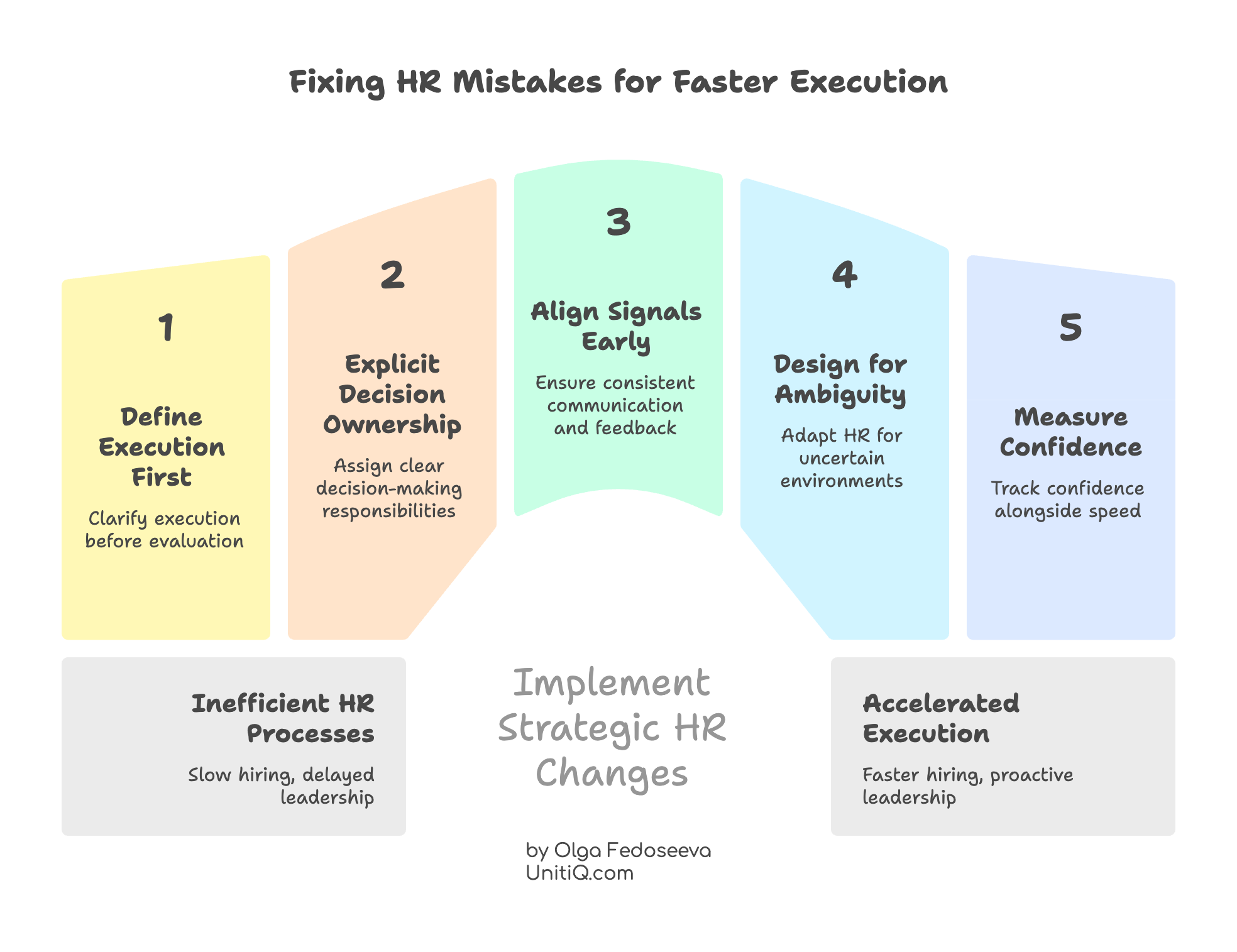
When uncertainty drops:
- hiring speeds up naturally
- leaders step out earlier
- execution regains momentum
That’s the real return on HR done right.
TL;DR / Key Takeaways
- The most expensive HR mistakes don’t look like HR problems
- Treating hiring as transactional prevents learning and compounding
- Activity does not equal decision confidence
- “Almost right” hires quietly tax execution
- Diffused ownership keeps leaders trapped in hiring
- Reducing uncertainty is the real job of HR in startups
About Author
Olga Fedoseeva is the Founder of UnitiQ, a talent acquisition partner for Series A–pre-IPO companies in Fintech, Robotics, and Mobility across EU, UKI, and MENA.
She works directly with founders and Heads of People who are stuck in hiring mode and need momentum back — helping teams move from reactive hiring to focused People Projects that reduce mis-hire risk and restore aligned execution.


