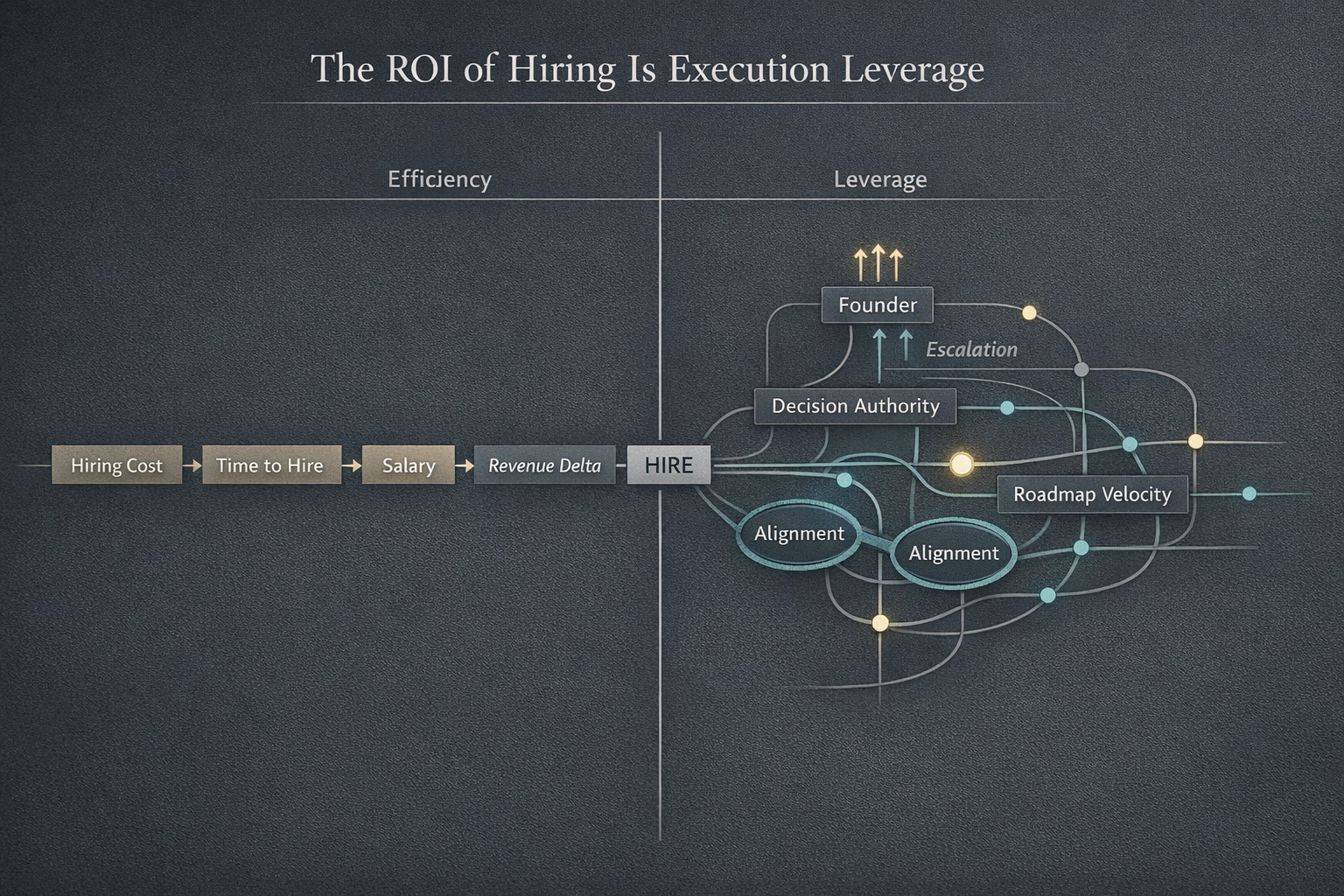
When founders ask about the ROI of Talent Acquisition, they usually mean one of three things:
- Cost per hire
- Time to hire
- Agency vs in-house efficiency
All reasonable questions.
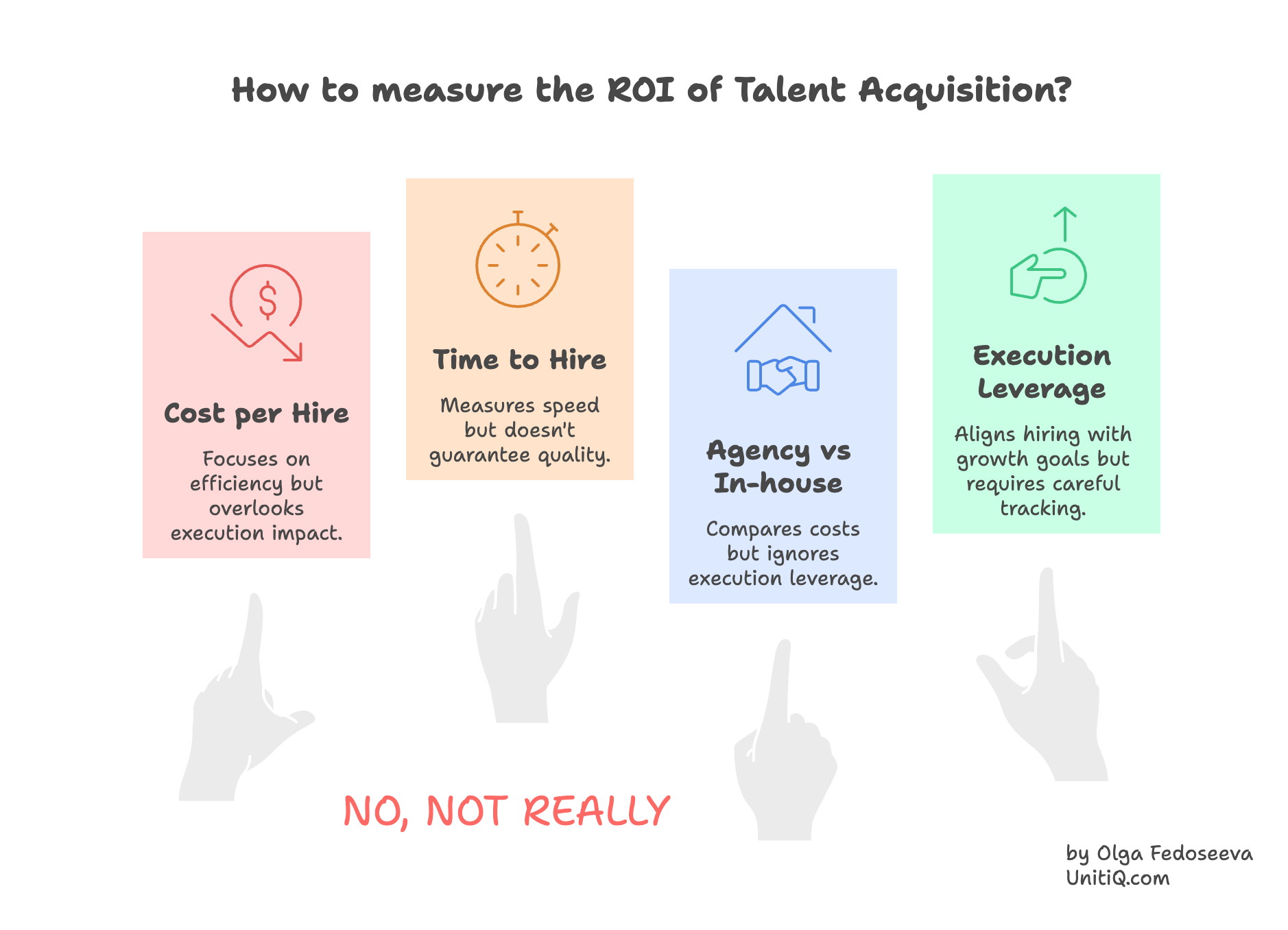
All strategically incomplete.
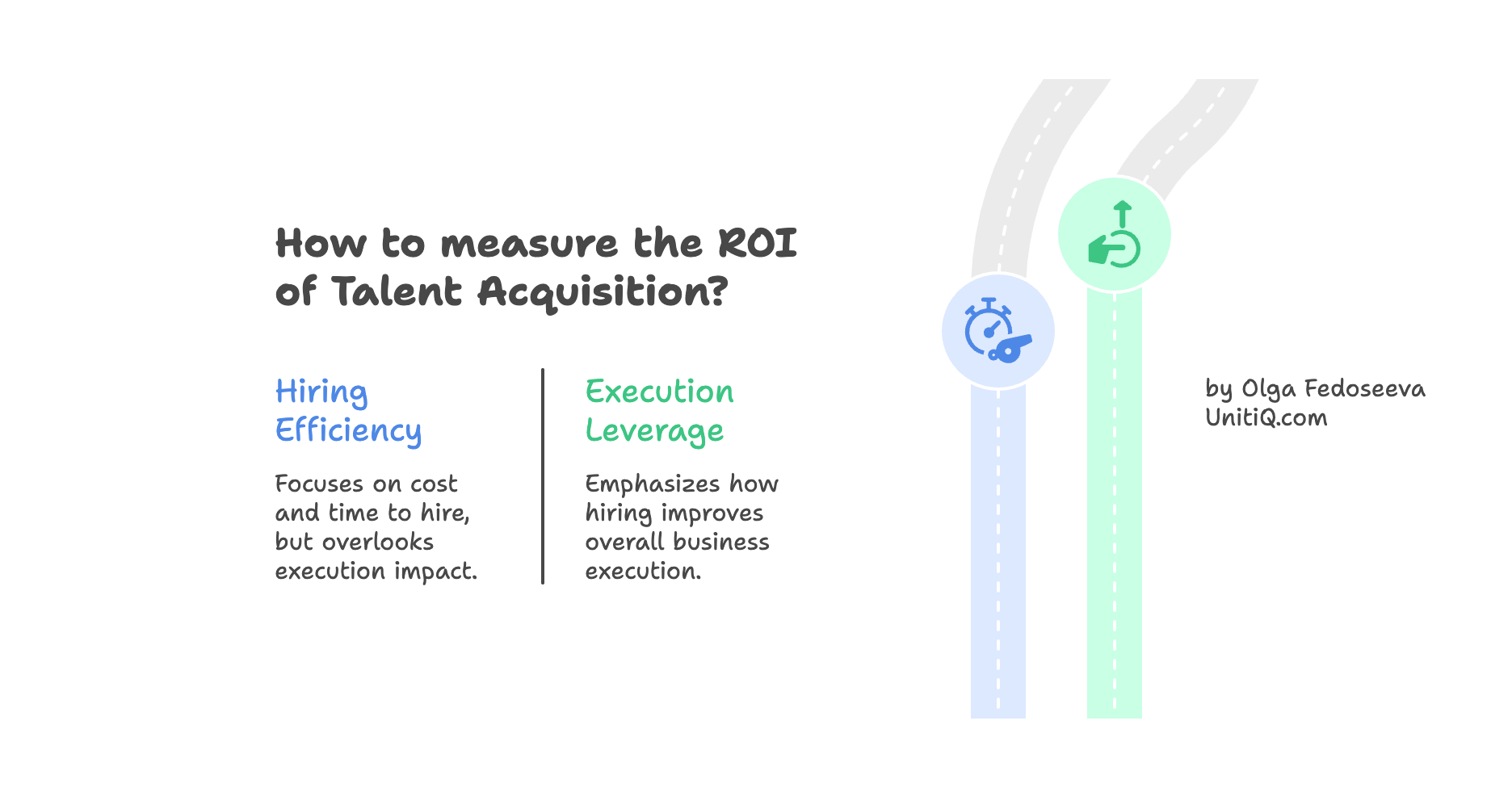
Because in a growth-stage startup, the ROI of Talent Acquisition isn’t about hiring efficiency.
It’s about execution leverage.
Most teams keep optimizing hiring activity because it’s measurable — while the real constraint is whether the org can absorb decisions without slowing down. (Read: Hiring Is Not the Bottleneck — Execution Capacity Is)
And if execution isn’t improving, your ROI is negative — no matter how “efficient” your hiring looks on paper.
The Traditional ROI Framing (And Why It Fails in Startups)
Conventional thinking defines TA ROI like this:
Revenue impact – Hiring cost = ROI
Or:
Cost per hire vs performance output.
The problem?
This works in stable corporate systems.
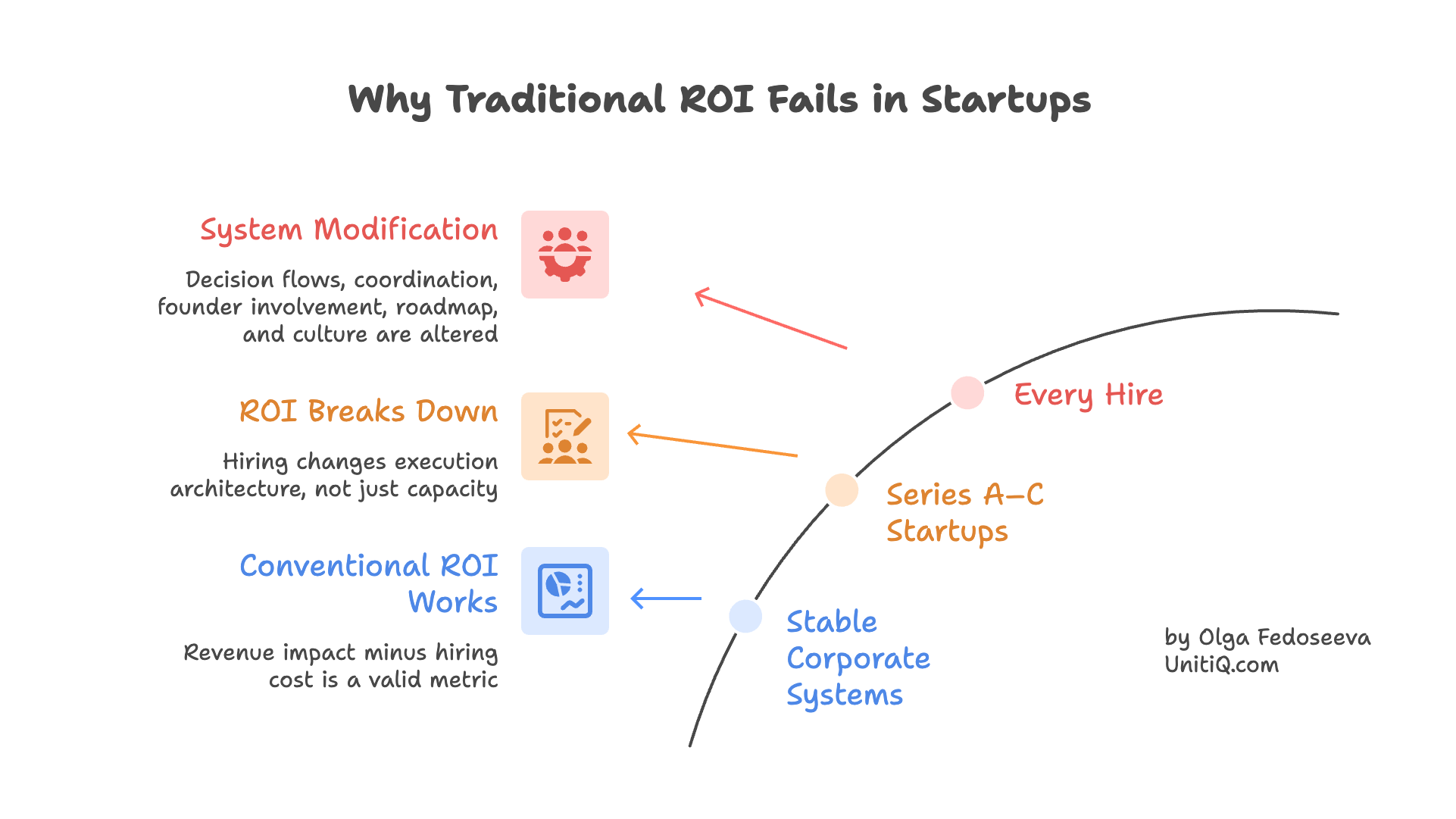
It breaks in Series A–C startups.
Because at growth stage, hiring doesn’t just add capacity.
It changes the execution architecture.
Every hire:
- Shifts decision flows
- Changes coordination cost
- Alters founder involvement
- Affects roadmap velocity - In growth-stage startups, hiring isn’t an HR activity — it’s one of the highest-leverage product decisions a founder makes.
- Influences cultural tolerance for ambiguity
That’s why ROI breaks down in Series A–C: decision authority quietly collapses, and hiring ‘senior’ doesn’t fix a broken decision system. (Read: Why Decision Authority Breaks as Startups Scale (And Hiring Can’t Fix It).
You’re not adding labor.
You’re modifying the system.
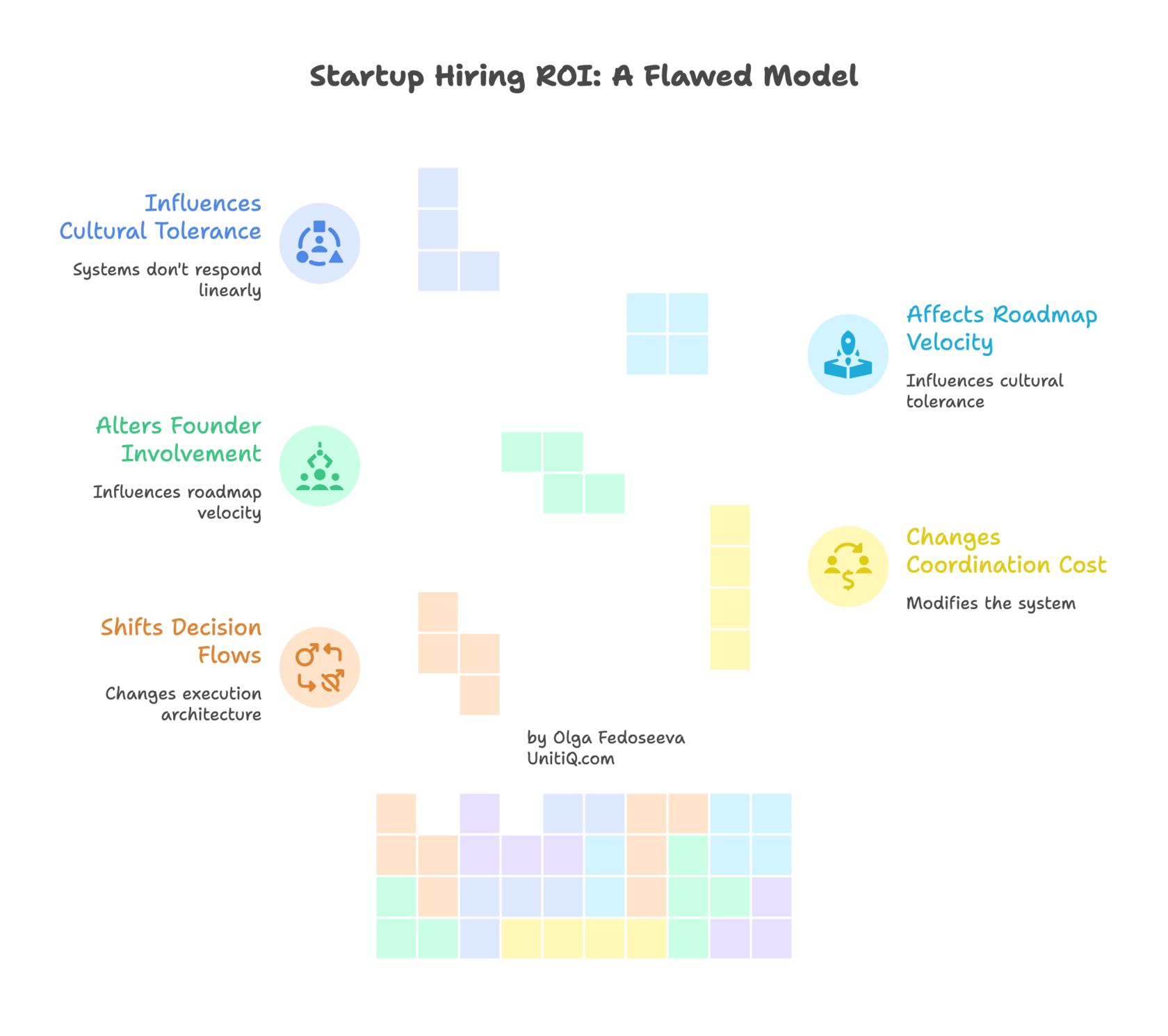
And systems don’t respond linearly.
The Real Risk: Execution Dilution
Here’s what actually destroys ROI in scaling startups:
You hire a “strong” candidate.
They’re competent.
They’re experienced.
They perform their function.
But:
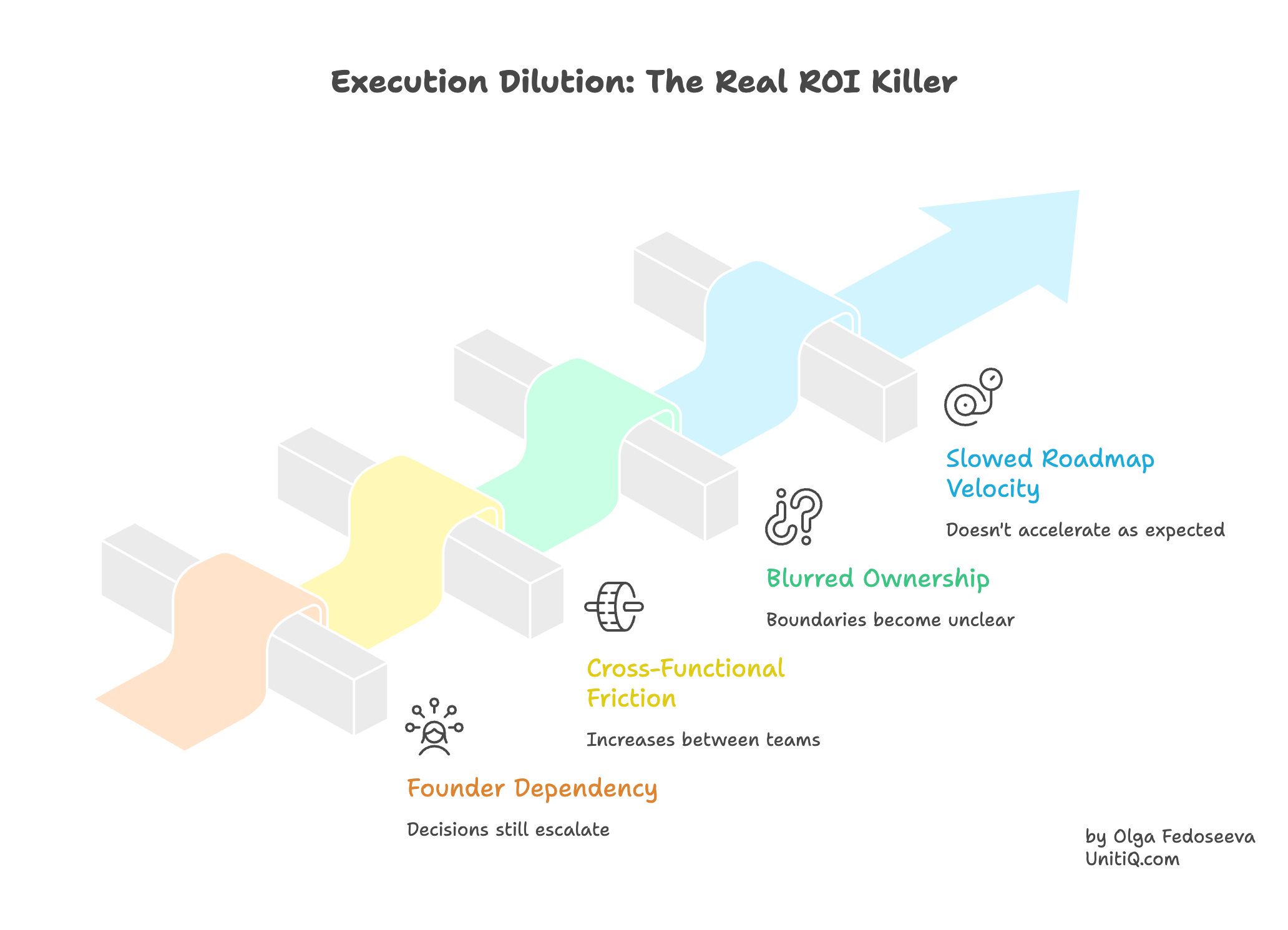
- Decisions still escalate to the founder
- Cross-functional friction increases
- Ownership boundaries blur
- Roadmap velocity doesn’t accelerate
The role is filled.
Execution hasn’t improved.
That’s negative ROI.
Because the breakdown rarely happens in interviews — it happens after the hire joins, when ownership boundaries and escalation routes were never designed. (Read: Execution Fails After Hiring — Not During It).
Not financially.
Structurally.
And structural drag compounds.
Redefining ROI: The Execution Leverage Model
In growth-stage startups, the ROI of Talent Acquisition should be measured by one variable:
Does this hire increase autonomous execution capacity?
If yes → positive ROI.
If no → coordination cost increases.
Here’s the Execution ROI Model for Series A–C companies.
A hire generates positive ROI when it:
Reduces Founder Re-Entry
Fewer operational escalations.
Fewer decisions bouncing back to the founder.
Increases Decision Autonomy
Clear authority.
Independent judgment under ambiguity.
Faster local decisions.
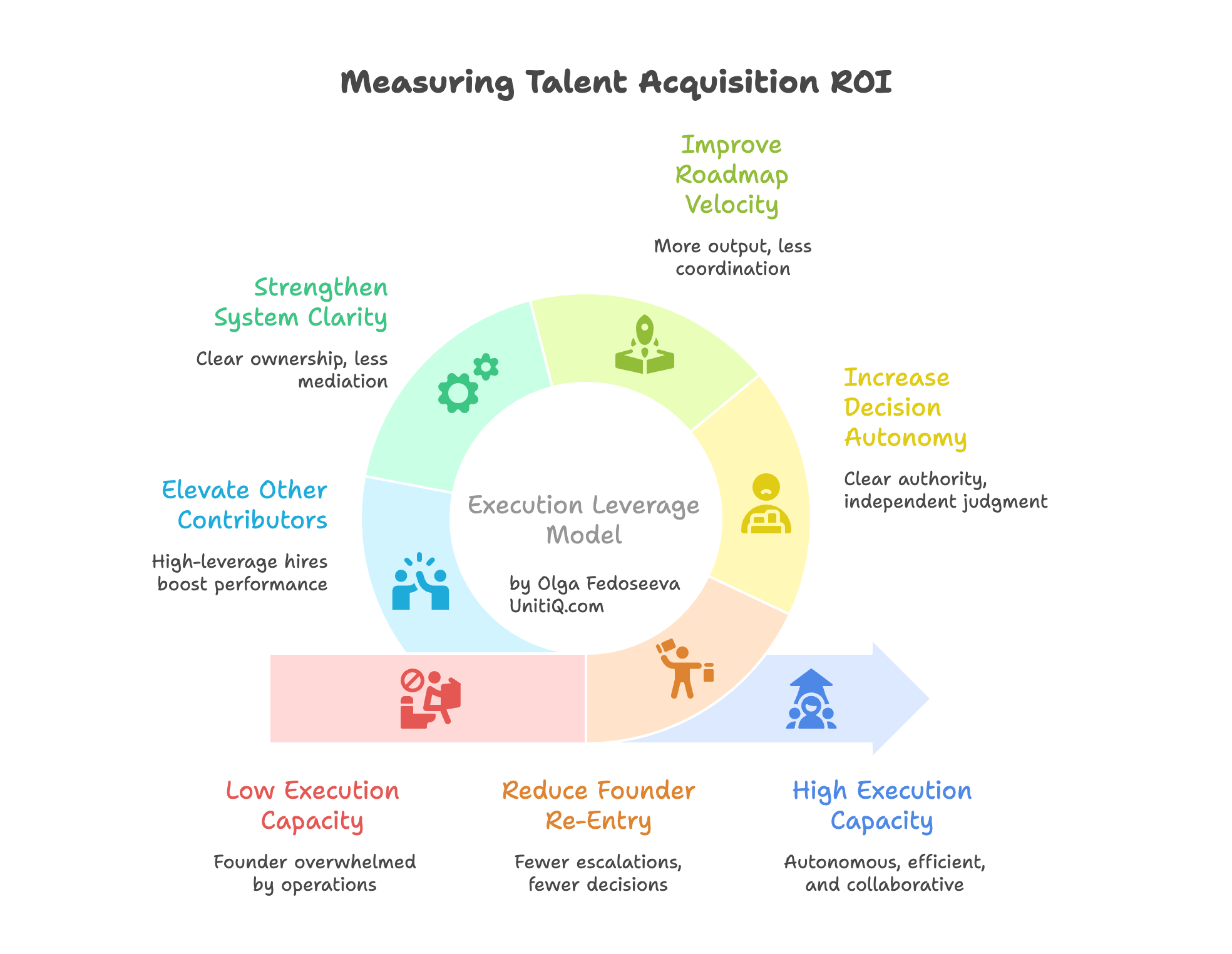
Improves Roadmap Velocity per Headcount
More output without exponential coordination overhead.
Strengthens System Clarity
Clear ownership boundaries.
Less cross-team mediation.
Fewer “who owns this?” conversations.
Elevates Other Contributors
High-leverage hires increase the performance of others.
Low-leverage hires consume alignment energy.
This is execution ROI.
Not cost efficiency.
Why Hiring Efficiency Can Mislead Founders
You can:
- Reduce time to hire
- Lower agency fees
- Improve sourcing velocity
And still damage execution.
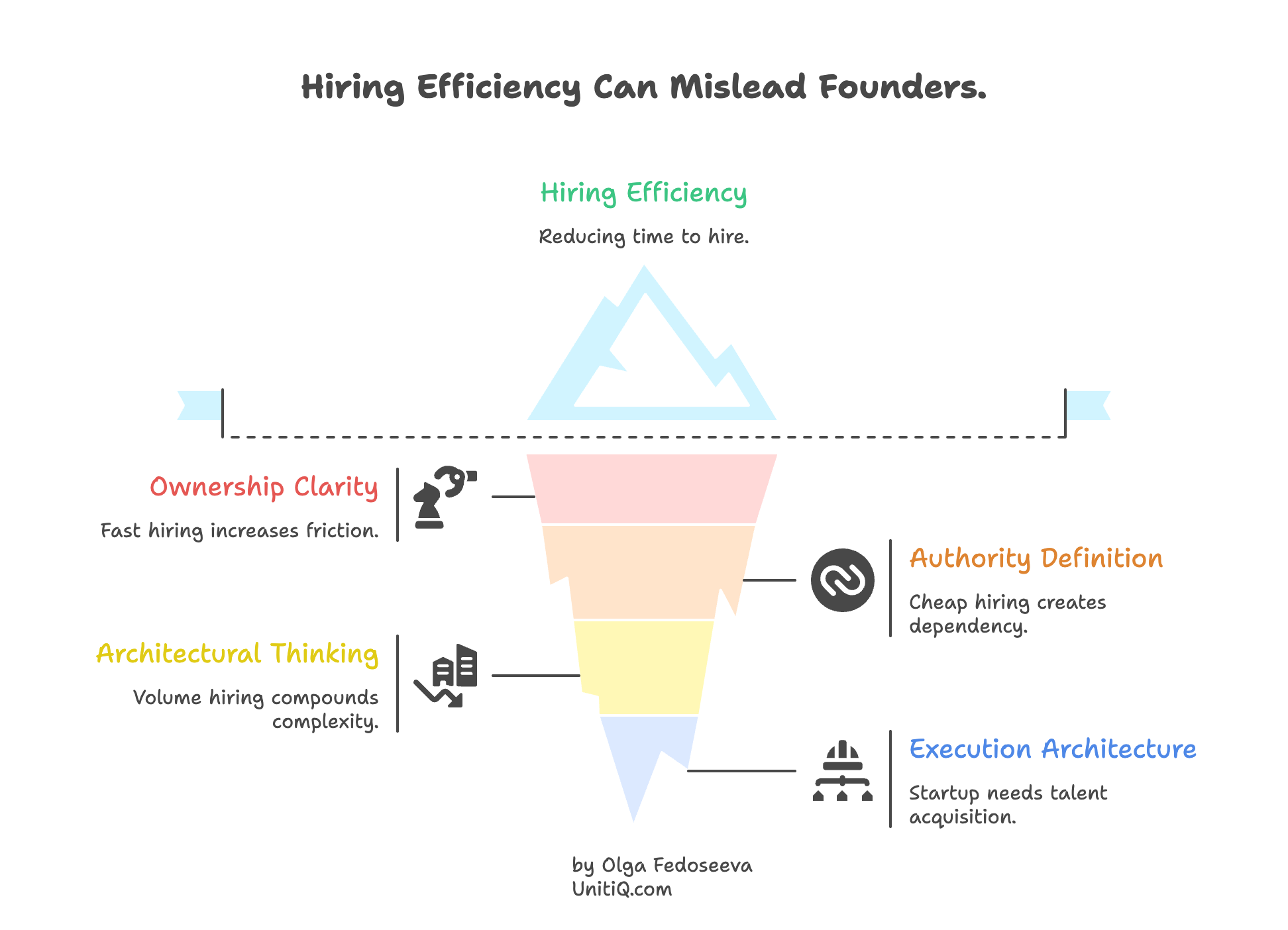
Fast hiring without ownership clarity increases friction.
Speed only helps when decision authority and ownership are already stable — otherwise every ‘fast’ hire increases coordination cost and founder re-entry. (Read: Why Hiring Faster Won’t Fix Your Execution)
Cheap hiring without authority definition creates dependency.
Volume hiring without architectural thinking compounds complexity.
The startup doesn’t need faster hiring.
It needs execution architecture.
That’s Talent Acquisition.
Not recruitment.
Why Startups Underinvest in Strategic TA
Because ROI is measured too narrowly.
Revenue feels direct.
Hiring feels supportive.
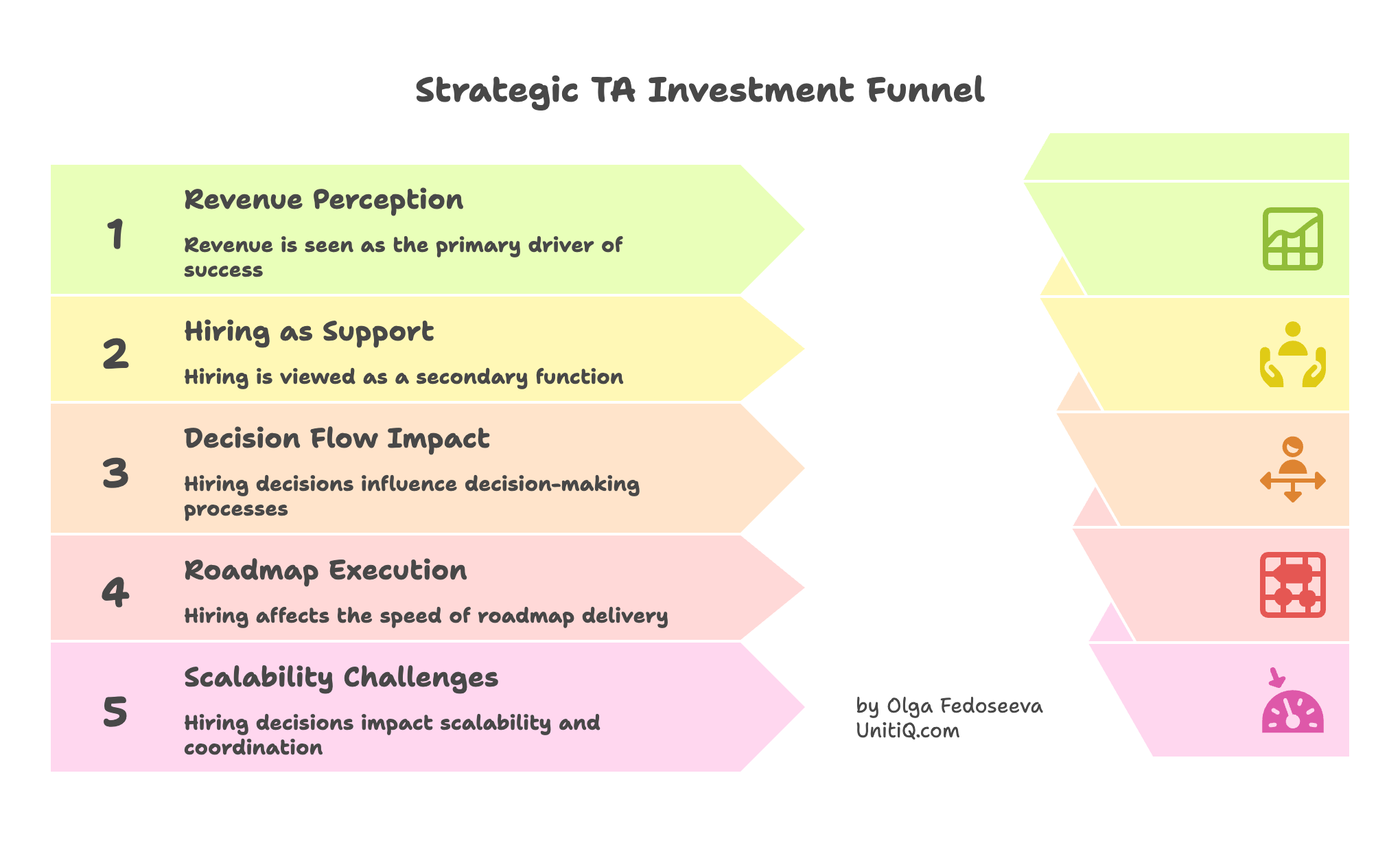
But hiring determines:
- How decisions move
- How quickly the roadmap ships
- Whether founders scale out of operations
- Whether coordination cost explodes at 40–70 people
Talent Acquisition is not overhead.
It’s structural design.
And structural mistakes are expensive to unwind.
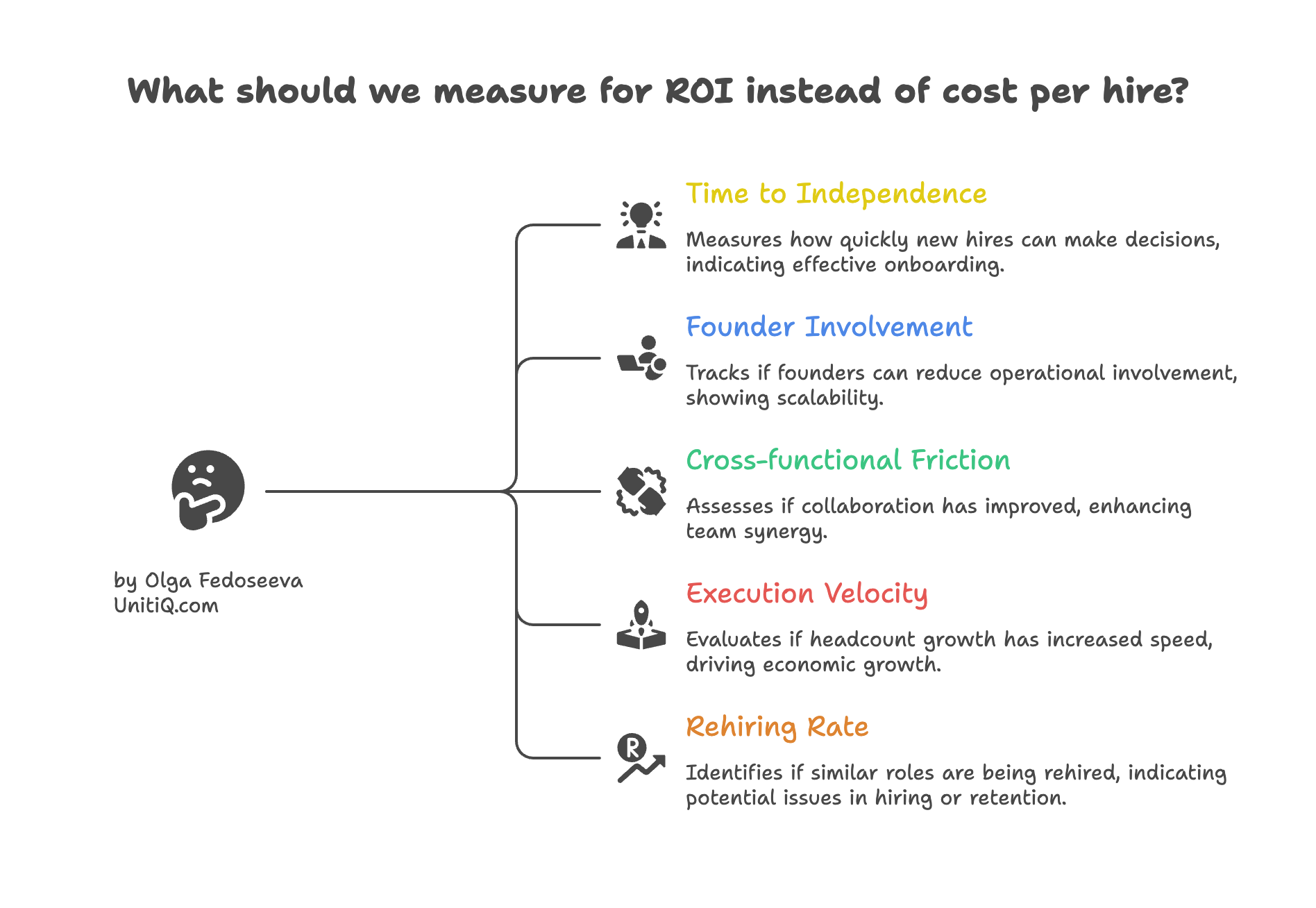
What Smart Founders Measure Instead
Instead of asking:
“What’s our cost per hire?”
Ask:
- How long until new hires make independent decisions?
- Has founder operational involvement decreased?
- Has cross-functional friction increased or decreased?
- Did headcount growth improve execution velocity?
- Are we rehiring similar roles repeatedly?
Those are execution signals, not admin KPIs — and they’re the only metrics that predict whether hiring is creating leverage or compounding friction. (Read: Talent Acquisition Metrics That Actually Matter in Startups)
These signals define real ROI.
Because in a startup, execution speed is the economic engine.
Not hiring efficiency.
The Strategic Shift
If hiring is not improving execution capacity, it’s not neutral.
It’s compounding fragility.
The ROI of Talent Acquisition is not a financial metric.
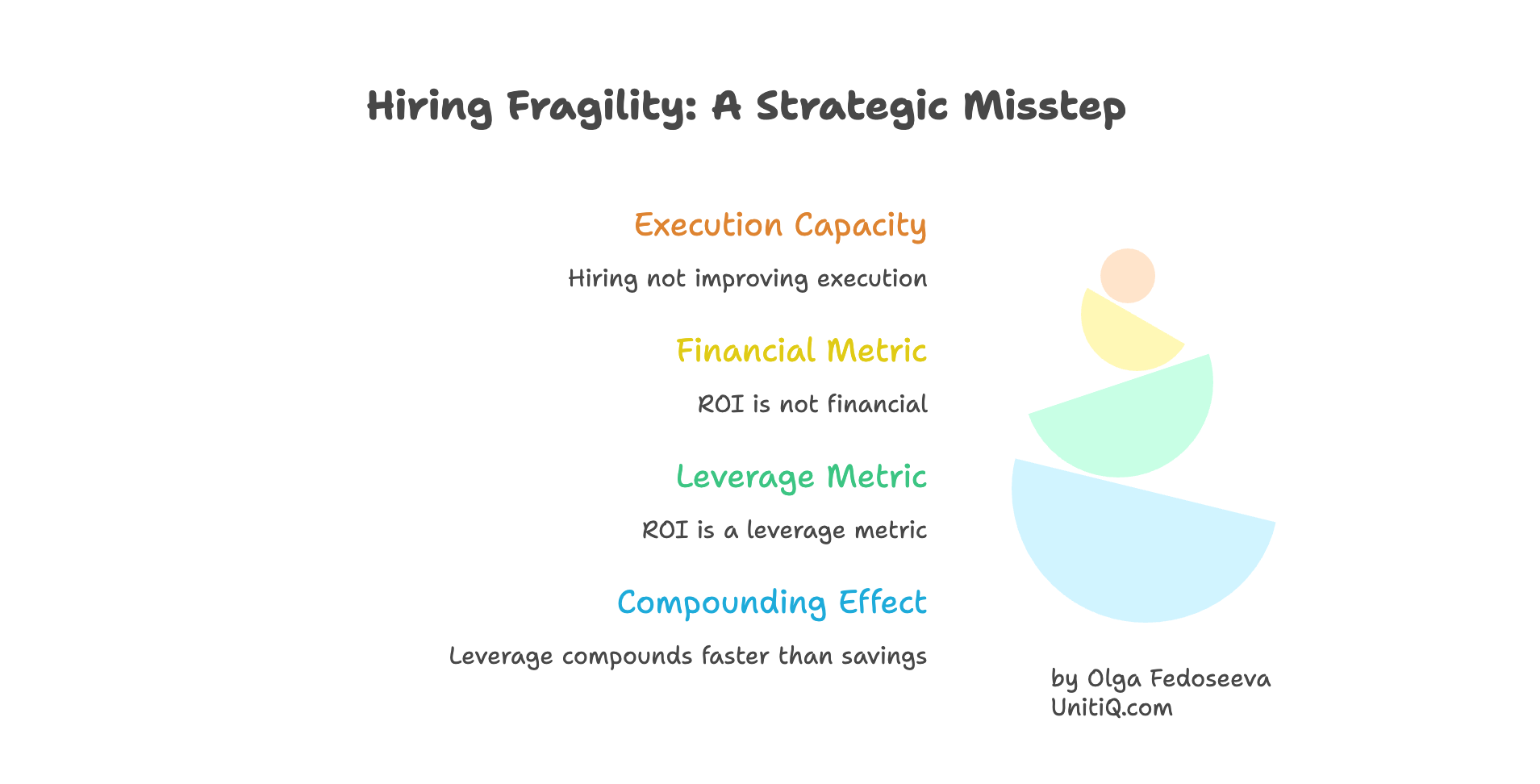
It’s a leverage metric.
And leverage compounds faster than cost savings ever will.
FAQ: ROI of Talent Acquisition in Growth-Stage Startups
What is the ROI of Talent Acquisition?
In growth-stage startups, the ROI of Talent Acquisition is the measurable increase in autonomous execution capacity relative to headcount investment.
How should startups measure Talent Acquisition ROI?
Beyond cost metrics, startups should measure:
- Time-to-decision autonomy
- Founder re-entry rate
- Roadmap velocity per headcount
- Coordination cost growth
Why is Talent Acquisition not a cost center?
Because each hire changes execution architecture. Strategic TA increases leverage and reduces structural drag. Poor TA increases coordination cost and slows delivery.
Does faster hiring improve ROI?
Only if role clarity and ownership design are strong. Speed without architectural clarity increases execution fragility.
Final Thought
You wouldn’t scale product without architecture.
You wouldn’t scale infrastructure without systems.
Scaling headcount without execution design is no different.
If you’re building at Series A–C and hiring still feels heavy, founder-dependent, or fragile — the issue isn’t talent supply.
It’s Talent Acquisition as a system.
And systems can be redesigned.
If you need execution-first hiring support without overbuilding internal HR too early, explore how Recruitment as a Subscription supports structural leverage — not just placements.
If you want to sanity-check which model fits your current stage — and where execution is actually breaking — we can walk through it together.
About the author
Olga Fedoseeva is the Founder of UnitiQ, a talent acquisition and People Projects partner for Tech Startups across EU, UKI, and MENA.
She works with founders in Fintech, AI, Crypto, and Robotics to prevent mis-hires before they compound — restoring execution momentum and protecting teams from quiet burnout.


