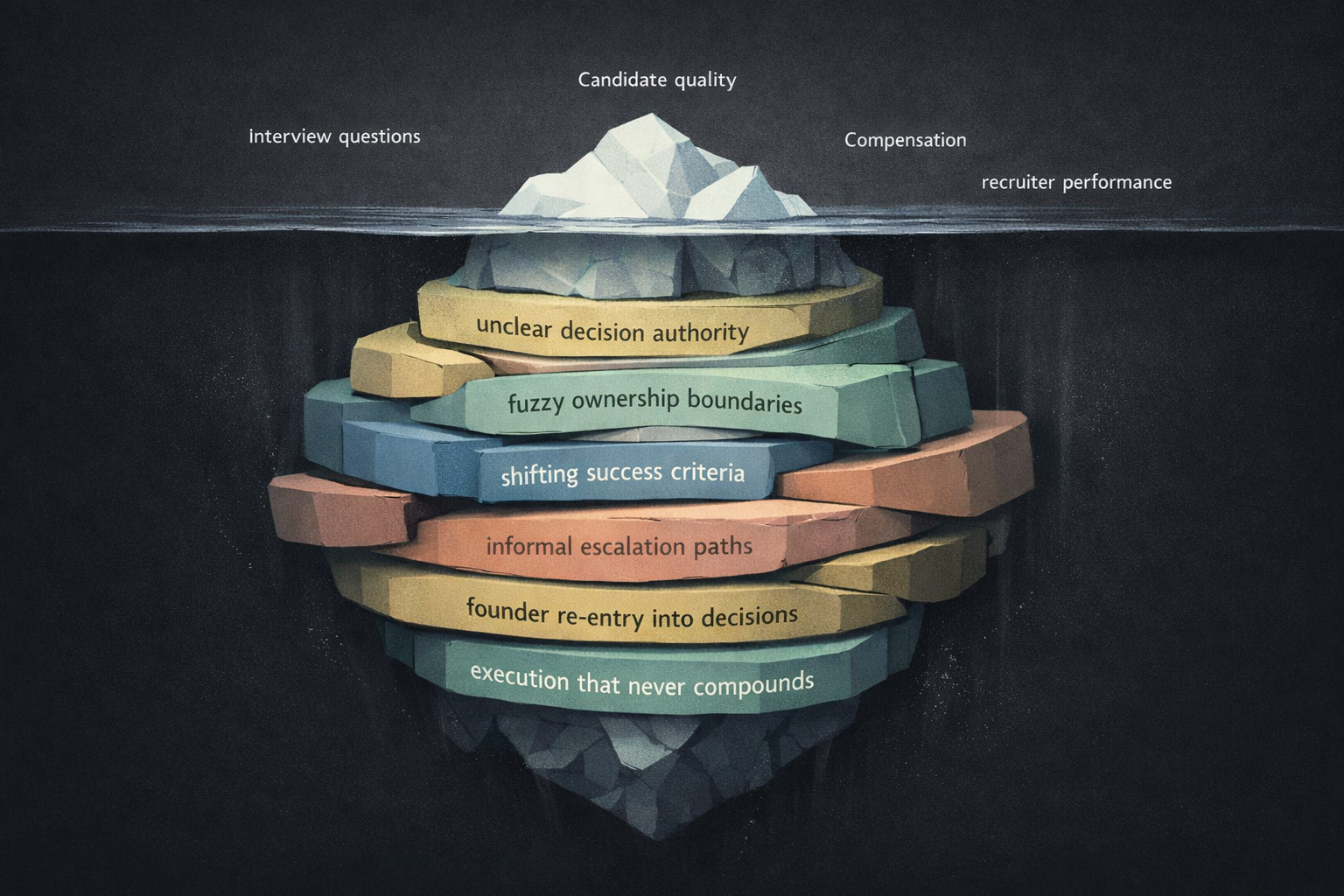
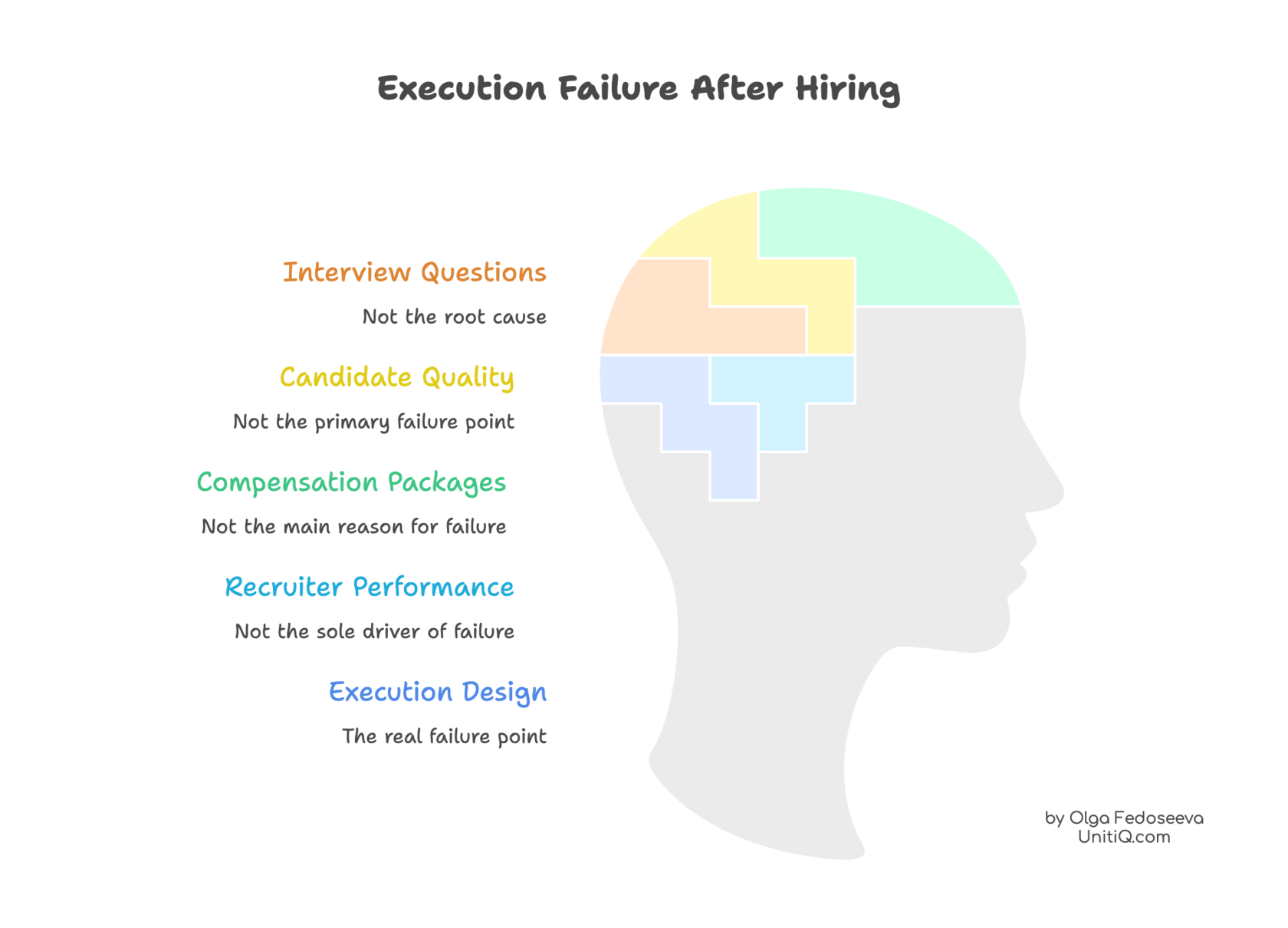
Most startups look for hiring failure in the wrong place.
They analyse:
- interview questions
- candidate quality
- compensation packages
- recruiter performance
But when execution slows, the real failure rarely lives in the interview process.
It shows up after the hire joins.
This breakdown often happens because the company’s cultural operating rules — how decisions are made, escalations happen, and trade-offs are resolved — were never clearly defined. (Read: Why Hiring the Right People Doesn’t Work Without a Clear Culture)
Thirty days in.
Ninety days in.
Right when the role was supposed to remove pressure — not add it.
This is why even strong candidates collapse early — not because they lack capability, but because the first 90 days expose structural gaps most startups never designed for scale. (Read: Why “Good Hires” Still Fail in the First 90 Days)
Hiring didn’t fail.
Execution design did.
The Hiring Moment Feels Decisive — But It’s Not
Interviews feel like the highest-stakes moment:
- decisions are visible
- trade-offs are debated
- founders are involved
- risk feels concentrated
So when things don’t work out later, teams instinctively look back and ask:
“Did we hire the wrong person?”
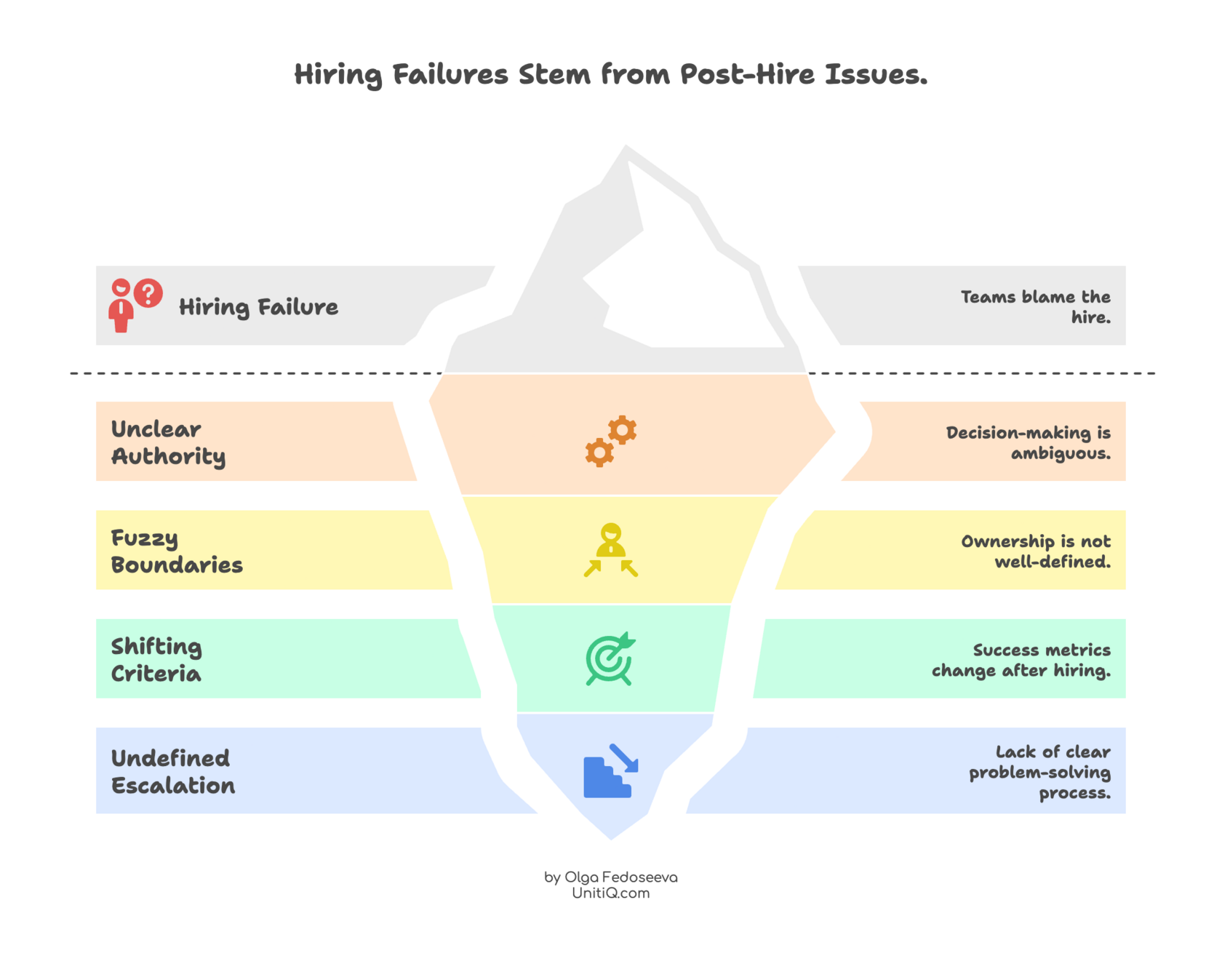
In reality, most hiring failures don’t come from bad selection.
They come from what happens next:
- unclear decision authority
- fuzzy ownership boundaries
- success criteria that shift post-hire
- escalation paths that were never designed
When decision rights remain implicit, escalation replaces ownership — and execution slows by design, not by accident. (Read: Fixing Decision Authority in Scaling Startups)
The hire enters.
Execution stalls.
And the organisation quietly blames the person.
Why Hiring “Works” — Then Execution Breaks
Many startups experience the same pattern:
- The candidate looks strong
- Interviews feel aligned
- The offer is accepted
- Optimism is high
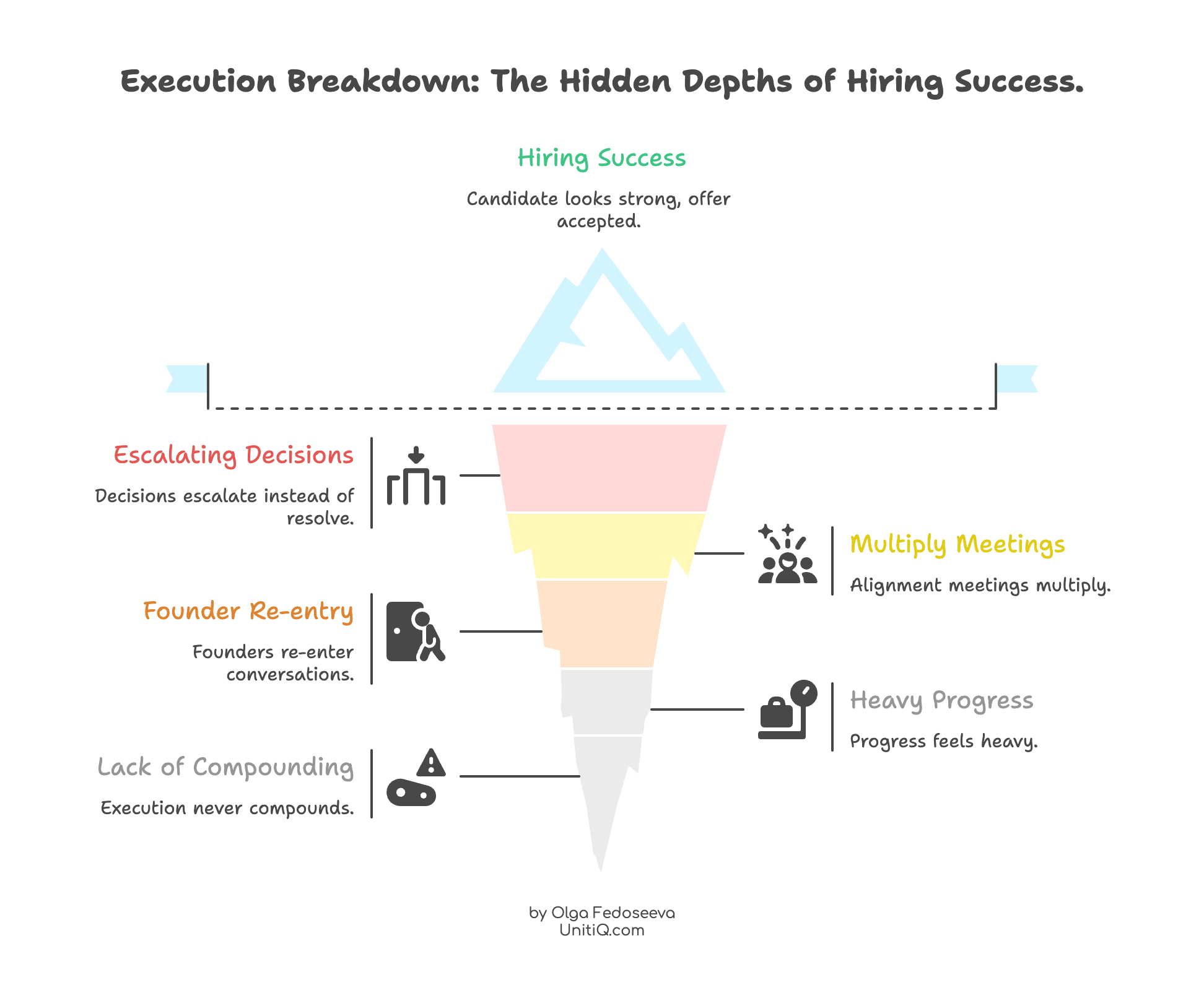
Then, slowly:
- decisions escalate instead of resolve
- alignment meetings multiply
- founders re-enter conversations
- progress feels heavy
Nothing failed loudly.
No obvious mistake was made.
But execution never compounds.
When hiring slows or feels heavier with every role, it’s often a signal that decision ownership has already fragmented across the organisation. (Read: When Hiring Slows, Decision Ownership Has Already Broken)
Execution compounds only when hiring is treated as infrastructure — not as a series of isolated recruitment events. (Read: Building Hiring Infrastructure for Scale)
That’s the signal.
The Real Question Startups Don’t Ask
Most teams ask:
“Did we hire well?”
The better question is:
“What execution authority did this role actually receive?”
Because execution doesn’t depend on capability alone.
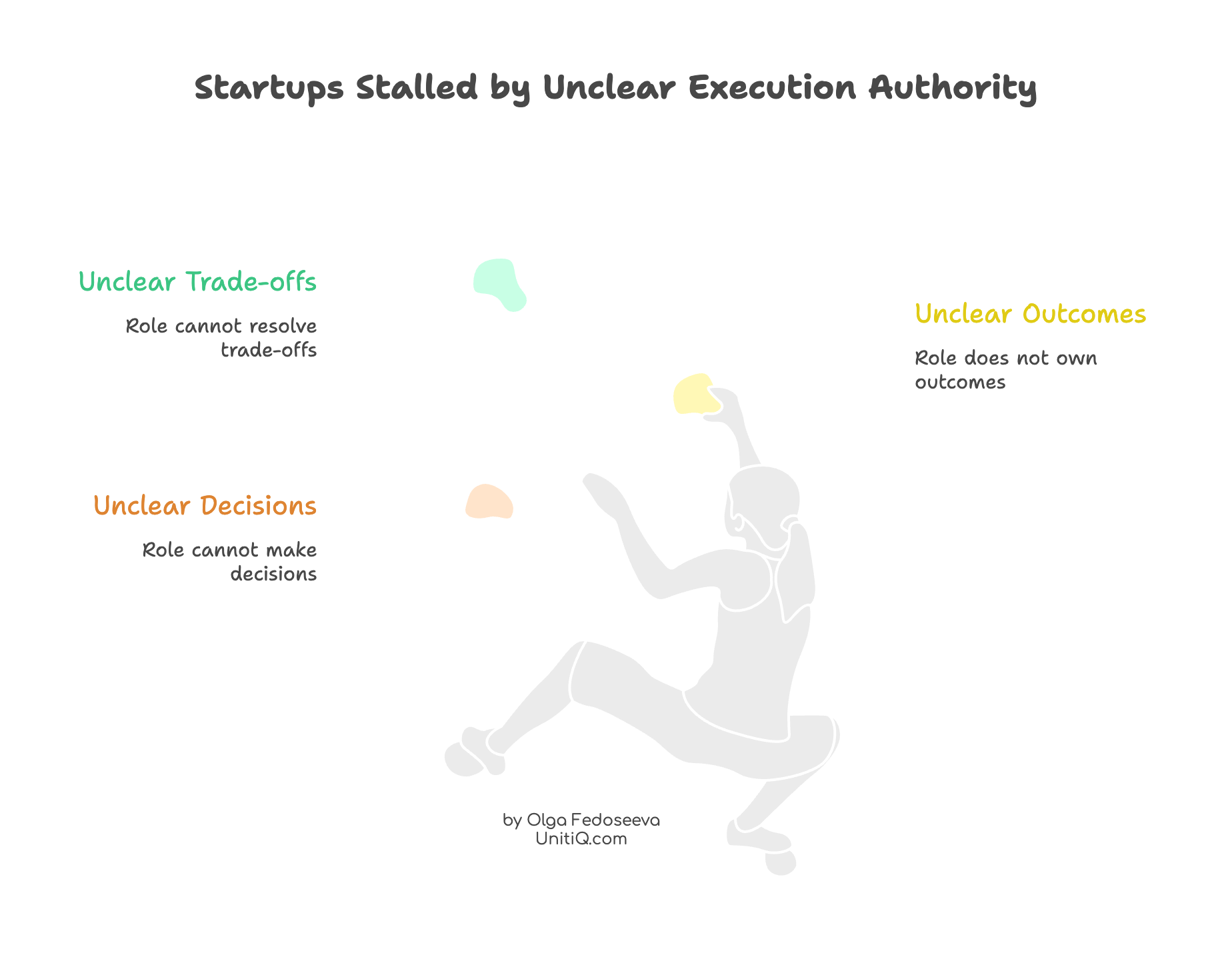
It depends on:
- what decisions the role can make
- what outcomes they own
- what trade-offs they are allowed to resolve
When these are unclear, even exceptional hires stall.
Not because they’re weak —
but because the system won’t let them move.
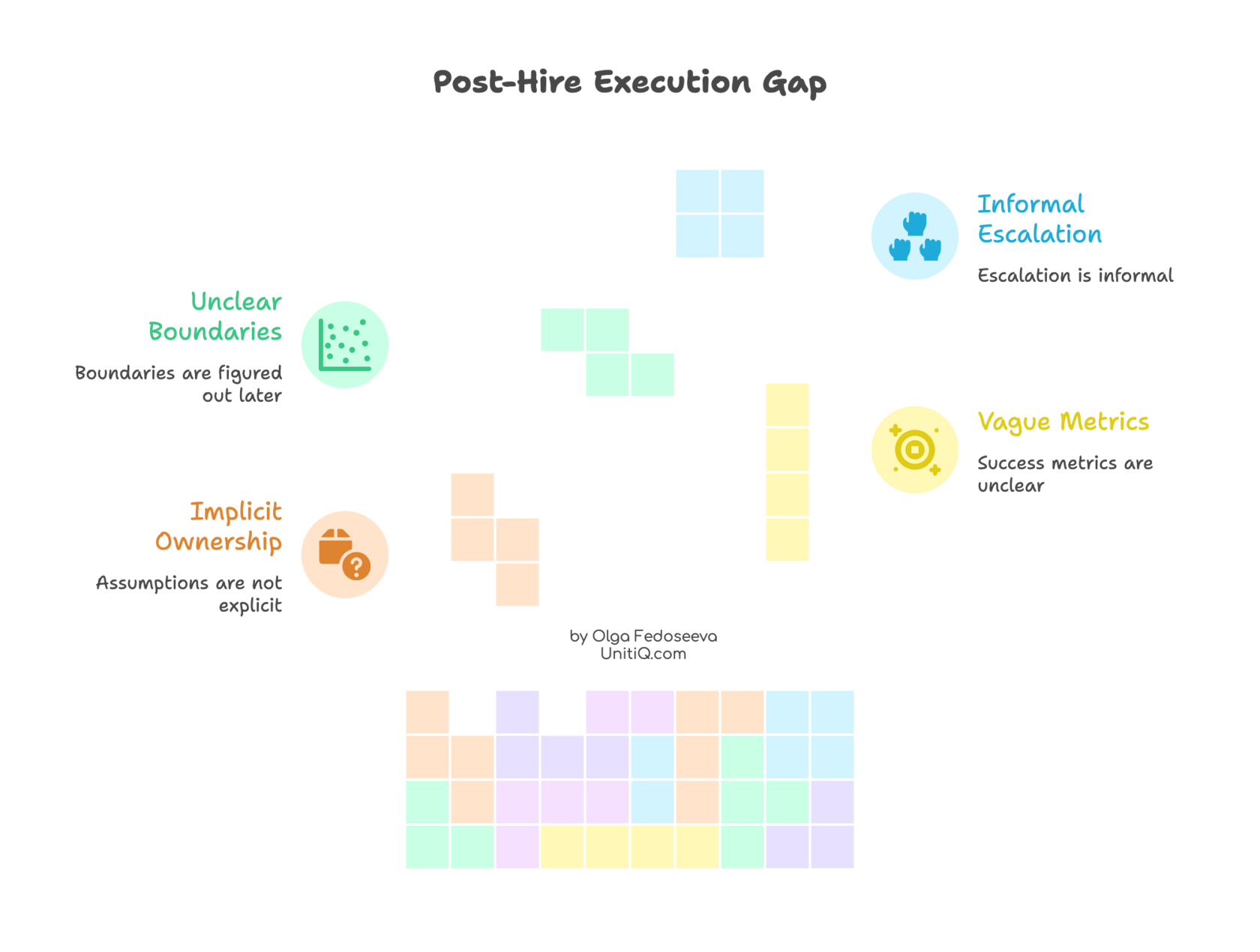
The Post-Hire Execution Gap
This is where most startups leak momentum.
After hiring:
- ownership assumptions remain implicit
- success metrics stay vague
- boundaries are “figured out later”
- escalation is informal
So the new hire:
- checks before deciding
- seeks validation instead of acting
- avoids irreversible calls
- escalates ambiguity upward
Execution slows — not from incompetence,
but from risk containment flowing to the top.
Founders feel it immediately.
They get pulled back in.
Why Senior Hires Fail More Often — Not Less
Paradoxically, this problem intensifies with senior hires.
Senior leaders:
- expect clear decision authority
- assume ownership is real
- move faster when boundaries exist
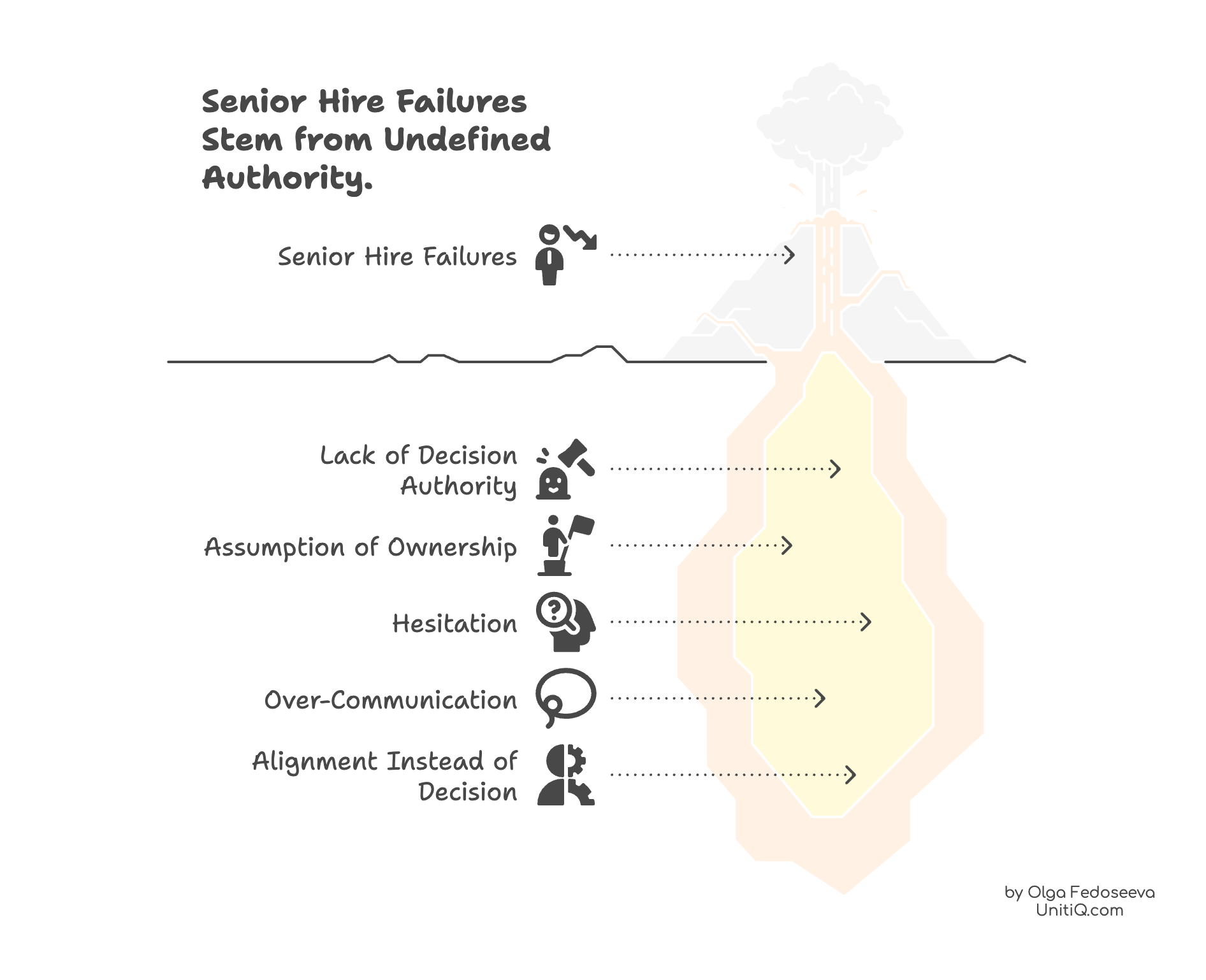
When those conditions are missing:
- they hesitate
- they over-communicate
- they align instead of decide
Teams read this as:
“They’re not delivering.”
But what actually happened is simpler:
authority was never designed.
Onboarding Is Not About Experience
Most startups treat onboarding as:
- cultural immersion
- relationship building
- tools and documentation
- early wins
Those things matter — but they don’t protect execution.
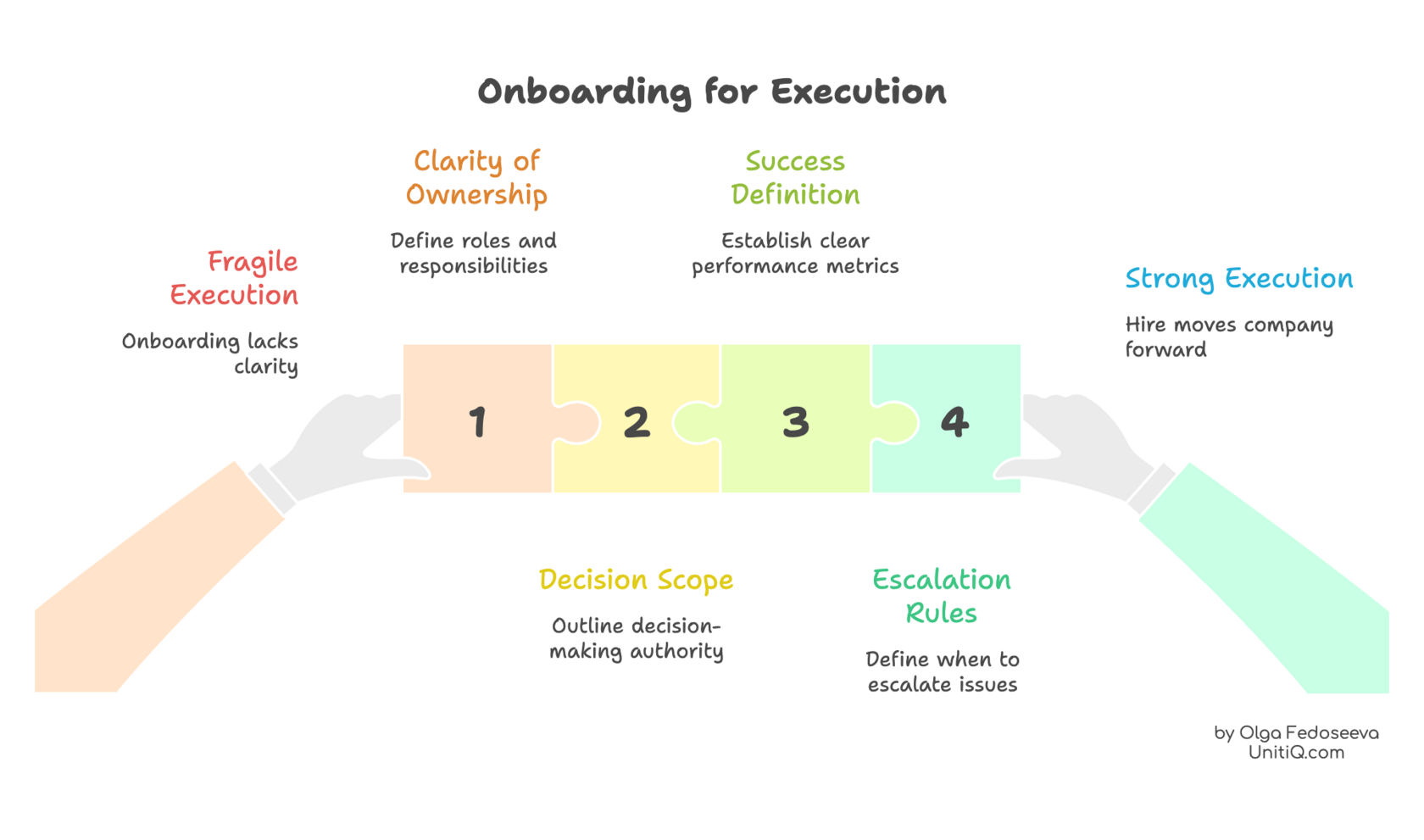
What actually determines success in the first 90 days is:
- clarity of ownership
- decision scope
- success definition
- escalation rules
Without these:
- onboarding feels supportive
- execution remains fragile
The hire understands the company —
but not how to move it forward.
The Silent Escalation Pattern
Here’s the pattern founders recognise but rarely name:
- “Let’s just sanity-check this.”
- “We should align before deciding.”
- “Maybe we need one more input.”
These aren’t collaboration problems.
They’re authority gaps.
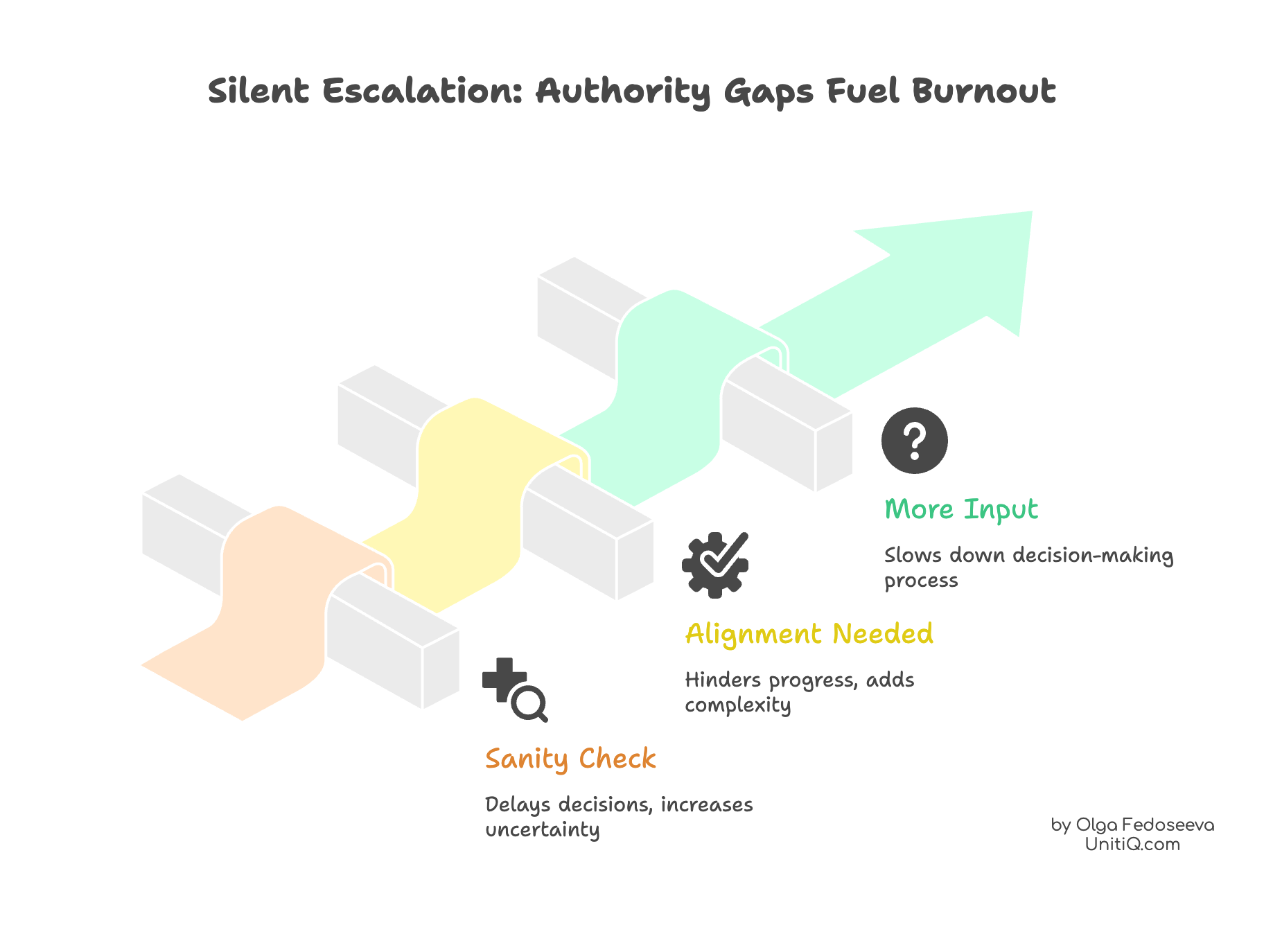
When decision authority isn’t explicit,
uncertainty escalates by default.
Founders absorb it — not because they want control,
but because someone has to hold the risk.
This is also why founders burn out on hiring long before headcount goals are met — because escalation quietly flows back to them. (Read: Why Founders Burn Out on Hiring Before It’s “Done”)
This is where burnout quietly forms.
Why This Isn’t a People Problem
When execution breaks post-hire, teams often respond by:
- tightening performance management
- adding check-ins
- rewriting role descriptions
- reconsidering the hire
But the issue isn’t motivation.
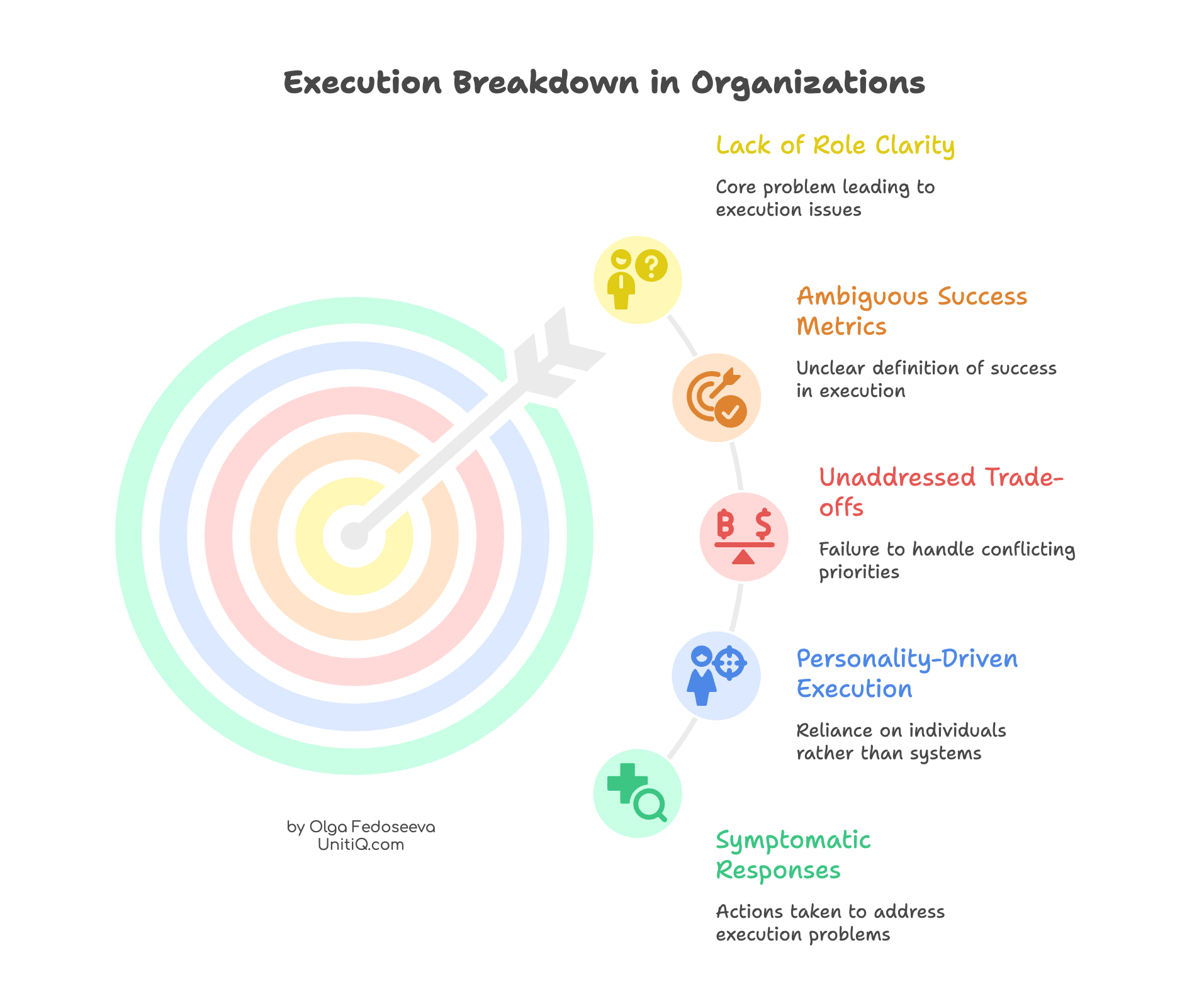
And it’s rarely capability.
It’s that the organisation never answered:
- What does this role decide?
- What does success mean in execution?
- What happens when trade-offs appear?
Without those answers, execution depends on personalities —
not systems.
What Execution-Ready Hiring Actually Requires
Hiring that compounds execution has five characteristics after the offer is signed:
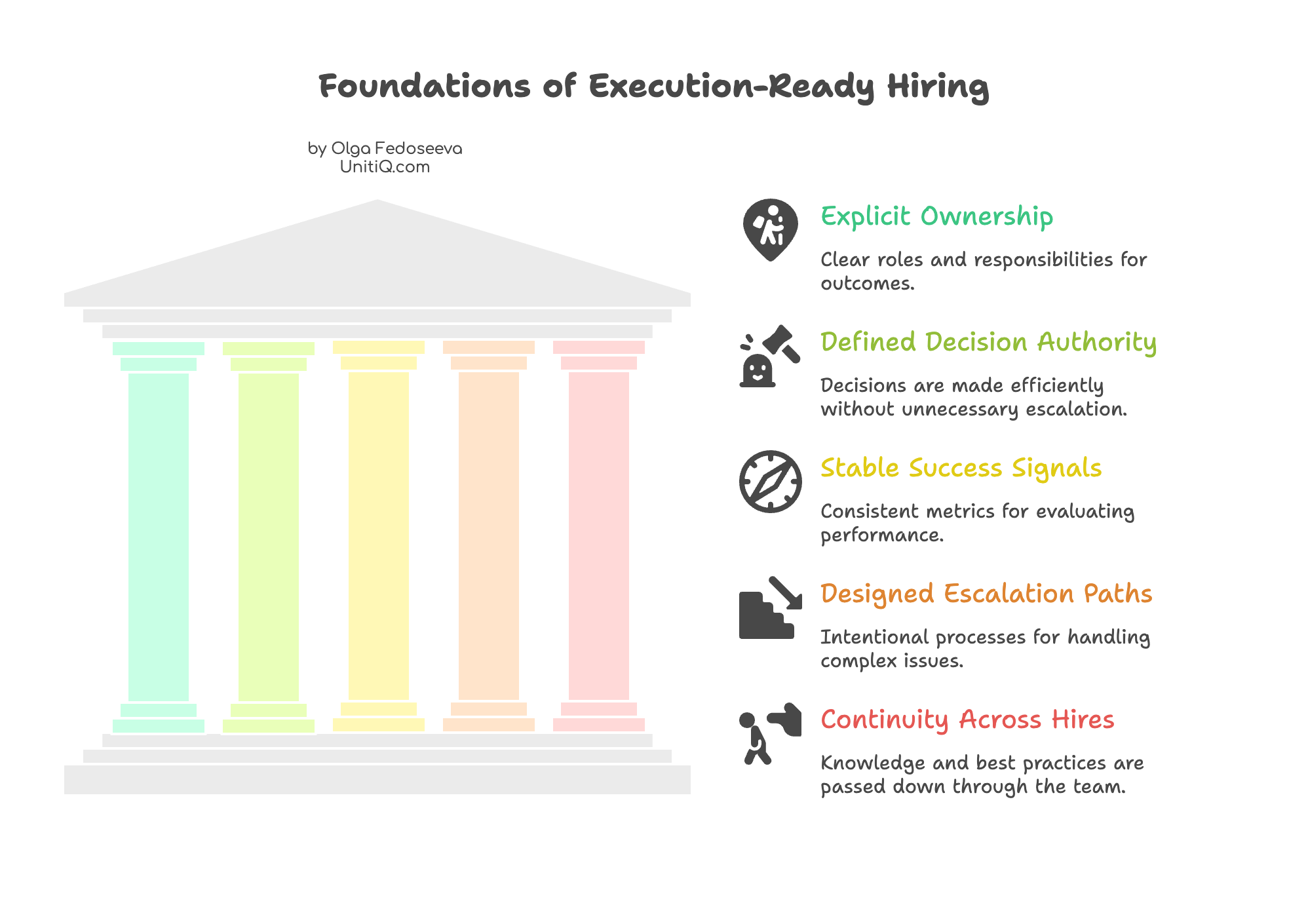
When hiring is treated as an event instead of a system, context resets with every role — and execution debt compounds silently. (Read: Why Event-Based Hiring Keeps Resetting Your Startup)
- Explicit ownership
- One role owns outcomes — not alignment.
- Defined decision authority
- Decisions don’t escalate by default.
- Stable success signals
- “What good looks like” doesn’t shift mid-quarter.
- Designed escalation paths
- Escalation is intentional, not habitual.
- Continuity across hires
- Learning carries forward instead of resetting.
When these exist, execution accelerates naturally.
When they don’t, hiring becomes a recurring drain.
Why This Keeps Repeating in Startups
Startups don’t ignore execution design on purpose.
They assume:
- strong people will figure it out
- culture will carry alignment
- speed will compensate for ambiguity
That works early.
It fails at scale.
Because execution doesn’t scale on goodwill.
It scales on clear authority and retained learning.
The Shift That Changes Everything
Execution improves when startups stop asking:
“Did we hire right?”
And start asking:
“What execution system did we drop this hire into?”
If that system isn’t intentionally built — with role architecture, escalation logic, and explicit decision ownership — hiring becomes a recurring drain instead of a compounding asset. (Explore: Building Hiring Infrastructure for Scale)
That shift reframes:
- mis-hires → execution gaps
- founder re-entry → system alarms
- slow progress → design failures
Hiring doesn’t fail in interviews.
It fails when execution authority is left undefined.
TL;DR
- Most hiring failures show up after onboarding, not during interviews
- Strong hires stall when decision authority isn’t designed
- Onboarding without ownership clarity protects comfort, not execution
- Founder re-entry is a system signal, not a leadership flaw
- Execution compounds only when ownership and authority are explicit
If hiring keeps feeling expensive after people join,
the problem isn’t who you hired —
it’s the execution system they entered.
If you want to sanity-check which model fits your current stage — and where execution is actually breaking — we can walk through it together.
About the author
Olga Fedoseeva is the Founder of UnitiQ, a global HR executive, and a talent acquisition and people strategy leader with 20+ years of experience across EMEA, the US, and APAC. She has personally hired 1,500+ employees, led people strategy for organisations scaling from 30 to 700+ employees, and writes about hiring systems, execution risk, and people infrastructure in growth-stage startups.
Read full author profile
LinkedIn
Read full author profile


