TL;DR
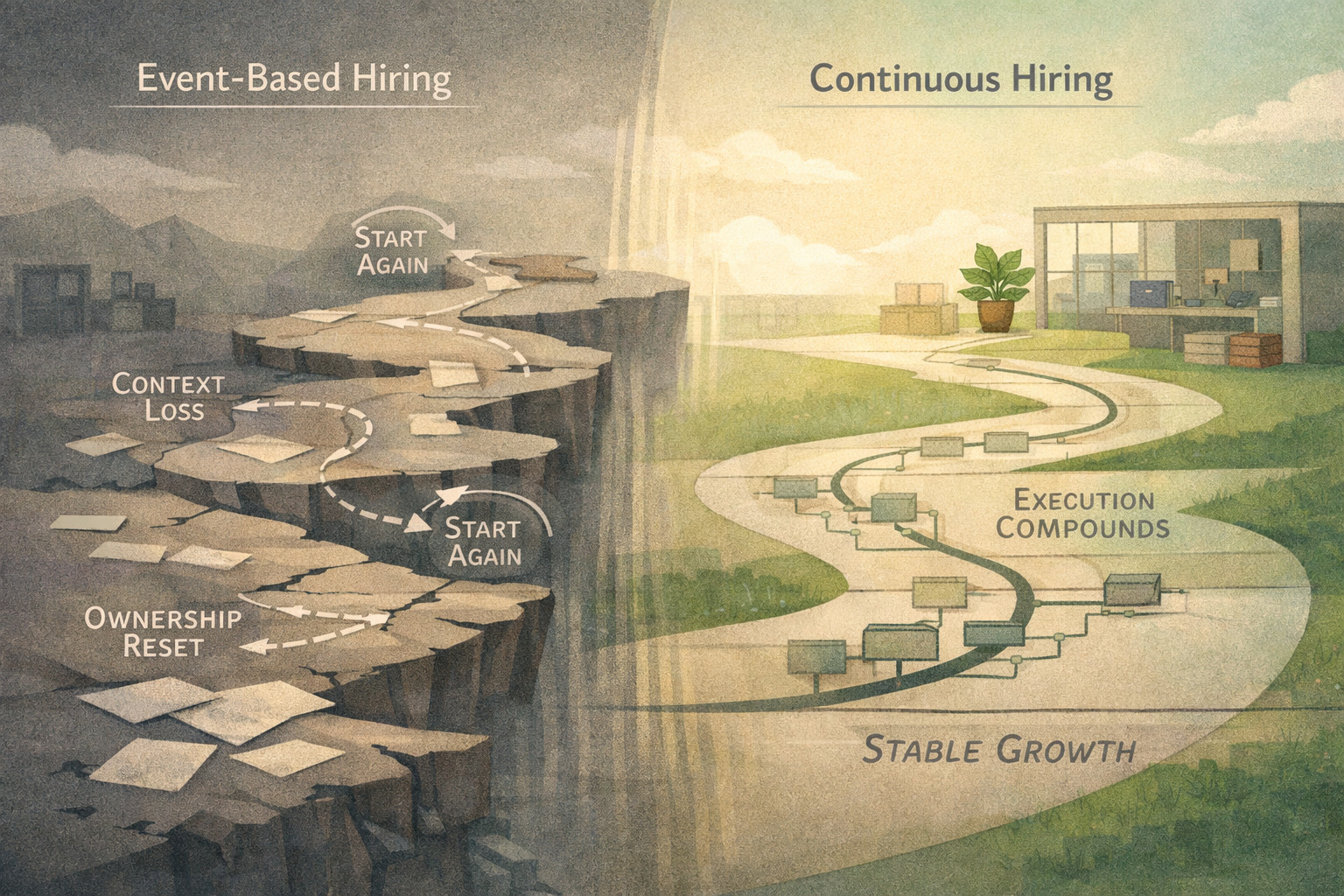
If hiring in your startup feels like a recurring emergency, the problem isn’t talent availability or recruiter quality. It’s that hiring is treated as an event, not a system. Event-based hiring resets context, ownership, and learning every time — slowing execution, exhausting founders, and repeating the same mistakes quarter after quarter.
Hiring Doesn’t Fail Loudly. It Resets Quietly.
Most Series A–C startups don’t break hiring.
They restart it.
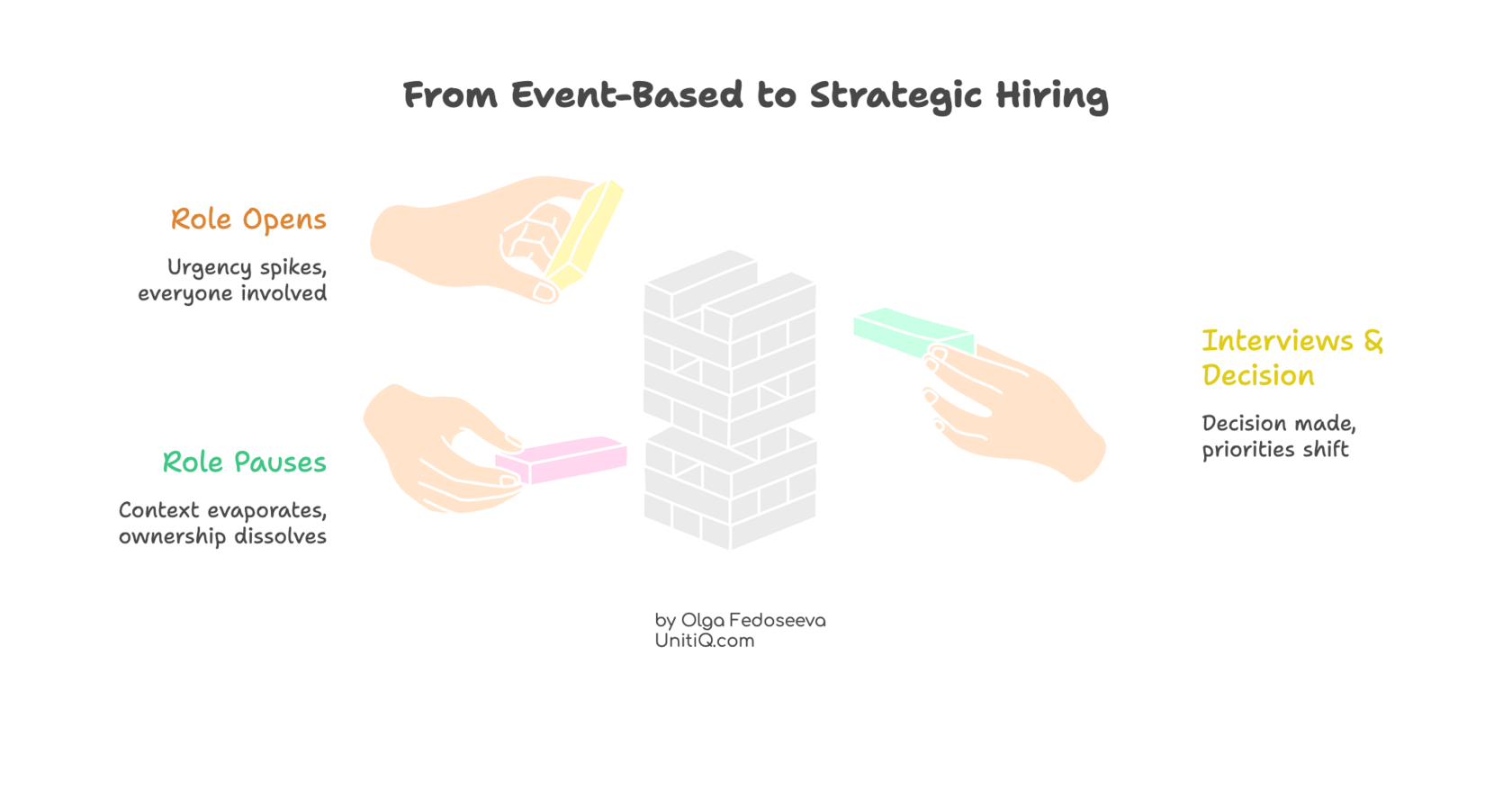
A role opens.
Urgency spikes.
Everyone gets involved.
Interviews happen.
A decision is made.
Then:
- priorities shift
- the role pauses
- context evaporates
- ownership dissolves
Three months later, the same role is open again — and it feels like starting from zero.
That’s not bad luck.
That’s event-based hiring.
If you want to sanity-check what’s breaking in your hiring system, we can walk through it together.
👉 Book a conversation
👉 Book a conversation
What Is Event-Based Hiring?
Event-based hiring is when recruiting is triggered only by pressure:
- a resignation
- a missed target
- a stalled roadmap
- a board question
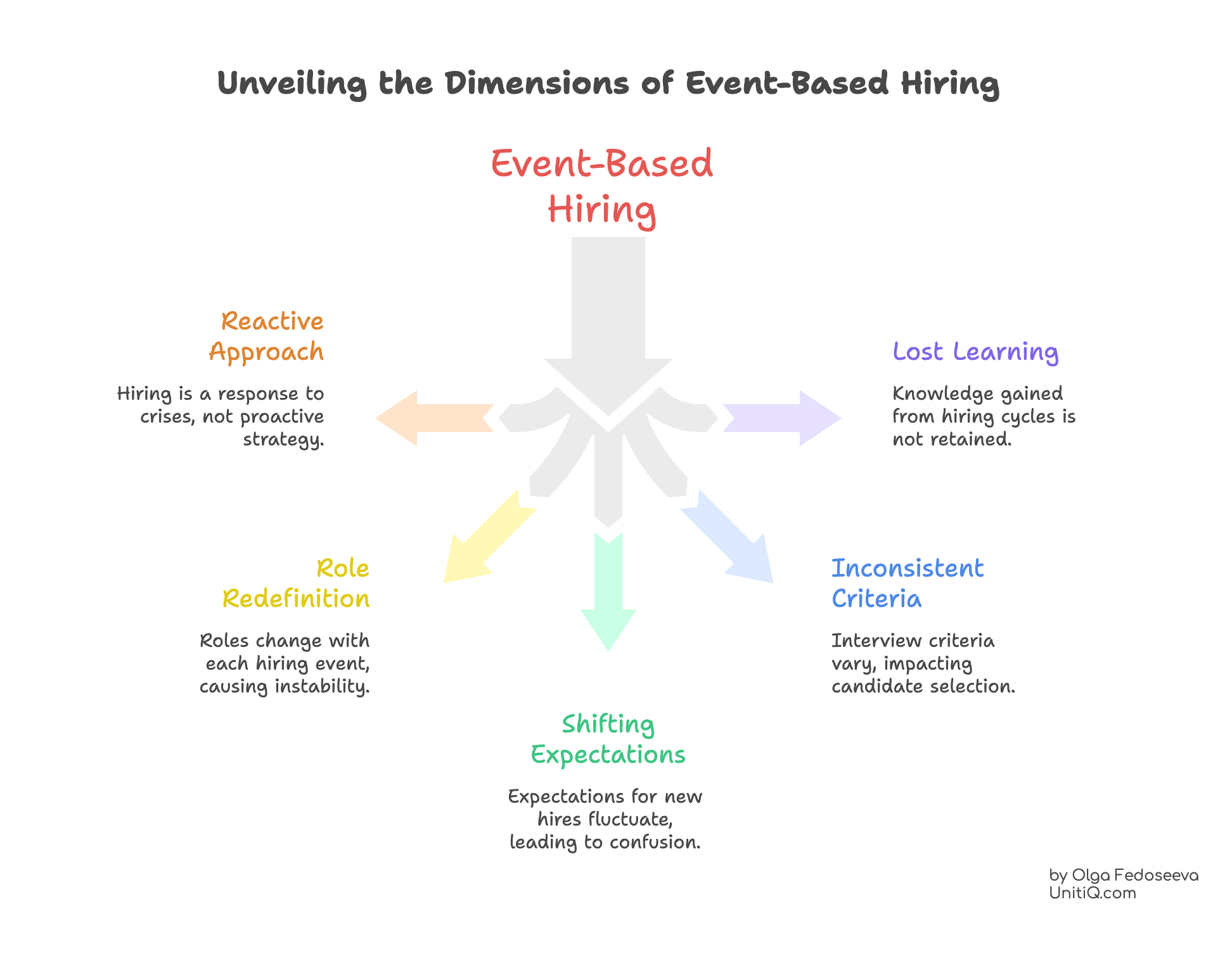
Hiring becomes a reaction, not an operating capability.
In this model:
- roles are redefined every time
- expectations drift
- interview criteria change
- learning is lost between cycles
Each hiring push is treated as a standalone project — instead of a continuation of an owned system.
This reset logic is also embedded in how most startups pay for hiring.
→ Why “Paying Per Hire” Is the Most Expensive Hiring Model
→ Why “Paying Per Hire” Is the Most Expensive Hiring Model
Why Event-Based Hiring Slows Execution
1. Context Is Lost Every Time
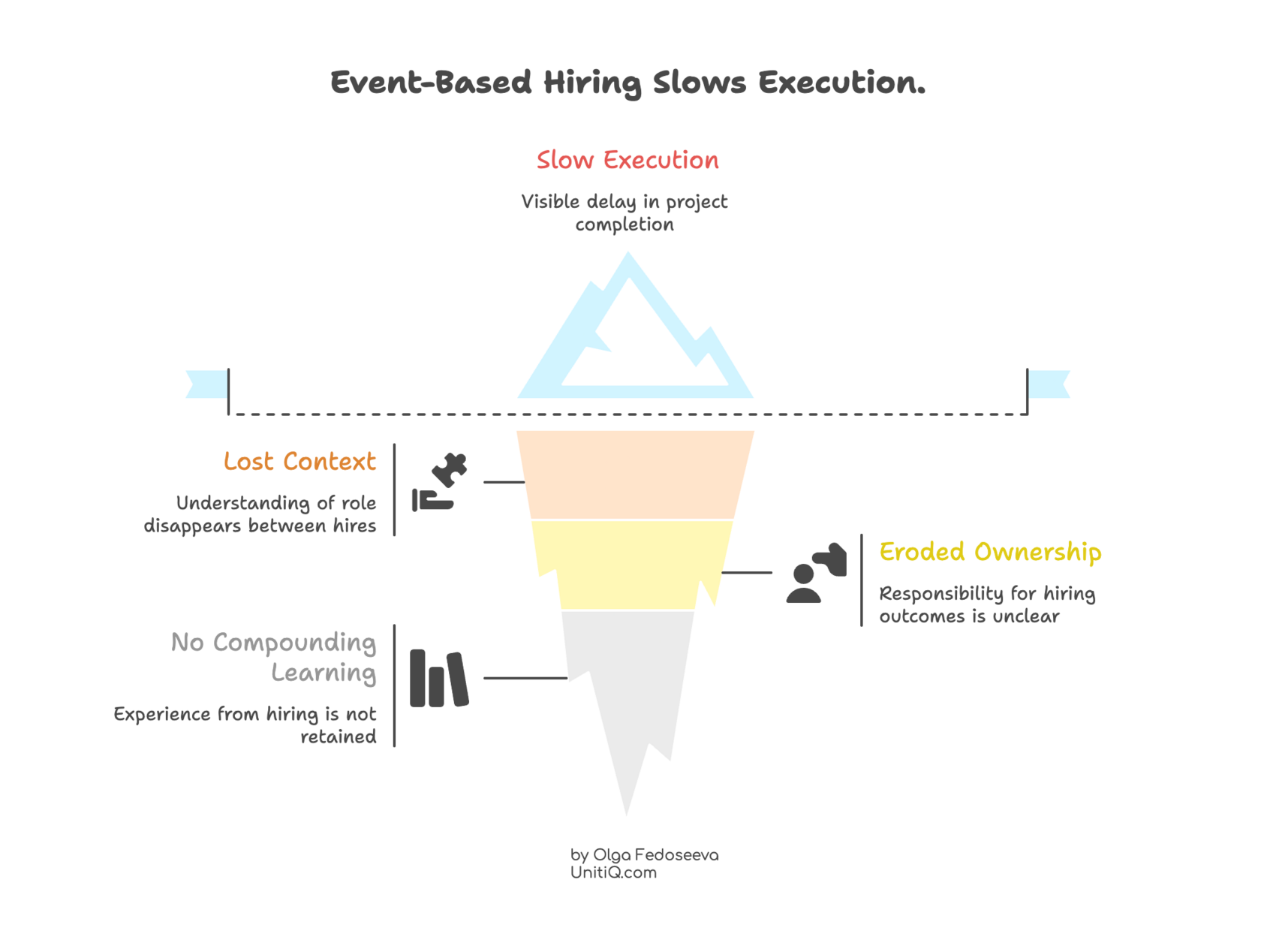
When hiring stops, the understanding of why the role exists disappears with it.
Next cycle:
- new stakeholders
- new assumptions
- new success definitions
The team debates fundamentals again — instead of improving decisions.
Execution doesn’t slow because people are missing.
In most cases, adding people actually increases friction when execution capacity isn’t ready.
→ Hiring Is Not the Bottleneck — Execution Capacity Is
→ Hiring Is Not the Bottleneck — Execution Capacity Is
It slows because context keeps resetting.
2. Ownership Quietly Erodes
In event-based hiring:
- no one owns hiring outcomes between roles
- responsibility spikes only during interviews
- accountability ends at the offer
This is what happens when hiring decisions collect input but lose a clear owner.
→ When Hiring Slows, Decision Ownership Has Already Broken
→ When Hiring Slows, Decision Ownership Has Already Broken
Once the hire is made, hiring ownership disappears — until the next crisis.
This is how founders end up permanently pulled back in.
Over time, this repeated re-entry drains energy and focus — even when headcount is growing.
→ Why Founders Burn Out on Hiring Before the Team Ever Scales
→ Why Founders Burn Out on Hiring Before the Team Ever Scales
3. Learning Never Compounds
Strong hiring systems get better over time.
Event-based hiring doesn’t.
Why?
- interview signals aren’t tracked
- mis-hire patterns aren’t documented
- role definitions aren’t refined
The organisation pays the cost of experience — without keeping the benefit.
This is why hiring often feels just as hard on the tenth role as it did on the first.
→ Why Your Hiring Never Gets Better — Even After Dozens of Roles
→ Why Your Hiring Never Gets Better — Even After Dozens of Roles
Why “More Recruiters” Doesn’t Fix This
Adding recruiters to an event-based model only increases activity, not leverage.
You may get:
- faster pipelines
- more candidates
- better coordination
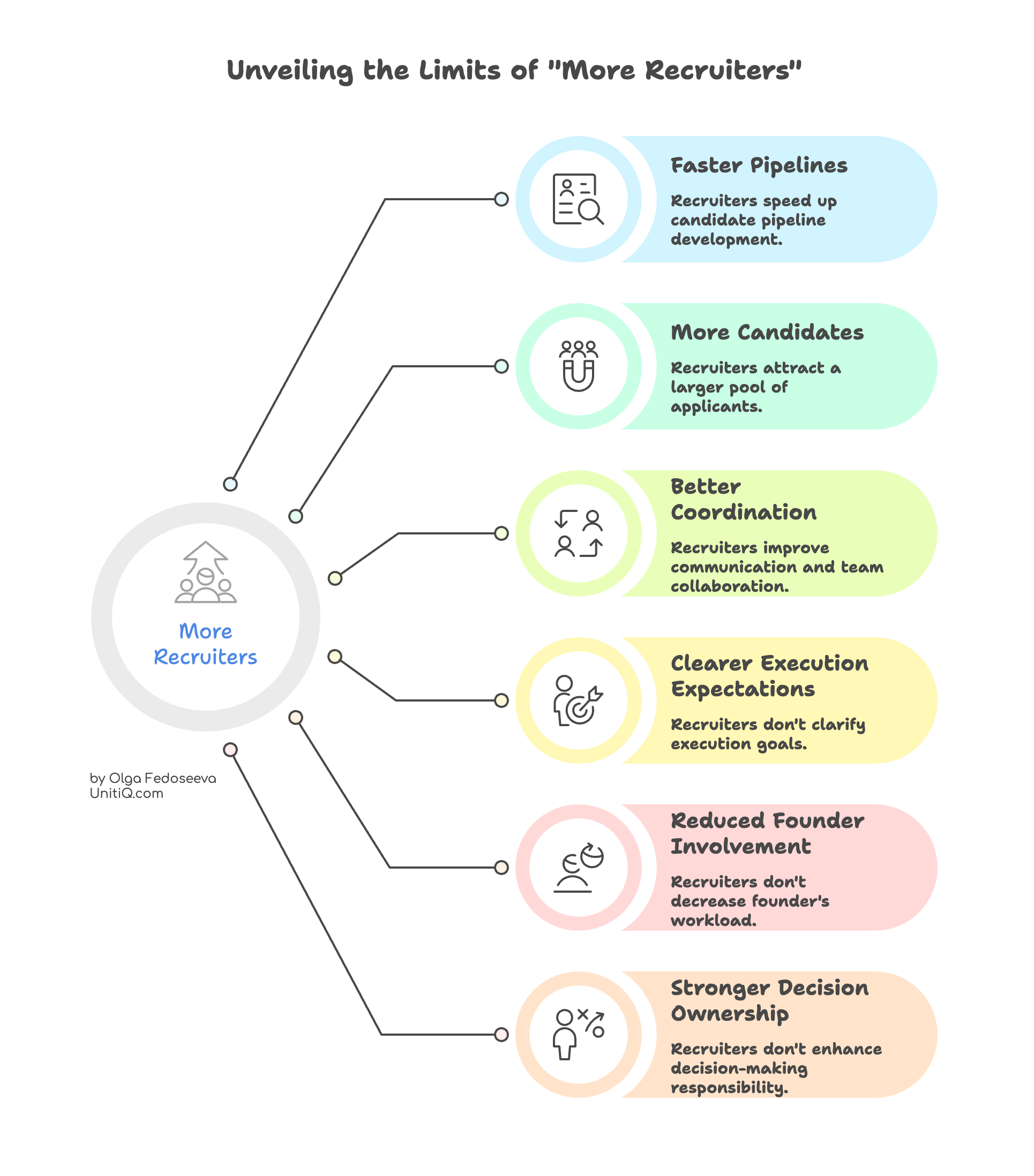
But you won’t get:
- clearer execution expectations
- stronger decision ownership
- reduced founder involvement
Because the underlying problem isn’t capacity.
It’s continuity.
Continuous Hiring Is an Execution System
Startups that scale don’t hire more often.
They hire continuously.
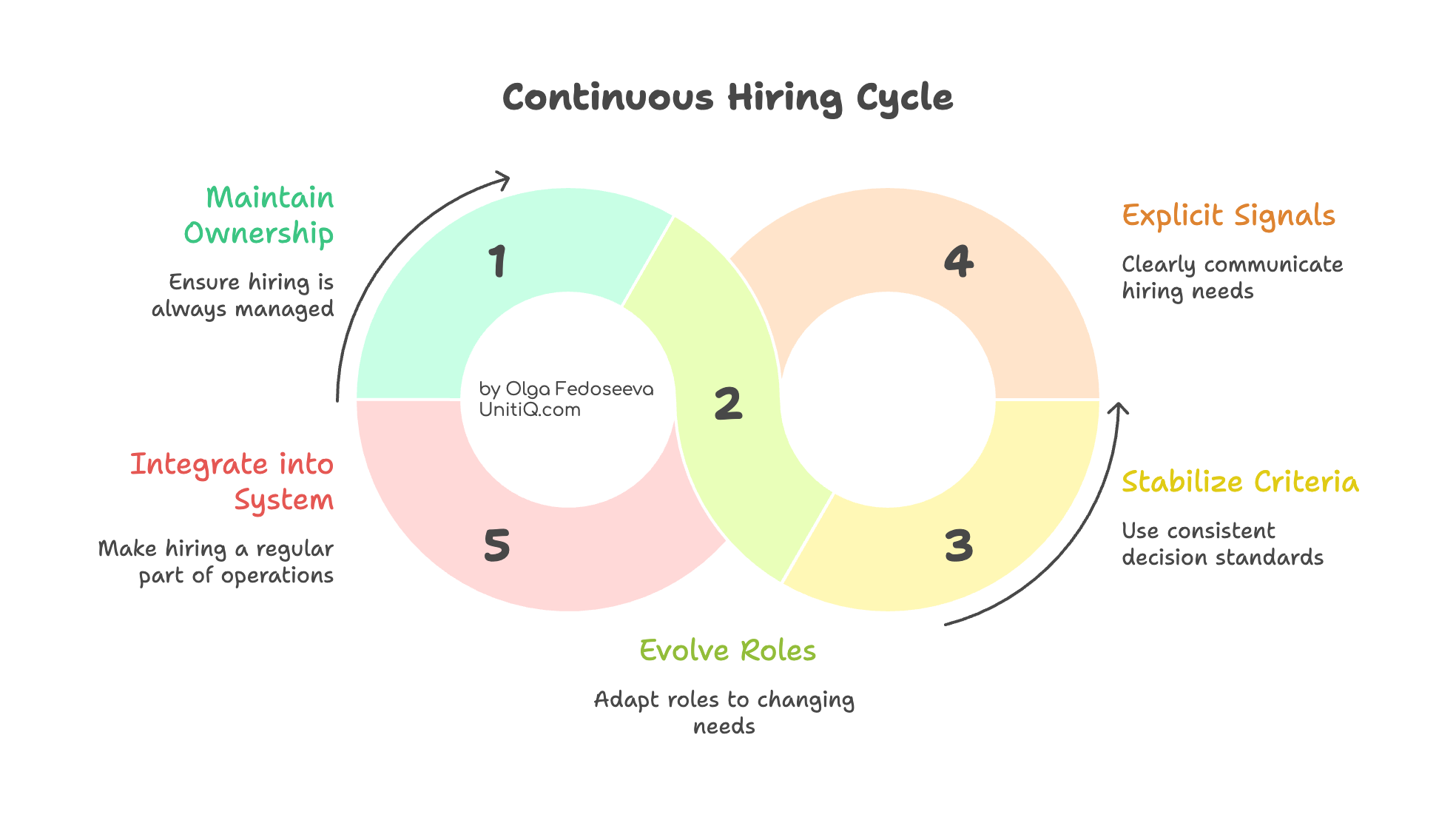
Continuous hiring means:
- hiring is always owned — even when no roles are open
- roles evolve instead of resetting
- decision criteria are stable
- execution signals are explicit
Hiring becomes part of the operating system — not a quarterly fire drill.
What Changes When Hiring Is Continuous
Hiring decisions improve
Because past outcomes inform future ones.
Founders step back
Because ownership doesn’t disappear between hires.
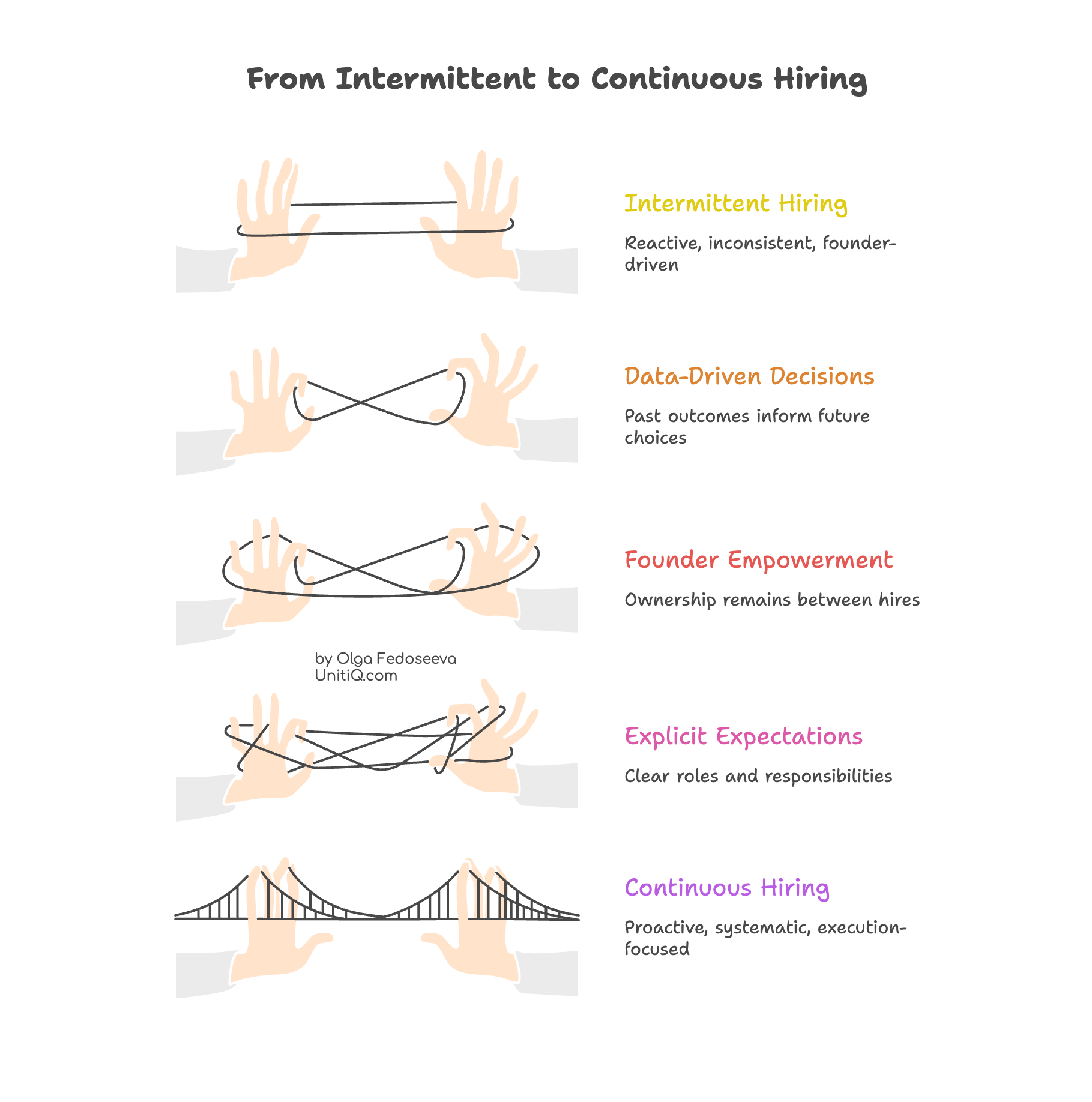
Mis-hires decrease
Because expectations are explicit before interviews begin.
Execution accelerates
Because new hires enter a system — not ambiguity.
This Is Why Recruitment as a Subscription Exists
Subscription-based or fractional talent ownership isn’t a pricing model.
Some startups solve this internally. Others temporarily bring in external ownership to stabilise the system.
→ Recruitment as a Subscription
→ Recruitment as a Subscription
It’s a structural fix.
It solves the real problem:
- loss of context
- fragmented ownership
- episodic decision-making
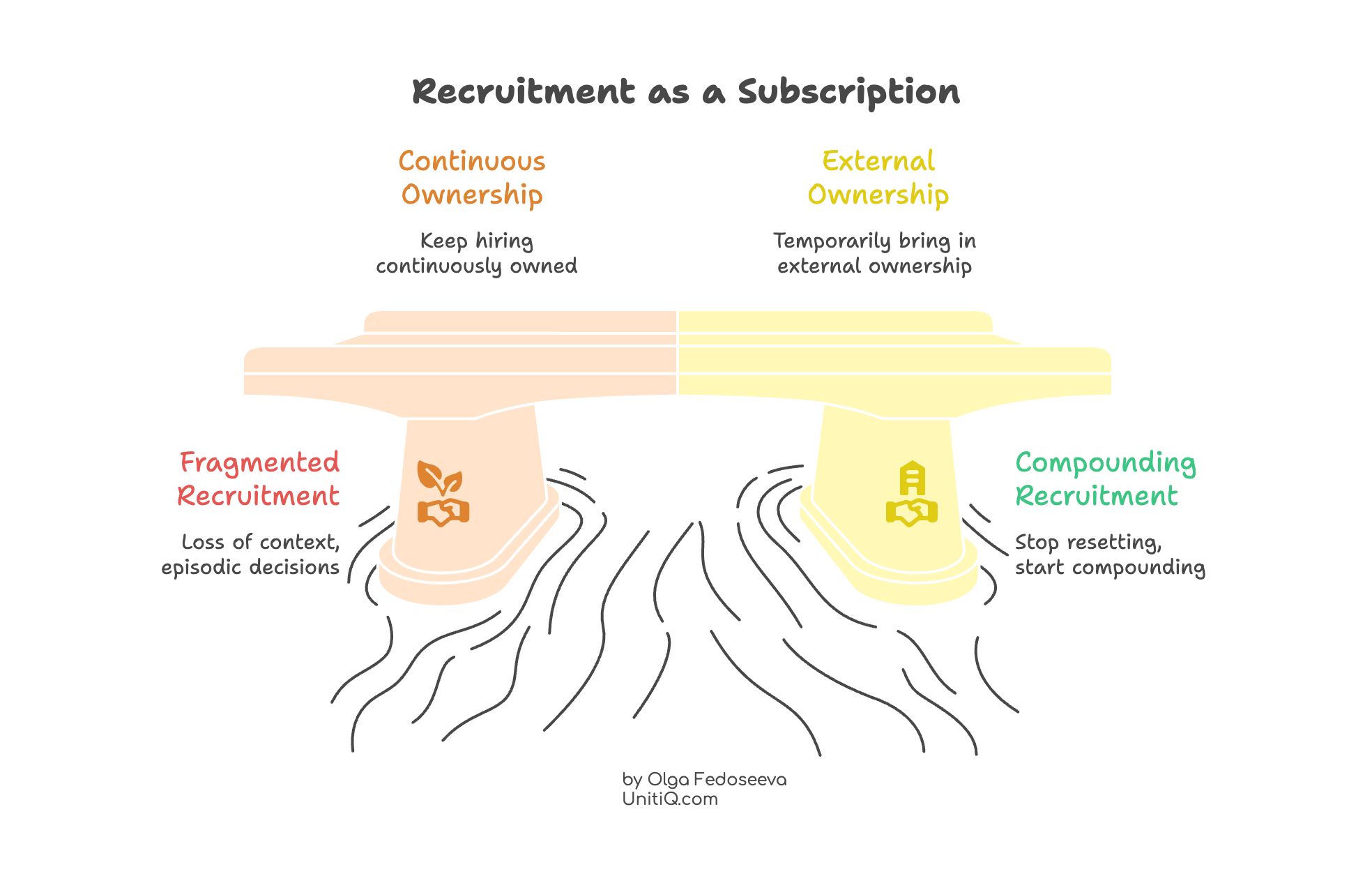
By keeping hiring continuously owned — even when nothing is open — startups stop resetting and start compounding.
The Question Founders Should Ask
Not:
“How fast can we fill this role?”
But:
“Who owns hiring outcomes when we’re not hiring?”
If the answer is unclear, execution will eventually slow — no matter how strong your candidates are.
Final Thought
Hiring doesn’t break your startup.
Restarting it does.
When hiring is treated as an event, execution resets.
When hiring is treated as a system, execution compounds.
That difference is where scale actually happens.
This shift — from episodic hiring to continuous ownership — is what separates scaling teams from stalled ones.
About the author
Olga Fedoseeva is the Founder of UnitiQ, a global HR executive, and a talent acquisition and people strategy leader with 20+ years of experience across EMEA, the US, and APAC. She has personally hired 1,500+ employees, led people strategy for organisations scaling from 30 to 700+ employees, and writes about hiring systems, execution risk, and people infrastructure in growth-stage startups.
Read full author profile
LinkedIn
Read full author profile


