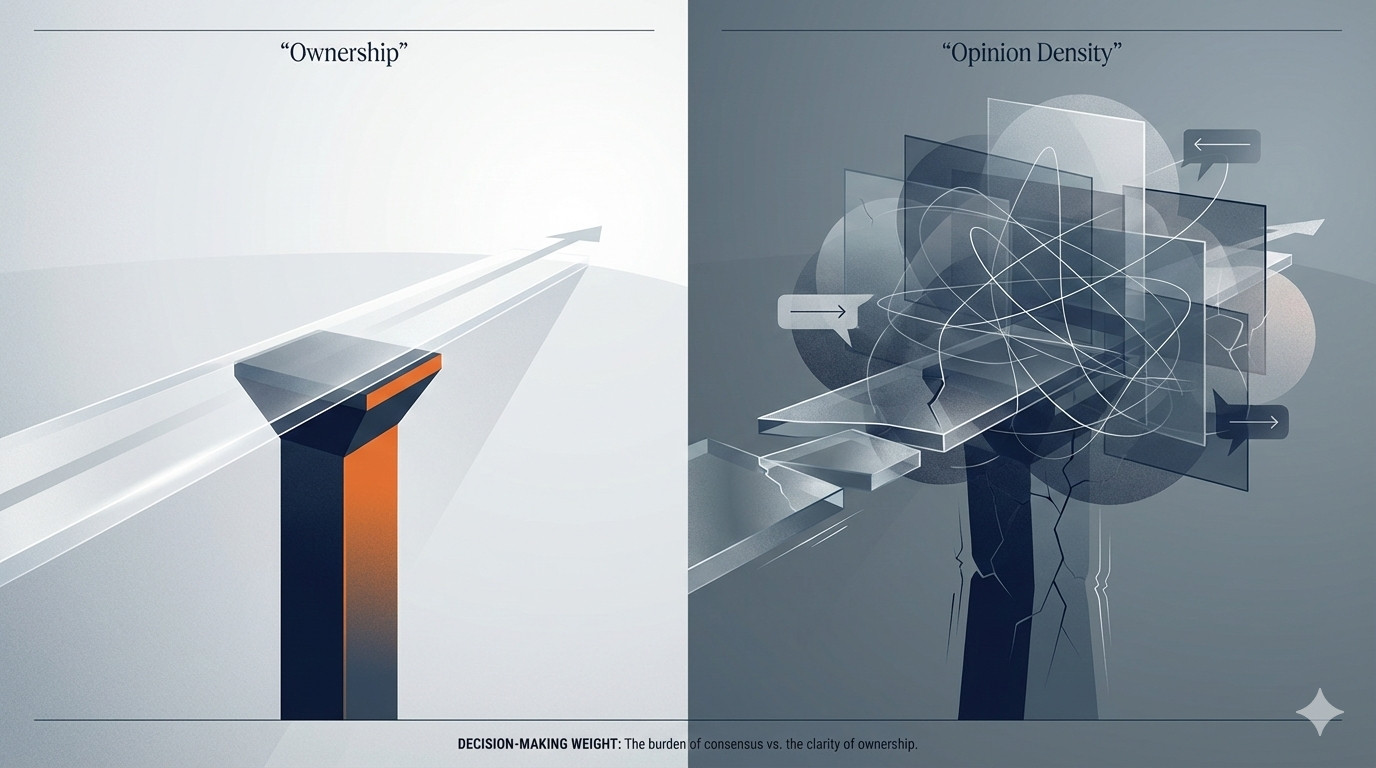
Hiring rarely collapses overnight.
In scaling startups, it degrades quietly — through more meetings, more opinions, and longer cycles that feel “thoughtful” but produce less momentum.
By the time founders say “we’re struggling to decide”, the real issue is already in place:
no one truly owns the hiring decision anymore.
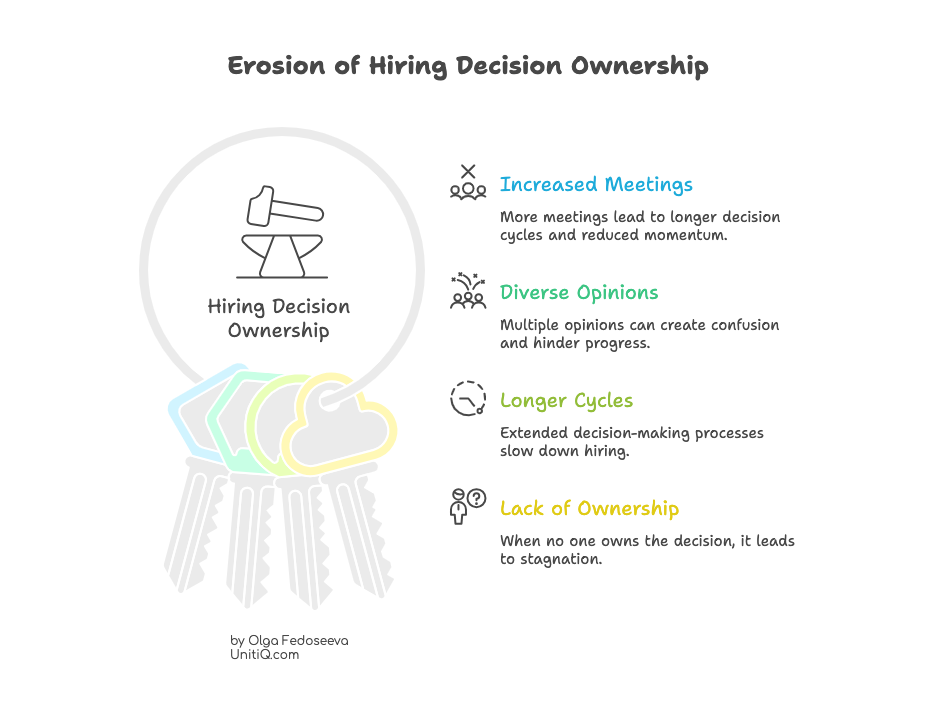
This article explains how decision ownership erodes, why it’s a system problem (not a people problem), and why execution slows long before hiring stops.
This erosion almost always starts earlier — when hiring is treated as an event instead of a continuously owned system, as we explain in Why Event-Based Hiring Keeps Resetting Your Startup.
The early-stage advantage: clear ownership
In early-stage companies, hiring decisions are brutally simple.
- One founder owns the role
- One business problem defines success
- One person carries the downside of a wrong hire
Speed comes not from confidence — but from clear authority.
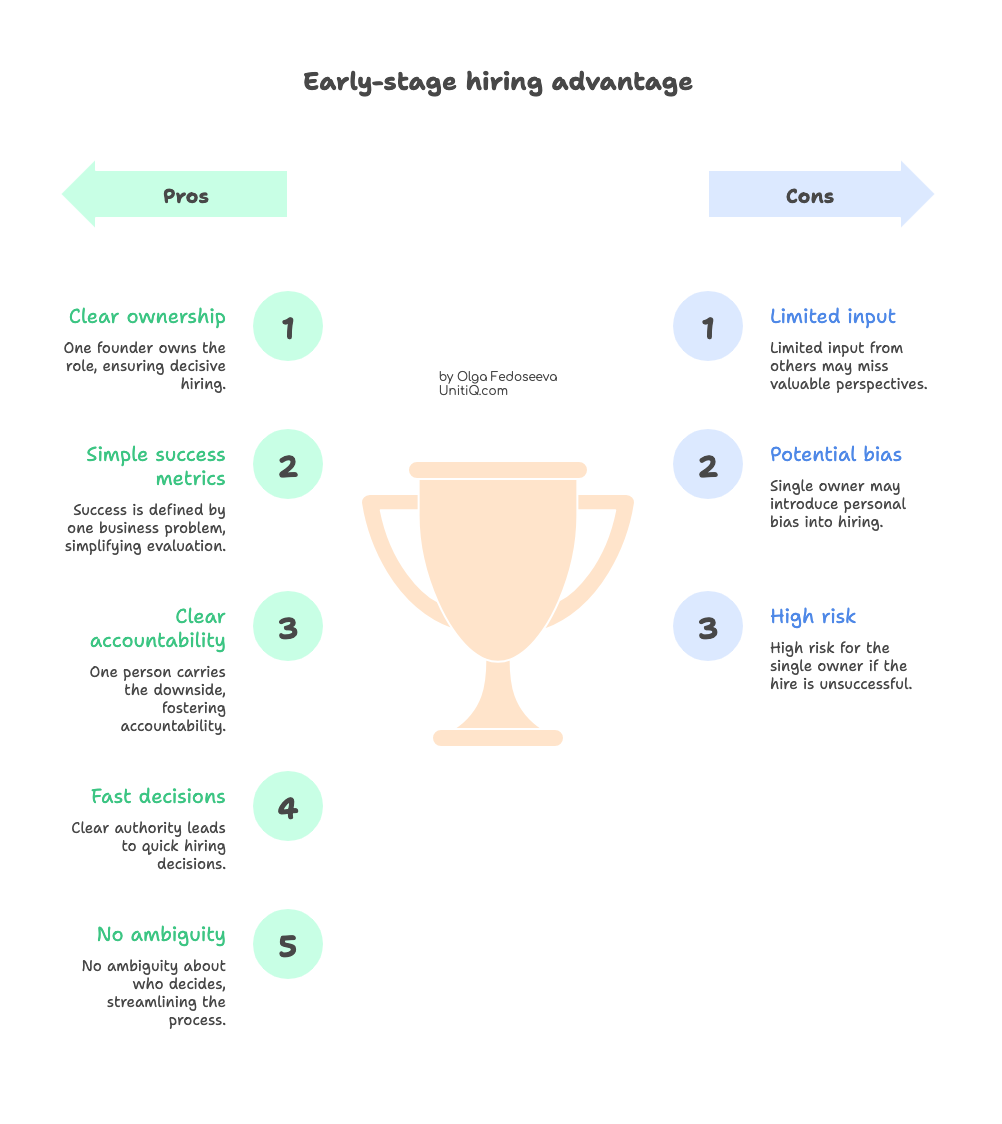
There’s no ambiguity about who decides.
There’s no diffusion of responsibility.
And there’s no illusion of safety through consensus.
What changes as startups scale
As companies move from Series A into Series B and beyond, hiring becomes “professionalised”.
The intent is good:
- reduce risk
- include stakeholders
- improve quality
- avoid bias
The result is different.
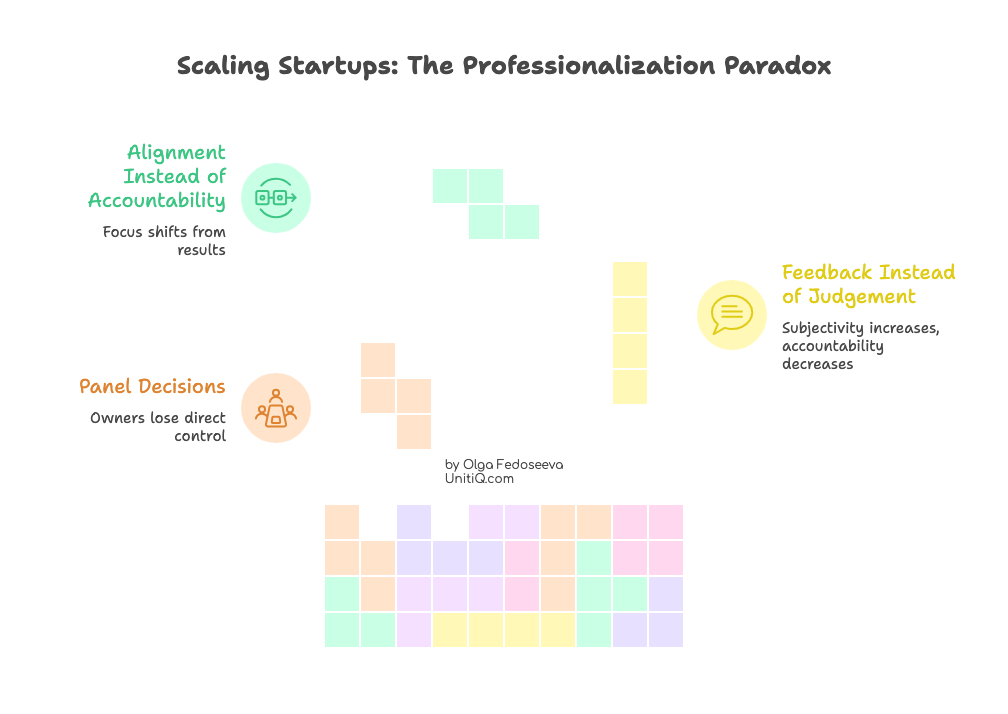
Gradually, hiring decisions start to involve:
This erosion often starts earlier — when roles are defined vaguely, success is unclear, and ownership is never truly anchored.
- panels instead of owners
- feedback instead of judgement
- alignment instead of accountability
No single step breaks the system.
The accumulation does.
When ownership dissolves this way, hiring doesn’t improve with experience — it accumulates learning debt, which is why hiring never actually gets better even after dozens of roles.
From ownership to opinion density
Here’s the quiet shift most teams miss:
- Ownership means one person is accountable for the outcome
- Opinions spread responsibility without carrying consequence
This is the same failure mode where everyone has a signal, but no one owns the decision — and hiring confidence collapses under the weight of input.
As more people contribute feedback:
- decisions feel heavier
- disagreement feels riskier
- saying “yes” feels irresponsible
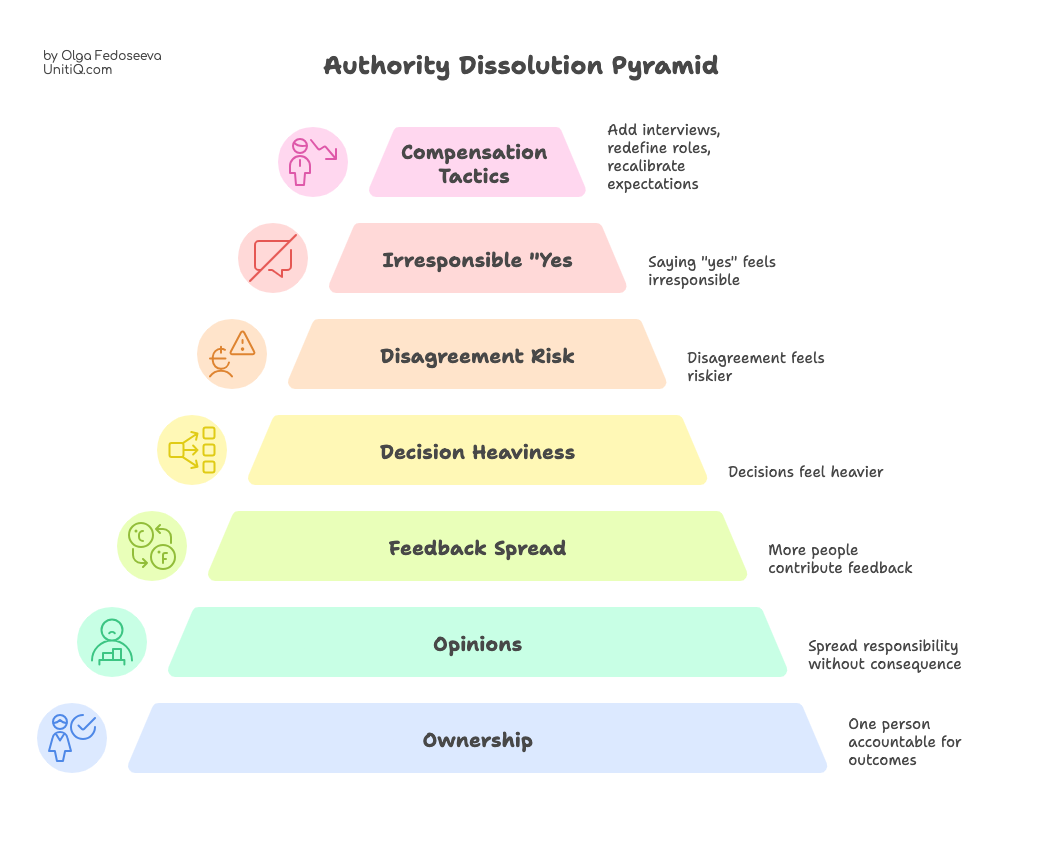
So teams compensate by:
- adding more interviews
- reopening role definitions
- recalibrating expectations mid-process
Hiring slows — not because candidates are weak, but because authority has dissolved.
This same authority gap is reinforced by per-hire hiring models, where ownership resets with every role instead of carrying forward.
Why consensus feels safe (but isn’t)
Consensus-based hiring feels rational because:
- it distributes risk
- it reduces individual blame
- it sounds mature
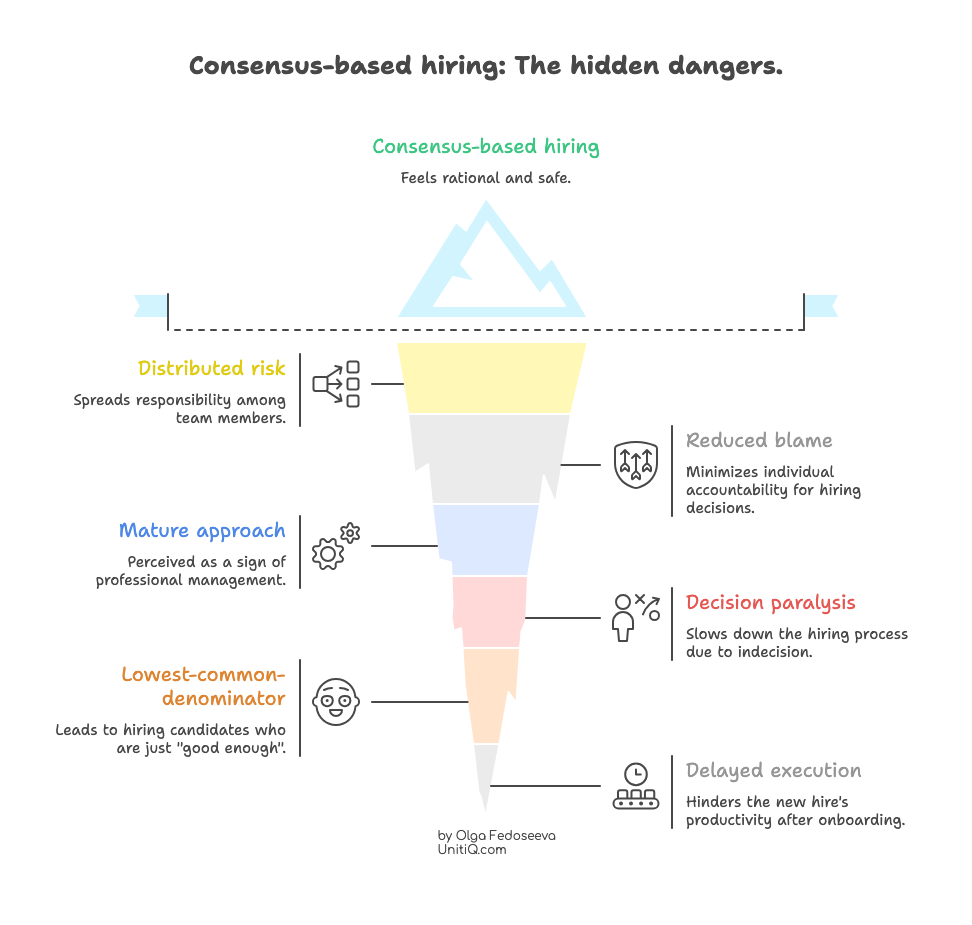
But in practice, it creates:
- decision paralysis
- lowest-common-denominator choices
- delayed execution after the hire
When everyone participates, no one owns the trade-offs.
And when no one owns the trade-offs, execution suffers immediately after onboarding — not during hiring.
This is also why hiring is rarely the real bottleneck — execution capacity is.
The execution cost nobody measures
Loss of decision ownership shows up as:
- longer ramp-up times
- unclear success metrics
- repeated re-alignment conversations
- founder re-entry into operational decisions
Founder re-entry is not a leadership failure — it’s a system alarm, and it’s exactly why founders burn out on hiring long before teams ever scale.
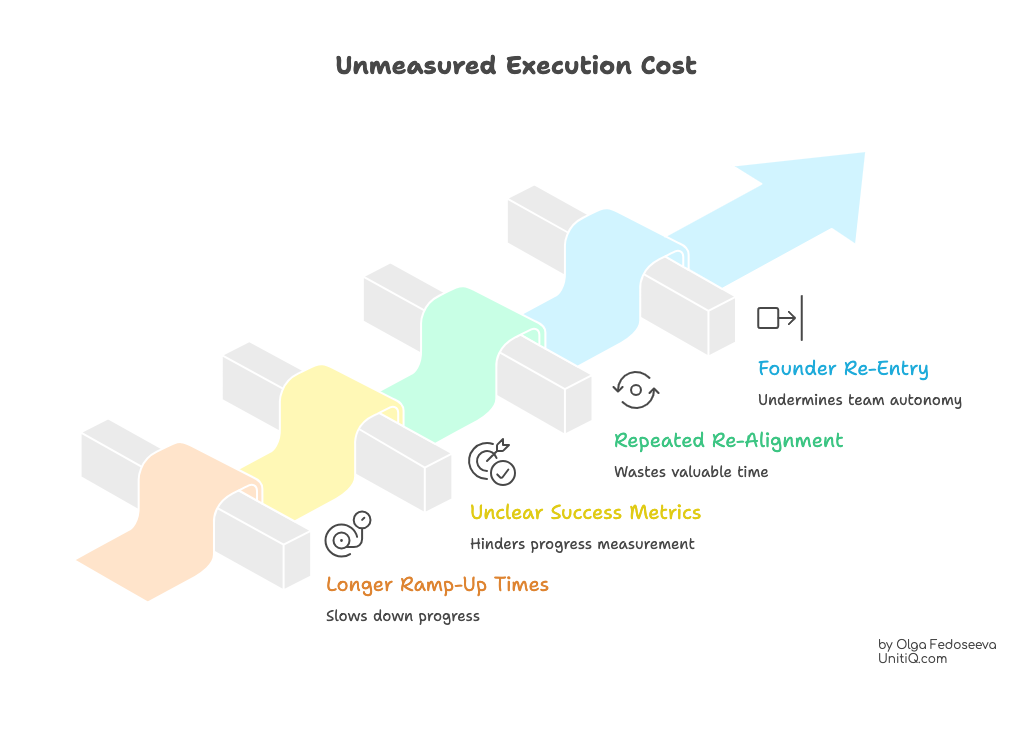
These aren’t onboarding issues.
They’re decision design failures.
Hiring didn’t fail.
The system that governs decisions did.
Why more process doesn’t fix this
Most companies respond by adding:
- stricter scorecards
- more calibration sessions
- additional interview stages
But process can’t replace ownership.
Without a clear decision owner:
- frameworks become shields
- data becomes justification
- hiring becomes defensible, not decisive
The system optimises for not being wrong instead of moving forward.
What strong hiring systems do differently
High-performing hiring systems don’t eliminate collaboration — they anchor it.
They ensure:
- one explicit decision owner per role
- clear escalation boundaries
- defined success signals tied to execution, not CVs
- continuity across hiring cycles
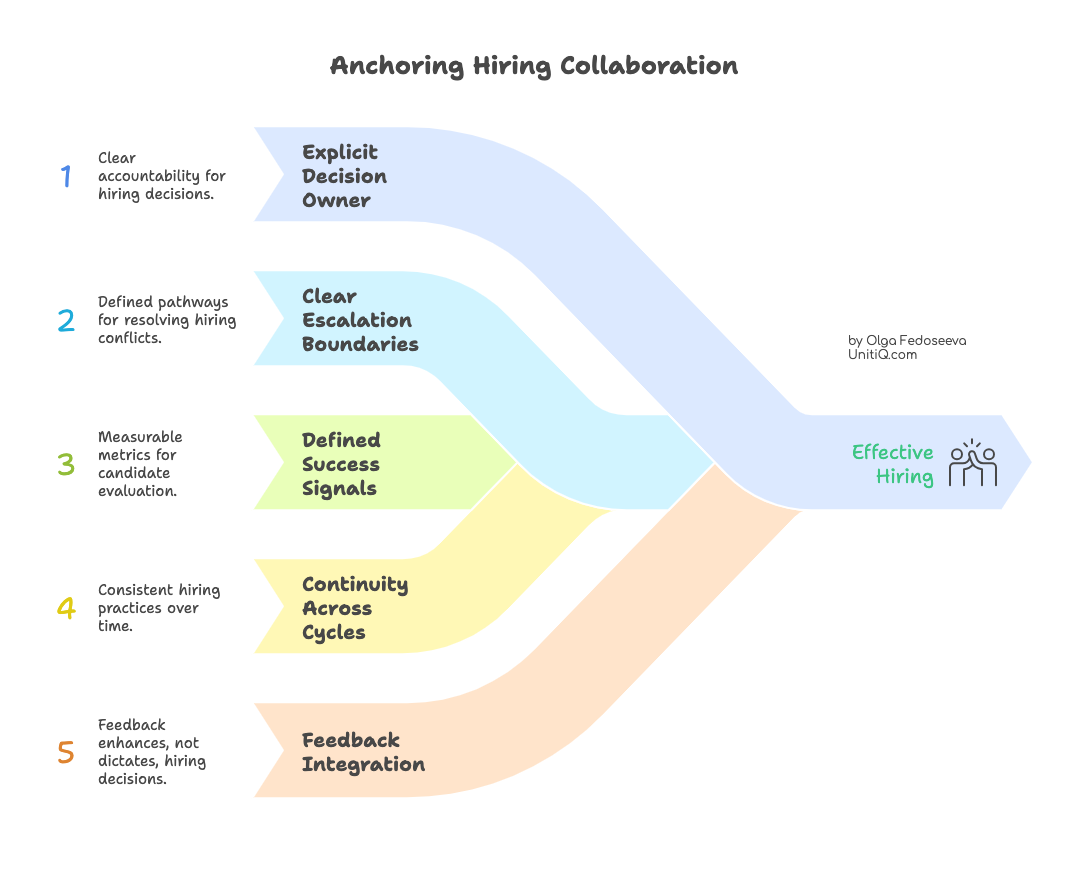
Feedback informs the decision.
It does not replace it.
The real signal to watch
If your hiring process shows these signs:
- “we need one more opinion”
- “let’s see a few more profiles”
- “we’re close, but not confident”
- “founders should weigh in”
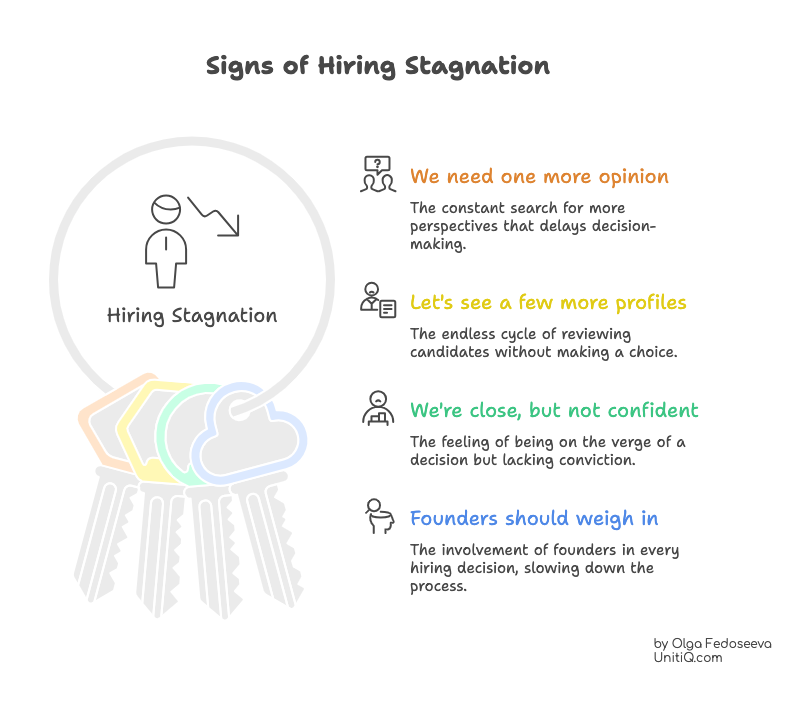
Hiring hasn’t slowed.
Ownership already has.
When ownership breaks this early, hiring resets instead of compounding — the defining pattern of event-based hiring.
Why this matters more at scale
As organisations grow:
- roles interact more tightly
- mistakes compound faster
- reversals cost more
That’s precisely when decision clarity matters most — and when it’s most likely to erode.
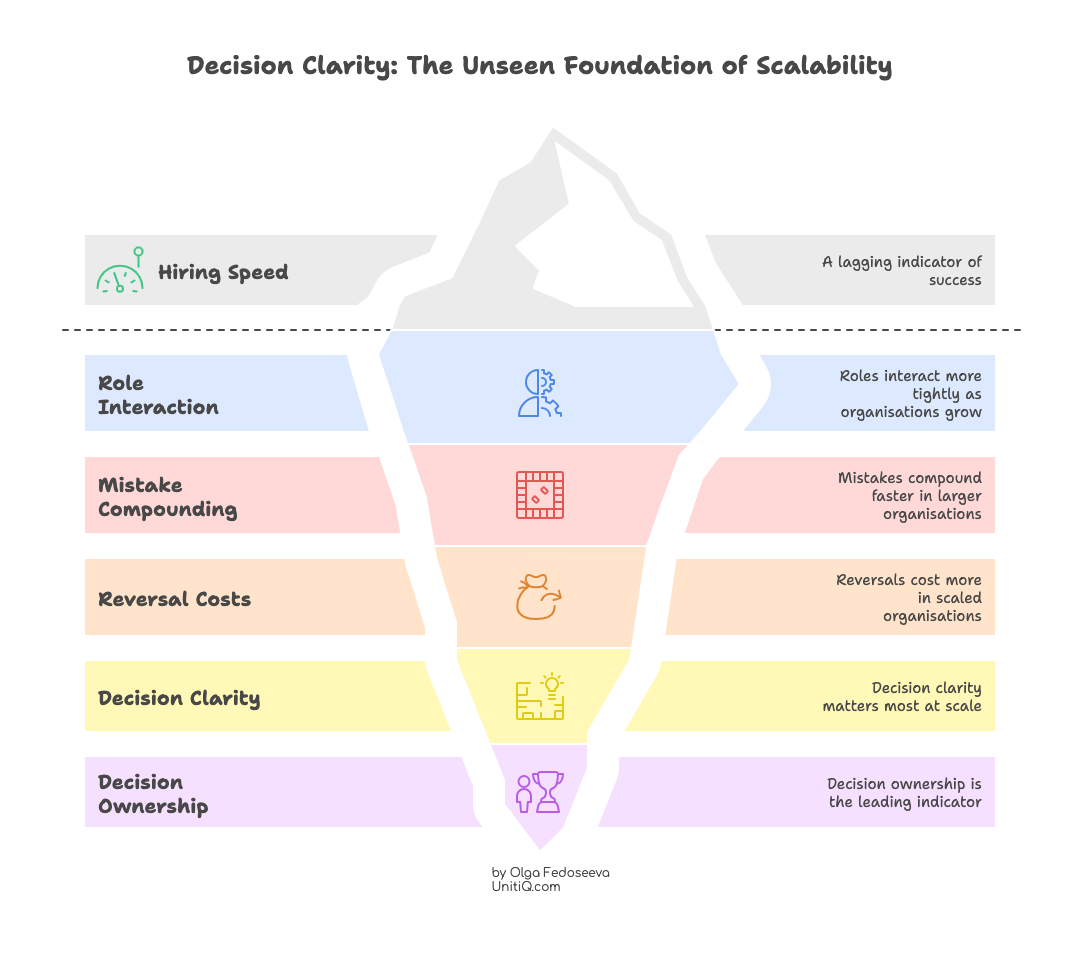
Hiring speed is a lagging indicator.
Decision ownership is the leading one.
TL;DR
- Hiring slows after decision ownership breaks — not before
- Consensus replaces accountability quietly
- More process doesn’t restore authority
- Execution suffers immediately after the hire
- Clear ownership is a system design choice, not a leadership trait
If hiring feels heavy, look upstream.
The bottleneck isn’t talent.
It’s who decides — and who no longer does.
If you want to sanity-check which model fits your current stage — and where execution is actually breaking — we can walk through it together.
About the author
Olga Fedoseeva is the Founder of UnitiQ, a global HR executive, and a talent acquisition and people strategy leader with 20+ years of experience across EMEA, the US, and APAC. She has personally hired 1,500+ employees, led people strategy for organisations scaling from 30 to 700+ employees, and writes about hiring systems, execution risk, and people infrastructure in growth-stage startups.
Read full author profile
LinkedIn
Read full author profile


