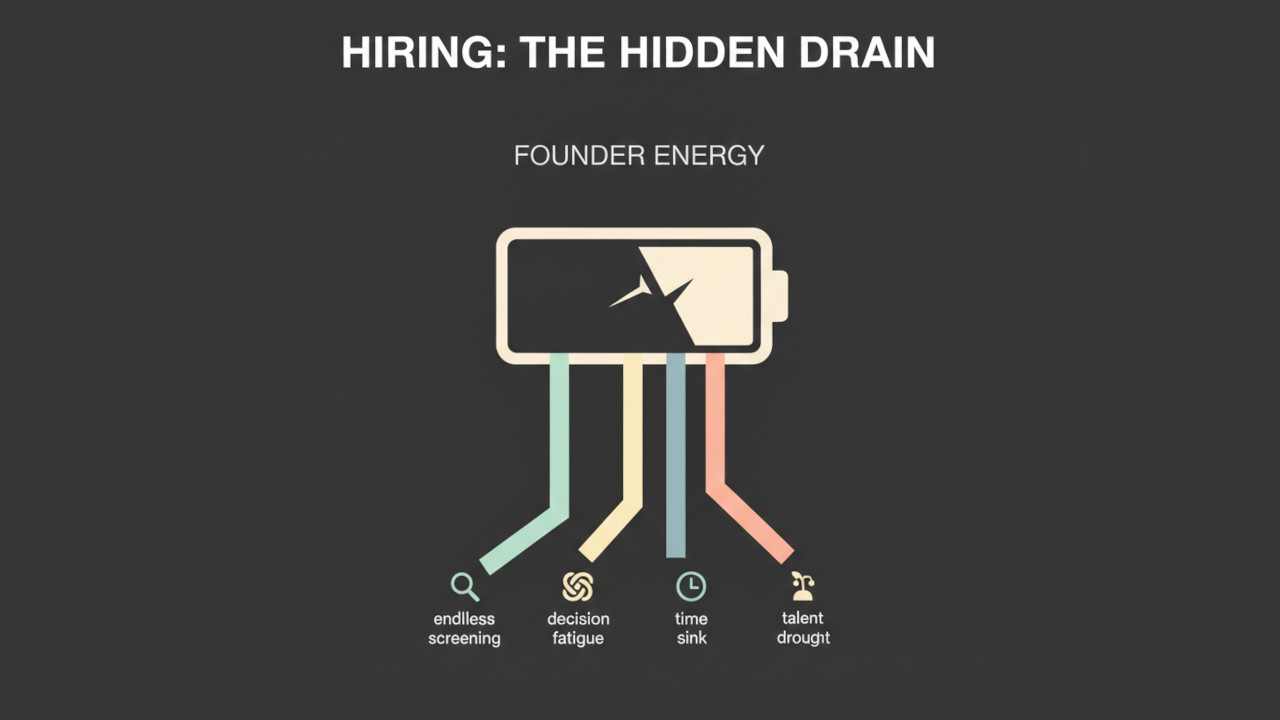
Founders don’t burn out because they hire too much.
They burn out because hiring never releases them.
Every new role is supposed to do one thing:
remove the founder from the decision loop.
But in many startups, the opposite happens.
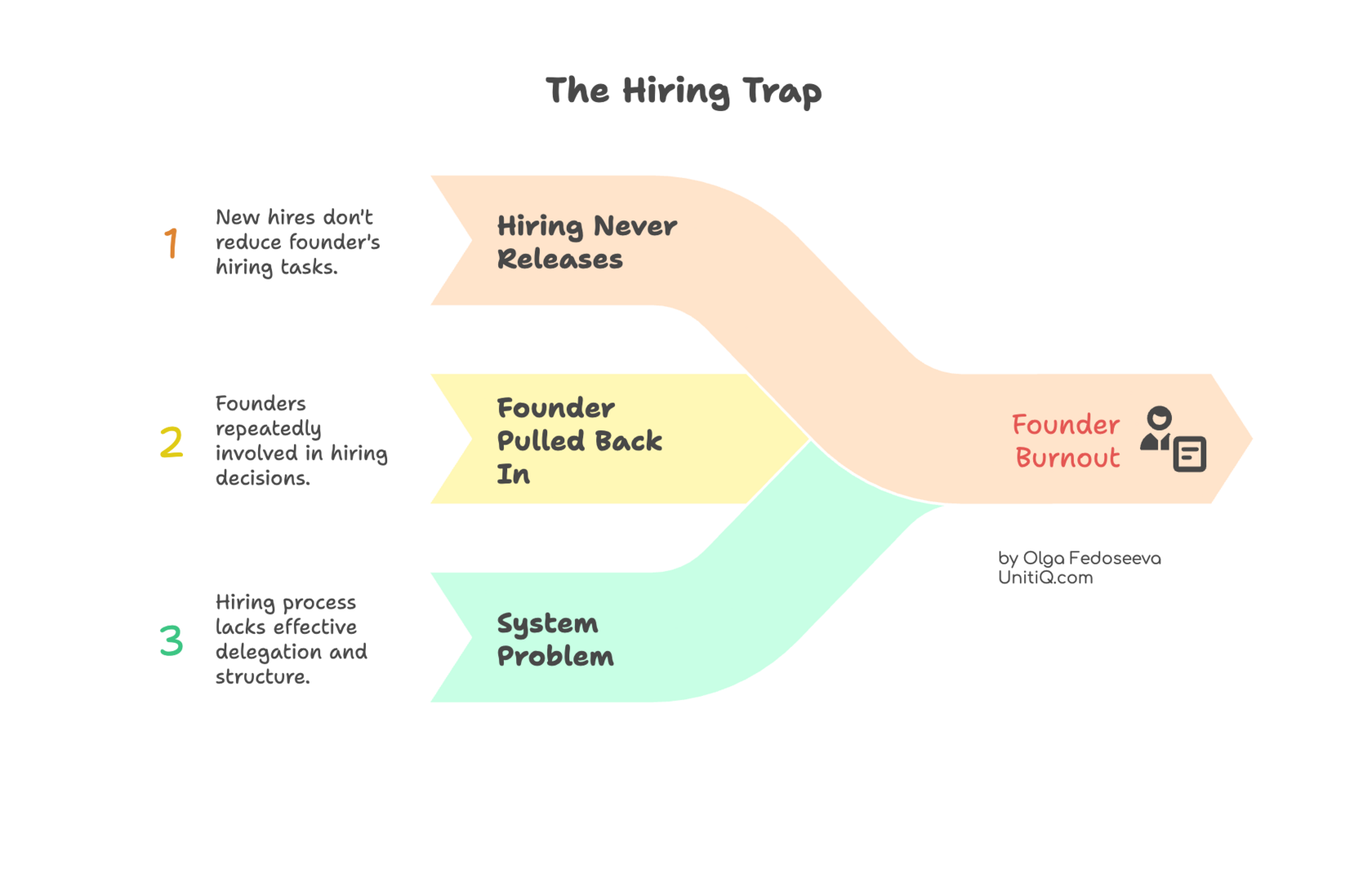
Hiring pulls founders back in — again and again — even as the team grows.
This isn’t a time-management issue.
And it’s not about delegation skills.
It’s a system problem.
That system problem usually starts earlier — when hiring is treated as an event instead of a continuously owned capability.
The promise founders believe
Most founders expect hiring to work like this:
- early on, I’m deeply involved
- as we grow, others take ownership
- eventually, hiring runs without me
That promise is logical.
It’s also rarely true.
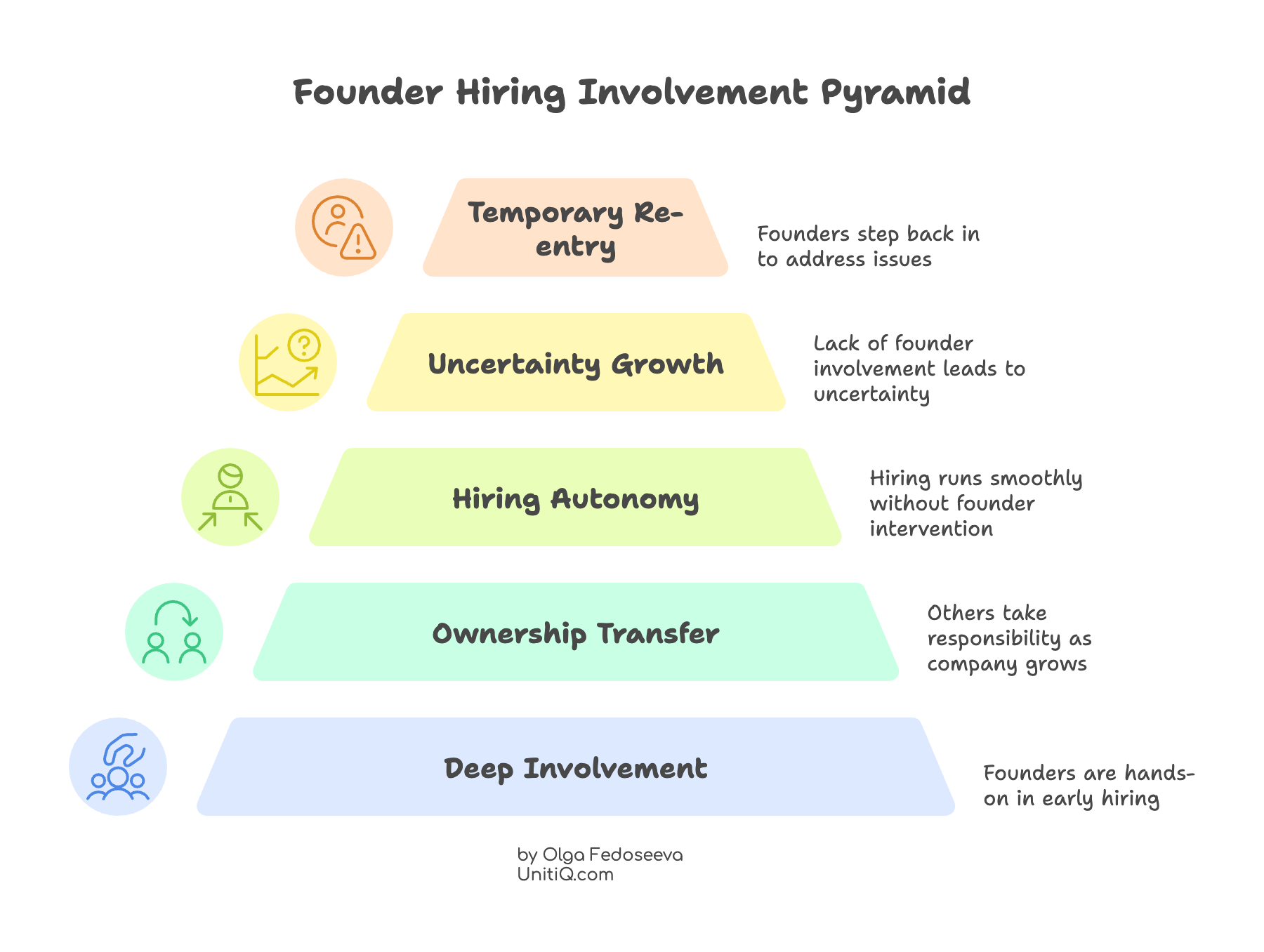
What actually happens is more subtle:
- founders step back
- uncertainty grows
- decisions feel riskier
- founders re-enter “temporarily”
That temporary involvement becomes permanent.
Why founders keep getting pulled back in
Founders don’t re-enter hiring because they want control.
When downside ownership disappears, hiring decisions slow and escalate — a pattern we unpack in detail in When Hiring Slows, Decision Ownership Has Already Broken.
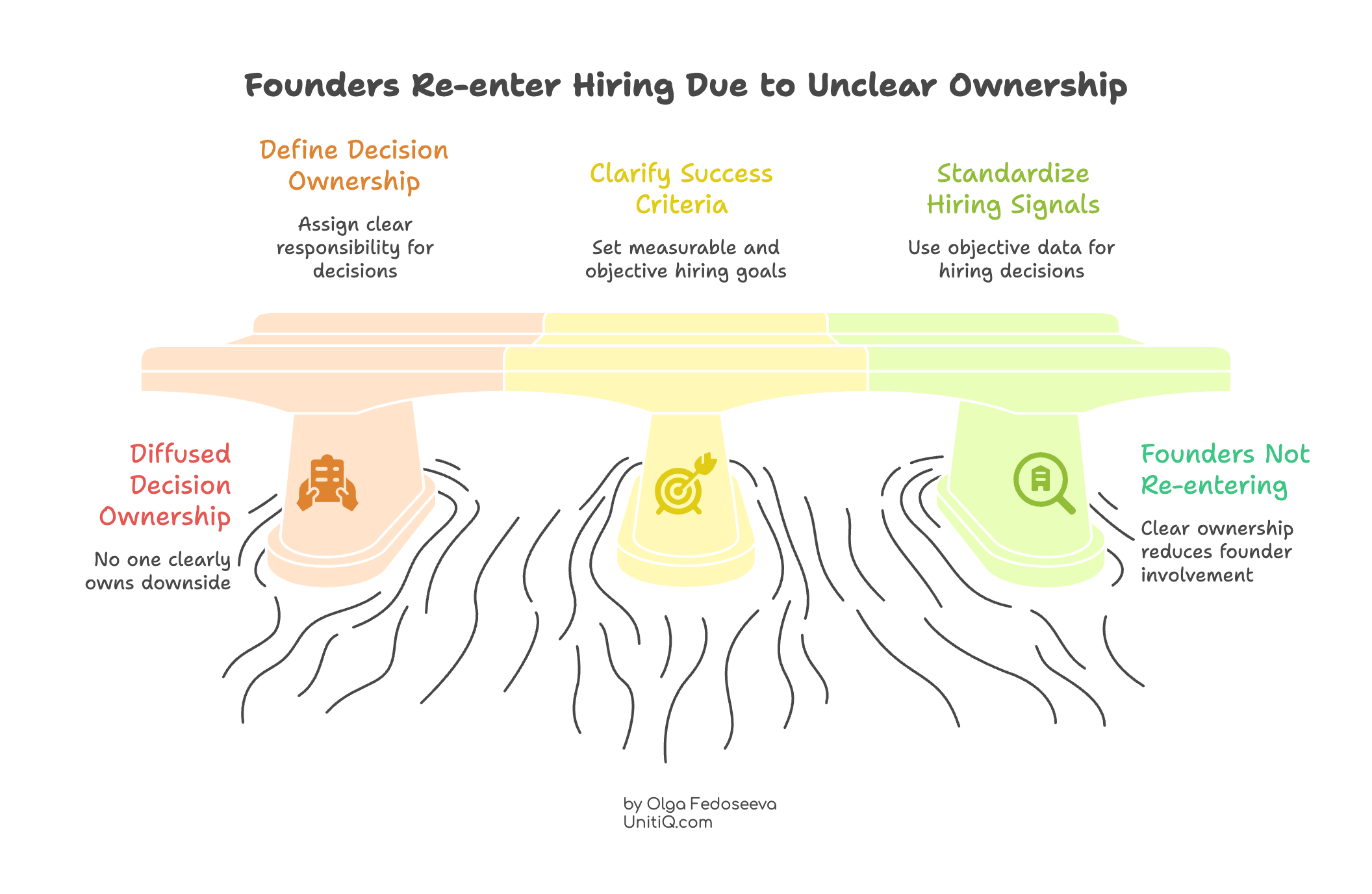
They re-enter because no one clearly owns the downside.
When:
- decision ownership is diffused
- success criteria are unclear
- hiring signals are subjective
every “yes” feels dangerous.
This uncertainty often starts much earlier — when roles are defined vaguely and success is never anchored to execution.
So teams escalate.
They ask for validation.
They seek alignment.
Founders become the safety net — not because they’re best suited, but because they’re the only ones who can absorb the risk.
The emotional cost nobody names
This is where burnout actually forms.
Not from volume.
Not from hours.
But from:
- re-litigating the same trade-offs
- revisiting decisions that should be settled
- carrying accountability without authority
- being responsible for outcomes you didn’t fully decide
Founders don’t feel busy.
That feeling comes from revisiting the same hiring decisions without learning ever compounding across roles.
They feel trapped.
Hiring becomes a background anxiety that never resolves.
That anxiety isn’t emotional — it’s operational, driven by execution risk that never fully surfaces.
Why “better delegation” doesn’t fix this
Advice usually sounds like:
- “trust your team”
- “let go”
- “empower others”
That advice assumes the system is sound.
Most hiring advice breaks down precisely because it ignores uncertainty, ownership erosion, and execution risk.
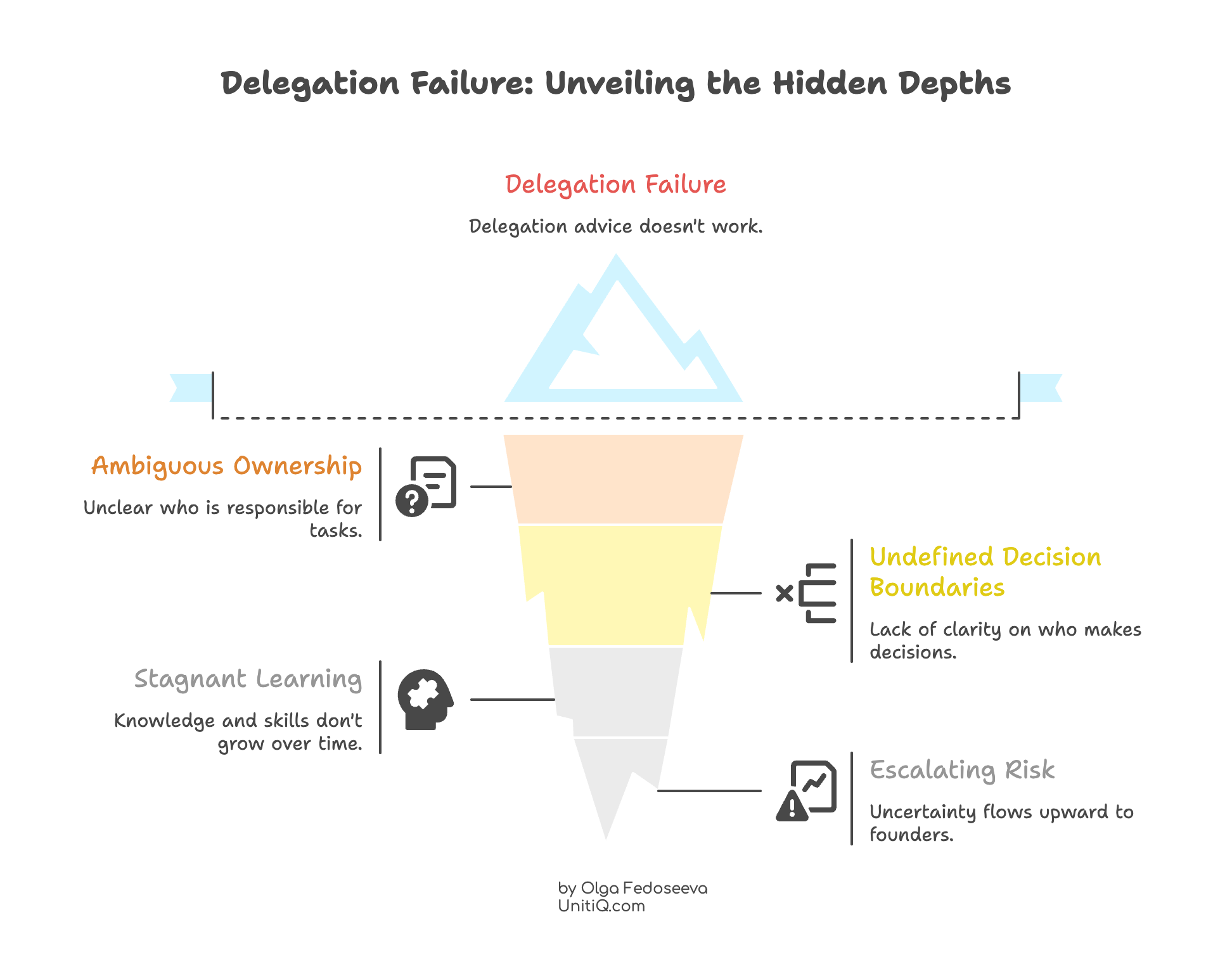
But delegation fails when:
- ownership is ambiguous
- decision boundaries are undefined
- learning doesn’t compound
You can’t delegate uncertainty.
The same uncertainty flow is why transactional, per-hire hiring models quietly increase cost instead of reducing it.
It just flows upward.
So founders step back in — not because they lack trust, but because the system keeps escalating risk to them.
The quiet signal of founder burnout
Watch for these patterns:
- founders “just joining the final interview”
- founders “sanity-checking” candidates
- founders rewriting role definitions late
- founders reopening decisions after consensus
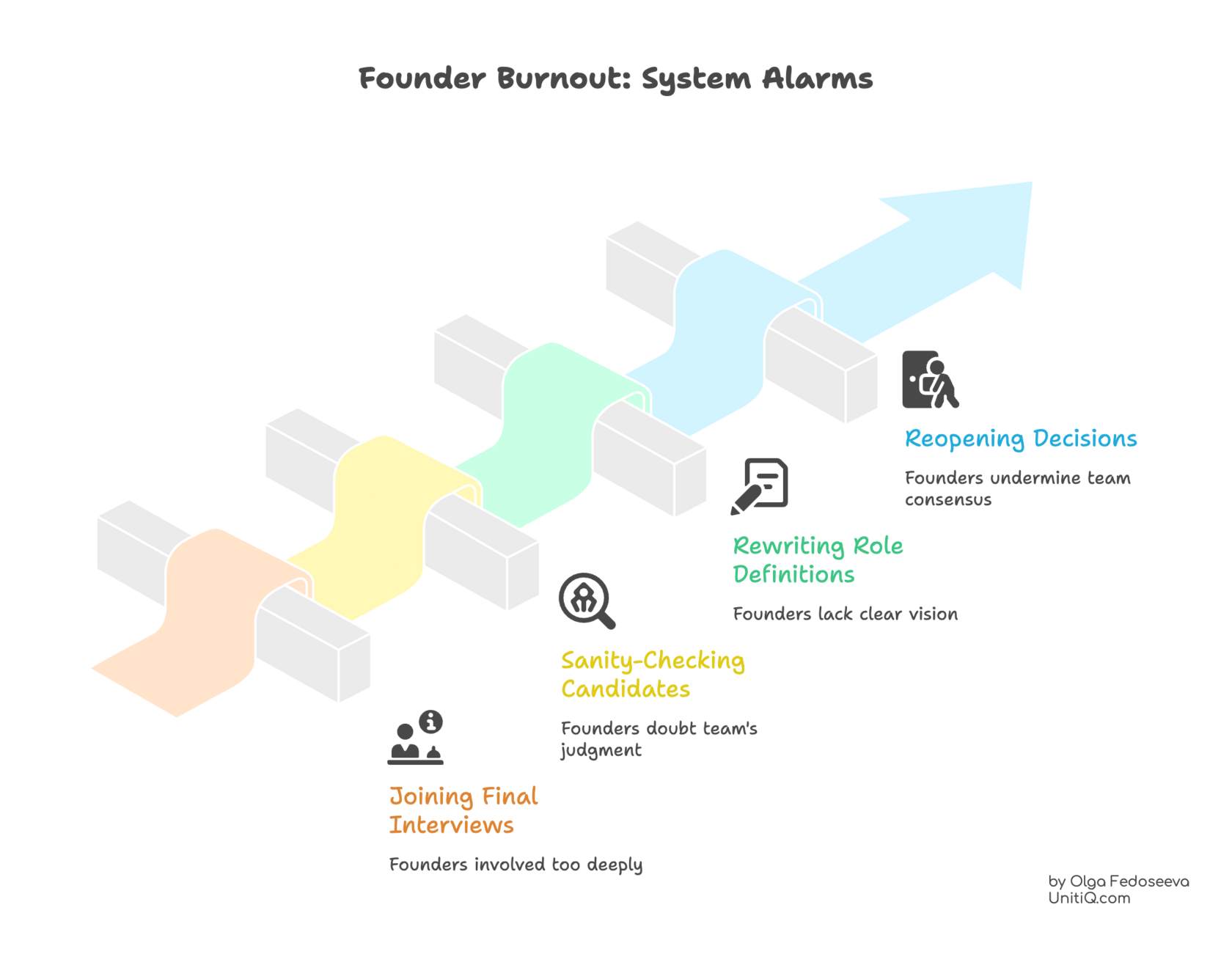
These are not micromanagement habits.
They are system alarms.
The hiring system is not containing risk — so it leaks to the top.
Why this happens before teams scale
The most dangerous moment is not hypergrowth.
It’s the in-between stage:
- too many roles for founder intuition
- too few systems for true ownership
- too much risk to be casual
This is where founders expect relief —
and instead feel the pressure peak.
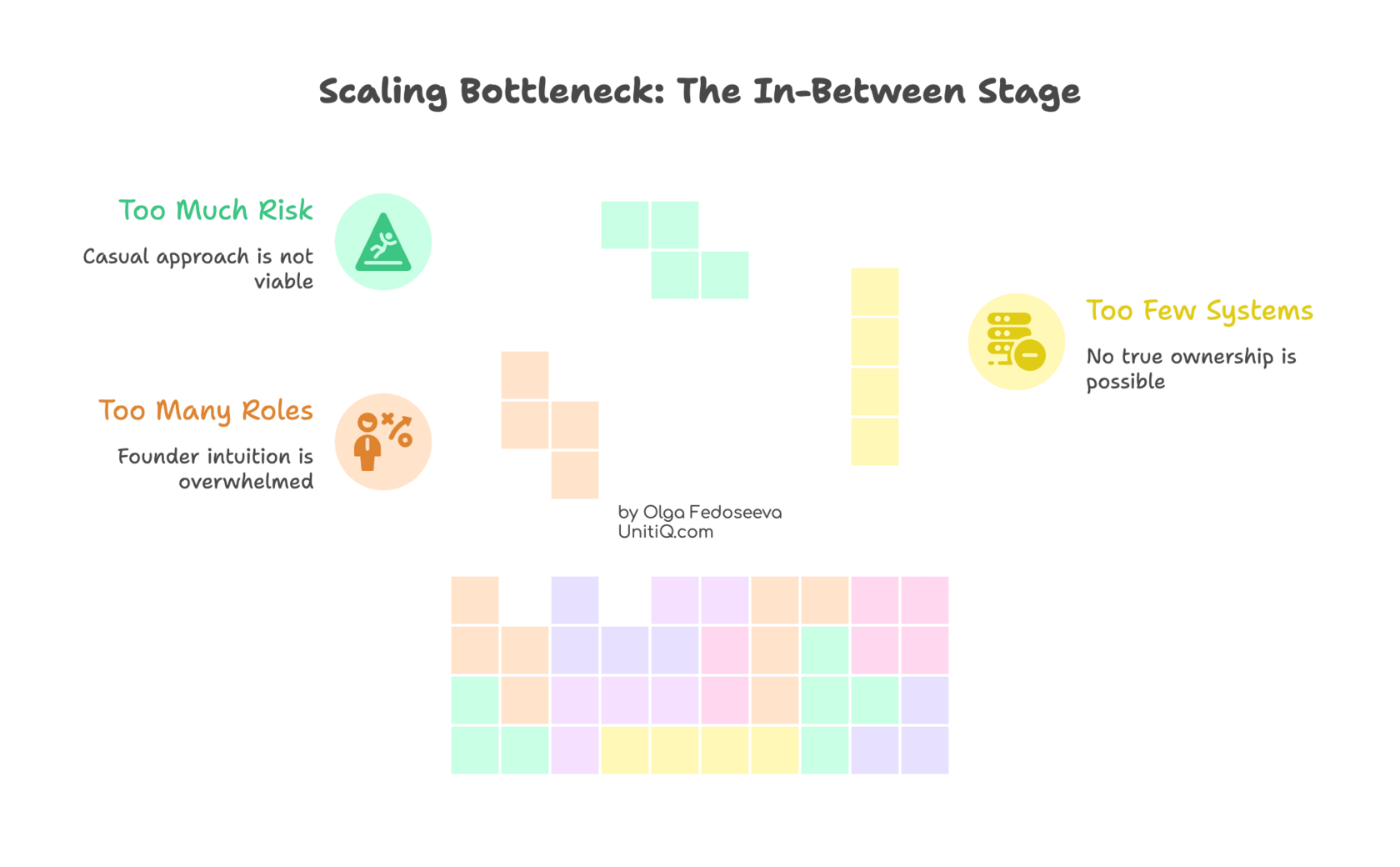
Hiring doesn’t slow because the market is hard.
It slows because the founder becomes the bottleneck again.
That bottleneck reappears whenever hiring resets instead of compounding between roles.
What changes when burnout disappears
In teams where founder burnout actually lifts:
- founders exit hiring decisions early
- ownership stays with role owners
- mistakes are absorbed locally
- learning compounds across roles
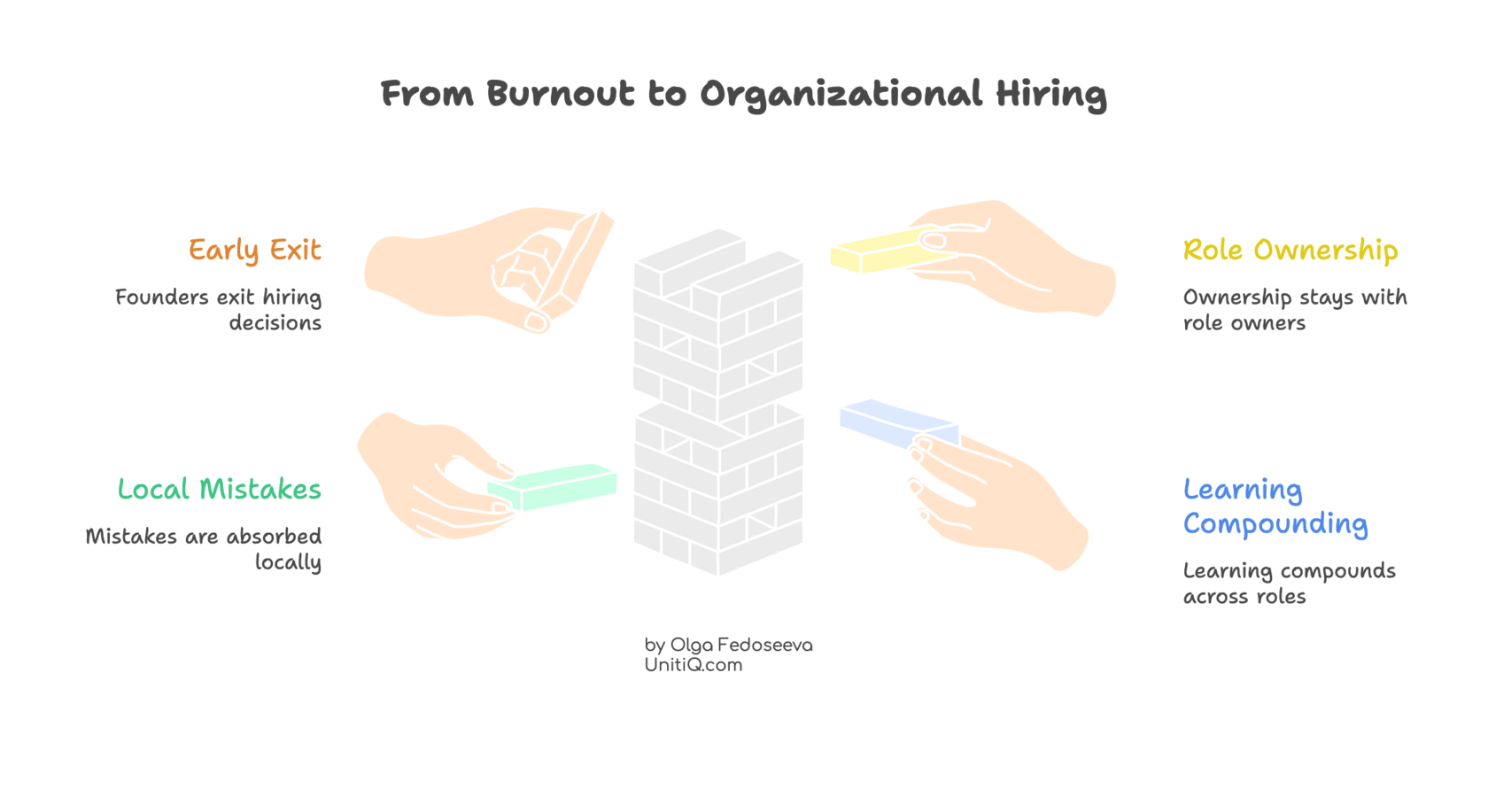
Hiring stops being a personal weight.
It becomes an organisational function.
Not perfect.
But contained.
This is why hiring feels heavier over time
Founders often say:
“Hiring used to be fun. Now it’s exhausting.”
That’s not nostalgia.
It’s signal.
It means:
- risk increased
- ownership didn’t
- systems didn’t catch up
So the founder’s role quietly expanded again —
without formal acknowledgement.
TL;DR
- Founders don’t burn out from hiring volume
- They burn out from unresolved decision ownership
- Delegation fails when uncertainty isn’t contained
- Founders re-enter hiring to absorb risk, not to control
- Burnout is a system failure, not a leadership flaw
If hiring keeps pulling you back in,
it’s not because you’re doing it wrong.
It’s because the system was never designed to let you out.
If you want to sanity-check which model fits your current stage — and where execution is actually breaking — we can walk through it together.
About the author
Olga Fedoseeva is the Founder of UnitiQ, a global HR executive, and a talent acquisition and people strategy leader with 20+ years of experience across EMEA, the US, and APAC. She has personally hired 1,500+ employees, led people strategy for organisations scaling from 30 to 700+ employees, and writes about hiring systems, execution risk, and people infrastructure in growth-stage startups.
Read full author profile
LinkedIn
Read full author profile


