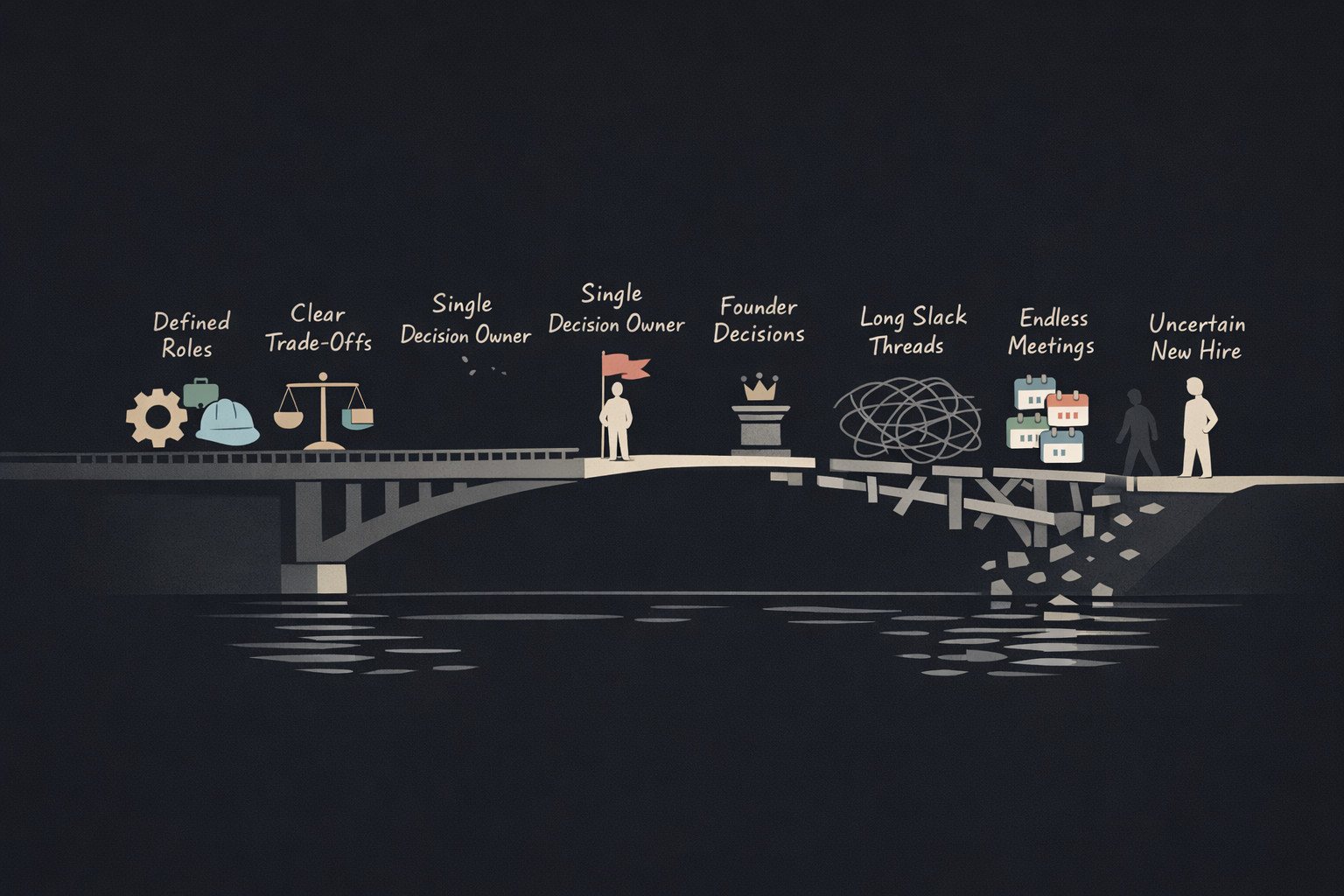
At 10 people, decisions feel natural.
At 25, they feel heavier.
At 60+, they start to stall.
Founders often interpret this as:
- “We need stronger people.”
- “We need more senior hires.”
- “We need better decision-makers.”
So they hire.
But decision problems rarely start with people.
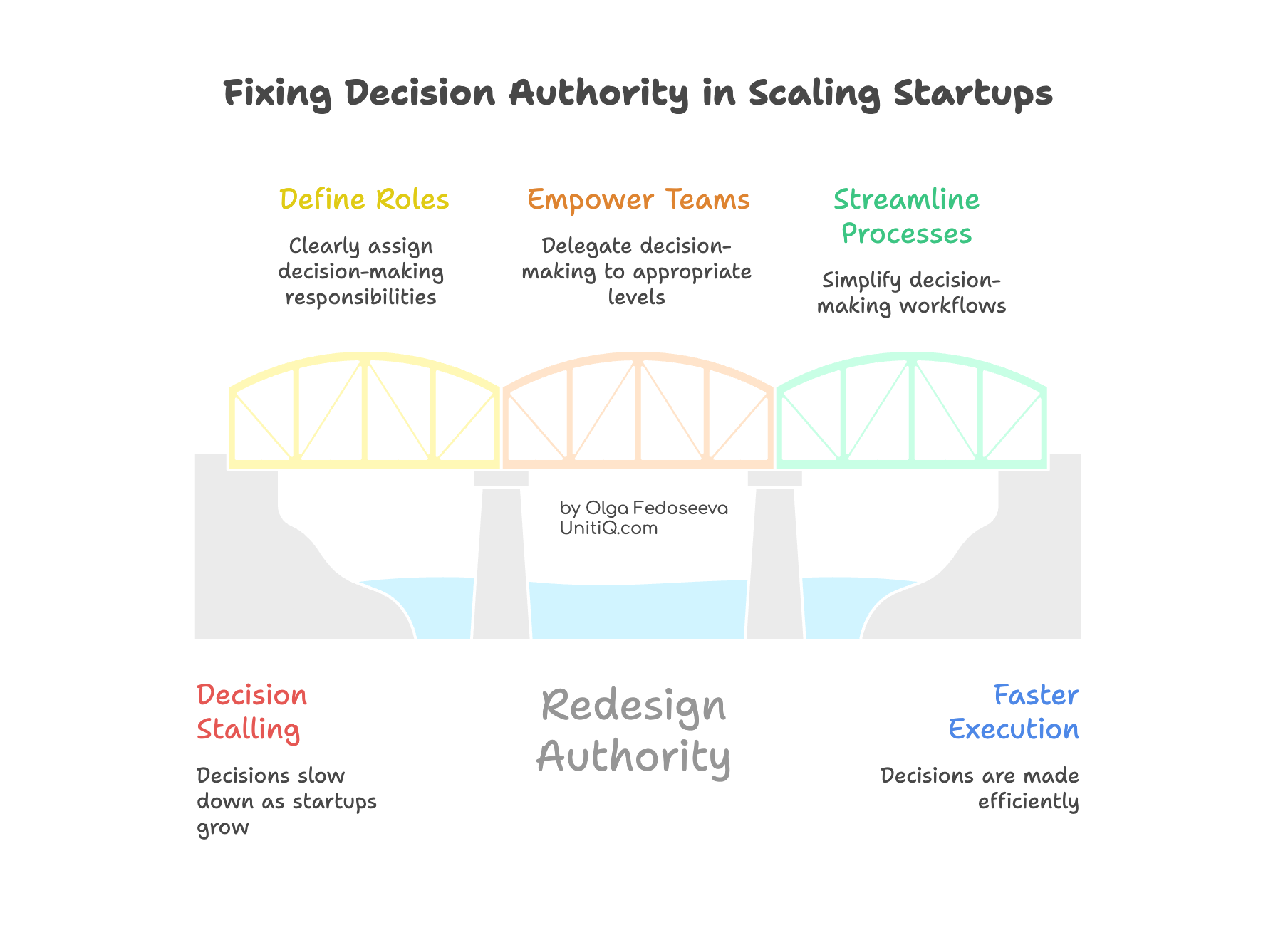
They start with authority design.
And hiring without fixing authority makes execution slower — not faster.
Most hiring failures don’t originate in interviews — they surface after onboarding, when execution design can’t absorb new ownership. (Read: Execution Fails After Hiring — Not During It)
The Invisible Shift After Series A
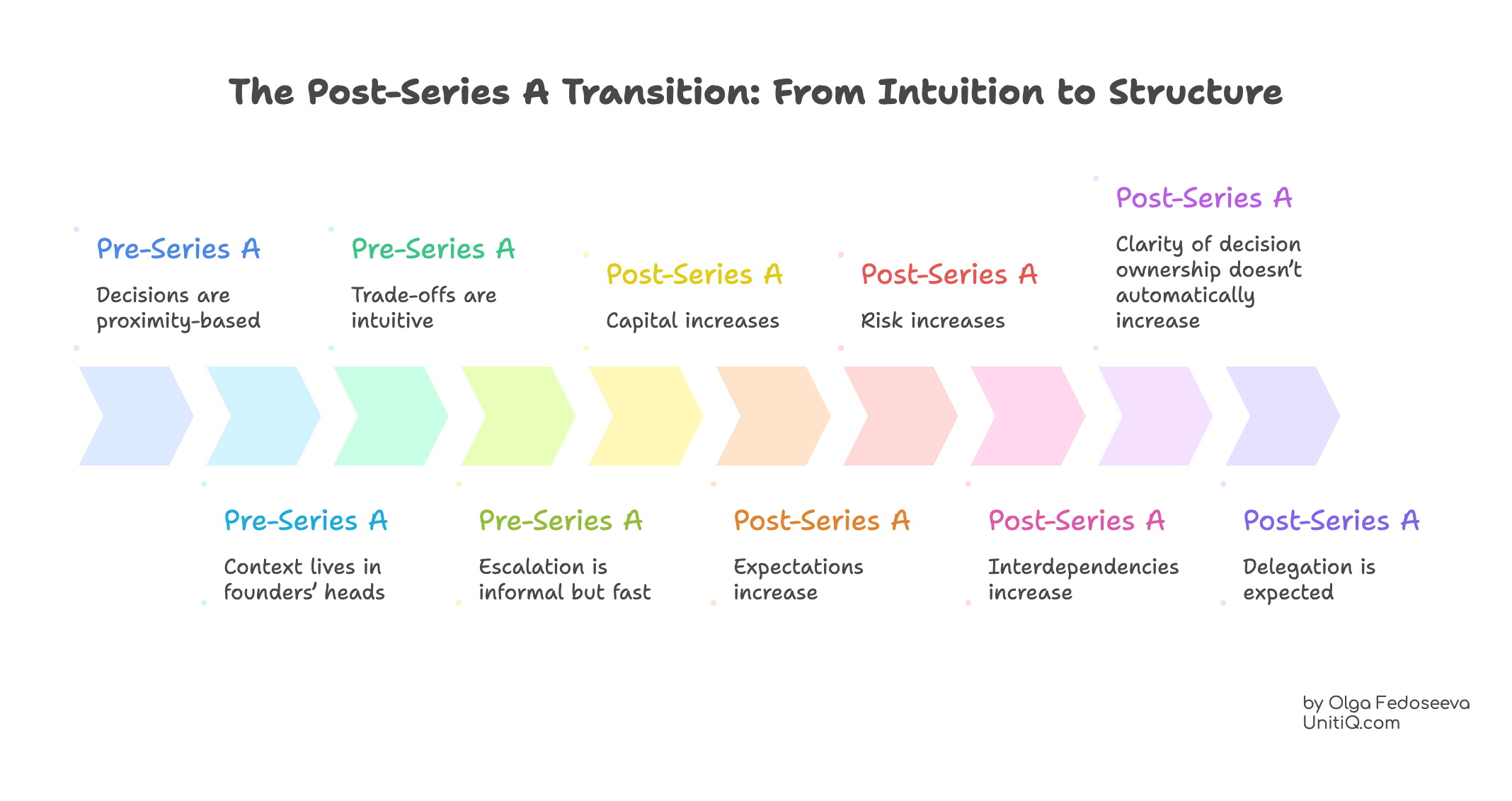
Pre-Series A:
- Decisions are proximity-based.
- Context lives in founders’ heads.
- Trade-offs are intuitive.
- Escalation is informal but fast.
Post-Series A:
- Capital increases.
- Expectations increase.
- Risk increases.
- Interdependencies increase.
What doesn’t automatically increase?
Clarity of decision ownership.
Instead, startups enter a fragile middle phase:
- Delegation is expected.
- Authority is not explicitly redesigned.
- Accountability is assigned without real decision power.
This is where execution begins to leak.
What “Broken Decision Authority” Actually Looks Like
It rarely looks dramatic.
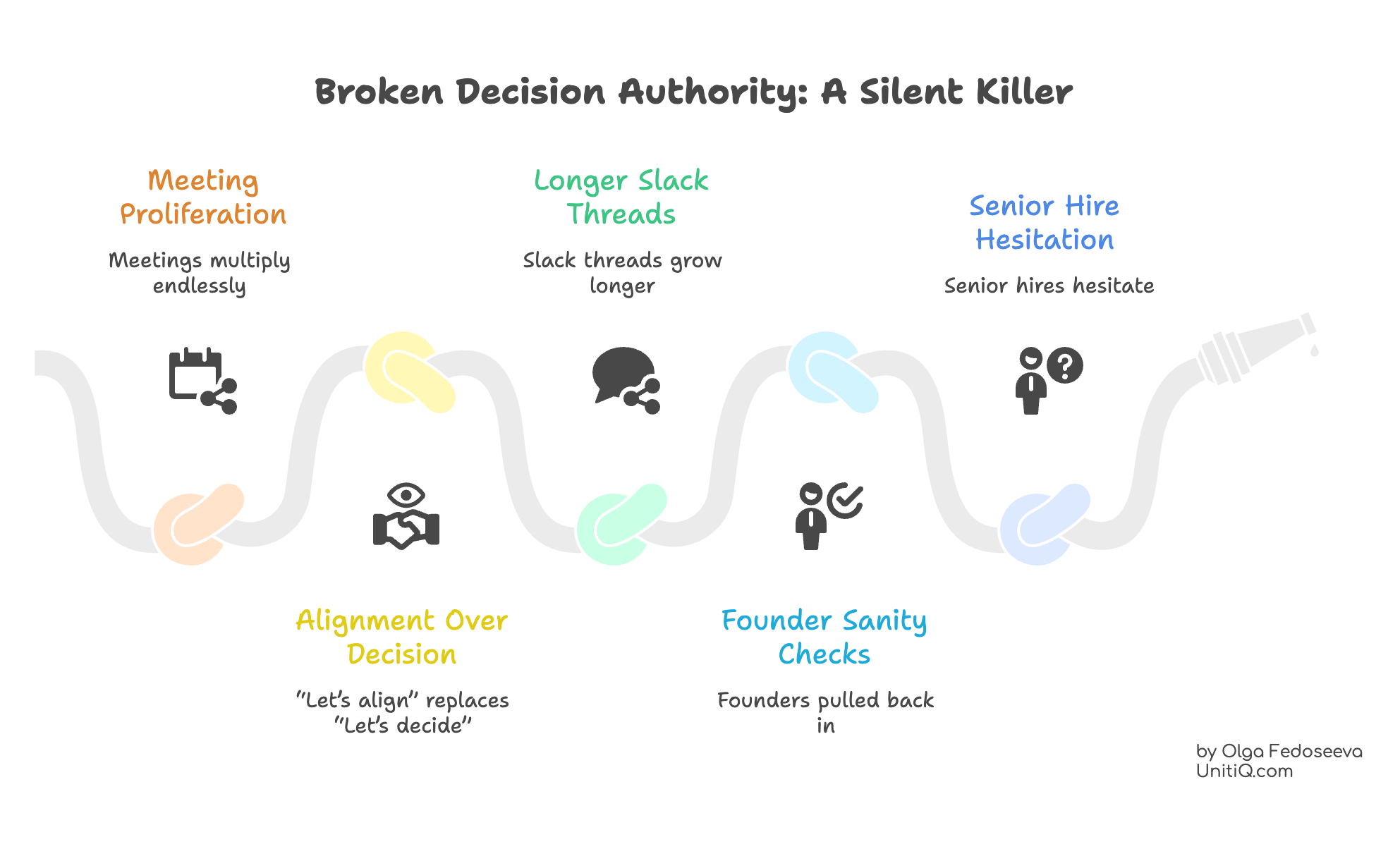
It looks like:
- Meetings multiply.
- “Let’s align” replaces “Let’s decide.”
- Slack threads grow longer.
- Founders are pulled back in “just to sanity check.”
- Senior hires hesitate before committing.
Nobody openly says authority is unclear.
But everyone feels it.
The 4 Authority Gaps That Kill Post-Hire Execution
1. Implicit Decision Rights
The role is told they “own” something.
But:
- Budget approval sits elsewhere.
- Final product sign-off stays with the founder.
- Cross-functional trade-offs require consensus.
Ownership without decision rights creates learned hesitation.
2. Undefined Trade-Off Boundaries
Can the Head of Product prioritize speed over polish?
Can Sales offer discounts without approval?
Can Engineering ship with known debt?
If trade-offs are unclear, escalation becomes the default.
Escalation slows execution.
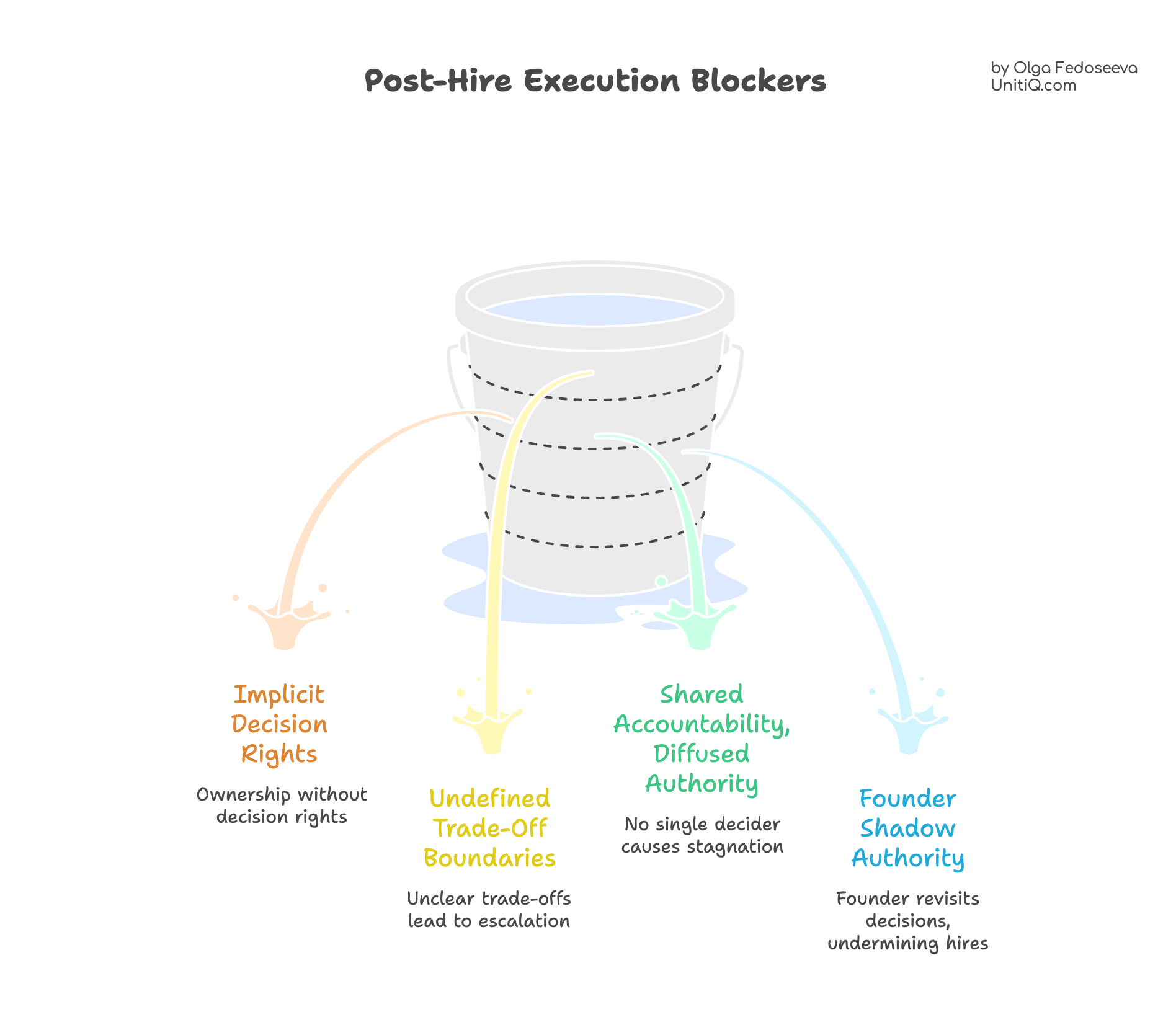
3. Shared Accountability, Diffused Authority
Multiple stakeholders.
Collective input.
No single decider.
This feels collaborative.
It produces stagnation.
4. Founder Shadow Authority
The most subtle gap.
The founder says:
“You decide.”
But:
- Revisits decisions.
- Re-frames priorities midstream.
- Joins operational meetings again.
This isn’t ego.
It’s system anxiety.
And it quietly undermines new hires.
This is why even strong operators can struggle in their first 60–90 days — not from lack of skill, but from unclear decision architecture. (Read: Why “Good Hires” Still Fail in the First 90 Days)
Why Hiring More Senior People Doesn’t Fix This
Senior hires expect:
- Clear decision scope.
- Stable success criteria.
- Defined escalation paths.
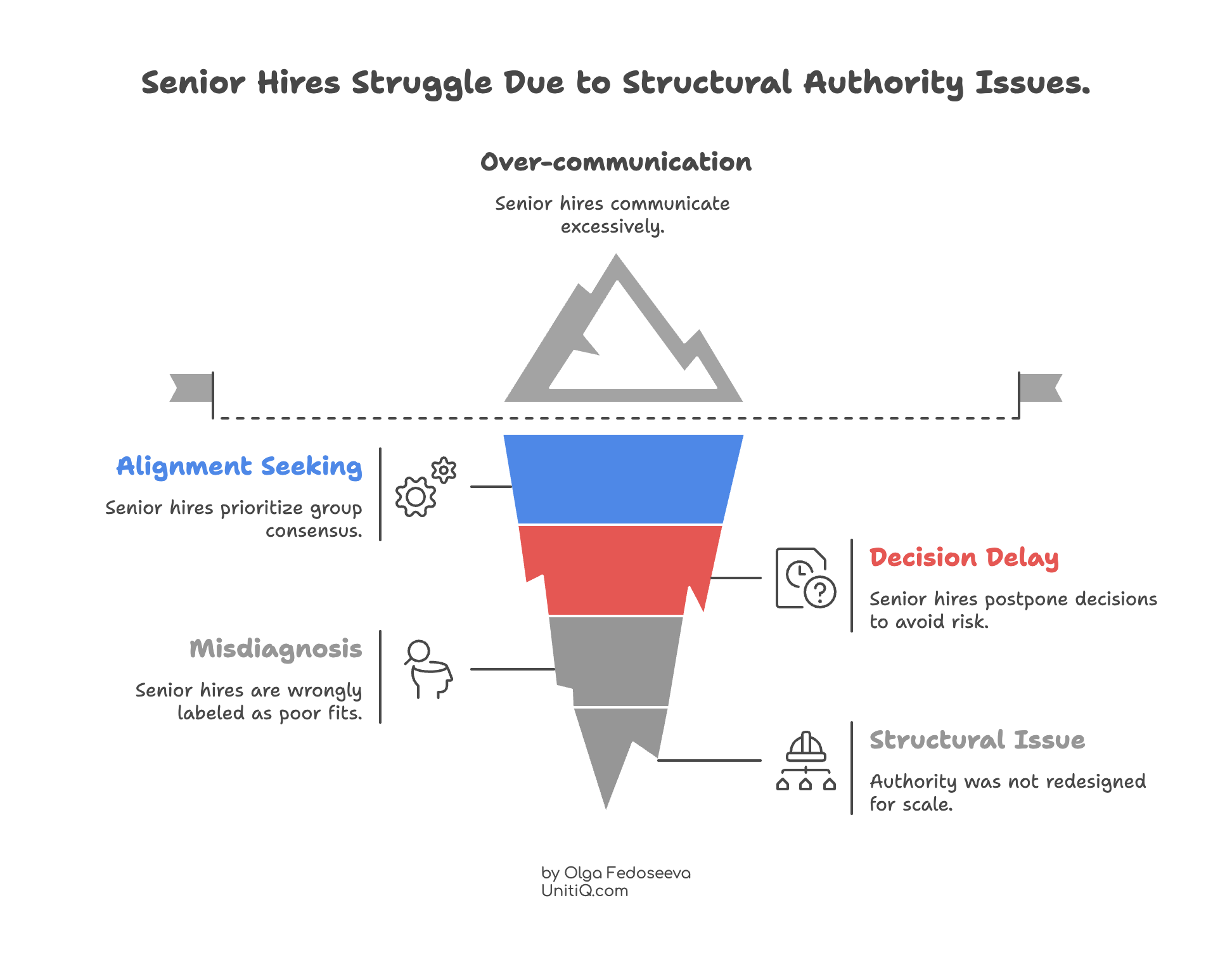
When those don’t exist, even strong operators:
- Over-communicate.
- Seek alignment instead of acting.
- Delay decisions to avoid being “wrong alone.”
When execution slows, many teams respond by accelerating hiring — assuming it’s a capacity issue rather than an authority issue. That rarely solves the real bottleneck. (Read: Why Hiring Faster Won’t Fix Your Execution)
This is often misdiagnosed as:
- “Wrong hire.”
- “Cultural mismatch.”
- “Not strategic enough.”
But the real issue is structural.
Authority was never redesigned for scale.
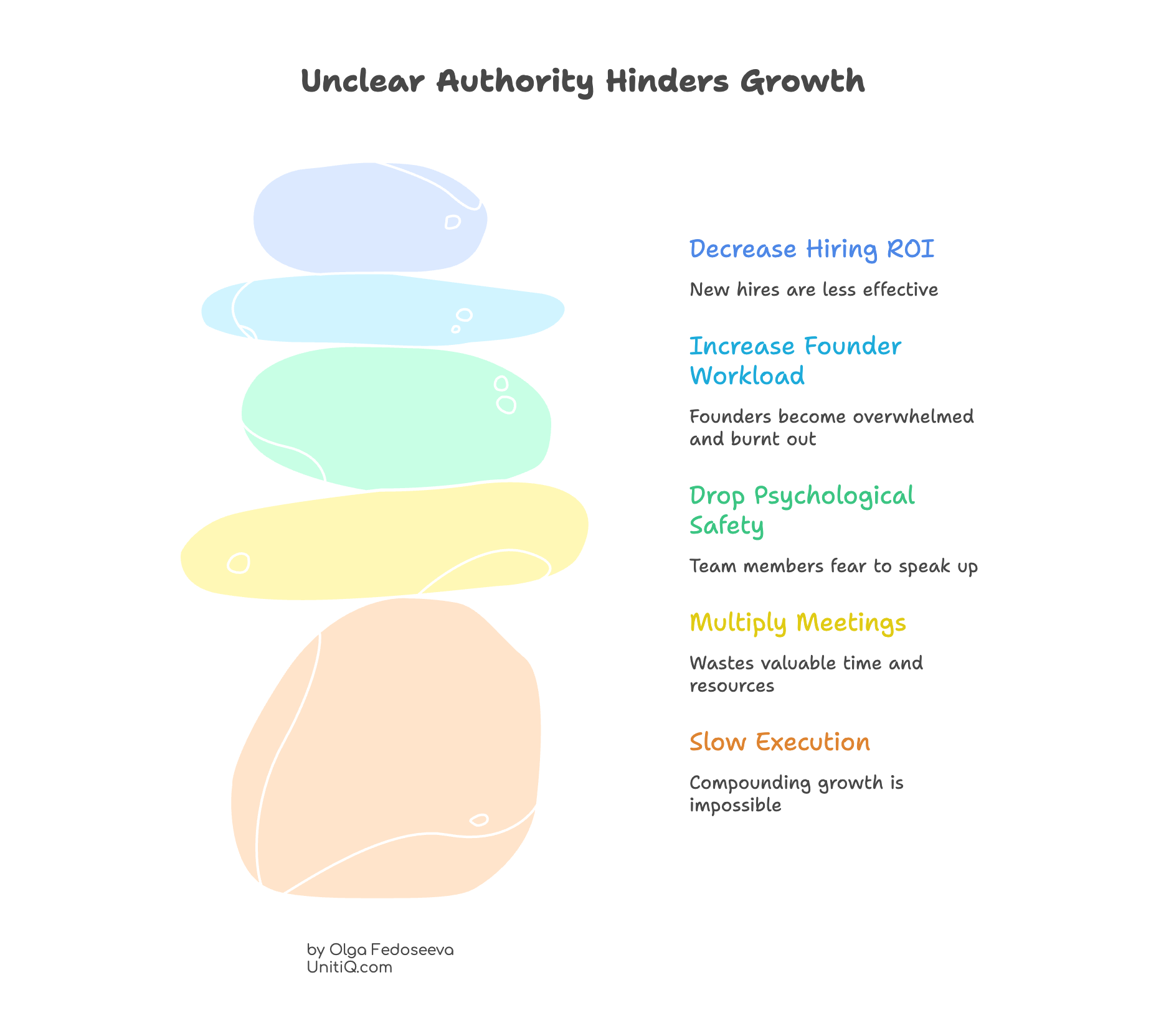
The Cost of Unclear Authority
When authority is ambiguous:
- Execution slows.
- Meetings multiply.
- Psychological safety drops.
- Founder workload increases.
- Hiring ROI decreases.
Most dangerously:
Execution stops compounding.
And compounding is what Series A–C companies survive on.
How to Redesign Decision Authority for Scale
Before hiring the next senior role, answer five questions:
1. What outcomes does this role fully own?
Not tasks. Outcomes.
2. What decisions can they make without approval?
Be explicit.
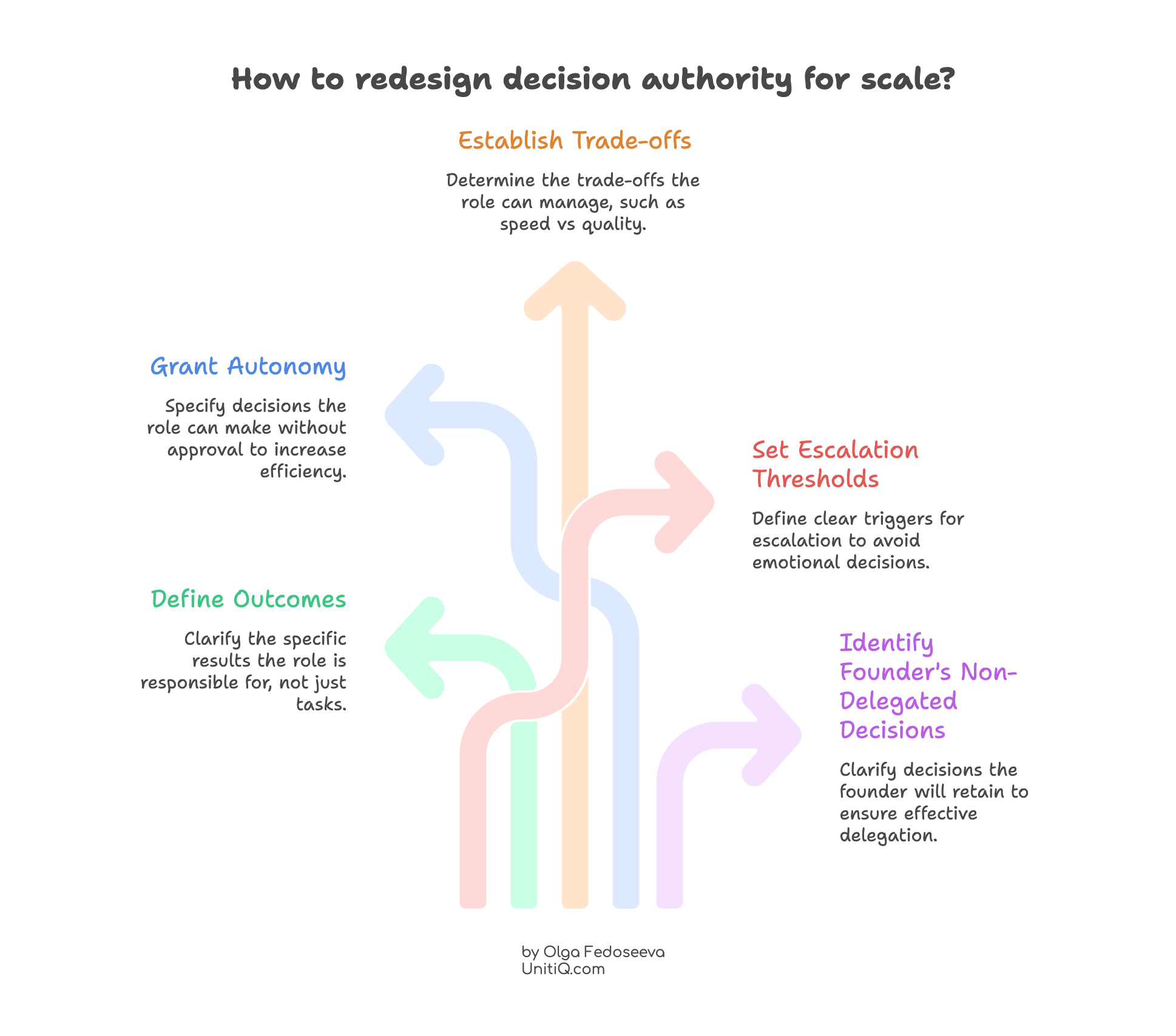
3. What trade-offs are within their control?
Speed vs quality? Cost vs performance? Autonomy vs alignment?
4. When must they escalate?
Define thresholds, not emotions.
5. What decisions will the founder never re-enter?
If this isn’t clear, delegation is performative.
Decision Design Is Hiring Infrastructure
When hiring is treated as an event instead of a system — with explicit role architecture and escalation logic — authority fragments with every new role. (Read: Building Hiring Infrastructure for Scale)
Founders often invest in:
- Better sourcing
- Better interviews
- Better compensation
- Better employer branding
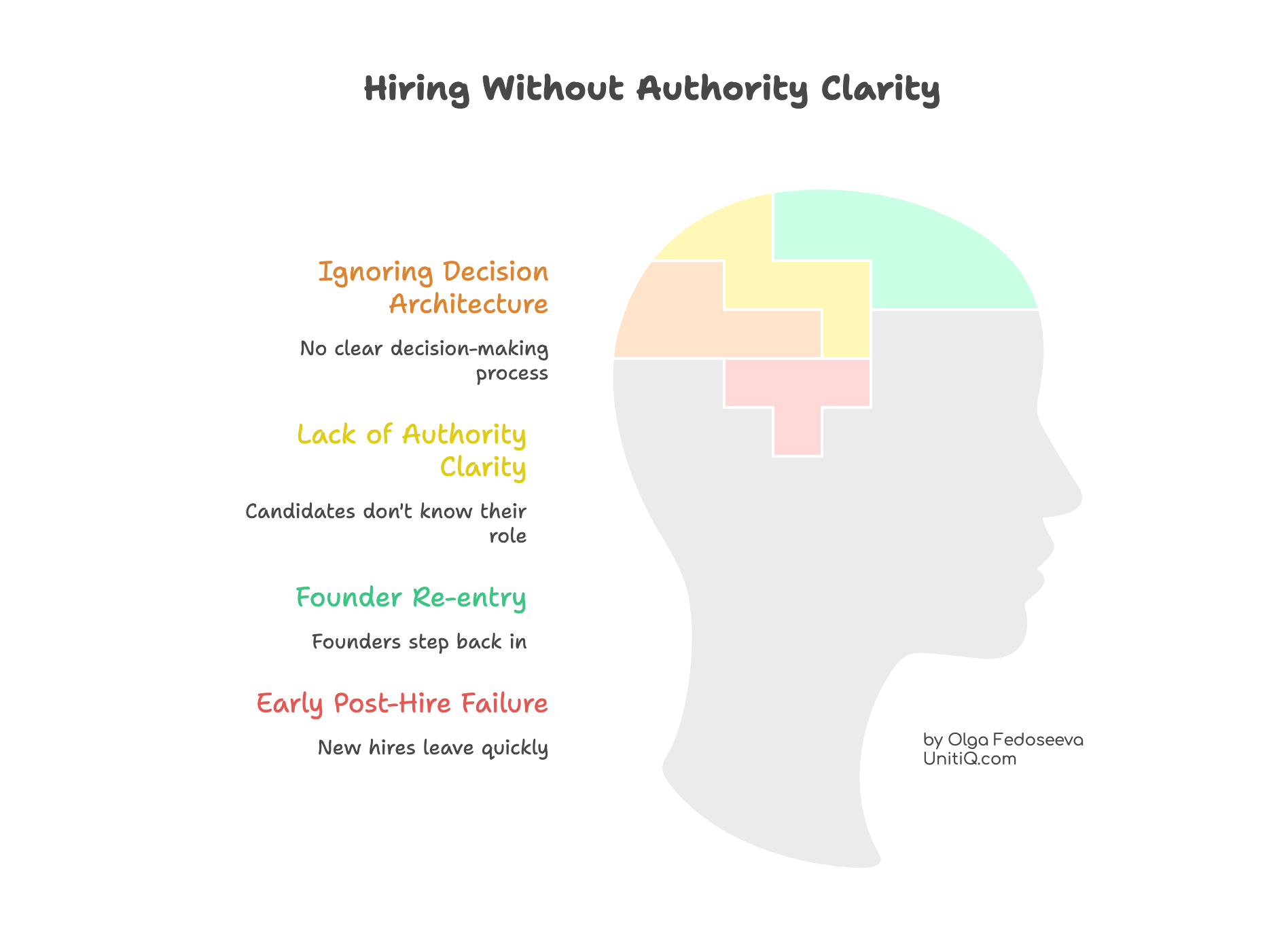
But ignore:
- Decision architecture.
Hiring without authority clarity creates:
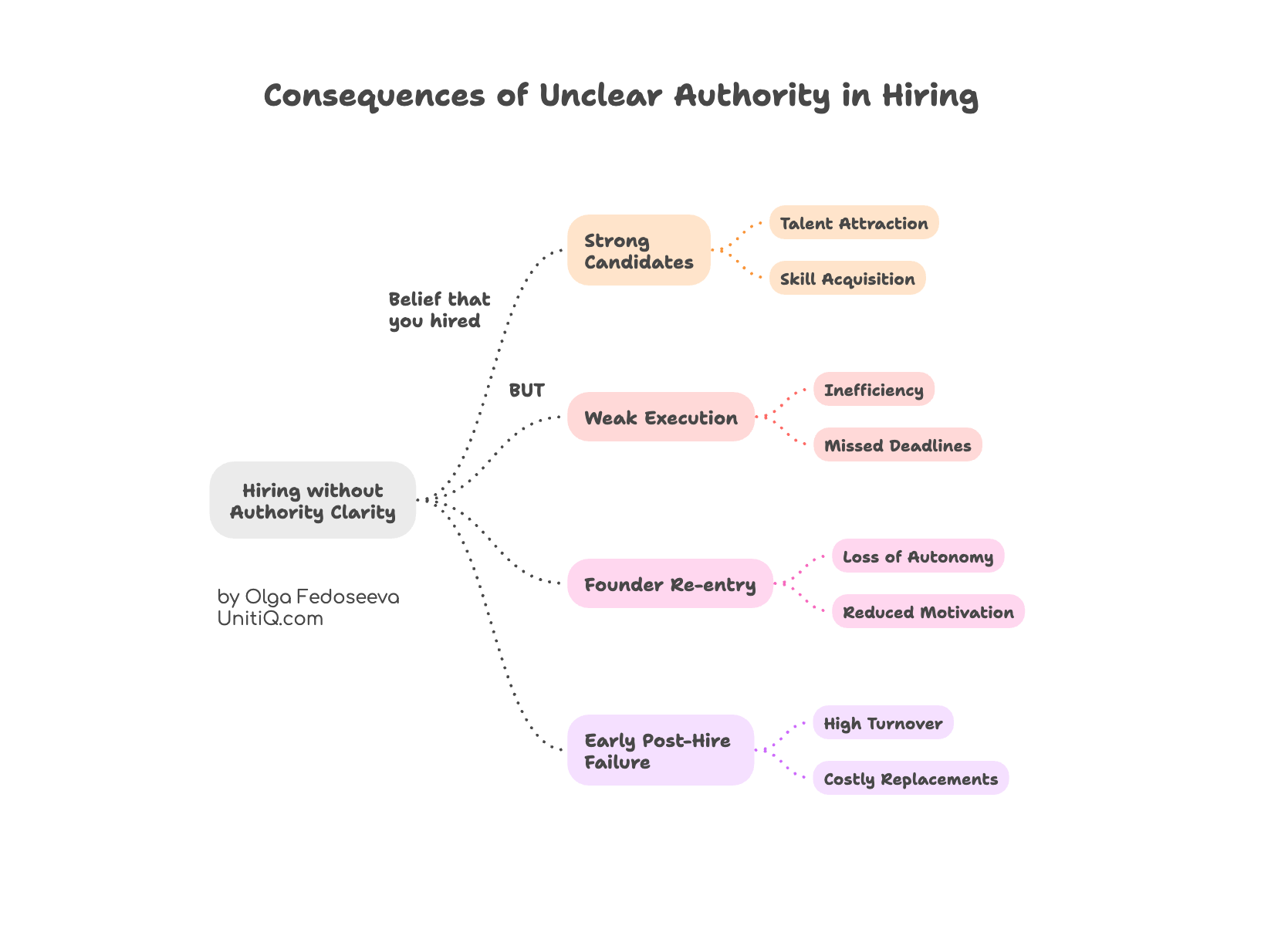
Strong candidates
Weak execution
Founder re-entry
And eventually:
Early post-hire failure.
When hiring resets context instead of compounding it, decision authority erodes with every new role. (Read: Why Event-Based Hiring Keeps Resetting Your Startup)
TL;DR
Decision authority breaks naturally as startups scale.
Hiring doesn’t fix it.
Better interview questions don’t fix it.
More senior people don’t fix it.
Authority must be redesigned intentionally.
Because in growth-stage startups, execution failure is rarely a people problem.
It’s a decision system problem.
If you want to sanity-check which model fits your current stage — and where execution is actually breaking — we can walk through it together.
About the author
Olga Fedoseeva is the Founder of UnitiQ, a global HR executive, and a talent acquisition and people strategy leader with 20+ years of experience across EMEA, the US, and APAC. She has personally hired 1,500+ employees, led people strategy for organisations scaling from 30 to 700+ employees, and writes about hiring systems, execution risk, and people infrastructure in growth-stage startups.
Read full author profile
LinkedIn
Read full author profile


