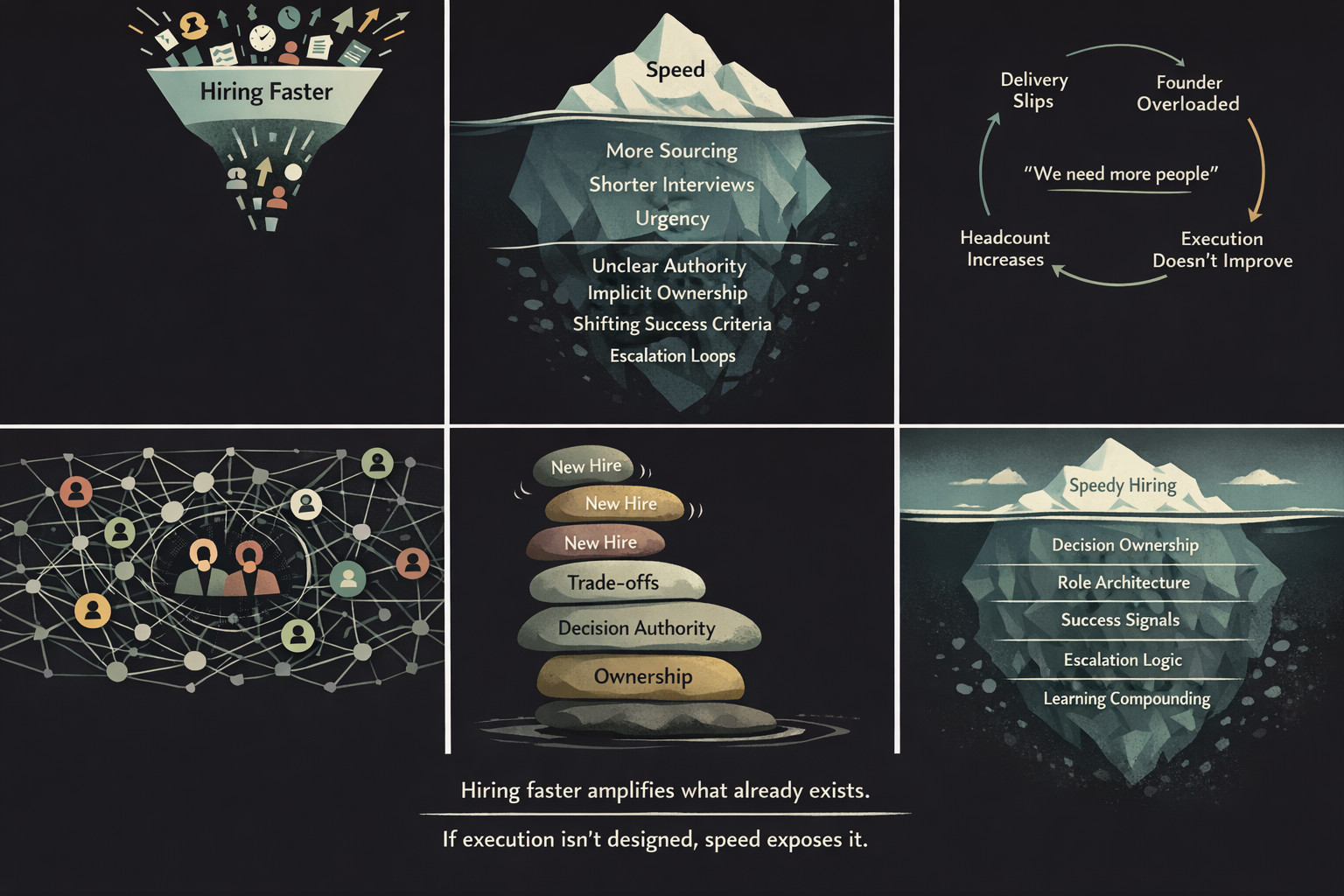
Short answer
Hiring faster rarely fixes execution problems in scaling startups.
Most execution failures happen because ownership, decision authority, and success criteria are unclear. When new hires enter this environment, coordination costs rise, founders get pulled back into decisions, and delivery slows instead of accelerating.
When execution slows, most startups respond the same way:
“We need to hire faster.”
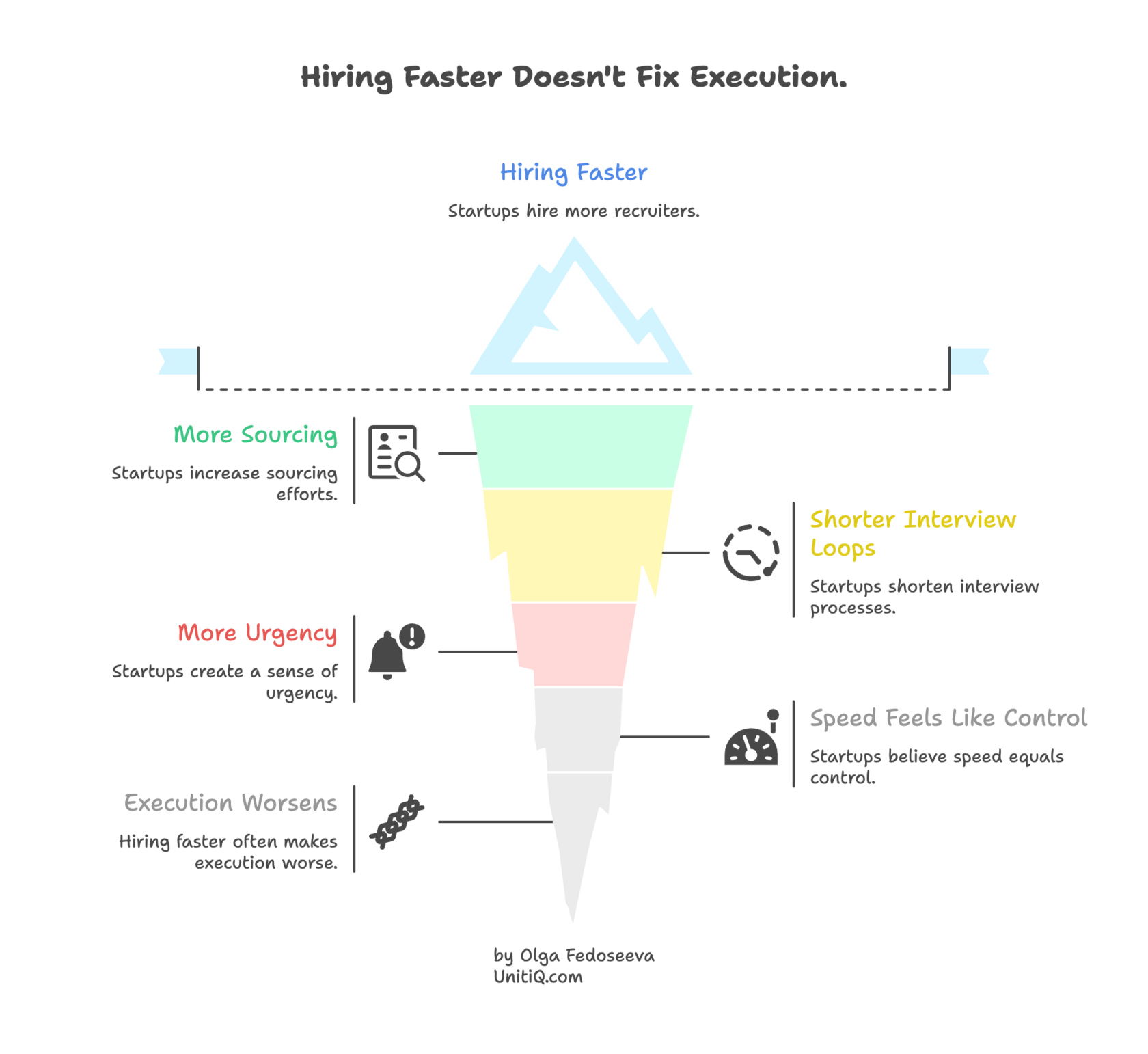
More recruiters.
More sourcing.
Shorter interview loops.
More urgency.
Speed feels like control.
Adding more sourcing power rarely fixes this dynamic. External recruiters can fill roles, but they cannot design the execution systems that make those roles effective. (Read: Why Recruitment Agencies Can’t Solve Post-Hire Execution Risk)
But in growth-stage startups, hiring faster rarely fixes execution.
It often makes it worse.
The Assumption: Execution Is a Capacity Problem
When delivery slips, roadmaps stall, or founders feel overloaded, the diagnosis sounds logical:
We don’t have enough people.
So hiring becomes the lever.
Add engineers.
Add PMs.
Add sales.
Add ops.
Headcount increases.
Execution doesn’t.
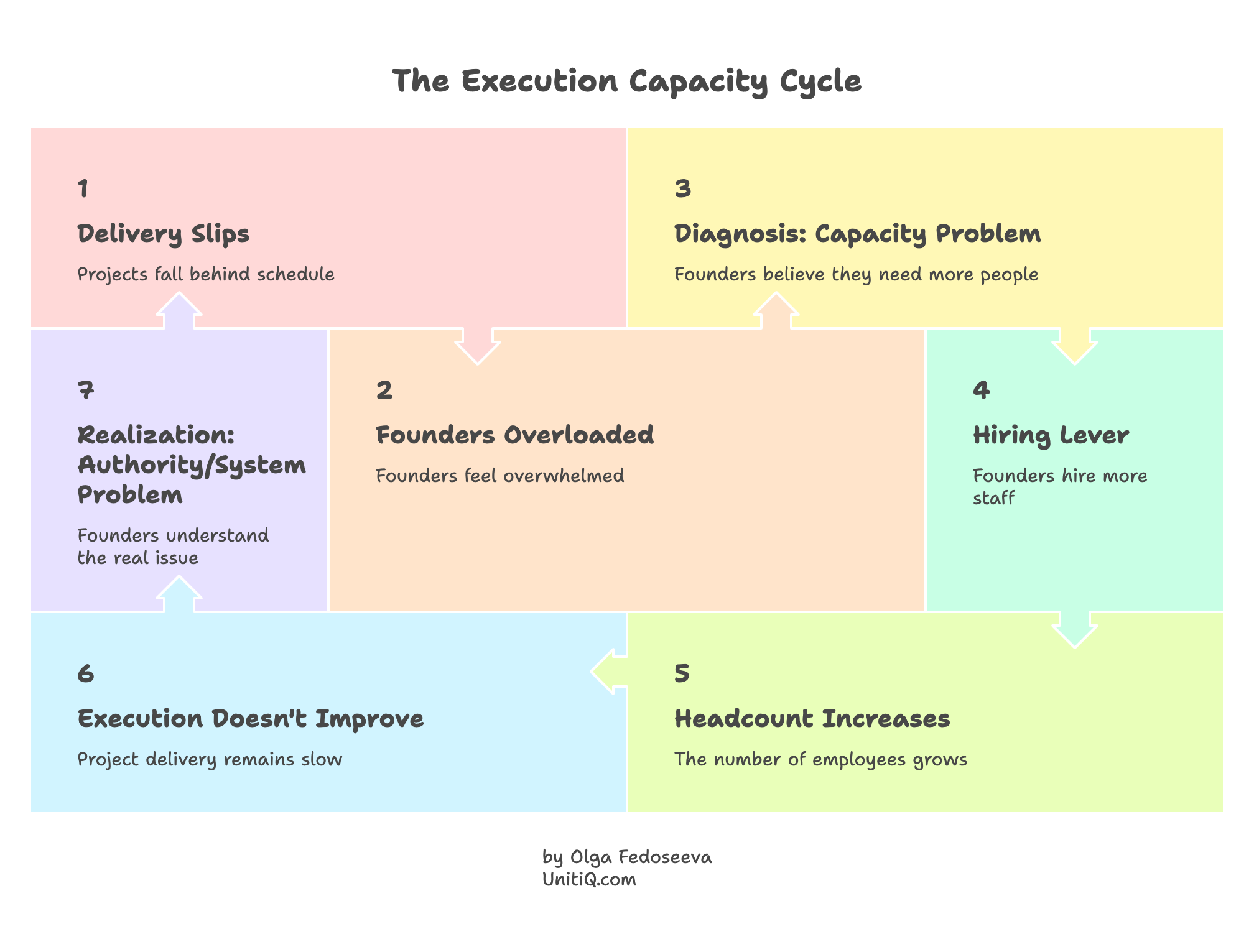
Because execution is rarely a volume problem. It is usually a signal that execution capacity has not been designed to scale. (Read: Hiring Is Not the Bottleneck — Execution Capacity Is)
It’s an authority and system problem.
The Hiring Velocity Trap
Many scaling startups fall into what can be called the Hiring Velocity Trap.
It usually unfolds in a predictable sequence:
Instead of restoring velocity, the system becomes more dependent on leadership attention. The organization grows — but execution does not compound.
It usually unfolds in a predictable sequence:
- Delivery slows or uncertainty increases.
- Leadership assumes the problem is lack of capacity.
- Hiring accelerates to restore speed.
- Coordination complexity increases.
- Founders get pulled back into decisions to resolve ambiguity.
Instead of restoring velocity, the system becomes more dependent on leadership attention. The organization grows — but execution does not compound.
What does “execution capacity” mean in startups?
Execution capacity is the ability of a startup team to deliver outcomes independently without constant founder intervention. It depends on three things: clear ownership of outcomes, defined decision authority, and success criteria that allow teams to move without escalation.
Hiring only increases execution capacity when these conditions are already in place.
Why More Hiring Can Slow You Down
Why complexity grows faster than capacity
Every new hire introduces:
- new decision nodes
- new ownership boundaries
- new trade-offs
- new escalation paths
If your execution design is fragile, each hire increases coordination cost.
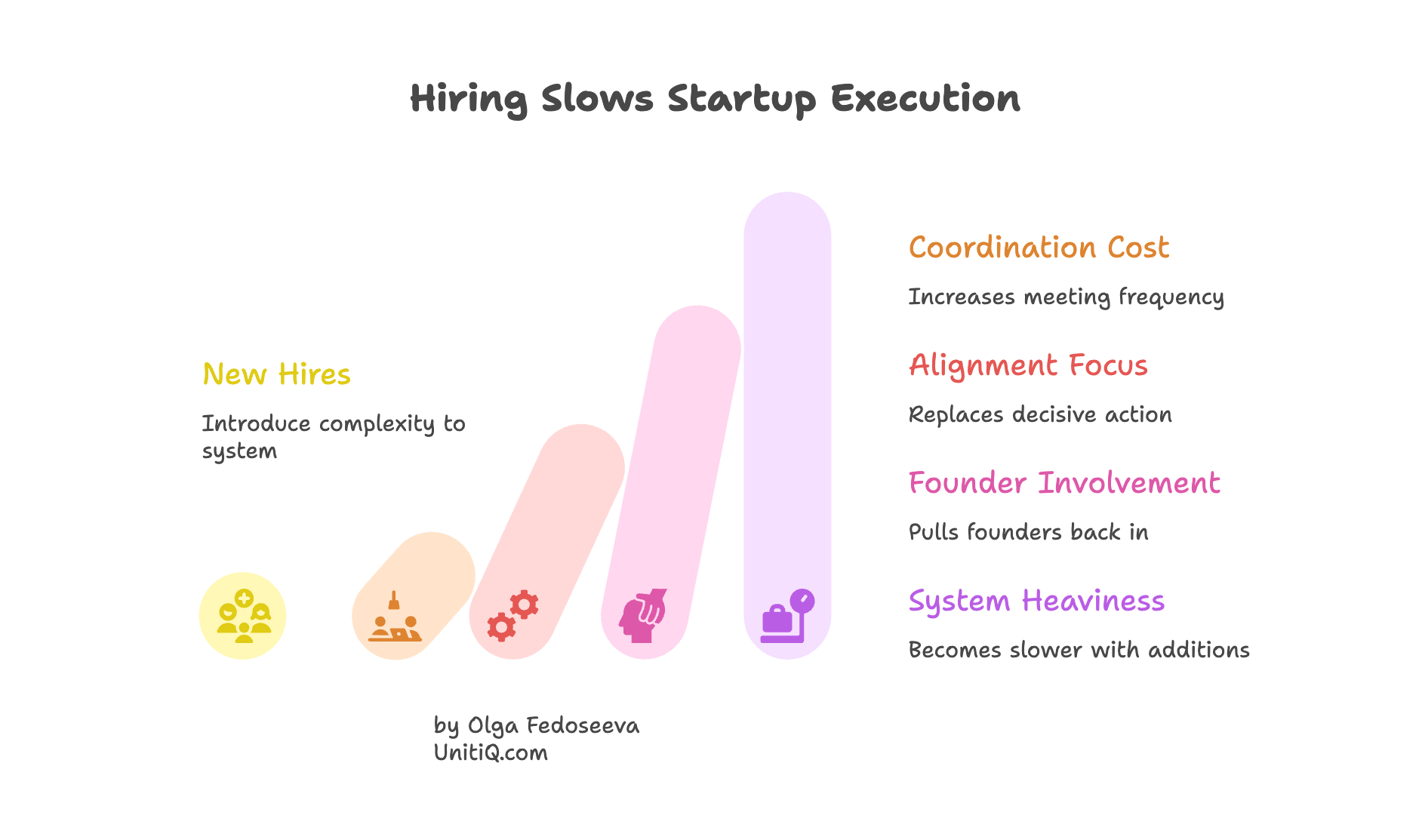
Meetings multiply.
Alignment replaces decisions.
Founders get pulled back in.
The system becomes heavier with every addition.
This is why many Series A–C startups feel slower at 60 people than they did at 20.
Not because talent quality dropped.
But because the system didn’t evolve.
As startups grow, decision authority often becomes fragmented long before founders notice hiring slowing down — creating invisible friction across teams. (Read: Why Decision Authority Breaks as Startups Scale)
The Hidden Pattern: Hiring as a Pressure Release
When founders feel overwhelmed, hiring feels like relief.
But hiring pressure often hides a deeper problem — founders stay trapped in hiring decisions because ownership inside the system never becomes truly distributed. (Read: Why Founders Burn Out on Hiring Before the Team Ever Scales)
“If we add one more strong person, this pressure will drop.”
Sometimes it does.
More often, pressure shifts instead of disappearing.
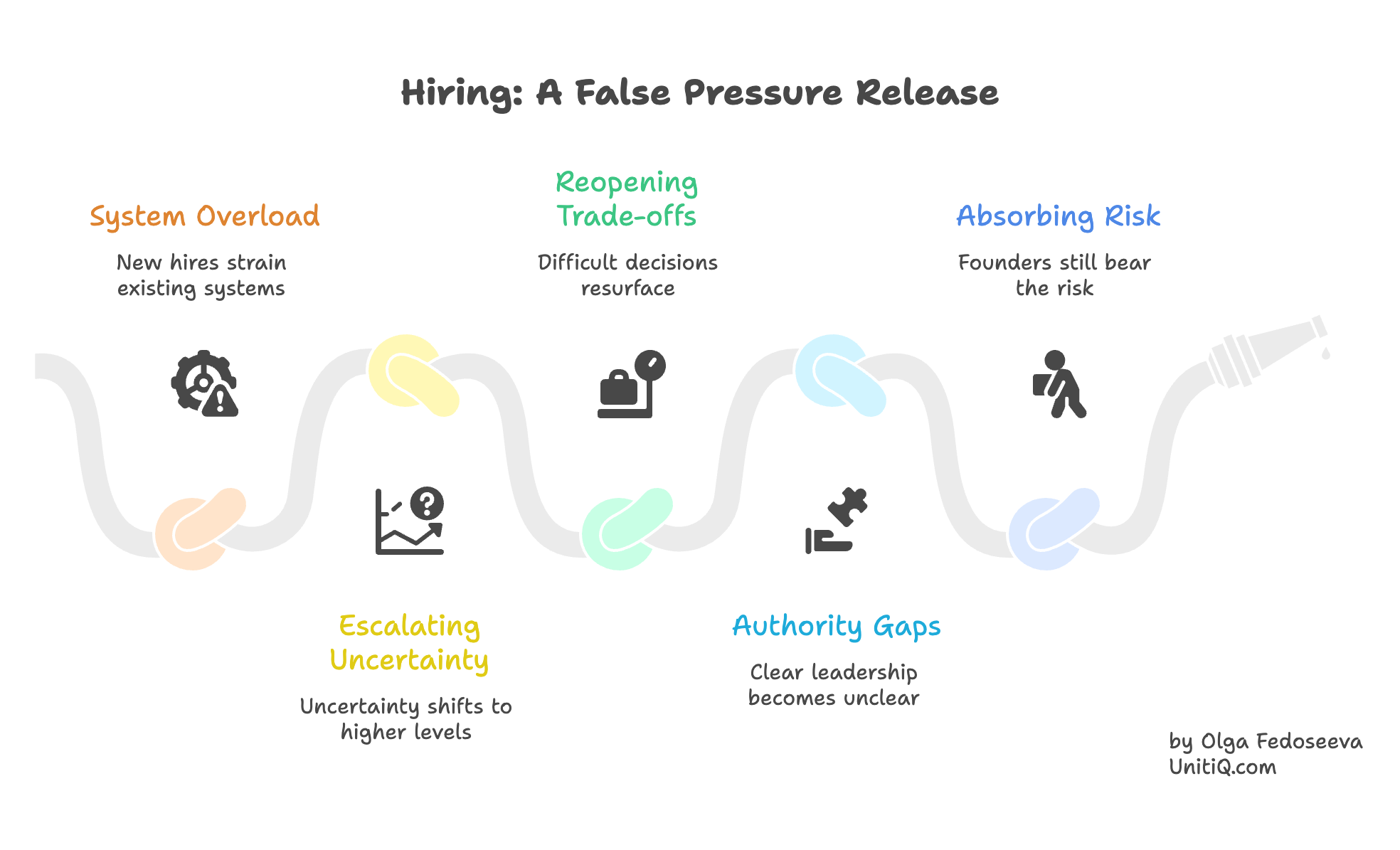
Instead of:
Founder overload
You get:
System overload
New hires escalate uncertainty upward.
Trade-offs reopen.
Authority gaps surface.
And founders still absorb the risk — just at a larger scale.
Hiring Faster Amplifies Execution Debt
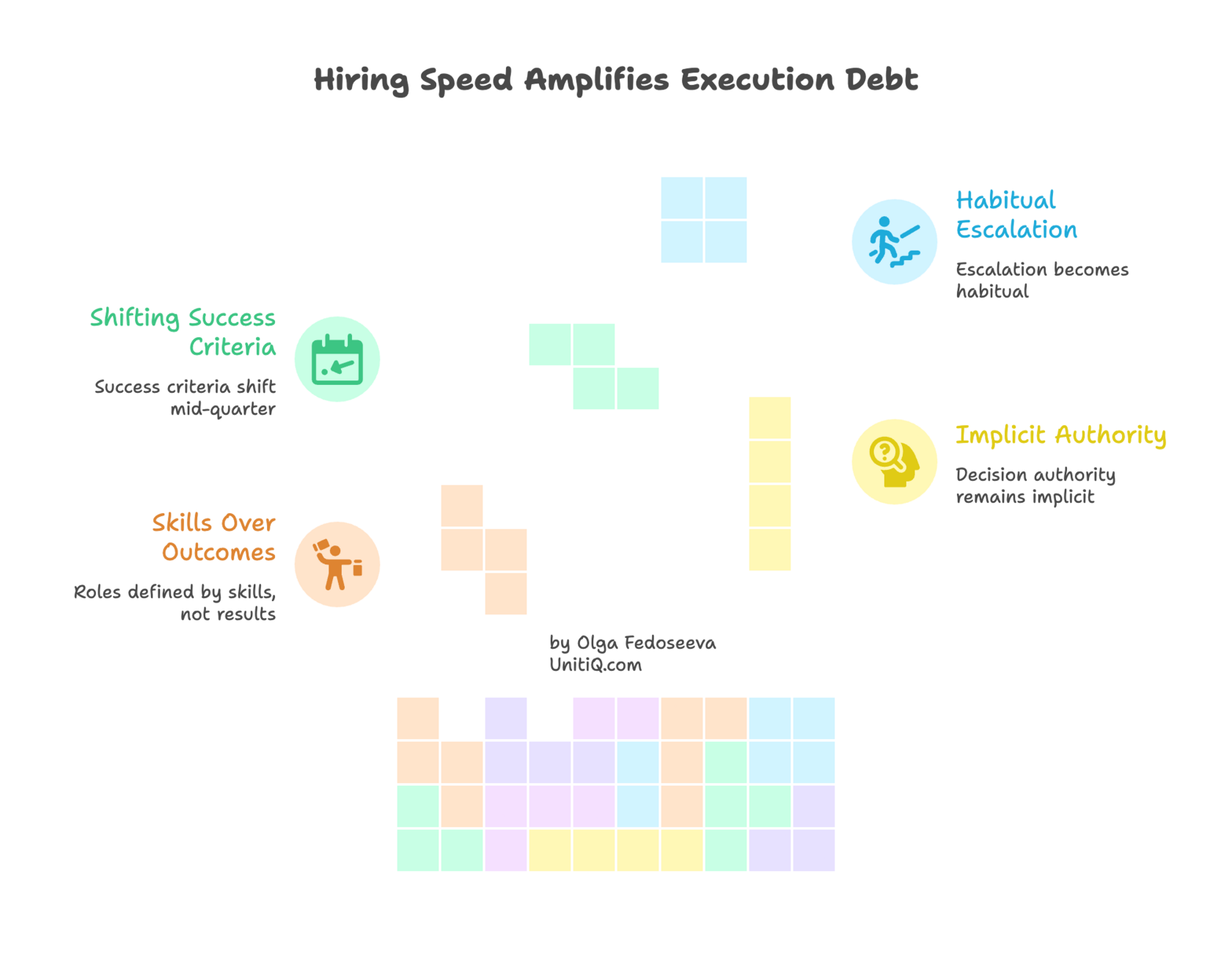
When hiring speed increases without execution clarity:
- Roles are defined by skills, not outcomes
- Decision authority remains implicit
- Success criteria shift mid-quarter
- Escalation becomes habitual
The result?
Execution debt.
What is execution debt?
Execution debt is the accumulation of unresolved ownership gaps, unclear decision authority, and shifting success criteria that silently slow delivery as teams grow.
Unlike technical debt, execution debt doesn’t appear in code or infrastructure. It shows up in coordination overhead, repeated escalations, and founders being pulled back into decisions the organization should already own.
Unlike technical debt, execution debt doesn’t appear in code or infrastructure. It shows up in coordination overhead, repeated escalations, and founders being pulled back into decisions the organization should already own.
And like technical debt, it compounds quietly.
You don’t notice it during interviews.
You notice it 90 days later.
Execution problems usually appear after the hire joins — when ownership, decision authority, and escalation paths were never clearly designed. (Read: Execution Fails After Hiring — Not During It)
The Post-Funding Trap
After Series A or B, pressure intensifies:
Capital increases.
Expectations increase.
Interdependencies increase.
Hiring becomes a signal of momentum.
So speed becomes symbolic.
But symbolic hiring is dangerous.
Because growth-stage execution is fragile.
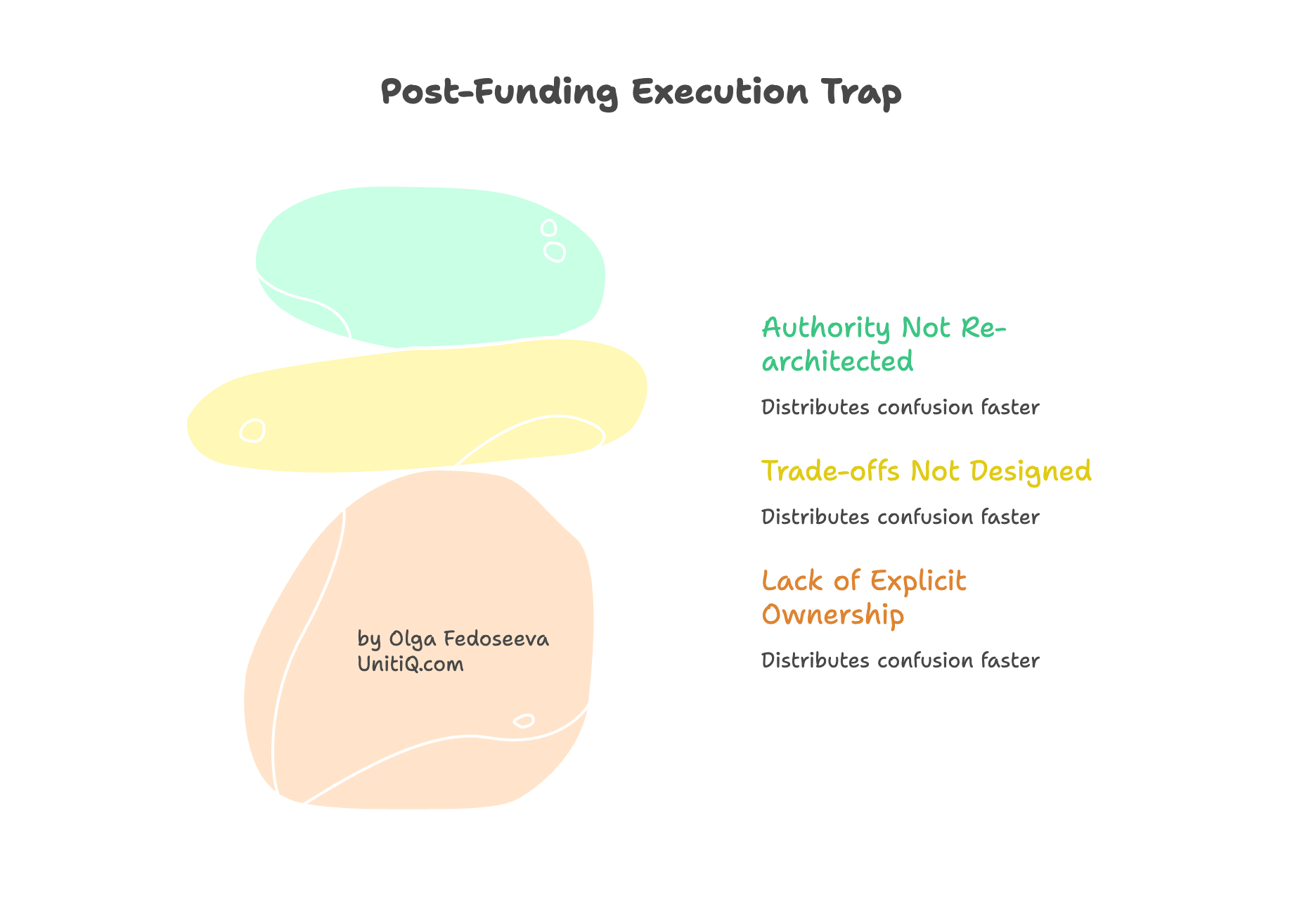
If ownership isn’t explicit,
if trade-offs aren’t designed,
if authority isn’t re-architected,
more hiring simply distributes confusion faster.
What Actually Fixes Execution
Execution improves when startups stop asking:
“How fast can we hire?”
And start asking:
“What must be true for this hire to move without escalating?”
Before opening a role, clarity should exist around:
- What decisions this role owns
- What outcomes it is accountable for
- What trade-offs it can resolve independently
- When escalation is appropriate — and when it isn’t
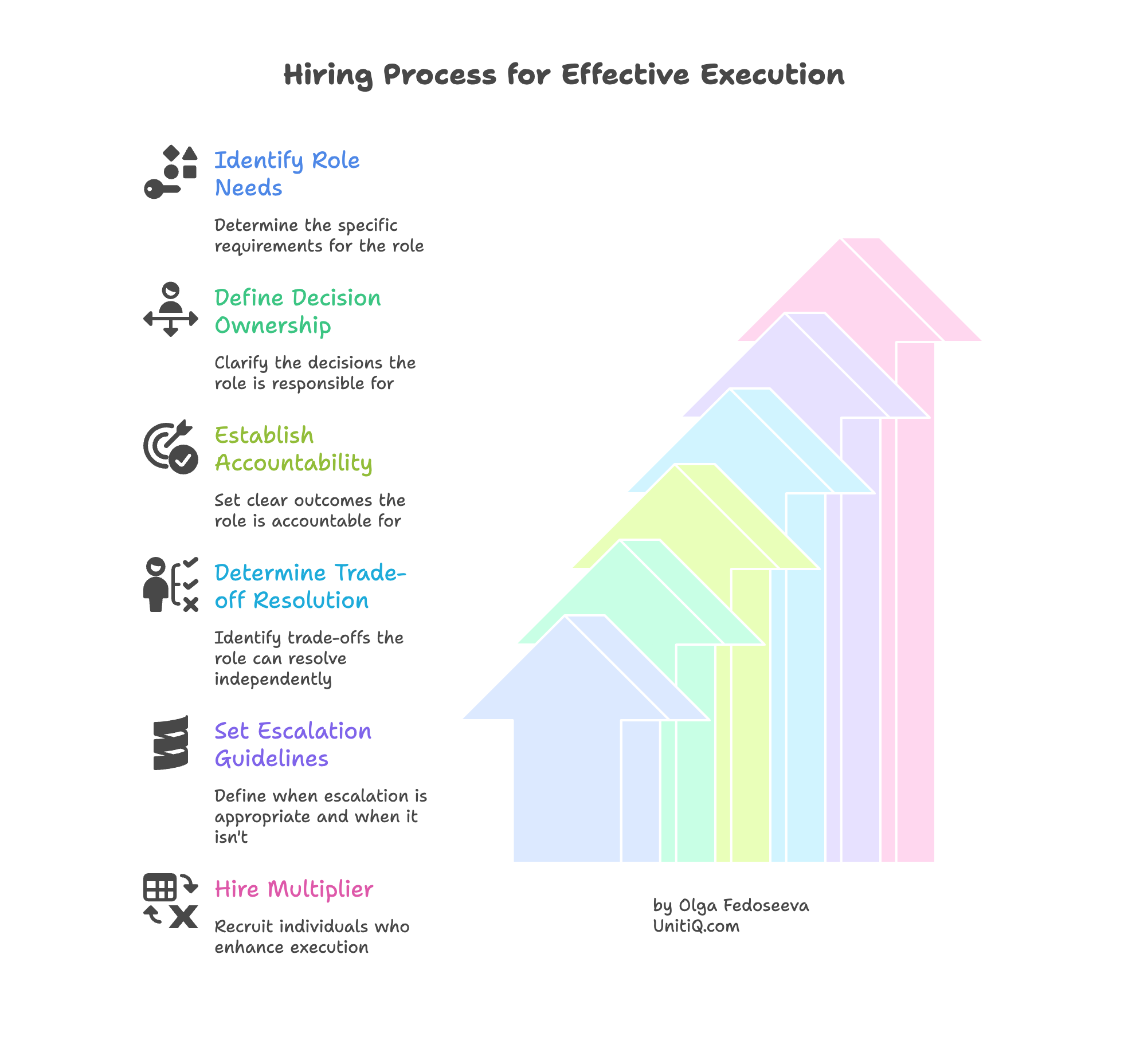
Hiring then becomes a multiplier.
This is also why the modern Talent Partner role exists — to translate business problems into structured hiring decisions instead of simply forwarding resumes. (Read: What Does a Modern Talent Partner Actually Do?)
Without this clarity, hiring becomes a magnifier of weakness.
The Difference Between Scaling Headcount and Scaling Execution
Scaling headcount:
Increases capacity.
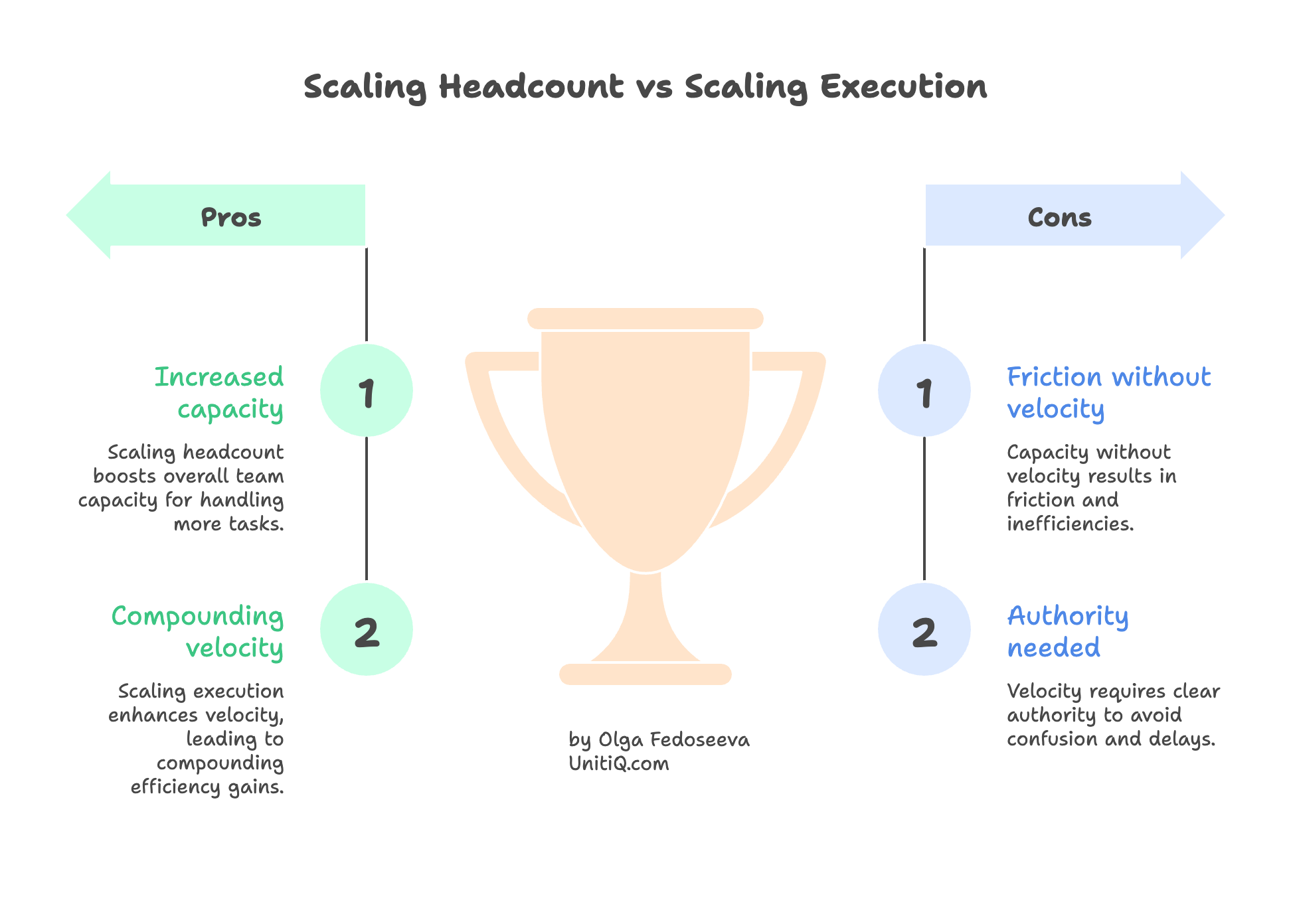
Scaling execution:
Increases velocity.
Capacity without velocity creates friction.
Velocity with clear authority creates compounding.
Hiring begins to feel dramatically easier only after decision ownership and execution capacity are properly designed across the team. (Read: When Hiring Finally Works (And Why It Suddenly Feels Easy)
That’s the difference.
When Hiring Faster Is Appropriate
Speed is not the enemy.
Hiring faster works when:
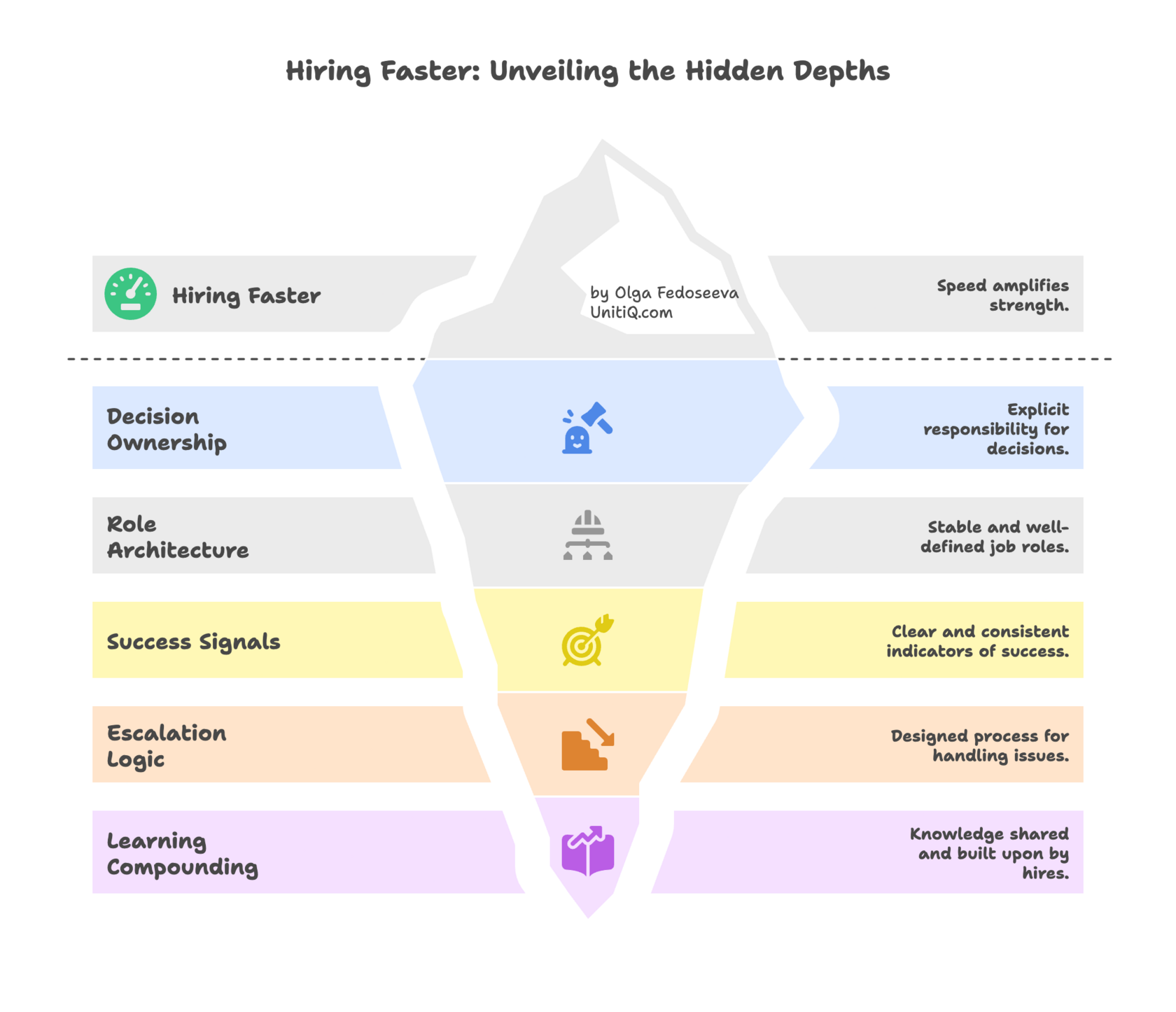
- Decision ownership is explicit
- Role architecture is stable
- Success signals don’t drift
- Escalation logic is designed
- Learning compounds across hires
In that environment, speed amplifies strength.
In a fragile system, speed amplifies instability.
The Real Question
If execution feels slow, ask:
Is the problem candidate flow?
Or is it unclear authority?
Is it lack of skills?
Or lack of designed ownership?
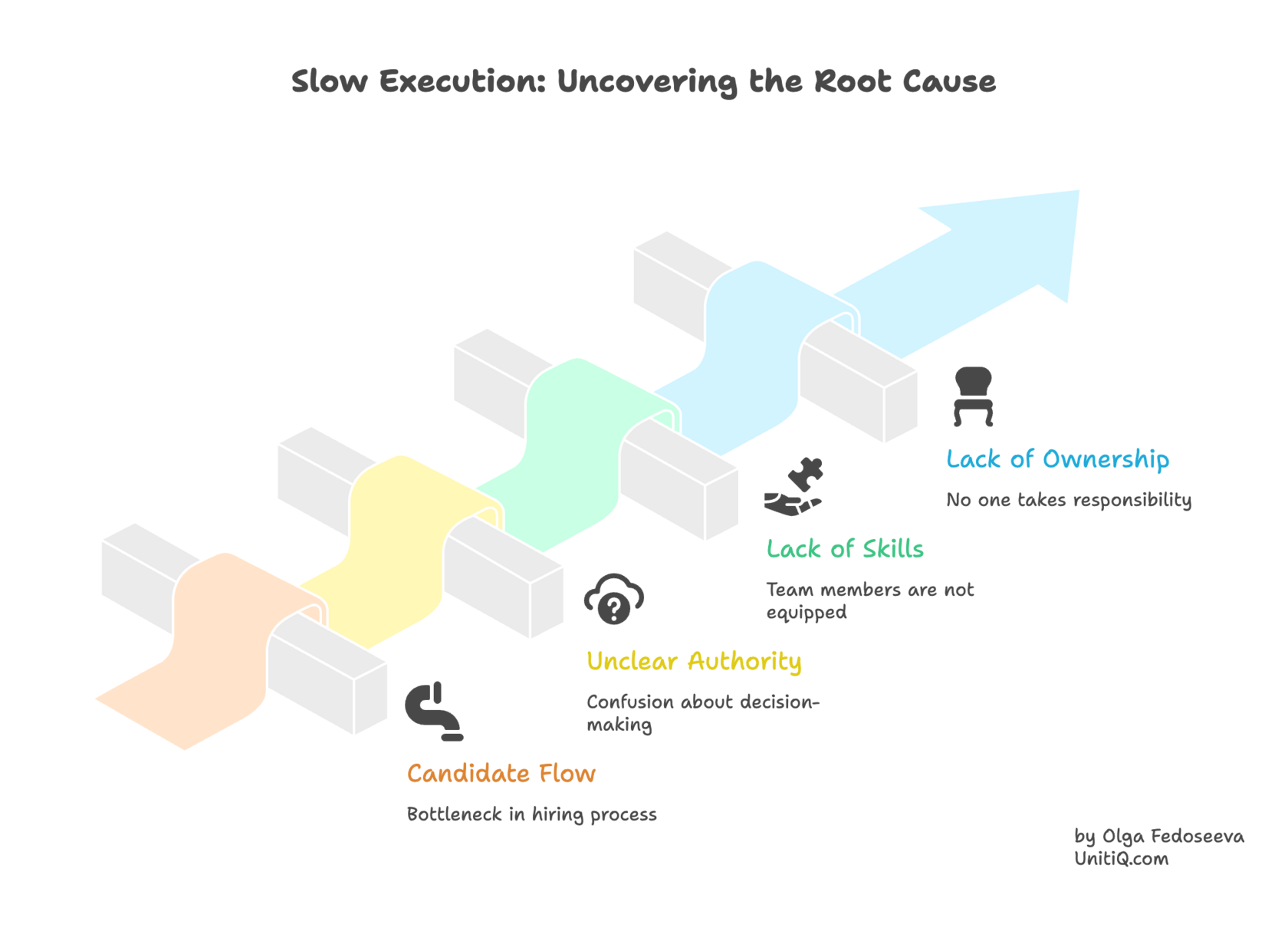
Because hiring faster won’t fix an execution system that was never designed to scale.
It will only expose it faster.
TL;DR
Execution rarely slows because hiring is too slow.
It slows because ownership and decision authority aren’t clearly designed.
It slows because ownership and decision authority aren’t clearly designed.
Hiring faster without execution clarity increases coordination cost
More headcount does not equal more velocity
Execution compounds only when roles can move without escalating
If hiring speed feels like the only lever left,
it’s worth asking whether the real bottleneck isn’t talent —
but execution architecture.
Frequently asked questions about hiring and execution
Why doesn’t hiring faster fix execution problems in startups?
Because most execution failures come from unclear ownership and decision authority. When these remain unresolved, adding more people increases coordination overhead instead of delivery speed.
When does hiring actually increase execution speed?
Hiring increases speed when roles have clear ownership, decisions can be made without escalation, and success criteria are stable enough for teams to move autonomously.
What should founders clarify before opening a role?
Before hiring, founders should define what outcomes the role owns, what decisions it can make independently, and what trade-offs it is responsible for resolving.
If you want to sanity-check which model fits your current stage — and where execution is actually breaking — we can walk through it together.
About the author
Olga Fedoseeva is the Founder of UnitiQ, a global HR executive, and a talent acquisition and people strategy leader with 20+ years of experience across EMEA, the US, and APAC. She has personally hired 1,500+ employees, led people strategy for organisations scaling from 30 to 700+ employees, and writes about hiring systems, execution risk, and people infrastructure in growth-stage startups.
Read full author profile
LinkedIn
Read full author profile


