Short answer
Recruitment agencies can fill roles, but they cannot redesign the execution system those roles operate inside. When ownership, decision authority, and success criteria are unclear, even strong hires struggle after joining. Most hiring failures therefore appear after onboarding — not during sourcing.
Most founders don’t hire recruitment agencies because they love agencies.
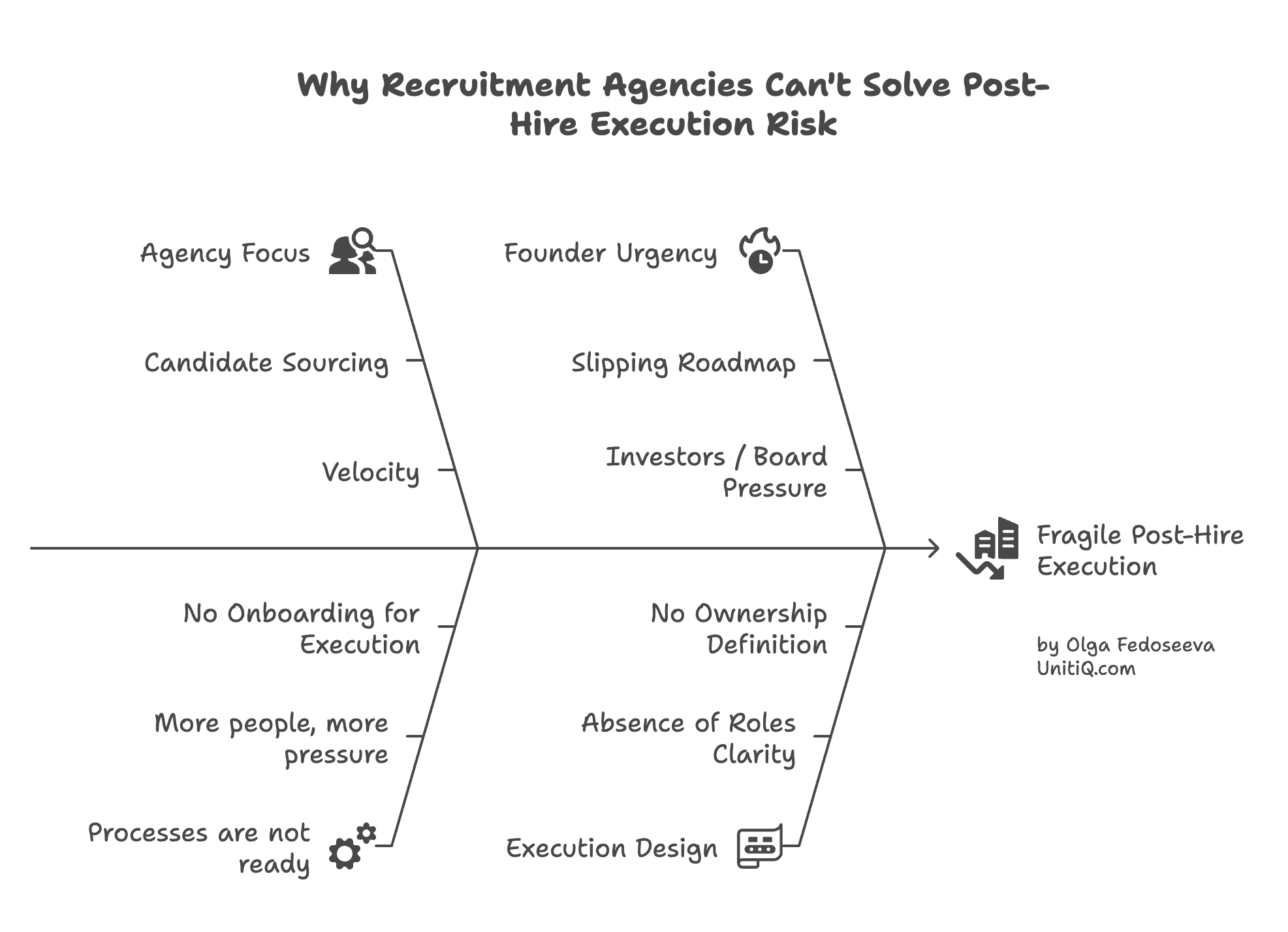
They hire them because something feels urgent:
a roadmap is slipping
a VP role is open too long
the board is asking questions
internal hiring feels slow
So they bring in external firepower.
More sourcing.
More candidates.
More velocity.
And often — the role gets filled.
But three months later, execution still feels fragile.
Because agencies can fill roles.
They cannot design execution systems.
What is post-hire execution risk?
Post-hire execution risk is the probability that a new hire will struggle to create impact after joining because ownership, decision authority, or success criteria were never clearly defined.
It rarely appears during interviews or candidate evaluation. It appears after onboarding — when the role must operate inside an execution system that was never explicitly designed.
It rarely appears during interviews or candidate evaluation. It appears after onboarding — when the role must operate inside an execution system that was never explicitly designed.
Most breakdowns don’t happen during sourcing — they appear after onboarding, when authority, ownership, and escalation design haven’t been clarified. (Read: Execution Fails After Hiring — Not During It)
The Real Problem Isn’t Sourcing
When hiring feels hard, it’s easy to diagnose the problem as:
- not enough candidates
- weak employer brand
- slow pipeline
- poor screening
Why sourcing does not solve execution
Agencies are built to optimise those variables.
The Placement Illusion
Many startups assume that solving hiring means filling a role quickly. This creates what can be called the Placement Illusion.
The logic looks straightforward:
But if ownership, decision authority, and success criteria were never designed, filling the role does not solve the underlying execution problem.
The placement succeeds.
Execution does not.
The logic looks straightforward:
- A role is open.
- An agency sources candidates.
- The role gets filled.
- Execution should improve.
But if ownership, decision authority, and success criteria were never designed, filling the role does not solve the underlying execution problem.
The placement succeeds.
Execution does not.
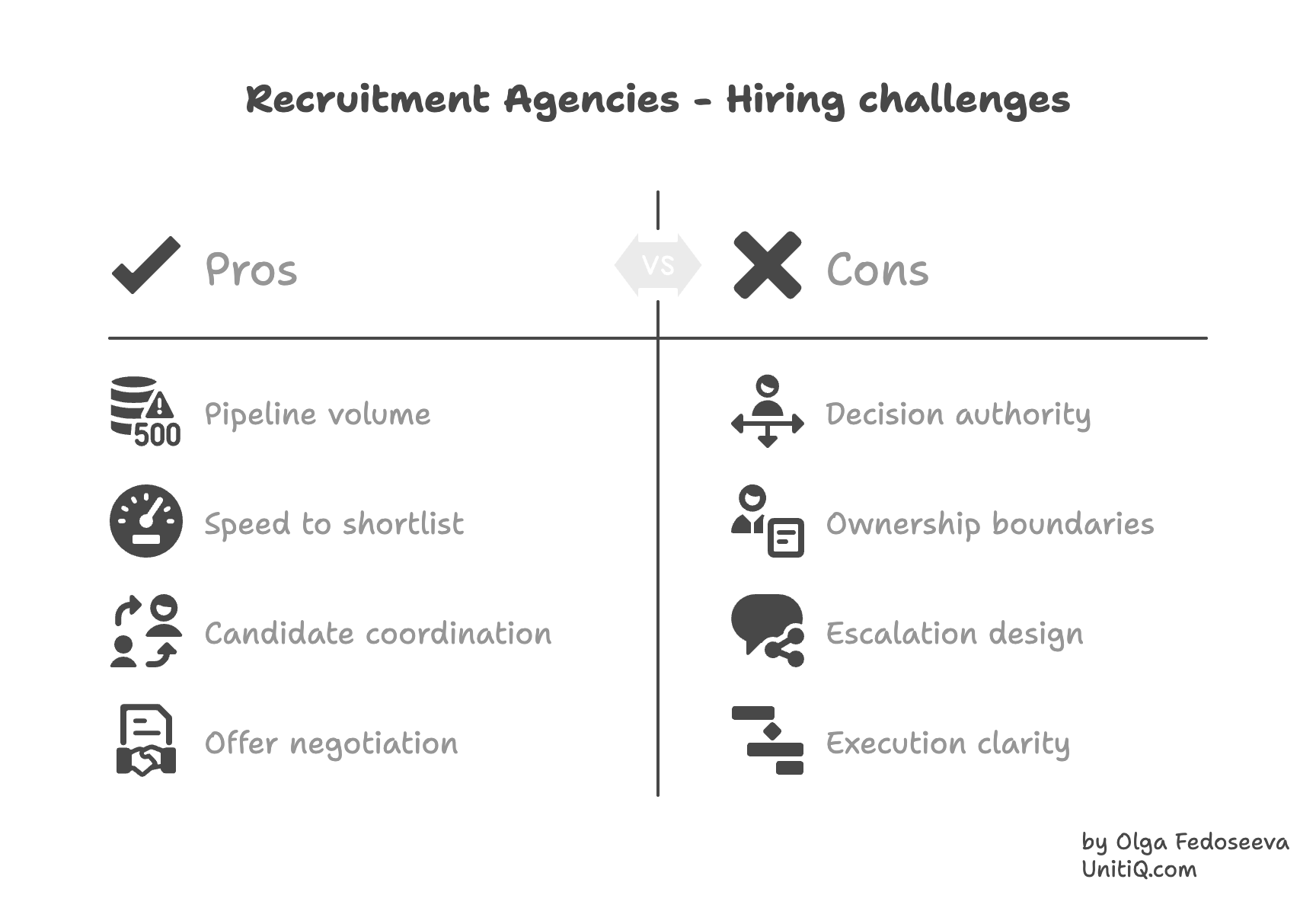
They improve:
- pipeline volume
- speed to shortlist
- candidate coordination
- offer negotiation
What they don’t control:
- decision authority after the hire
- ownership boundaries
- escalation design
- execution clarity
And that’s where most post-hire failures actually live.
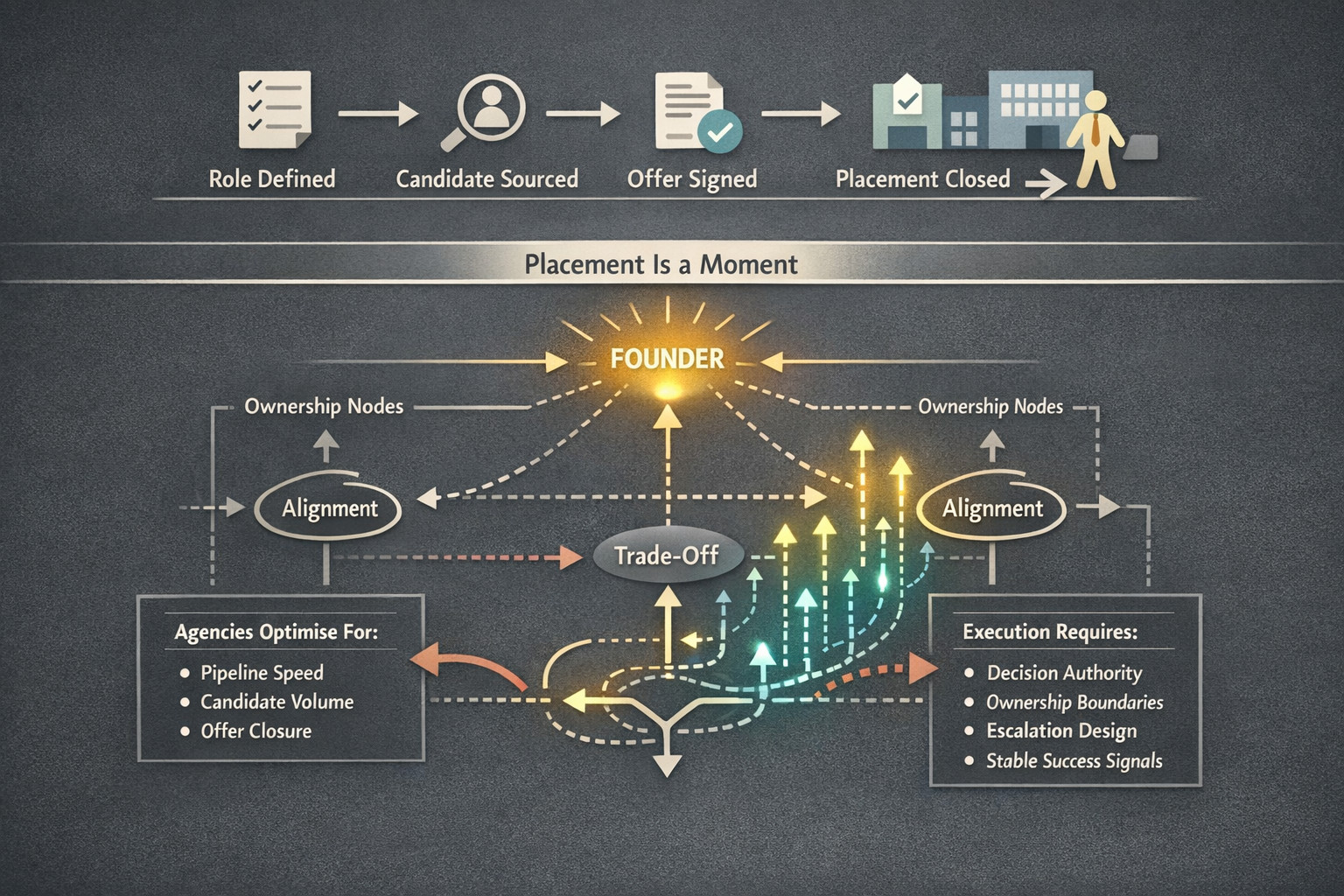
Placement Is a Moment. Execution Is a System.
Recruitment agencies optimise for placement.
Placement is a transaction:
role defined → candidates sourced → offer signed → invoice issued
Execution is different.
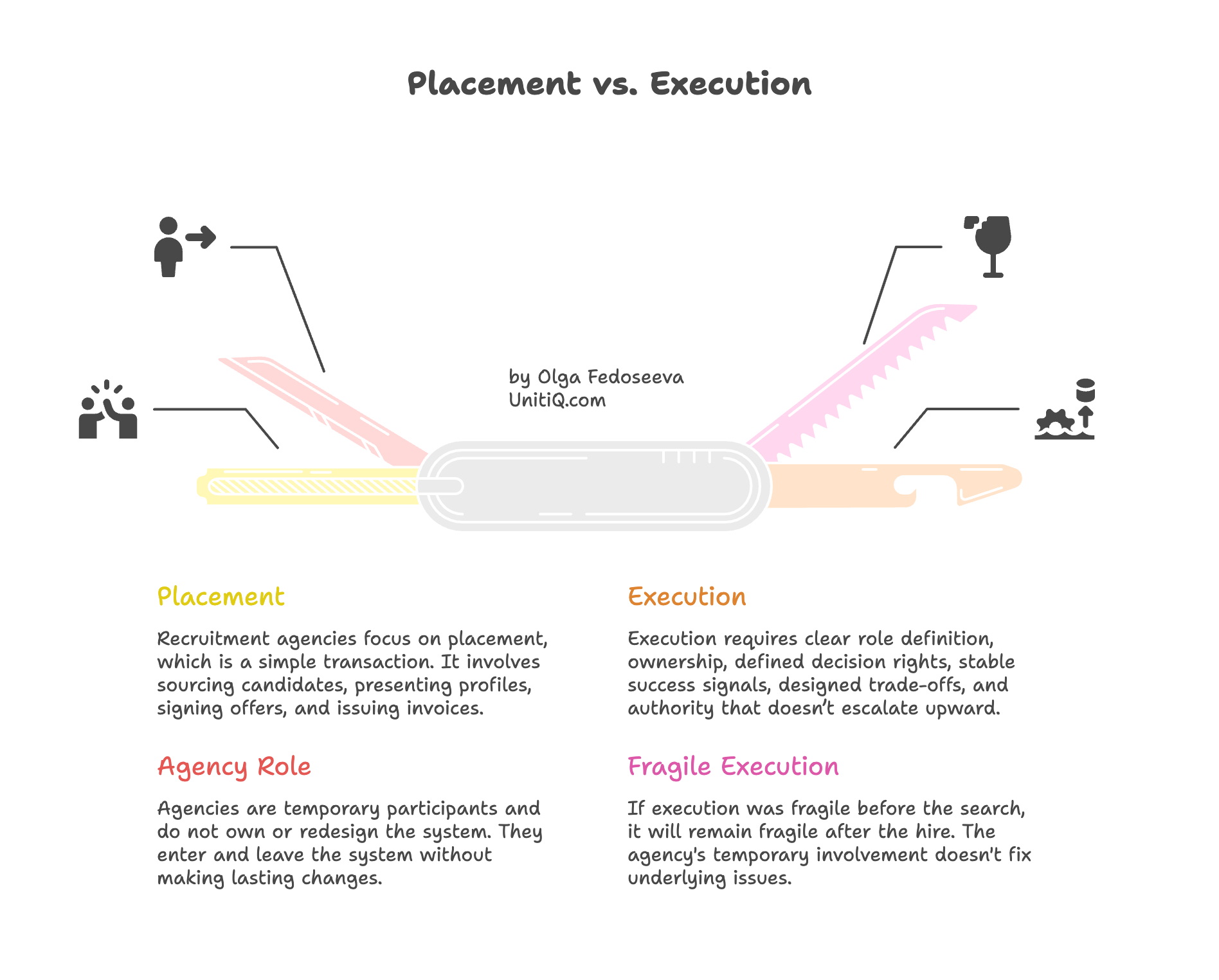
Execution requires:
clear ownership
defined decision rights
stable success signals
designed trade-offs
authority that doesn’t escalate upward
Agencies don’t own these conditions.
They enter the system temporarily.
They don’t redesign it.
What is execution design?
Execution design is the process of defining how work moves through the organisation — who owns outcomes, who makes decisions, and how trade-offs are resolved without escalation.
Without explicit execution design, new hires inherit ambiguity instead of authority. Recruiters can source talent, but they cannot redesign the internal decision system the role depends on.
Without explicit execution design, new hires inherit ambiguity instead of authority. Recruiters can source talent, but they cannot redesign the internal decision system the role depends on.
So if execution was fragile before the search,
it will be fragile after the hire.
Why Strong Candidates = New Hires Still Stall
Here’s the pattern founders recognise:
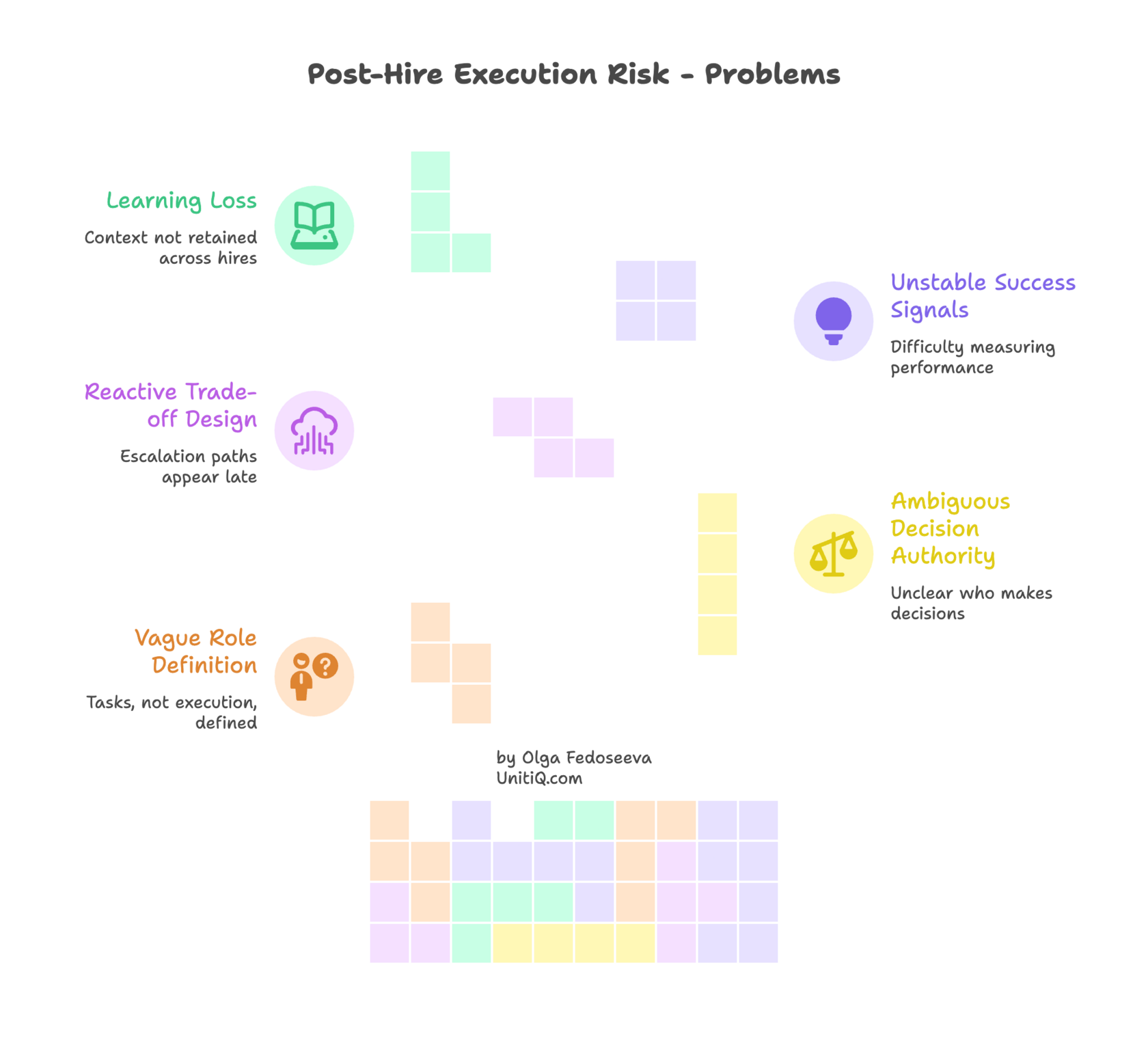
- The candidate looks strong.
- Interviews feel aligned.
- References are solid.
- The offer is competitive.
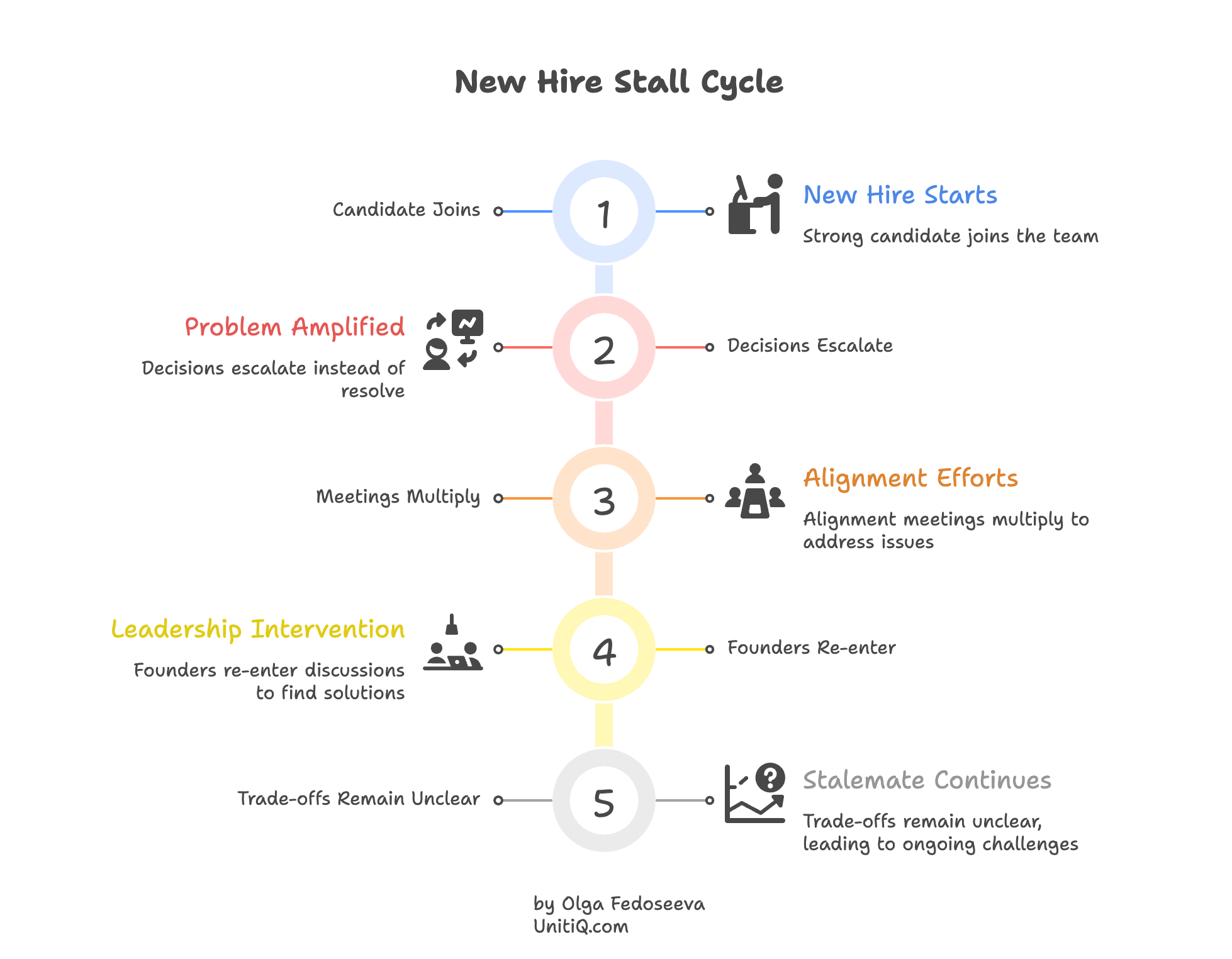
The hire joins.
Then:
- decisions escalate instead of resolve
- alignment meetings multiply
- founders re-enter discussions
- trade-offs remain unclear
It looks like:
“Maybe we overestimated the candidate.”
More often, it’s this:
authority was never explicit.
Recruitment agencies can assess capability.
They cannot guarantee decision design.
Agencies Optimise for Match — Not For Leverage
Agencies are incentivised to:
- close the role
- satisfy the hiring manager
- move to the next search
They are not structurally incentivised to ask:
- What execution risk does this role remove?
- What decisions should no longer escalate?
- What trade-offs will this hire own independently?
- What founder involvement should disappear?
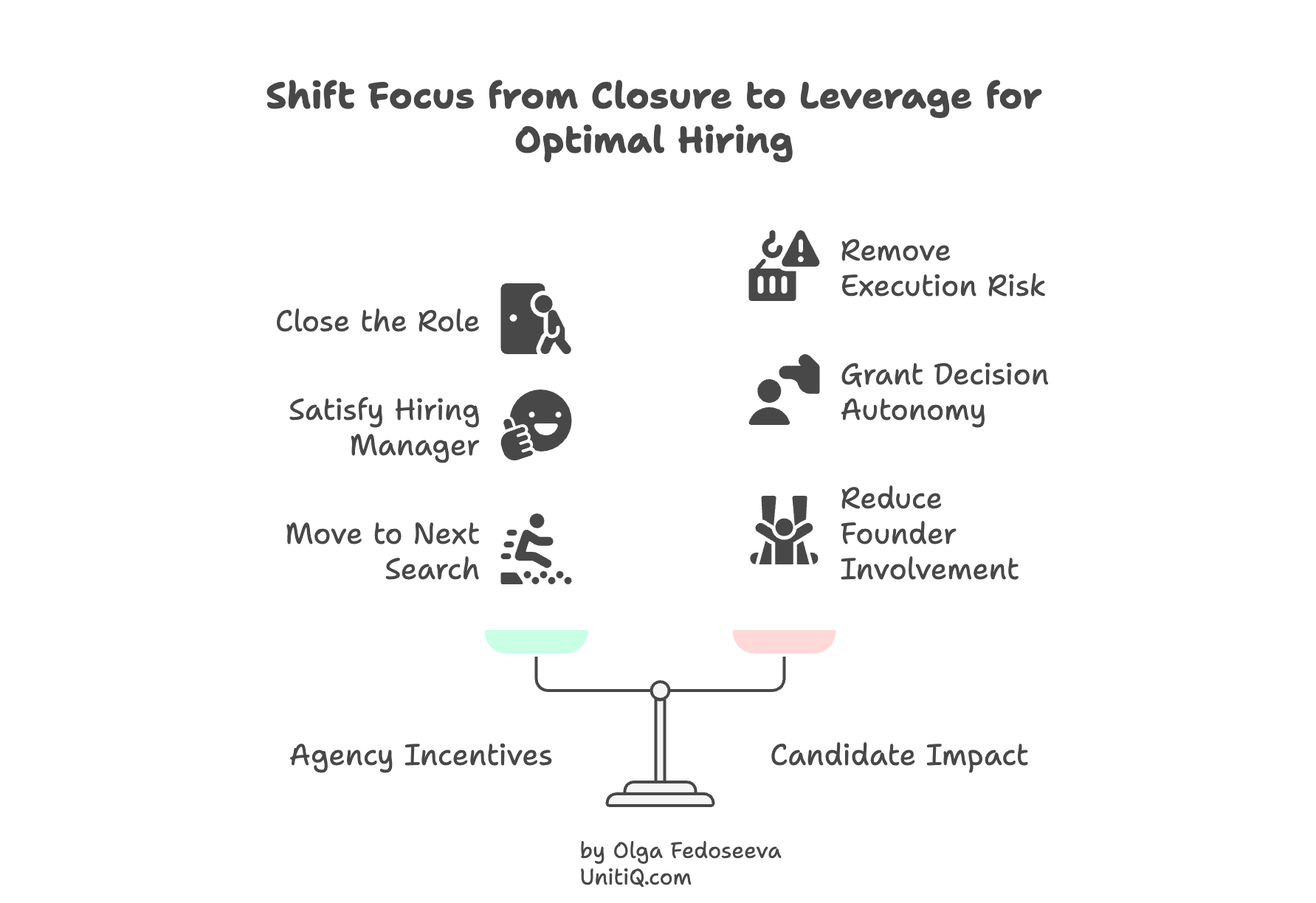
Without those answers, even a “perfect” candidate increases coordination cost.
More seniority.
More alignment.
More meetings.
More escalation.
The hire adds capacity — but not leverage.
The Growth-Stage Trap
This problem intensifies in Series A–C startups.
Before funding:
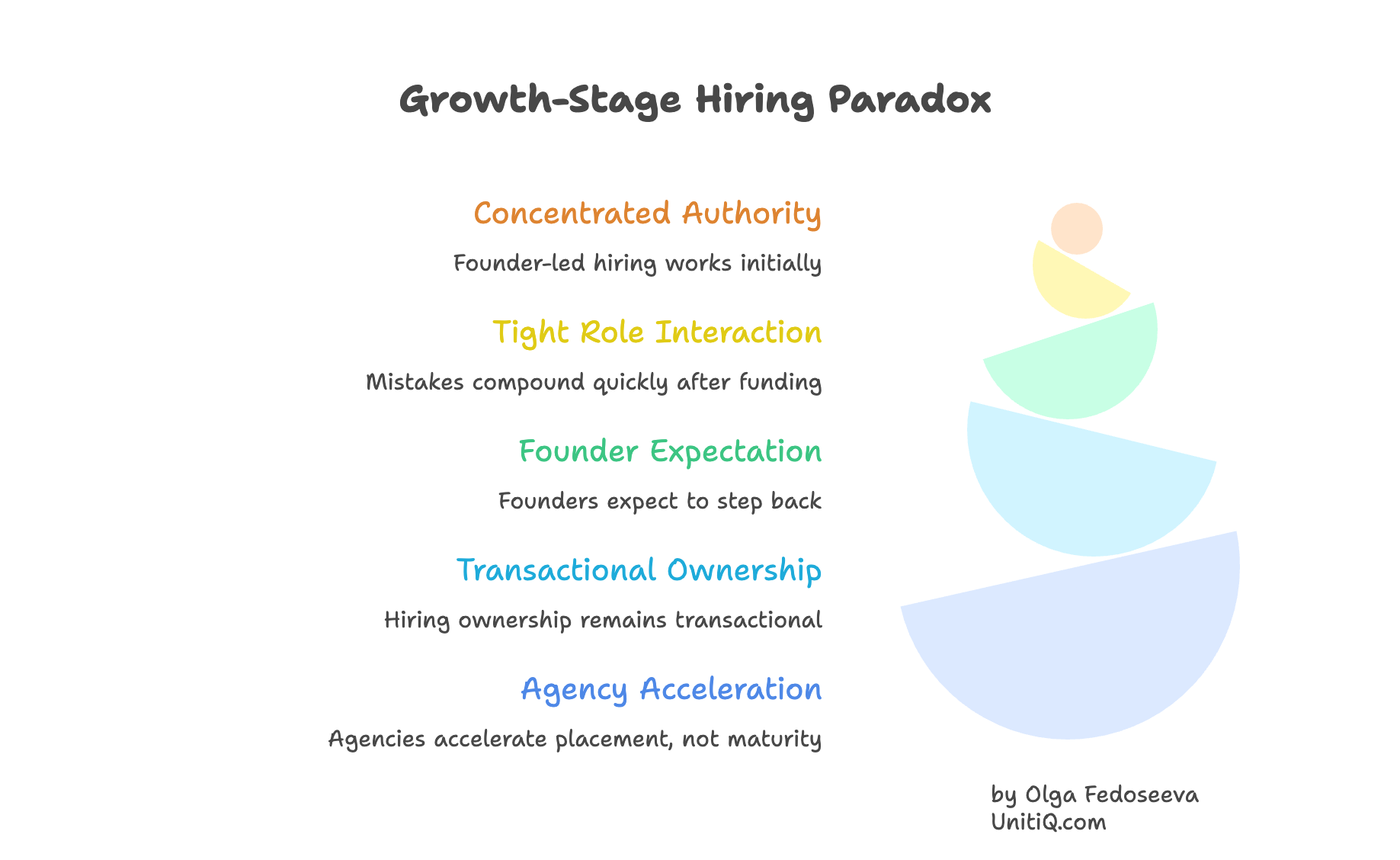
Founder-led hiring works because authority is concentrated.
After funding:
Roles interact tightly.
Mistakes compound.
Founders expect to step back.
But if hiring ownership is still transactional,
bringing in agencies only accelerates placement —
not system maturity.
So hiring gets faster.
Execution gets heavier.
Speed amplifies whatever system already exists — clarity or ambiguity. (Read: Why Hiring Faster Won’t Fix Your Execution)
That’s the paradox.
What Agencies Actually Solve (And What They Don’t)
To be precise:
Recruitment agencies are useful when:
- you lack sourcing capacity
- you need market access
- you’re entering a new geography
- you need a specialised candidate pool
They solve pipeline problems.
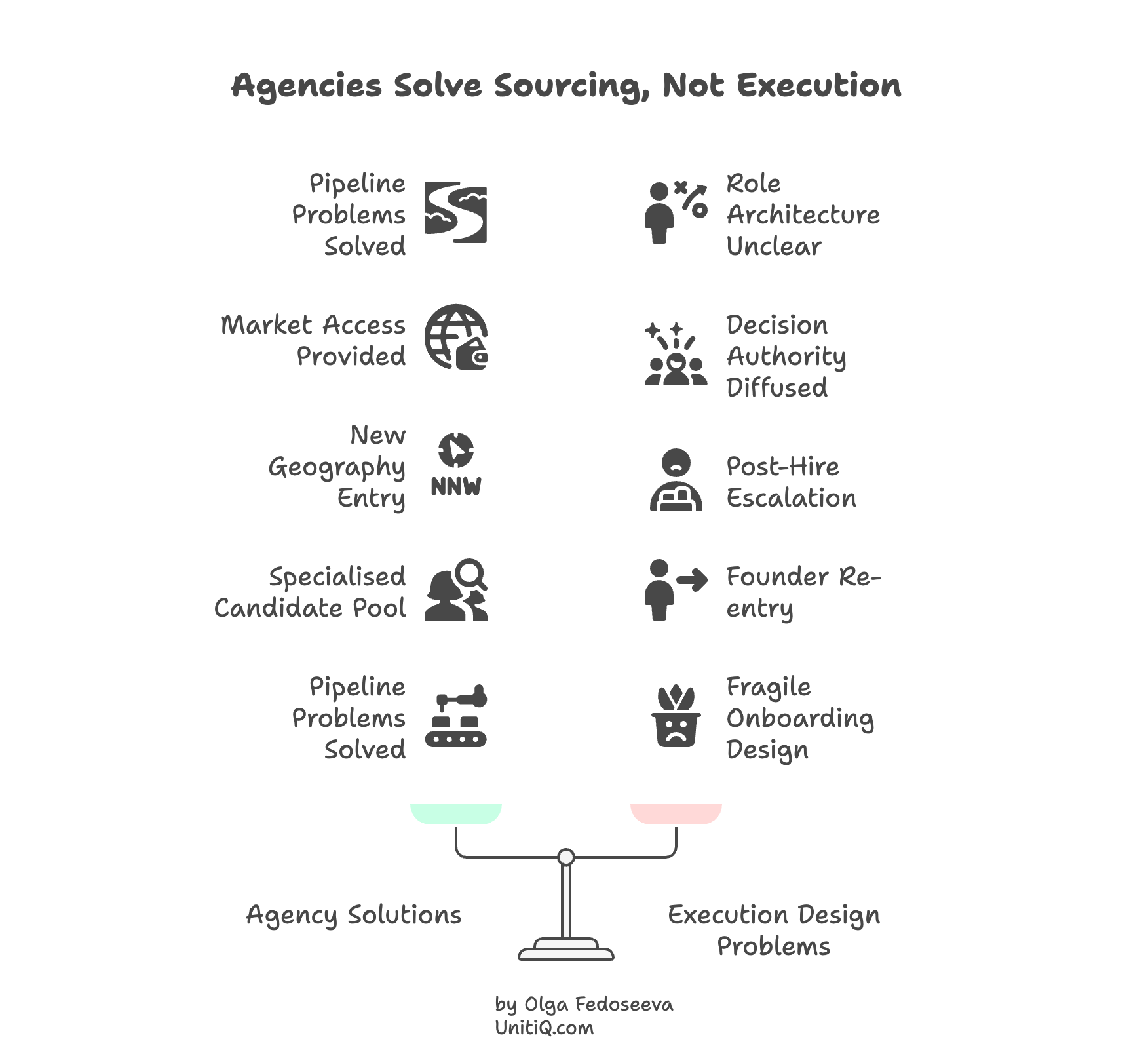
They do not solve:
- unclear role architecture
- diffused decision authority
- post-hire escalation patterns
- founder re-entry
- fragile onboarding design
Those are execution design problems.
And they exist before the search even starts.
The Invisible Post-Hire Risk
Most hiring risk doesn’t show up in interviews.
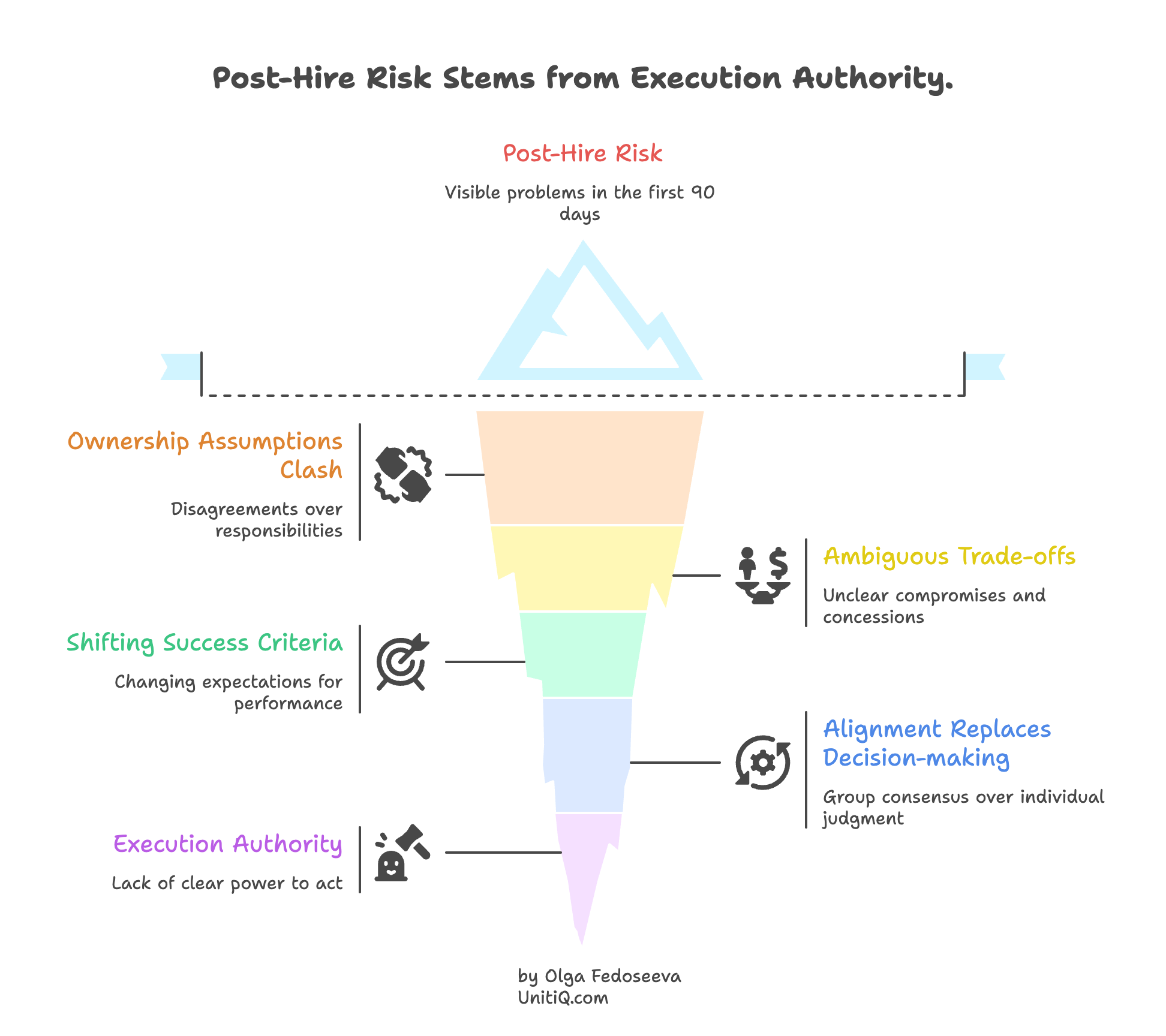
It shows up in the first 90 days:
- ownership assumptions clash
- trade-offs remain ambiguous
- success criteria shift
- alignment replaces decision-making
This pattern is common in growth-stage startups, where capable hires stall not because of skill gaps, but because execution conditions were never stabilised. (Read: Why “Good Hires” Still Fail in the First 90 Days)
When that happens, companies often react by:
- tightening performance management
- blaming onboarding
- questioning the hire
But the issue isn’t talent quality.
Many hiring failures look like performance issues — but they’re usually structural system gaps. (Read: The HR Mistakes That Quietly Cost Startups Execution)
It’s execution authority.
As startups move from founder-led decisions to shared ownership, authority often becomes implicit instead of explicit — and that’s where friction begins. (Read: Why Decision Authority Breaks as Startups Scale)
Agencies cannot design post-hire authority.
They exit when the contract closes.
Why “Better Briefing” Isn’t Enough
Some founders respond:
“We just need to brief the agency better.”
Better briefs help sourcing.
They don’t redesign:
- how decisions flow
- who absorbs risk
- how escalation is handled
- how ownership compounds
Execution risk is not a candidate specification problem.
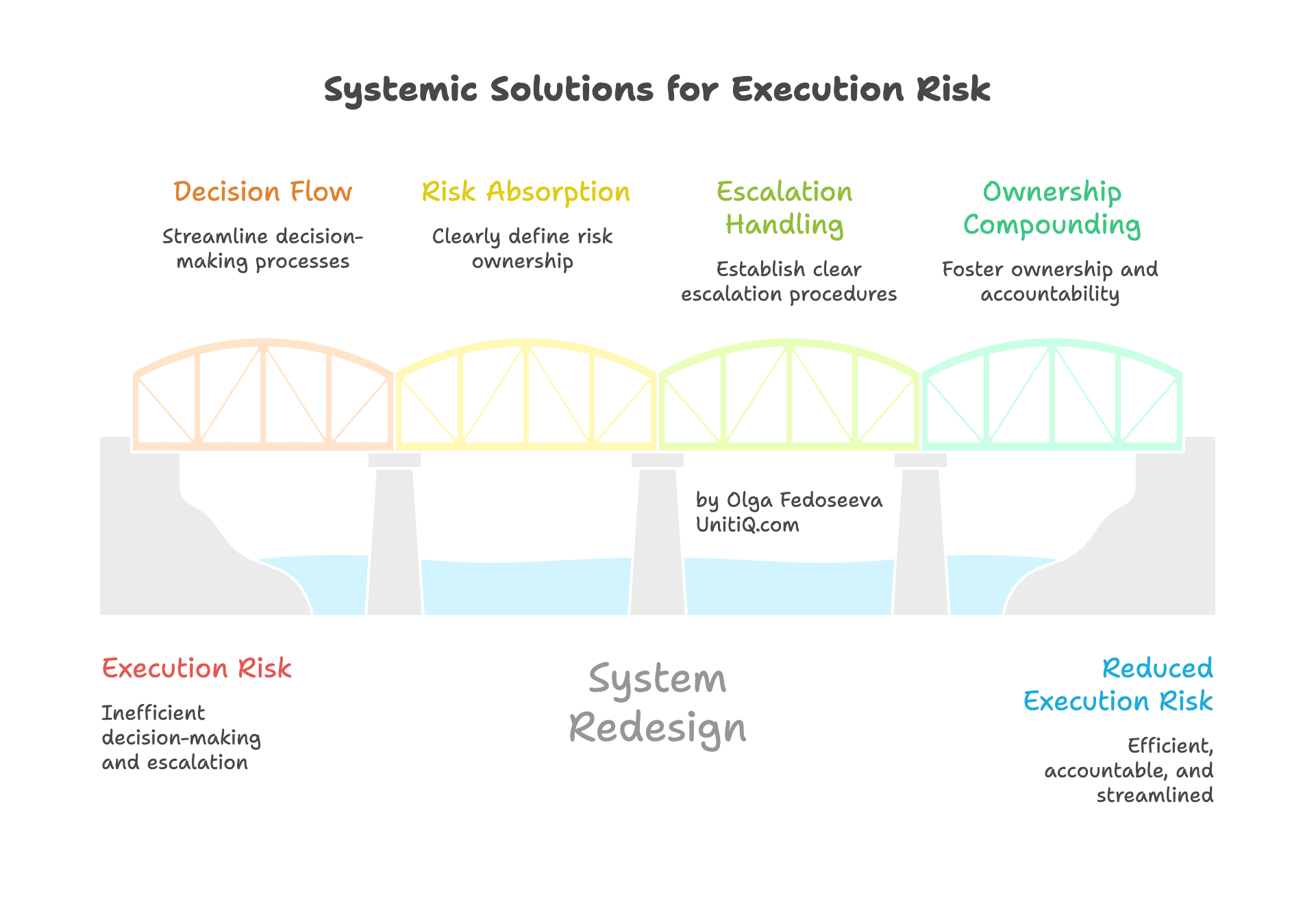
It’s a system architecture problem.
In growth-stage companies, hiring must function as infrastructure — not as a pipeline accelerator. (Read: Hiring as Infrastructure: Why Talent Acquisition Must Be Designed for Scale)
What Actually Reduces Post-Hire Execution Risk
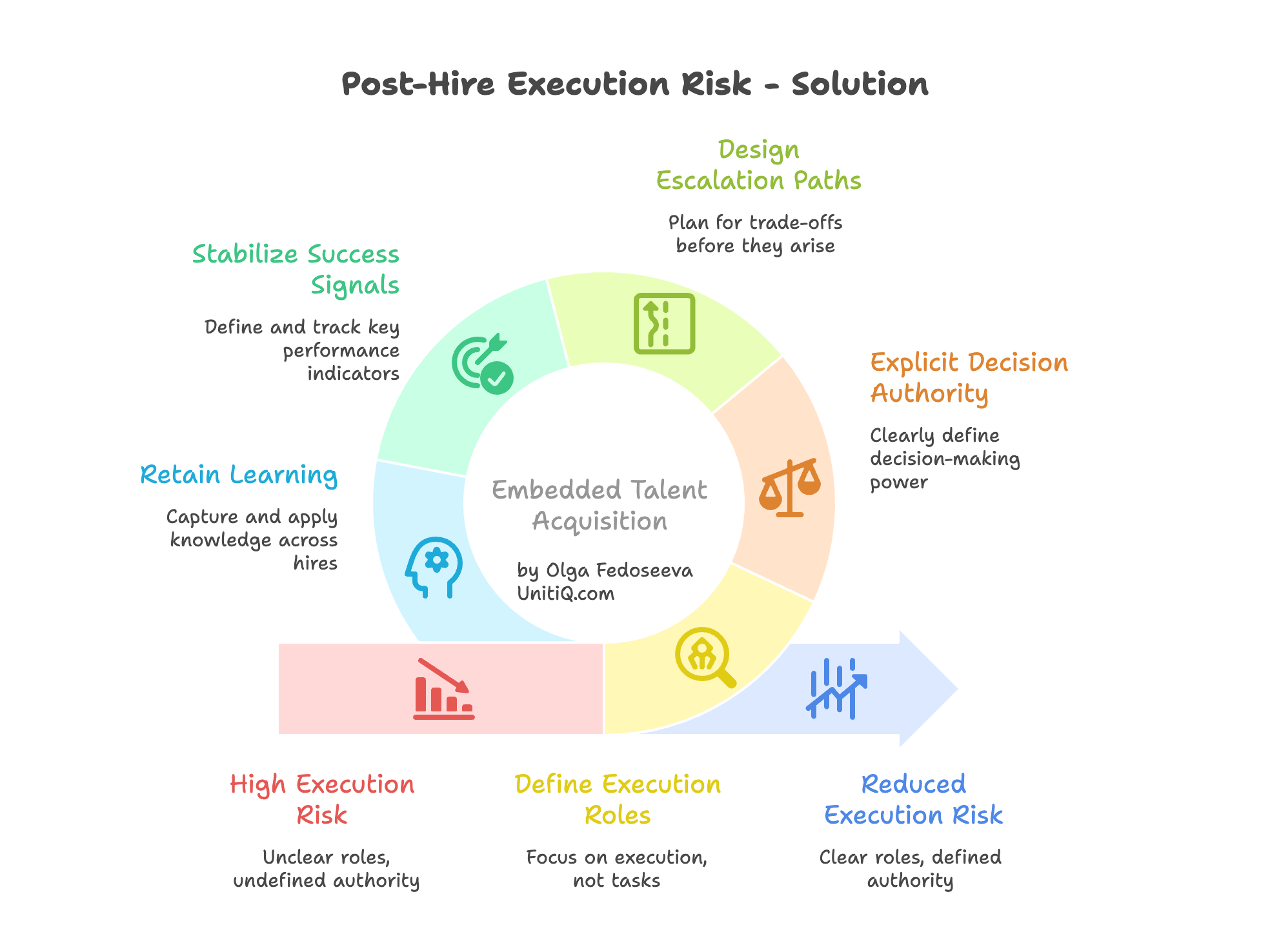
Reducing post-hire execution risk requires:
- Defining the role in terms of execution, not tasks
- Making decision authority explicit
- Designing escalation paths before trade-offs appear
- Stabilising success signals
- Retaining learning across hires
This is why embedded or fractional talent acquisition models outperform transactional recruiting in growth-stage startups.
Not because they source better.
Because they:
stay inside the system
own hiring continuously
carry context forward
design authority before placement
They optimise for leverage, not placement.
The Founders’ Reality
Founders don’t burn out because agencies are bad.
They burn out because:
each new hire still escalates risk upward.
If every role still needs founder validation,
the hiring model hasn’t reduced execution risk.
It has redistributed it.
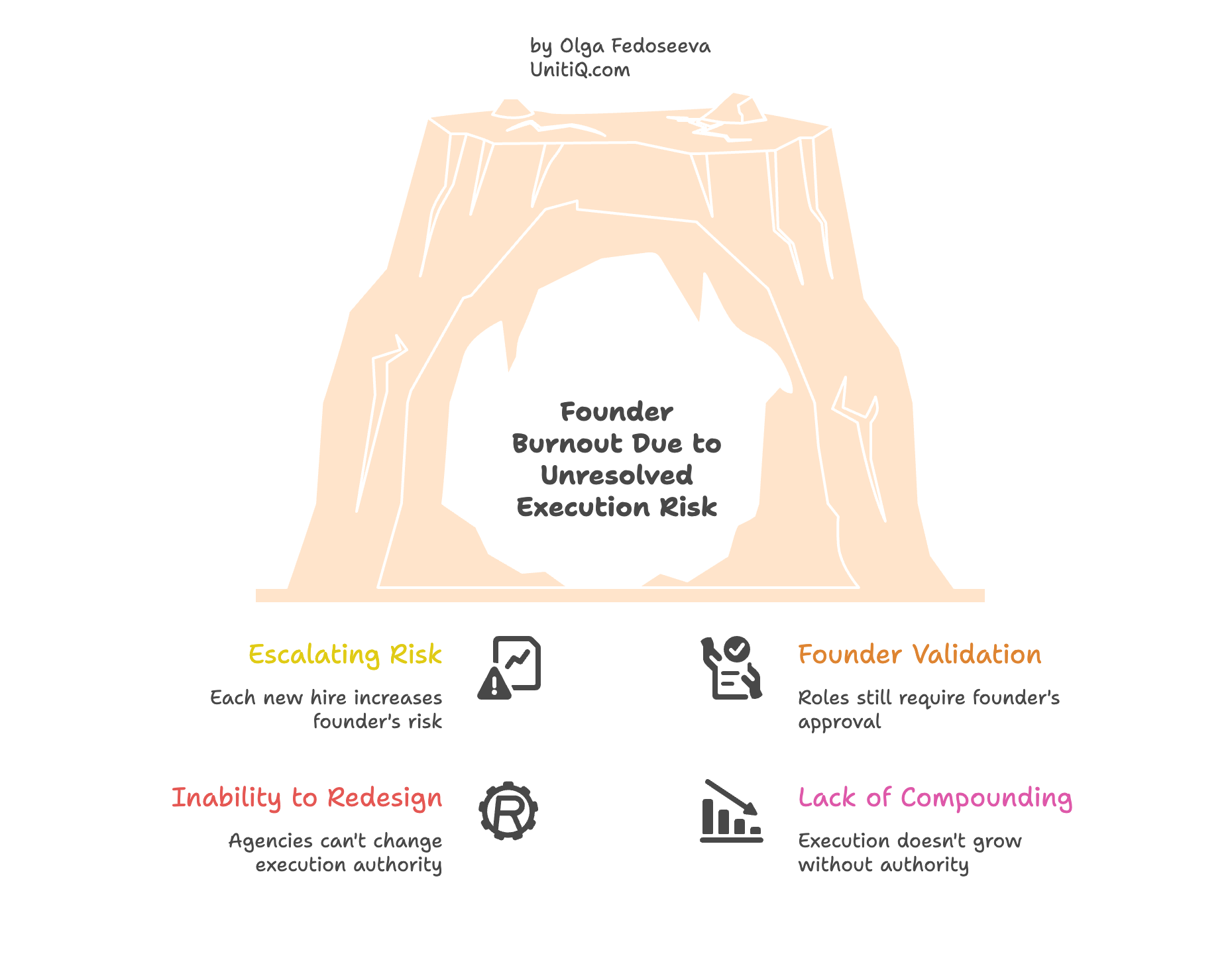
Agencies can accelerate hiring activity.
They cannot redesign how execution authority works.
When hiring is treated as an isolated event rather than a continuous system, execution resets with every new role. (Read: Why Event-Based Hiring Keeps Resetting Your Startup)
And without that, execution doesn’t compound.
TL;DR
Recruitment agencies optimise for placement, not execution design
Most hiring failures appear after onboarding — when authority and ownership were never clearly designed.
Strong candidates stall when authority is undefined
Agencies don’t own decision architecture or escalation design
Post-hire execution risk is a system problem, not a pipeline problem
If hiring feels expensive even after roles are filled,
the problem isn’t candidate quality.
It’s the execution system they entered.
Frequently asked questions about recruitment agencies and execution risk
Why can recruitment agencies fill roles but still fail to fix execution problems?
Because agencies optimise for sourcing and placements. Execution problems usually come from unclear ownership, decision authority, and success criteria inside the company.
When do recruitment agencies actually work well?
Agencies work best when the role is already clearly defined, decision ownership is explicit, and the organisation knows exactly what success looks like.
What reduces post-hire execution risk before hiring begins?
Clear ownership of outcomes, defined decision authority, stable success signals, and escalation logic designed before interviews begin.
If you want to sanity-check which model fits your current stage — and where execution is actually breaking — we can walk through it together.
About the author
Olga Fedoseeva is the Founder of UnitiQ, a global HR executive, and a talent acquisition and people strategy leader with 20+ years of experience across EMEA, the US, and APAC. She has personally hired 1,500+ employees, led people strategy for organisations scaling from 30 to 700+ employees, and writes about hiring systems, execution risk, and people infrastructure in growth-stage startups.
Read full author profile
LinkedIn
Read full author profile


