
Short Answer
Hiring great talent has changed because candidates now evaluate companies as much as companies evaluate them. In fast-growing startups, hiring success depends less on sourcing volume and more on clarity: clear roles, decision authority, mission relevance, and fast, structured evaluation. Companies that design hiring for execution — not just recruitment — still win.
TL;DR
- Top candidates no longer apply blindly — they evaluate companies before engaging
- Hiring speed and clarity now influence candidate decisions as much as compensation
- Traditional recruiting tactics (job boards, generic outreach) produce weaker signal
- Strong hiring systems focus on role clarity, decision ownership, and execution impact
- Companies that treat hiring as infrastructure — not a process — consistently attract stronger talent
Why Hiring Great Talent Has Changed
Over the last few years, the hiring environment changed in three fundamental ways.
Not because talent disappeared.
But because how talent evaluates opportunities has evolved.
For growth-stage startups, hiring now resembles market positioning and decision design, not just recruiting activity.
1. Top Candidates Evaluate Companies — They Don’t Just Apply
High performers rarely spend time browsing job boards.
In many startups, the challenge is not the availability of talent but how the company communicates its mission, challenges, and expectations to potential candidates. (Read: Why Your Startup Isn’t Attracting Top Talent — And It’s Not About Brand)
They observe:
- how companies communicate
- how leaders think
- whether the mission is meaningful
- how teams operate internally
The strongest candidates are constantly receiving inbound interest.
So when they engage with a company, they are not simply applying.
They are evaluating whether the company deserves their time and energy.
That means every interaction becomes a signal:
- how clearly the role is explained
- how structured the interview process is
- how leadership communicates priorities
Hiring today is not just selection.
It is mutual evaluation.
This is also why many startups increasingly rely on Talent Partners rather than transactional recruiters — people who can translate business context into hiring decisions and represent the company effectively to candidates. (Read: What Does a Modern Talent Partner Actually Do?)
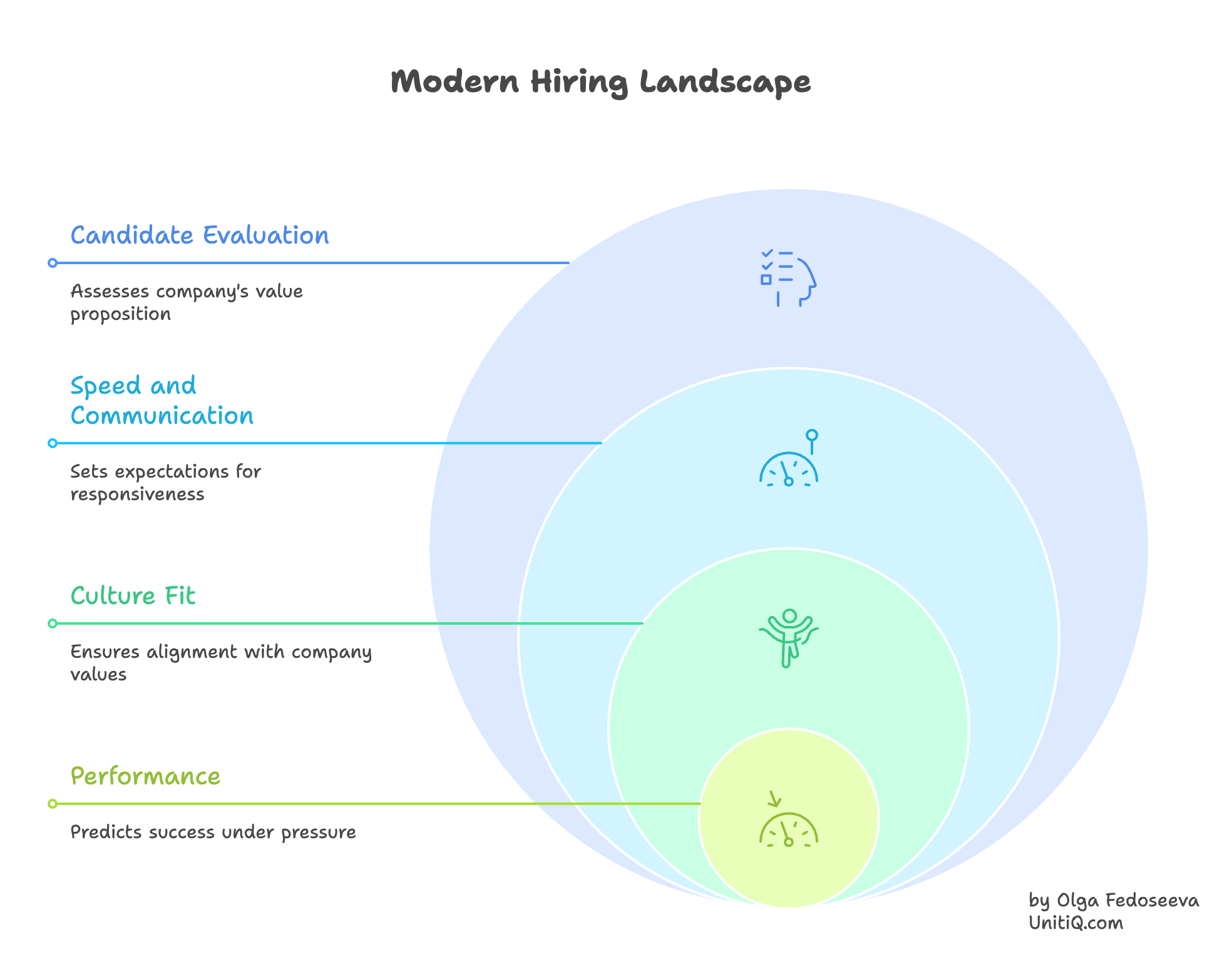
2. Speed and Communication Expectations Have Changed
Technology — especially AI tools — has reshaped expectations around responsiveness.
Candidates now expect:
- faster responses
- clearer explanations
- shorter feedback loops
A hiring process that moves slowly or communicates vaguely sends an unintended message:
the company itself may operate slowly.
In startups, speed signals competence.
And competence attracts talent.
Companies that treat hiring with the same urgency as product development tend to convert stronger candidates.
3. “Culture Fit” Is No Longer Enough
For years, many companies hired based on vague cultural alignment.
But culture alone does not predict performance.
Strong hiring systems now evaluate signals such as:
- clarity of thinking
- ownership behavior
- decision-making ability
- adaptability in ambiguous environments
These signals reveal how a candidate will operate when pressure appears.
This shift reflects a broader change in hiring — founders increasingly evaluate how candidates think, learn, and make decisions rather than relying on resumes or job titles alone. (Read: Hiring in a Post-Resume World: What Founders Should Really Be Screening For)
Which matters far more than whether someone seems “likeable” in interviews.
What Still Works in Hiring
Despite the changes, several core hiring principles remain constant.
Companies that apply them consistently still outperform competitors.
1. Role Clarity Attracts Strong Candidates
Top candidates respond to clarity.
Role clarity is not just important for attracting strong candidates — it also determines how teams execute after hiring. When responsibilities and decision ownership are unclear across teams, execution slows even when companies continue hiring. (Read: Role Clarity by Team: Where Execution Breaks)
They want to understand:
- what outcomes the role owns
- what decisions they will control
- how success will be measured
- how the role contributes to company goals
Vague job descriptions repel strong talent.
Because experienced candidates know that unclear roles usually mean unclear execution systems.
Clarity signals maturity.
2. Respectful Speed Improves Hiring Outcomes
Speed alone is not the goal.
Respectful speed is.
That means:
- clear expectations before interviews
- structured conversations
- transparent feedback loops
When candidates feel respected and informed, conversion rates increase significantly.
3. Precision Beats Volume
Traditional recruiting often focuses on pipeline size.
But for critical hires, volume creates noise.
High-impact hiring requires:
- clear success criteria
- careful candidate calibration
- structured evaluation
This shift toward structured, signal-based hiring is what many startups now describe as precision hiring — a model focused on defining role outcomes and identifying real success signals before sourcing candidates. (Read: Precision Hiring in 2026: The New Playbook for Startups That Need Execution, Not Just Candidates)
In other words:
precision over volume.
Why This Matters for Founders
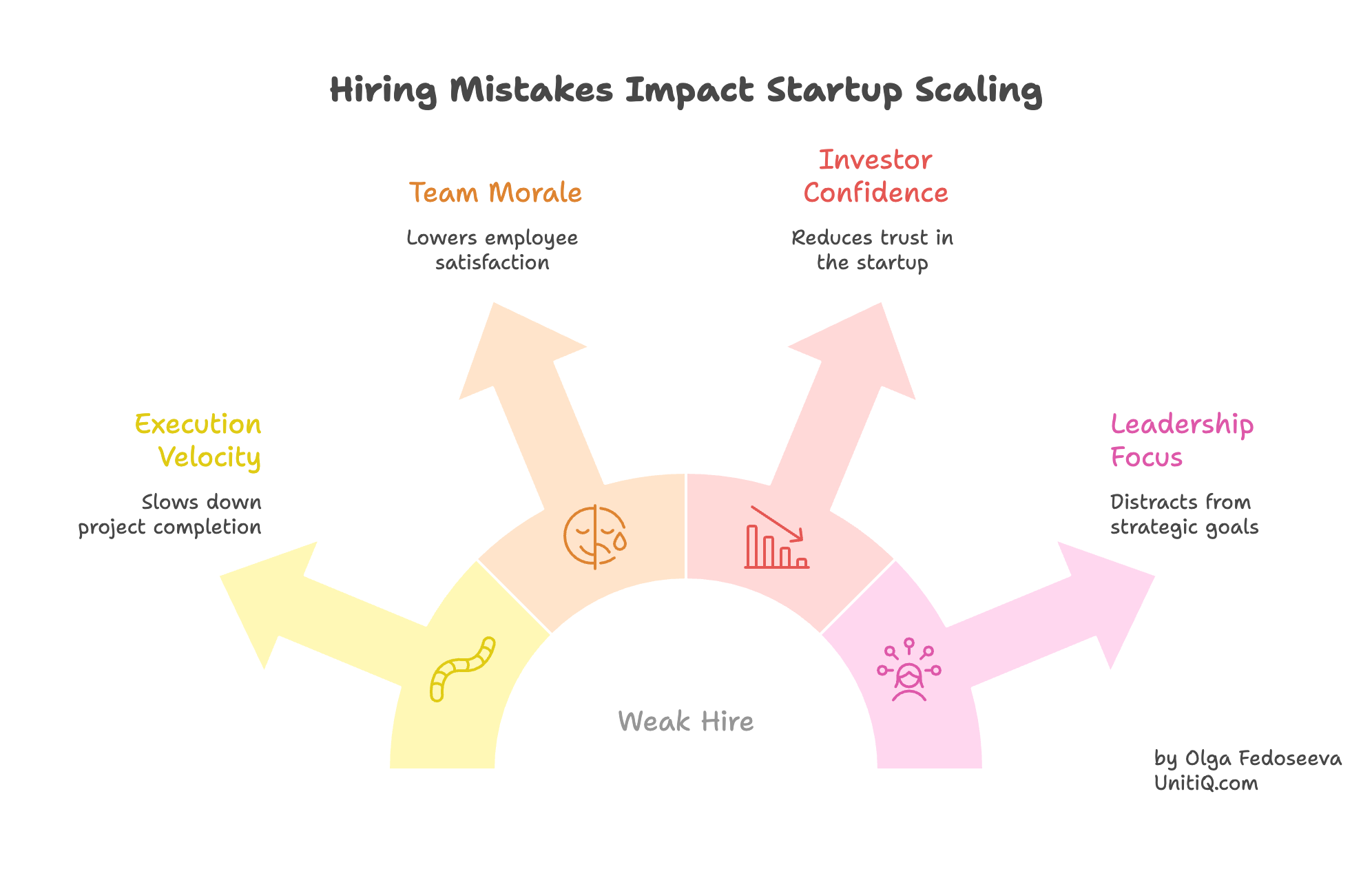
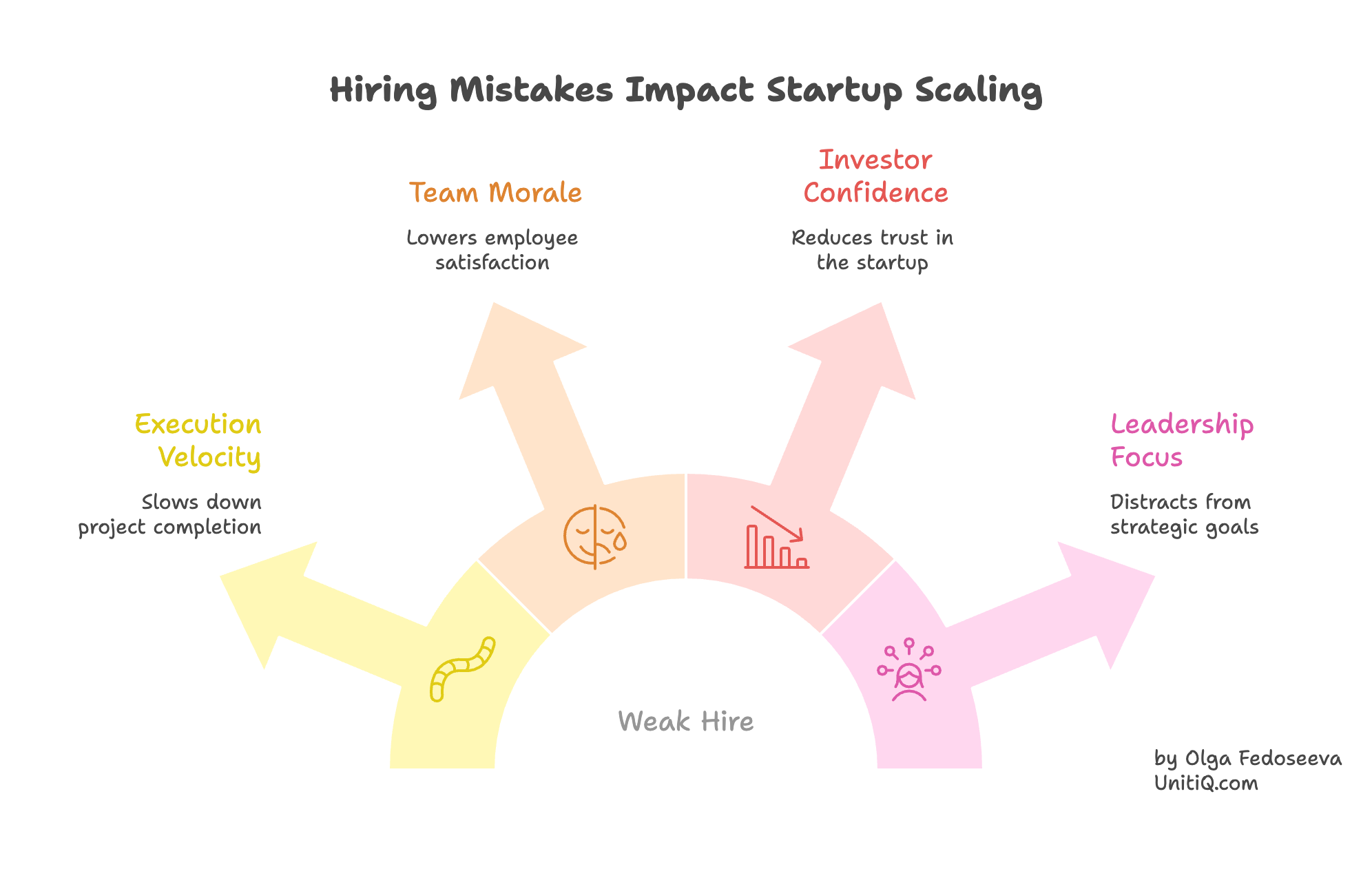
Hiring mistakes in scaling startups carry higher consequences than ever before.
A weak hire does not only affect payroll.
It can affect:
- execution velocity
- team morale
- investor confidence
- leadership focus
But strong hires compound.
They unlock decisions, remove friction, and increase team momentum.
Which means hiring is no longer just an HR activity.
It is an execution lever.
In scaling startups, hiring functions best when it is designed as part of the company’s operational infrastructure rather than treated as a reactive recruiting activity. (Read: Hiring as Infrastructure: Why Talent Acquisition Must Be Designed for Scale)
The UnitiQ Approach
At UnitiQ, we approach hiring differently. We do active hiring without waiting for strong candidates to apply.
We treat it as execution infrastructure, not a recruiting task.
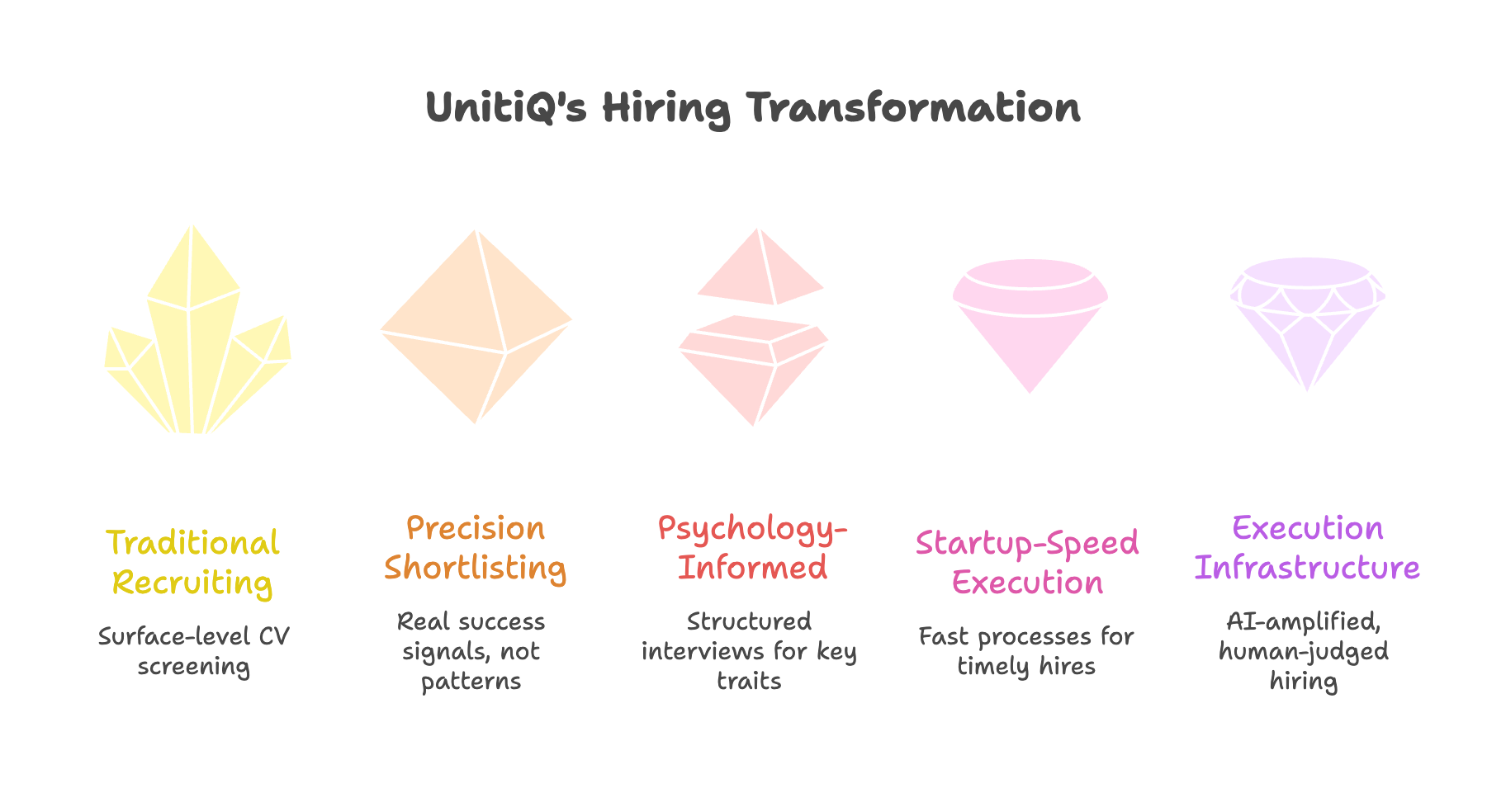
Our model focuses on three principles:
Precision
We build candidate shortlists based on real signals of success — not surface-level CV patterns.
Psychology-Informed Evaluation
Structured interviews test decision-making, ownership, and adaptability.
Startup-Speed Execution
Processes move fast because timing often determines whether great candidates join — or disappear.
AI tools can accelerate workflows.
But hiring still requires human judgment and deep context.
Technology amplifies the process.
It does not replace it.
FAQ
Why has hiring top talent become harder?
Because strong candidates now evaluate companies more critically. They prioritize meaningful work, leadership quality, and operational clarity.
Do job boards still work for hiring great talent?
They can work for volume hiring. But the strongest candidates often come from targeted outreach, networks, and strategic recruiting.
Why is hiring speed important today?
Slow processes signal organizational friction. Fast, structured hiring demonstrates competence and increases candidate trust.
What attracts high-performing candidates most?
Clear roles, meaningful missions, strong leadership, and evidence that the company executes effectively.
Final Thought
Hiring great talent has not become impossible.
But it has become more transparent.
For early-stage startups, this shift means hiring must evolve from ad-hoc recruiting into a defined Talent Acquisition function with clear ownership, structured evaluation, and repeatable hiring workflows. (Read: How Early-Stage Startups Should Build Their First Talent Acquisition Function)
Candidates now see the signals companies used to hide:
- unclear roles
- slow decisions
- inconsistent leadership
The companies that win are the ones that treat hiring seriously.
Not as a process.
But as a system that determines how execution scales.
If you want to sanity-check which model fits your current stage — and where execution is actually breaking — we can walk through it together.
About the author
Olga Fedoseeva is the Founder of UnitiQ, a global HR executive, and a talent acquisition and people strategy leader with 20+ years of experience across EMEA, the US, and APAC. She has personally hired 1,500+ employees, led people strategy for organisations scaling from 30 to 700+ employees, and writes about hiring systems, execution risk, and people infrastructure in growth-stage startups.


